
Fruit Tea-Bag Cuts for Infusion Blends: Pineapple, Mango and Orange Peel
By the Silk Route Ventures Trade Team | 24 November 2026
Buyer’s snapshot
- Fruit pieces behave differently from herbs in a blend. Pineapple and mango are sugar-rich and hygroscopic, so a small rise in moisture turns free-flowing pieces into clumps, while orange peel stays dry and carries the aroma.
- Caking in amorphous, sugar-rich dried fruit happens when the product moves into a rubbery state, and the temperature at which that happens falls as water content rises (SciELO, Ciência e Tecnologia de Alimentos).
- One market estimate puts the global fruit tea market at about USD 2.1 billion in 2025, rising to USD 3.48 billion by 2031 (Ken Research), so blend lines are adding fruit components.
- Silk Route Ventures (SRV) supplies pineapple, mango and orange peel tea-bag cuts in bulk from a first-order MOQ of 100 kg per SKU, with trial quantities from 10 kg.
- The decision tables for blend design sit in the first and fourth sections below.
Most buyers write a fruit tea-bag cut spec the way they write a herb spec: a particle size range, a moisture ceiling, a heavy metals line. That works for hibiscus or lemongrass. It misses the failure that fruit pieces cause on a blend line, which is behaviour rather than composition. A pineapple piece that tests at the right moisture on the day it is packed can still clump in a hopper three months later, and a mango piece can coat a hibiscus calyx until the fill weight drifts.
This post is about those behaviours. It covers three fruit cuts that go into infusion blends (pineapple, mango and orange peel), how they differ, and what to write on the RFQ so the blend runs the same in month six as it did on the sample. For the underlying cut-size definitions, the tea-bag-cut specification guide and the tisane buyer’s guide already do the groundwork, so this piece does not repeat them.
What do pineapple, mango and orange peel each bring to an infusion?
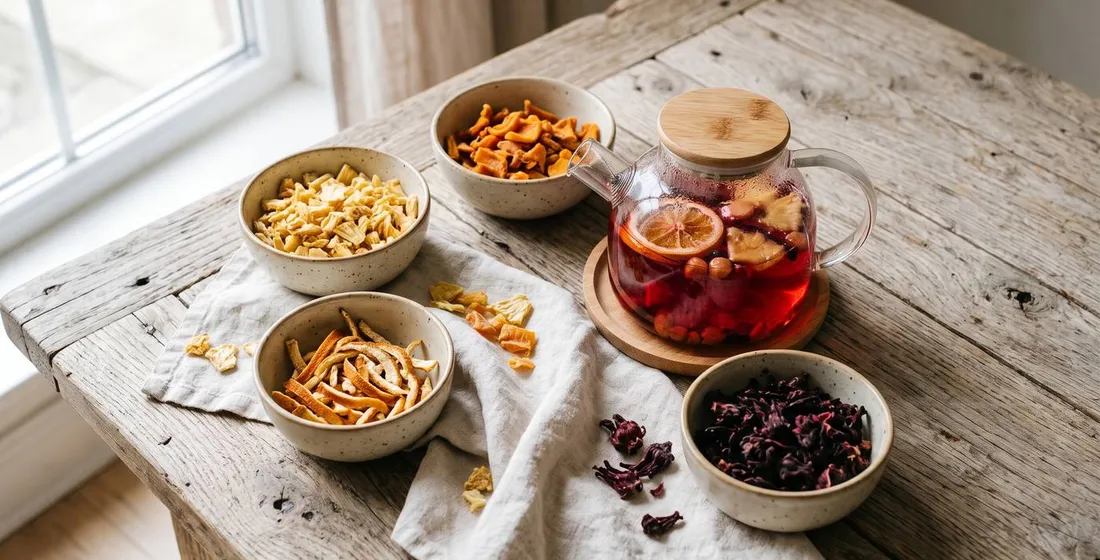
Each fruit does a different job in the cup, and that job decides how much of it a blend can carry. Pineapple adds sweet-tart body and a tropical top note. Mango adds natural sweetness and a rounder aroma. Orange peel adds citrus oil, the brightest aroma of the three, and almost no sugar.
Silk Foods Ceylon (SFC) makes all three as tea-bag cuts at its Matale facility under FSSC 22000 V6, and the product pages describe them in these terms: Pineapple Dehydrated TBC is sweet-tart and tuned for quick infusion, Mango Tea Bag Cut blends smoothly with black tea, rooibos and other fruit pieces, and Orange Peel TBC lifts blends with hibiscus, rooibos and cinnamon.
| Component | Role in the cup | Sugar and stickiness risk | What it needs from the spec |
|---|---|---|---|
| Pineapple tea-bag cut | Sweet-tart body, tropical note | High: sugar-rich, hygroscopic | Moisture and water activity ceiling, sealed packaging, cut range |
| Mango tea-bag cut | Sweetness, rounder aroma | High: sugar-rich, hygroscopic | Same as pineapple, plus colour and sulphite declaration |
| Orange peel tea-bag cut | Citrus oil, top note | Low: little sugar, dry | Pith and oil retention, cut range, MRL screen |
| Hibiscus cut (the usual base) | Colour, acidity | Low, but acidic and fibrous | Cut grade matched to the fruit pieces |
The practical point is the sugar column: pineapple and mango cause line trouble, orange peel rarely does.
Why do sugar-rich fruit pieces clump?
Sugar-rich dried fruit is largely amorphous, which means its sugars are not crystalline and sit in a glassy state when dry. Add moisture and the glass softens. Published work on dehydrated fruit products describes the glass transition temperature falling as water content rises, and notes that water activity alone does not fully describe these state changes (SciELO, Ciência e Tecnologia de Alimentos, retrieved 24 November 2026). Work on freeze-dried mango adds the consequence: caking of amorphous powders occurs in the rubbery state, and the degree of caking fell when carriers raised the transition temperature.
For a blender, that translates into three plain rules:
- A fruit piece that is safe at 20 C in a cool store can soften in a warm container at the dock or in a tropical warehouse. The spec needs to name the storage temperature, not only the moisture.
- Moisture does not stay where you put it. A damp hibiscus or herb component sitting beside dry pineapple will pass water to the fruit, because the fruit is the more hygroscopic of the two. Blend components should be matched on water activity, not only on moisture percentage.
- Packaging is part of the spec. A pineapple cut in a loosely closed liner behaves like a different ingredient from the same cut in a sealed, moisture-barrier bag.
The dried mango formats post uses a water activity at or below 0.60 as its bake-stable benchmark for inclusions. Treat that as a reference point for conversation with the supplier rather than a universal limit: the right ceiling for an infusion blend depends on the other components, the pack and the shelf-life claim, and it should be agreed in writing against a measured sample.
Buyer’s checklist: fruit components in an infusion blend
- Moisture and water activity stated per fruit component, not averaged across the blend
- Cut range in millimetres and the sieve method, per component
- Storage temperature and packaging type written into the spec
- Blend components compared on water activity so the fruit is not the driest or wettest part
- Sulphite status stated per fruit (declared above 10 mg/kg as SO2)
- A hopper or storage trial on the sample, not only a lab result
- Lot-to-lot cut and moisture reported with the certificate of analysis
How does cut size interact with a hibiscus and herb base?
Blend uniformity depends on the pieces being similar in size and density. When they are not, they separate during transport and filling: fine pieces sift to the bottom of the sack, coarse pieces rise, and the first bags off the line taste different from the last. Fruit pieces make this worse because dense, sticky fruit does not travel with light, fibrous hibiscus.
A tea-bag cut is not a defined standard. One 2022 review in Frontiers in Pharmacology reports fine cuts at roughly 0.315 to 2.00 mm, and the term still needs a millimetre range and a sieve method in the contract. For a blend, the useful extra step is to pick a fruit cut and a base cut from the same size window, so neither component sits at the edge of the range.
The hibiscus cut grades post sets out the common base grades. As a working rule, ask the supplier for fruit cuts that sit inside the same sieve window as the hibiscus or herb you are blending, then confirm it on a 1 kg sample blend before the first full run. Orange peel is the forgiving one: it is dry, light and does not stick, so it tolerates a wider window. Pineapple and mango need the tighter match.
What a blend does in the bag. Picture a tisane brand moving from a single herb to a three-fruit blend. The sample passes the lab and the first pallet runs well. Then the line operator reports that the hopper bridges on humid mornings and fill weights wander. The certificate of analysis has not changed. What changed is the blend: the fruit pieces have pulled a little moisture from the base, and the sticky ones have started to bind. The fix is rarely a different supplier. It is a tighter moisture and cut spec, a sealed liner, and a storage instruction on the pallet. The first step for any new fruit blend is to run the sample through the same hopper, on a humid day, before committing to volume.
Which spec lines go on the RFQ?
The RFQ for a fruit tea-bag cut needs the same basics as any botanical (identity, cut, moisture, contaminants) plus the behaviour lines above.
| Spec line | What to ask for | Why it matters on a blend |
|---|---|---|
| Cut range | Millimetre range and sieve method per fruit | Keeps fruit and base in the same size window |
| Fines ceiling | Maximum share passing the finest sieve | Fines coat larger pieces and raise dust |
| Moisture and water activity | Both, per lot, with the test method | Controls clumping and moisture transfer |
| Sulphite status | Stated per fruit; SO2 above 10 mg/kg must be declared | Decides the label, and blenders often want sulphite-free fruit |
| Colour | Colour description or reference sample | Pineapple and mango darken with age, and the cup colour shifts |
| Pesticide residue and contaminants | Panel aligned to the destination market | EU MRLs apply to the dried product through processing factors |
| Packaging and storage | Barrier liner, carton, storage temperature | Protects the fruit from moisture pick-up |
| Shelf life | Stated period at a named storage temperature | Sets the best-before the brand can claim |
On sulphites, the Food Safety Authority of Ireland states that where sulphur dioxide or sulphite is present above 10 mg/kg (as SO2), it must be declared, and the E-number cannot be used as an additive label above that level (FSAI, retrieved 24 November 2026). Many tisane brands want fruit without added sulphite for a cleaner label. The sulphite-free dehydrated fruit post covers what that does to colour and moisture, which are the two lines most likely to move when sulphite comes out.
For contaminant and foreign matter lines, the European Spice Association’s Quality Minima Document is the reference point most European buyers use for herbs and spices bought for processing (CBI buyer requirements, retrieved 24 November 2026). It is non-binding, so the numbers still belong in your own contract. For orange peel specifically, see the dried orange and lemon peel post on pith, oil retention and MRLs, and the pineapple formats post for how the same pineapple behaves in snack and bakery formats.
What does a blend recipe look like in practice?
There is no single recipe, and SRV does not publish blend ratios as a spec. A useful starting framework is to treat the sugar-rich fruit as a flavour accent rather than the bulk, let the base (hibiscus or a rooibos-style herb) carry the volume, and let orange peel supply the aroma lift. The right ratio is found by cup testing and a storage trial, not by a table.
For a very different ingredient with the same buyer discipline, see the Ceylon silver tips white tea post.
Where SRV is not the right fit: brands that want a fruit flavour at the lowest possible ingredient cost, and that are happy with flavouring rather than fruit pieces, will find a cheaper route in flavoured tea. SRV’s fruit cuts are for brands that want visible, labelled fruit in the bag and a spec to back it up.
Frequently asked questions
What is a tea-bag cut for dried fruit?
A tea-bag cut is a small, uniform piece sized for fast steeping and consistent bag filling. It is not a defined standard, and one 2022 review reports fine cuts at roughly 0.315 to 2.00 mm (Frontiers in Pharmacology). Write the millimetre range and sieve method into the contract so the supplier and buyer measure the same thing.
Why do dried pineapple and mango clump in a tea blend?
Both are sugar-rich and amorphous, so added moisture lowers their glass transition temperature and they soften and bind (SciELO, Ciência e Tecnologia de Alimentos). A damp base component can pass moisture to the fruit. Control water activity per component, use sealed packaging and name a storage temperature on the spec.
Does dried fruit for tea need to be sulphite-free?
Not necessarily, but sulphite status must be stated. Where sulphur dioxide is present above 10 mg/kg as SO2 it must be declared on the label (FSAI). Many tisane brands prefer fruit with no added sulphite, which affects colour and moisture, so state your requirement on the RFQ and confirm it on the certificate of analysis.
Does Silk Route Ventures offer private label for fruit tea-bag cuts?
Yes. Silk Route Ventures supplies pineapple, mango and orange peel tea-bag cuts in bulk and for private-label tea and infusion fill, made at the Silk Foods Ceylon facility in Matale. First-order MOQ is 100 kg per SKU, trial quantities start at 10 kg, and private-label or custom-specification orders run 4 to 6 weeks from PO to dispatch.
How Silk Route Ventures can help
Silk Route Ventures supplies pineapple, mango and orange peel tea-bag cuts to tea blenders and tisane brands, shipped in bulk or filled for private label from the Silk Foods Ceylon (SFC) facility in Matale under FSSC 22000 V6. First-order MOQ is 100 kg per SKU, with trial quantities from 10 kg. Samples are free for evaluation and the buyer pays the courier. Standard SKUs run 2 to 3 weeks from PO to dispatch, a certificate of analysis is available on request, and pricing is FOB Colombo, with CFR and CIF on request. For a custom fruit blend, the R&D team takes a signed brief to an approved formulation in 3 to 4 weeks at most. Browse the wider Ceylon spice and botanical range, then contact us to send an inquiry or request a sample.
Sources
- “Glass transition and sorption properties of Köftür: a dehydrated fruit-based product,” Ciência e Tecnologia de Alimentos (SciELO). https://www.scielo.br/j/cta/a/ZYGw84JL8BT5DgnmKgBdRNw/?lang=en (retrieved 24 November 2026).
- Food Safety Authority of Ireland, “Sulphur Dioxide and Sulphites.” https://www.fsai.ie/Business-Advice/Running-a-Food-Business/Food-Safety-and-Hygiene/Additives/Sulphur-Dioxide-and-Sulphites (retrieved 24 November 2026).
- CBI, “What requirements must herbs and spices meet to be allowed on the European market?” (references the European Spice Association Quality Minima Document). https://cbi.eu/market-information/spices-herbs/buyer-requirements (retrieved 24 November 2026).
- Ken Research, “Global Fruit Tea Market Size, Share and Forecast, 2026-2031.” https://www.kenresearch.com/industry-reports/global-fruit-tea-market.md (retrieved 24 November 2026).
- Frontiers in Pharmacology (2022), tea-bag-cut particle size range, as cited in the SRV tea-bag-cut specification guide.
Written by the Silk Route Ventures Trade Team. Silk Route Ventures (E-Silk Route Ventures (Pvt) Ltd) is a Sri Lankan B2B supply-chain operator for the Food, Beverage, Wellness, and Nutraceuticals sectors. The Silk Foods Ceylon manufacturing arm holds BRCGS and FSSC 22000 V6 certifications. Questions or to request a sample: Contact us or email info@esilkroute.com.lk.