
Ceylon Silver Tips White Tea: Spec and Price Ceiling for Buyers
Buyer’s snapshot
- In 2025, Sri Lanka exported 257.44 million kg of tea for USD 1.51 billion, an average FOB of USD 5.85 per kg, up slightly from USD 5.83 in 2024 (Daily Mirror Business, Tea Industry Overview for the period January to December 2025, 2026). Silver tips sits far above that blended average.
- Silver tips is white tea, not a black tea grade. It is hand-plucked unopened buds, withered and dried without the rolling or oxidation used for BOP, FBOP, or any grade on the orthodox black tea ladder (Tea Exporters Association of Sri Lanka).
- Yield is the real cost driver: roughly 5 kg of fresh buds reduces to 1 kg of finished silver tips (Tea Exporters Association of Sri Lanka), a far steeper ratio than a bulk black tea grade runs.
- Silk Foods Ceylon (SFC) already lists ST (Silver Tips) in its leaf tea range under BRCGS and FSSC 22000 V6, with a 50 kg first-order MOQ per grade and a 2 to 3 week PO-to-dispatch lead.
- This post is for specialty tea and spice brands specifying an ultra-premium single-origin SKU. For a standard private-label breakfast blend, the BOP and FBOP grade primer is the more relevant read.
Sri Lanka’s tea trade earned USD 1.51 billion in 2025 on 257.44 million kg of exports, at an average FOB of USD 5.85 per kg (Daily Mirror Business, 2026). That blended average spans everything from mass-market fannings to the finest whole-leaf grades, and it says nothing about silver tips. Silver tips and its white tea siblings sit outside the black tea ladder entirely, in a different process with a yield ratio that explains most of the price gap on its own. Silk Route Ventures (SRV) ships both categories from the same Matale facility, and this piece is the spec, the yield math, and the private-label economics behind that gap.
What is Ceylon silver tips white tea, and how does it differ from black tea grades?
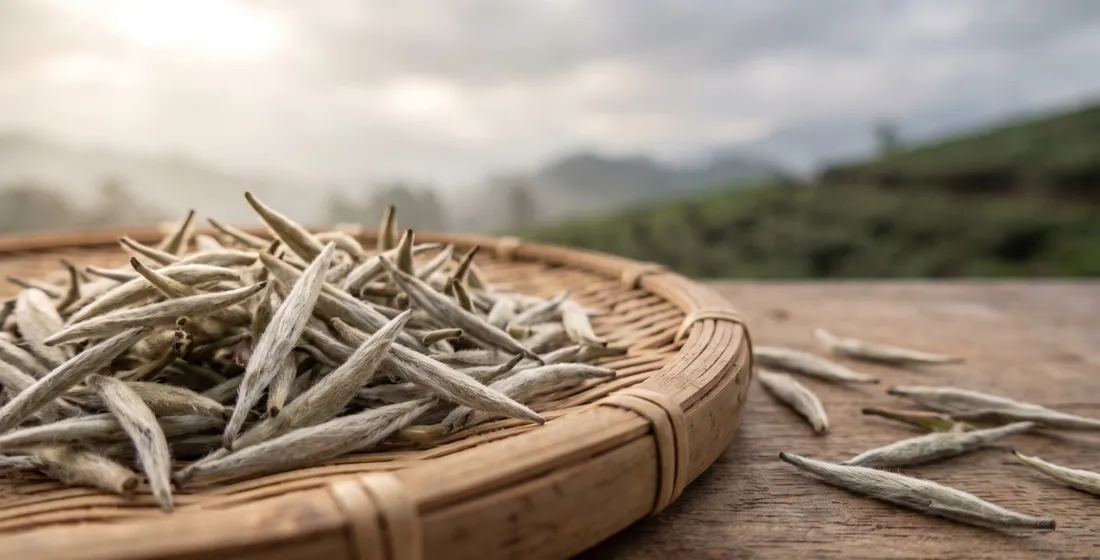
Ceylon silver tips is white tea: whole, unopened tea buds, hand-plucked, then withered and dried without the rolling or oxidation that produces black tea grades such as BOP or FBOP (Tea Exporters Association of Sri Lanka). The bud alone, not the leaf, is the raw material, which is why silver tips carries a silvery-white down and a pale, delicate liquor rather than the dark, brisk cup of a broken-leaf grade.
The name “golden tips” causes real confusion on an RFQ, and it is worth separating out. Sri Lankan producers sell a golden-hued white tea named Golden Tips, made the same way as silver tips but from buds with a warmer tone (Tea Exporters Association of Sri Lanka). Separately, “golden tip” is also a grading descriptor inside the black tea ladder, where FTGFOP (Finest Tippy Golden Flowery Orange Pekoe) describes golden bud content mixed into an otherwise broken-leaf black tea. A buyer asking a supplier for “golden tips” should confirm which product is meant before a sample ships. The word names two different things depending on which side of the tea family it sits in.
White tea’s minimal processing is also why it sits outside ISO 3720:2011, the compositional standard that governs black tea (International Organization for Standardization, 2011). White tea has its own definition track instead: ISO/TR 12591:2013 set the first industry-wide, science-based definition of white tea as a distinct category, and a further draft, ISO/DIS 20680, is currently at enquiry stage to extend that definition into a full requirements standard. A buyer citing “ISO compliance” on a white tea RFQ should specify which of the two tracks is meant; they are not interchangeable.
How Ceylon silver tips is made, from bud to dried leaf
Production narrows to a few steps, and the discipline is in what does not happen rather than what does. Pluckers take a single unopened bud, harvested before sunrise so the bud has not begun to open in the day’s heat (Sri Lanka Export Development Board, “Ceylon White Tea”). The bud is hand-rolled, then dried in shade rather than run through a rolling-and-fermenting line, specifically to prevent the oxidation that darkens a black tea leaf. Sri Lanka’s white tea gardens sit at 2,200 to 2,500 metres elevation and typically harvest once a year, not on the continuous pluck cycle a bulk black tea garden runs (Sri Lanka Export Development Board).
Herman Gunaratne, the planter behind Handunugoda Estate, is widely credited with pioneering Sri Lanka’s modern white tea category. In a September 2021 interview, he described the finished product bluntly: “Virgin White tea sells for $2,000 a kilo” (Al Jazeera, 2021). That figure is one boutique estate’s retail price, not a wholesale or auction benchmark, and it should not be read as a market average. It is still the clearest illustration of how far a per-kilogram number can move once the raw material is a hand-picked bud instead of a machine-cut leaf.
Spec snapshot: Ceylon silver tips white tea
- Category: white tea (unoxidized), not a grade on the orthodox black tea ladder
- Material: whole, unopened tea bud only, hand-plucked pre-sunrise
- Processing: hand-rolled, shade-dried, no rolling line, no oxidation
- Elevation: 2,200 to 2,500 m gardens, typically one harvest per year
- Yield: approximately 5 kg fresh bud to 1 kg finished leaf
- SFC MOQ: 50 kg first order per grade; lead 2 to 3 weeks PO to dispatch
Where silver tips sits on the Ceylon tea grade ladder
Silver tips does not slot into the black tea grade ladder at all, which is the most common spec error on an RFQ that asks for it “like BOP, but the premium version.” The table below places it alongside the orthodox grades already covered in Silk Foods Ceylon’s BOP and FBOP grade primer, so a buyer can see where the category boundary actually sits.
| Grade | Category | Processing | Typical cup | Best-fit format |
|---|---|---|---|---|
| Silver Tips | White tea | Hand-plucked bud, shade-dried, unoxidized | Pale gold, delicate, subtly sweet | Ultra-premium loose-leaf, single-origin retail |
| Golden Tips | White tea | Hand-plucked golden bud, shade-dried, unoxidized | Pale amber, soft, mellow | Ultra-premium loose-leaf, gifting SKUs |
| OP / OP1 | Black tea, whole leaf | Rolled, fully oxidized, orthodox | Light, delicate liquor | Premium loose-leaf |
| FBOP | Black tea, broken | Rolled, fully oxidized, tip sorted in | Rounder, aromatic | Premium loose-leaf, specialty tea bags |
| BOP | Black tea, broken | Rolled, fully oxidized | Fast, strong, full-bodied | Strong loose-leaf, milk-tea blends |
| Dust1 | Black tea, fannings | Rolled, fully oxidized, finest cut | Fastest, darkest | Mass-market tea bags |
Source: Tea Exporters Association of Sri Lanka grade nomenclature and Sri Lanka Export Development Board white tea production notes. Buyers building a bagged rather than loose-leaf SKU should also check the pyramid, round paper, and string-and-tag cut spec primer, since format drives cut spec independently of grade.
Does silver tips move through the Colombo auction like bulk grades?
The weekly Colombo Tea Auction is the primary price-discovery mechanism for bulk Ceylon tea, and its published record prices track conventional black tea grades. Forbes and Walker’s May 2022 record-price catalogue, for example, listed its all-time highs entirely in BOP1 and OP1 black tea grades, at Rs 2,900 to 3,500 per kilogram; no white or silver tips line item appeared (Daily FT, 2022). White tea does not typically show up in conventional bulk auction catalogues at all.
That does not mean Sri Lanka has no channel for specialty-grade sales outside the weekly bulk auction. The Sri Lanka Tea Board and the Colombo Tea Traders’ Association run occasional specialty and charity sales alongside the conventional auction, among them a September 2025 sale in Osaka that set a record JPY 125,000 per kilogram, for a specialty black tea rather than a white one (Daily FT, via History of Ceylon Tea, 2025). The mechanism for specialty-grade sale exists. Ceylon white tea has simply not been the headline lot in the public examples on record, which is one more reason a buyer should treat any quoted silver tips price as a direct negotiation, not a published benchmark.
What sets the private-label price ceiling on an ultra-premium Ceylon tea SKU?
The 5-to-1 yield ratio is the number a private-label buyer actually needs before building a retail price, not the headline per-kilogram figure. Silk Foods Ceylon’s tea line carries the same first-order floor across every leaf grade: 50 kg per grade, PO-to-dispatch in 2 to 3 weeks. For a BOP or FBOP grade, 50 kg is a modest capital commitment. For silver tips, that same 50 kg represents roughly five times the fresh-bud tonnage and five times the hand-plucking labor behind it, with a per-kilogram cost to match. The MOQ floor does not move. What moves is how much capital that floor represents.
That is the real private-label price ceiling: not a published price cap, but the point where a brand’s retail-pack economics stop clearing the landed cost of a 50 kg ultra-premium order. A 50 g retail pouch has to carry enough margin, at a retail price the buyer’s channel will actually support, to amortize that first-order commitment before a second order looks viable. Brands running genuine specialty loose-leaf retail at a premium price point clear that math without difficulty. Brands positioning silver tips as a volume line item inside a mass-market blend generally do not, and the more honest spec for that brief is a broken-grade black tea, not a diluted version of a bud-only product.
Buyers evaluating this math usually fall into one of two camps: brands specifying an ultra-premium ingredient against an existing private-label packer, and specialty tea and spice brands building a new single-origin retail SKU from scratch. SRV’s ingredient supply serves both, from the same BRCGS and FSSC 22000 V6 audited Matale facility that ships the BOP and FBOP grades. Buyers still working out whether a low-volume ultra-premium order clears their unit economics at all may also find the low-MOQ contract manufacturing math a useful companion read before the first sample request.
Certification snapshot: Silk Foods Ceylon, Matale
- BRCGS and FSSC 22000 V6 cover the leaf tea line, including silver tips and golden tips. Coverage details: the FSSC 22000 V6 explainer and what BRCGS signals to a retail buyer.
- USDA Organic and EU Organic (on relevant SKUs)
- Per-batch COA, including moisture and organoleptic checks on every leaf-tea lot; see how to read a COA for what the panel covers
- Sri Lanka EDB-registered exporter
FAQ
What is the difference between Ceylon silver tips and golden tips?
Both are white tea made from hand-plucked, unopened buds, shade-dried without oxidation. Silver tips uses buds with a silvery-white down; golden tips uses buds with a warmer, golden hue (Tea Exporters Association of Sri Lanka). Neither is the “golden tip” bud content used as a grading descriptor inside black tea names like FTGFOP, a separate use of the same term.
Does Silk Route Ventures supply silver tips as bulk ingredient, or only as a finished retail SKU?
SRV ships silver tips as bulk leaf against the buyer’s spec from the BRCGS and FSSC 22000 V6 audited Matale facility, with a 50 kg first-order MOQ per grade and samples dispatched by international courier in 3 to 5 business days. Private label packaging into a retail-ready SKU is available from the same facility for brands ready to launch.
Why does silver tips cost so much more per kilogram than BOP or FBOP?
Yield is the driver: roughly 5 kg of hand-plucked fresh buds reduces to 1 kg of finished silver tips (Tea Exporters Association of Sri Lanka), against a far lower raw-material and labor cost per kilogram for a rolled, broken black tea grade like BOP. The premium tracks the plucking and drying discipline, not a marketing position.
Does silver tips trade through the weekly Colombo Tea Auction?
Not typically. The Colombo Tea Auction’s published record prices track conventional black tea grades; Forbes and Walker’s 2022 all-time record-price catalogue listed its highs entirely in BOP1 and OP1 grades (Daily FT, 2022). White tea generally moves through direct or specialty sale channels instead of the weekly bulk auction.
What certifications cover Silk Foods Ceylon’s white tea line?
The leaf tea line, including silver tips and golden tips, sits under BRCGS and FSSC 22000 V6. USDA Organic and EU Organic apply on relevant SKUs. Every batch ships with a COA, and Silk Route Ventures is a Sri Lanka EDB-registered exporter.
How Silk Route Ventures can help
Silk Route Ventures (SRV) supplies certified-organic, single-origin Ceylon tea, including silver tips and golden tips leaf grades, to specialty tea and spice brands across the US, EU, and Australia. Bulk leaf is shipped against the buyer’s spec from the BRCGS and FSSC 22000 V6 audited Silk Foods Ceylon (SFC) facility in Matale. First-order MOQ is 50 kg per grade; samples ship door-to-door by international courier (DHL, FedEx, UPS) at 3 to 5 business days. For brands ready to launch a private-label silver tips SKU under their own label, SRV runs private label packaging from the same site. For the wider grade range and export compliance context, see the 2026 Ceylon export compliance checklist.
Contact us to send an inquiry or request a sample.
Sources
-
Tea Exporters Association of Sri Lanka, “Tea Grade” (n.d.). https://teasrilanka.org/tea-grade (retrieved 17 September 2026)
-
Sri Lanka Export Development Board, “Ceylon White Tea” (n.d.). https://www.srilankabusiness.com/tea/white-tea.html (retrieved 17 September 2026)
-
Al Jazeera (AFP), “Organic food revolution in Sri Lanka threatens its tea industry,” 2021. https://www.aljazeera.com/news/2021/9/1/organic-food-revolution-sri-lanka-tea-industry (retrieved 17 September 2026)
-
Daily Mirror Business, “Tea Industry Overview for the period January to December 2025,” republished by History of Ceylon Tea, 2026. https://www.historyofceylontea.com/ceylon-publications/ceylon-tea-articles/tea-industry-overview-january-december-2025.html (retrieved 17 September 2026)
-
Daily FT, “Forbes & Walker Tea Brokers announces 11 all-time record prices,” 2022. https://www.ft.lk/Agriculture/Forbes-Walker-Tea-Brokers-announces-11-all-time-record-prices/31-734453 (retrieved 17 September 2026)
-
Daily FT, “Ceylon Specialty Estate Tea of the Year 2025 charity auction,” republished by History of Ceylon Tea, 2025. https://www.historyofceylontea.com/ceylon-publications/ceylon-tea-articles/ceylon-specialty-estate-tea-of-the-year-2025-charity-auction.html (retrieved 17 September 2026)
-
International Organization for Standardization, ISO 3720:2011, Black tea, Definition and basic requirements. https://www.iso.org/standard/51541.html (retrieved 17 September 2026)
-
International Organization for Standardization, ISO/TR 12591:2013, White tea, Definition. https://www.iso.org/standard/51542.html (retrieved 17 September 2026)
-
Food and Agriculture Organization, Intergovernmental Group on Tea, 25th Session outcomes, 2024. https://www.fao.org/markets-and-trade/commodities-overview/intergovernmental-groups/fao-intergovernmental-group-on-tea/intergovernmental-group-on-tea-(25th-session)/en (retrieved 17 September 2026)
Written by the Silk Route Ventures Trade Team. Silk Route Ventures (E-Silk Route Ventures Ltd) is a Sri Lankan B2B supply-chain operator for the Food, Beverage, Wellness, and Nutraceuticals sectors. The Silk Foods Ceylon manufacturing arm holds BRCGS and FSSC 22000 V6 certifications. Questions or to request a sample: Contact us or email info@esilkroute.com.lk.