
Ceylon Tea Bag Formats: Pyramid, Round Paper, String and Tag
Buyer’s snapshot
- Regulation (EU) 2025/40 entered into force on 11 February 2025. Article 9 requires permeable tea and coffee bags placed on the EU market to be compostable under industrial composting conditions from 12 February 2028. Nylon and PET pyramid mesh does not meet that test.
- In 2019, a McGill University team measured roughly 11.6 billion microplastic and 3.1 billion nanoplastic particles released from a single plastic pyramid bag steeped at 95°C. A 2025 follow-up in Polymers found cellulose bags shed particles too, so paper is not automatically a zero-particle answer.
- Bag format dictates cut spec, not the other way round. Round paper bags want a 1 to 2 mm tea cut. Pyramid bags want a 3 to 5 mm pyramid cut. Order the wrong one and the bag either chokes the doser or bleeds fines.
- Silk Foods Ceylon runs pyramid, round paper, string and tag, and filter paper formats from Matale, under BRCGS and FSSC 22000 V6, with a 50 kg per SKU first-order MOQ on the cut material.
- The format-to-cut table and the machine-speed table below are the procurement-actionable parts. Take both into the RFQ.
Why the bag, and not the tea, is now the decision
Most functional tea briefs arrive at a supplier already solved on the inside of the bag. The buyer knows the botanical, the blend ratio, sometimes the assay. The bag itself gets treated as packaging trivia, decided late and by price. Regulation (EU) 2025/40, the Packaging and Packaging Waste Regulation, ended that. It entered into force on 11 February 2025 and applies generally from 12 August 2026, and Article 9 gives permeable tea and coffee bags until 12 February 2028 to be industrially compostable. For a brand owner currently selling nylon pyramid sachets into the EU, that is a reformulation of the packaging with a date attached. This post is about the bag.
What actually separates a pyramid bag from a round paper bag?
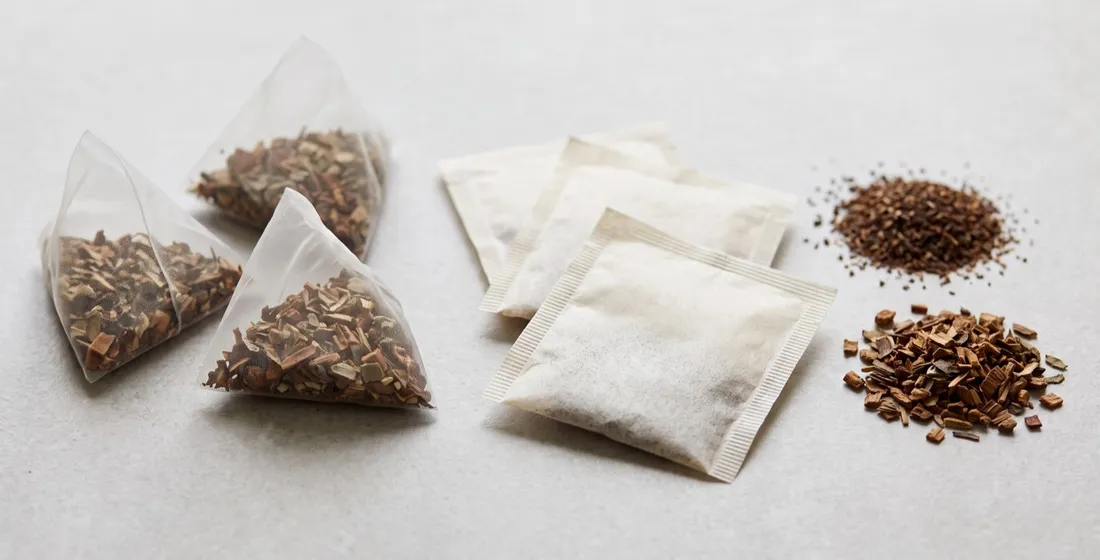
A pyramid tea bag is a tetrahedral sachet of woven or non-woven mesh, sealed ultrasonically because the mesh polymer softens rather than glues. A round or square paper bag is filter paper, either heat-sealed along its edge or knotted shut in the traditional double-chamber format. That single difference in construction sets particle size, fill weight, brew rate, machine throughput, and, from February 2028, EU legality.
The pyramid exists for one reason: headspace. A tetrahedron holds a larger internal volume than a flat sachet of the same footprint, so leaf pieces can tumble and infuse instead of compressing into a wet slab. That is why pyramids became the format for whole-leaf and coarse-cut functional blends, where the visible piece size is part of the product story. IMA’s CT10 pyramid line, for example, dispenses fill volumes from 2.2 to 8.1 cc and is engineered for long-leaf tea and herbs, accepting coarse fragments up to 10 mm while minimising breakage.
The flat paper bag exists for the opposite reason: speed and cost. A double-chamber bag folds around a fine particle load and extracts quickly through a large surface area at a fraction of the material cost. It has no window, so it makes no visual promise about the leaf inside. For a private-label blend built on efficacy claims rather than appearance, that is often the correct trade.
Neither format is inherently better. They serve different briefs, and the mistake worth avoiding is choosing the pyramid because it looks premium and then discovering the blend does not have a cut grade that suits it.
Mesh, paper, and the February 2028 compostability deadline
Bag material is now the highest-consequence line on a tea RFQ. Nylon (PA6) mesh melts around 215 to 225°C and requires ultrasonic sealing. It composts in neither industrial nor home conditions, and it is the material behind the microplastic findings that have followed the category since 2019. PLA mesh, the corn-starch derived material sold under names such as Soilon, softens far lower, around 150 to 180°C, and carries EN 13432 and ASTM D6400 certification for industrial compostability. Buyers should note the qualifier: industrial, not home. A PLA pyramid still needs a municipal composting stream to break down, and most consumer bins are not that.
| Bag material | Base | Seal method | Thermal behaviour | Compostability |
|---|---|---|---|---|
| Nylon (PA6) mesh | Petrochemical polyamide | Ultrasonic | Melts approx. 215 to 225°C | Neither industrial nor home. Fails PPWR Art. 9 from Feb 2028 |
| PET mesh | Petrochemical polyester | Ultrasonic | High melt point | Neither industrial nor home. Fails PPWR Art. 9 from Feb 2028 |
| PLA mesh (Soilon type) | Corn-starch derived polylactic acid | Ultrasonic or laser | Softens approx. 150 to 180°C | Industrially compostable, certified to EN 13432 and ASTM D6400. Not home compostable |
| Heat-sealable filter paper | Abaca and wood pulp with thermoplastic fibre | Thermal | Standard flat-bag seal temperatures | Generally compostable, subject to resin content |
| Non-heat-sealable filter paper | Abaca and wood pulp | Knotted, folded, or stapled | No seal layer | Generally compostable, the cleanest paper option |
Filter paper carries its own dossier question, and it is one most buyers never ask. Heat-sealable and wet-strength teabag papers are commonly treated with polyamidoamine-epichlorohydrin resin so the bag survives boiling water without disintegrating. That resin carries residual chloropropanols, 1,3-dichloropropanol and 3-monochloropropane-1,2-diol. Germany’s Bundesinstitut für Risikobewertung recommends extractable limits of 2 µg/L for 1,3-DCP and 12 µg/L for 3-MCPD, tested at higher paper-to-water ratios specifically because tea bag paper sits in near-boiling water for minutes. Ask for the migration data. A supplier who has it will send it in a day.
Where Silk Route Ventures walks away
Briefs that want a nylon pyramid at the lowest available mesh price for an EU-bound programme launching in 2027. The format has 18 months of legal life left in that market and the requalification cost lands on the brand owner, not on the mesh supplier. For a non-EU programme with no compostability commitment, nylon is a legitimate commercial choice and a competent mesh converter is the more honest answer than a premium quote.
How does bag format change the cut spec you order?
The cut is the part of the specification a tea supplier actually controls, and it is where format decisions become sourcing decisions. Fine particles brew fast and extract hard, which is why the flat double-chamber bag runs on fannings and dust grades. Coarse particles brew slower but hold visual identity, which is why the pyramid runs on broken-leaf and cut-piece material. Silk Foods Ceylon (SFC) cuts to two standing specifications for bagged applications: a 1 to 2 mm tea cut and a 3 to 5 mm pyramid cut.
| Bag format | SFC cut spec | Particle behaviour | Best-fit blend type |
|---|---|---|---|
| Round or square heat-sealed paper | Tea cut, 1 to 2 mm | Fast extraction, high surface area, fines pass into the cup as sediment if under-screened | High-volume retail, efficacy-led functional blends |
| Double-chamber knotted paper | Tea cut, 1 to 2 mm | Two chambers double the wetted surface, fastest brew of the four | Mass retail, foodservice, hospitality sachets |
| Pyramid mesh | Pyramid cut, 3 to 5 mm | Tumbles in the headspace, slower and more even extraction, visually legible | Specialty retail, premium functional, single-origin storytelling |
| Large filter paper (loose-fill) | Pyramid cut or coarser | Handles bark, root, and flower pieces a doser would otherwise bridge | Herbal and Ayurvedic infusions, catering pots |
This is the single most common correction the Silk Route Ventures (SRV) trade desk makes on a first tea enquiry. A brand arrives with a pyramid brief, a mesh sample, and a cut spec written for a flat bag, usually because the cut spec was copied from an existing paper-bag SKU. The pyramid then fills to weight but not to volume, the bag sits half-slack, and the visual argument that justified the pyramid in the first place disappears. Fixing it is a cut change, not a bag change, and it costs a fresh production run of the raw material. Screening the spec before the first PO costs nothing.
The same logic already governs the spice and herb side of the catalogue. Formats such as Ceylon cloves in tea cut and pyramid cut, dried ginger tea cut and pyramid cut, sarsaparilla (Iramusu) tea cut, nutmeg tea cut, and hibiscus cut grades for tea blending exist precisely so a blender can match particle size to the bag rather than to the ingredient. For the tea base itself, Ceylon BOP and FBOP tea grades set the leaf-side vocabulary that sits underneath all of this.
What the packing machine does to your unit cost
Format decides machine, and machine decides the packing charge per thousand bags. The published numbers are worth having in front of you, because the intuition most buyers carry, that the fancier bag must be the slower one, is only half right.
| Machine | Format | Published speed | Note |
|---|---|---|---|
| Teepack Constanta RC | Double-chamber round or flat paper | Up to 250 bags per minute | Manufacturer specification |
| IMA CT10 | Pyramid, ultrasonic-sealed mesh | Up to 300 bags per minute | Manufacturer specification, top-line rating |
| IMA Maisa EC12 range | Single-chamber heat-sealed flat paper | 110 to 140 bags per minute | Dealer-listed specifications, not a manufacturer sheet |
| IMA Maisa EC15 | Double-chamber knotted, non-heat-sealable | Not published | Traditional knotted format |
Read those as nameplate ratings, not as field averages. A pyramid line rated at 300 bags per minute is quoting an ideal fill with a well-behaved cut; the same line running a bark-heavy Ayurvedic infusion with 8 mm pieces will not hold that number. What the table does establish is that pyramid packing is not inherently slow. The cost premium on a pyramid SKU is carried mostly by the mesh material and the ultrasonic tooling, not by throughput. That matters when a converter quotes a pyramid at three times the paper price and attributes it to “slower machinery.”
Specifying string, tag, and envelope on the RFQ
String and tag is not one decision. It is three, and each has an independent cost and compliance consequence. The string itself is usually cotton or a paper-cotton blend, and on a compostable brief it must be uncoated. The tag is paper or card, printed, and it is where most of a bag’s visible branding lives. The overwrap envelope, the individually sealed sachet that keeps a single bag aroma-tight, is a separate laminate entirely and is the component most likely to fail a compostability claim while the bag inside passes.
The sequence that keeps an RFQ clean is to specify from the inside out: cut spec, then fill weight, then bag material and seal method, then string and tag, then envelope, then outer carton. Buyers who specify from the outside in tend to lock a carton count and a retail price first, then discover the bag material that would meet their sustainability copy does not fit the cost they already published.
Spec snapshot: bagged tea and herbal formats at Silk Foods Ceylon
- Bag formats: pyramid mesh, round paper, string and tag, filter paper
- Cut specs: tea cut 1 to 2 mm; pyramid cut 3 to 5 mm
- Cut and blending capacity: 100 to 200 kg per hour on the spice and herb line
- Certifications: BRCGS, FSSC 22000 V6, USDA Organic and EU Organic per SKU
- First-order MOQ: 50 kg per SKU on cut material
- Samples: 3 to 5 business days door to door by international courier
- Production lead time: 2 to 3 weeks from PO to dispatch
Which format fits which private-label brief?
The honest answer is that three variables decide it, and price is the least important of them: the destination market’s regulatory horizon, the visual promise the brand is making, and the cut grade the blend can actually support.
| If the brief is | Choose | Because |
|---|---|---|
| EU retail, launching 2027 or later | PLA mesh pyramid or heat-sealable paper | PPWR Article 9 closes nylon and PET from 12 February 2028 |
| Premium specialty, visible whole-leaf or bark pieces | Pyramid, 3 to 5 mm cut | Headspace preserves piece integrity and the visual claim |
| High-volume grocery, price-led | Double-chamber paper, 1 to 2 mm cut | Fastest brew, lowest material cost, no mesh premium |
| Hospitality and foodservice | Paper with string, tag, and envelope | Envelope protects aroma in open storage; tag carries the brand |
| Home-compostable claim on pack | Non-heat-sealable paper, uncoated string | PLA is industrially compostable only, and most envelopes are not compostable at all |
| Ayurvedic or herbal infusion with bark and root | Large filter paper or pyramid | Coarse pieces bridge in fine-bag dosers |
For distributors running multi-category programmes, the format question compounds. A range of eight functional infusions across two bag formats is two machine setups, two mesh or paper specifications, two compostability dossiers, and two cut grades from the raw-material supplier. Consolidating the cut side of that under one certified processor removes most of the coordination cost, which is the same argument that applies to private label manufacturing across the wider B2B buyer’s guide to Ceylon spices.
Frequently asked questions
Are pyramid tea bags being banned in the EU?
Not banned, but restricted by material. Regulation (EU) 2025/40 requires permeable tea and coffee bags on the EU market to be industrially compostable from 12 February 2028. A PLA-mesh pyramid certified to EN 13432 continues to qualify. Nylon and PET pyramid mesh does not, so the format survives while those two materials do not.
What particle size does a pyramid tea bag need?
Pyramid bags run on coarse cut, typically 3 to 5 mm, because the tetrahedral headspace is what the format is for. Silk Foods Ceylon cuts a standing 3 to 5 mm pyramid grade alongside a 1 to 2 mm tea cut for flat paper bags. IMA’s CT10 pyramid line accepts fragments up to 10 mm, so bark and flower pieces are workable.
Does Silk Route Ventures supply cut material for private-label tea bags?
Yes. Silk Foods Ceylon supplies tea cut at 1 to 2 mm and pyramid cut at 3 to 5 mm across spices, herbs, and Ayurvedic botanicals, from a Matale facility holding BRCGS and FSSC 22000 V6, with USDA Organic and EU Organic on the relevant SKUs. First-order MOQ is 50 kg per SKU, and samples ship in 3 to 5 business days.
Do paper tea bags release microplastics?
Less than synthetic mesh, but not zero. A 2025 study in Polymers found polyamide and polypropylene bags released up to 14 billion particles per litre, while cellulose bags released up to 170 billion per litre, with most particles between 200 nm and 1 µm. Cellulose particles degrade far faster in the environment than synthetic polymer particles.
How Silk Route Ventures can help
Silk Route Ventures supplies cut and blended tea, spice, herb, and Ayurvedic botanical material to specialty brands and multi-category distributors across the US, EU, and Australia, specified to the bag format the buyer is packing into. Tea cut runs at 1 to 2 mm and pyramid cut at 3 to 5 mm, blended and packed from the BRCGS and FSSC 22000 V6 audited Silk Foods Ceylon facility in Matale, with USDA Organic and EU Organic on the relevant SKUs. First-order MOQ is 50 kg per SKU, samples ship door to door by international courier in 3 to 5 business days, and production lead time is 2 to 3 weeks from PO to dispatch. For brands consolidating an infusion range under one supplier, Silk Route Ventures also runs end-to-end private label from the same site. Contact us to send an inquiry or request a sample pack against your bag format.
Sources
- European Parliament and Council, Regulation (EU) 2025/40 on packaging and packaging waste, retrieved 2026-08-07, https://eur-lex.europa.eu/legal-content/EN/TXT/PDF/?uri=OJ:L_202500040
- European Bioplastics, Article 9 PPWR: why certain packaging formats should be compostable, retrieved 2026-08-07, https://www.european-bioplastics.org/article-9-ppwr-why-certain-packaging-formats-should-be-compostable-2/
- Hernandez, Xu, Wilkinson and Tufenkji, Plastic Teabags Release Billions of Microparticles and Nanoparticles into Tea, Environmental Science and Technology, 2019, retrieved 2026-08-07, https://pubs.acs.org/doi/10.1021/acs.est.9b02540
- McGill University Newsroom, Some plastic with your tea?, 2019, retrieved 2026-08-07, https://www.mcgill.ca/newsroom/channels/news/some-plastic-your-tea-300919
- Evolution of Microplastics Released from Tea Bags into Water, Polymers, 2025, retrieved 2026-08-07, https://pmc.ncbi.nlm.nih.gov/articles/PMC12526631/
- IMA Group, CT10 tea bag packaging machine, retrieved 2026-08-07, https://imagroup.com/machines/ct10/
- Teepack, Constanta machine, retrieved 2026-08-07, https://www.teepack.com/en/constanta/constanta-machine
- Migration of chloropropanols 3-MCPD and 1,3-DCP from paper straws into food simulants, Journal of Consumer Protection and Food Safety, 2024, retrieved 2026-08-07, https://link.springer.com/article/10.1007/s00003-024-01523-7
- BioResources, Polyamidoamine epichlorohydrin (PAAE) wet-strength agent, retrieved 2026-08-07, https://bioresources.cnr.ncsu.edu/resources/polyamidoamine-epichlorohydrin-paae-wet-strength-agent-generations-application-performance-and-recyclability-in-paperboard-and-linerboard/
Written by the Silk Route Ventures Trade Team. Silk Route Ventures (E-Silk Route Ventures Ltd) is a Sri Lankan B2B supply-chain operator for the Food, Beverage, Wellness, and Nutraceuticals sectors. The Silk Foods Ceylon manufacturing arm holds BRCGS and FSSC 22000 V6 certification. Questions or to request a sample: Contact us or email info@esilkroute.com.lk.