
The B2B Buyers Guide to Ceylon Spices in 2026
Published: 2026-05-17 Last updated: 2026-05-17
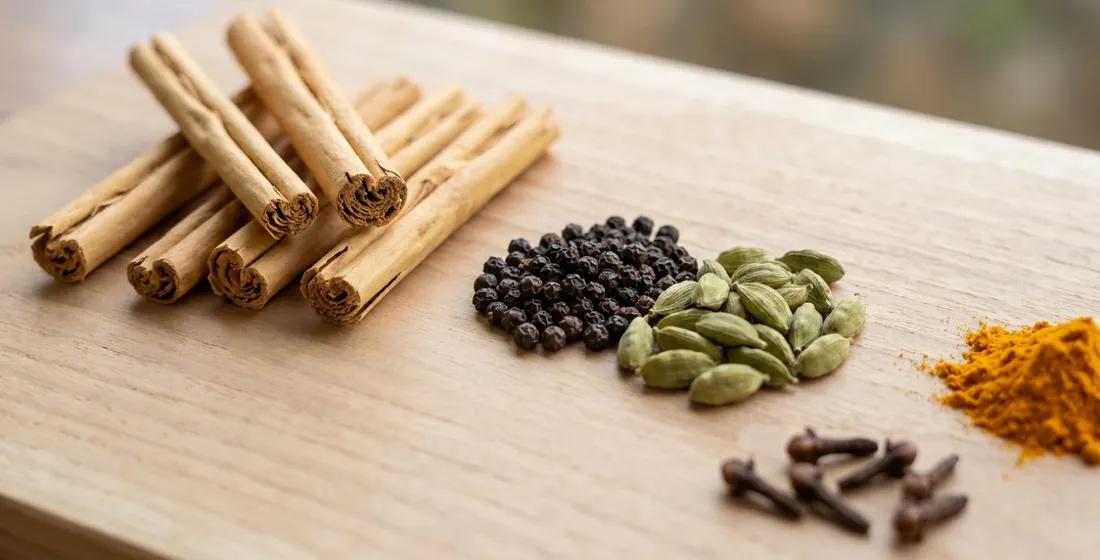
Hero: editorial flat-lay of true Ceylon cinnamon quills, black peppercorns, green cardamom pods, whole cloves, and turmeric powder on a plain unmarked light wooden surface. Photographed in editorial trade-publication style.
Buyer’s snapshot
Buyer's snapshot Sri Lanka exported roughly 19,600 metric tonnes of cinnamon and held more than 60% of its 2025 spice trade value (~USD 449.9M, per Sri Lanka EDB, 2025) in cinnamon alone, locking in dominant share of the true Ceylon (*Cinnamomum verum*) global supply. "Ceylon Cinnamon" became an EU Protected Geographical Indication on 2 February 2022 (EU Reg 2022/144). The label phrase is legally reserved for product compliant with the registered specification. Through 2024 and 2025, the US FDA expanded its public health alert on ground cinnamon to 19 brands for elevated lead. The recalled product was cassia; no true Ceylon cinnamon was implicated. Silk Route Ventures supplies bulk Ceylon spices and finished private-label retail spice SKUs from the BRCGS and FSSC 22000 V6 audited Silk Foods Ceylon facility in Matale. First-order MOQ is 100 kg per SKU; samples are free for evaluation (you cover the courier). For US, UK, EU, and AU brands competing on origin and certification, this is the procurement spec. For lowest-shelf retail, cassia from a competent processor is the more honest answer. |
In 2024, the US FDA opened a recall investigation that, by November 2025, listed 19 ground cinnamon brands with lead levels between 2.03 and 7.68 ppm (US FDA, public health alert, 2025). Every recalled product traced back to cassia stocks, not to true Ceylon cinnamon. For procurement teams sourcing under the “Ceylon cinnamon” label, the recall did two things at once. It validated the species premium that already existed in the spec sheet. And it raised the bar on supplier qualification, because the next FSMA Rule 204 audit cycle will not accept a vague chain of custody.
This piece is the procurement spec for buyers sourcing Ceylon spices from Sri Lanka in 2026. Silk Route Ventures (SRV) trades the spice catalogue, and the Silk Foods Ceylon (SFC) facility in Matale runs the processing line under FSSC 22000 V6. The post walks through what “Ceylon spices” means in regulatory terms, what changed for procurement after the 2024 recall, how the major Ceylon SKUs compare with Vietnamese, Indian, and Indonesian alternatives at the spec level, and what an RFQ should contain before a sample ships.
What does “Ceylon spices” actually mean in 2026 procurement?
“Ceylon spices” refers to the spice catalogue grown and processed in Sri Lanka, with true Ceylon cinnamon (Cinnamomum verum) as the flagship. Sri Lanka holds the EU Protected Geographical Indication for Ceylon Cinnamon (Reg. (EU) 2022/144, registered 2 February 2022), and the country supplies the dominant share of the species globally. For a procurement spec, Ceylon spices means an origin claim that is botanically verified, MRL-disciplined, and audit-evidenced to the destination market.
The catalogue at the Silk Foods Ceylon site covers the working spice list a B2B buyer normally specifies: true Ceylon cinnamon (quillings No 1 to 3, C4, C5, H1, H2, Alba, plus powder, tea cut, and pyramid cut), black pepper, white pepper, cardamom, cloves, coriander, cumin, fennel, fenugreek, ginger, mace, mustard, nutmeg, tamarind, turmeric, vanilla, and curry-powder blends. The spice line runs at 100 to 200 kg per hour, with FSSC 22000 V6 covering the spice line, and USDA Organic plus EU Organic on selected SKUs, confirmed per SKU.
Ceylon is not a generic descriptor. For procurement teams, the practical test is botanical verification (Cinnamomum verum for cinnamon, Piper nigrum for pepper, Elettaria cardamomum for green cardamom) confirmed in writing on every batch. The Sri Lanka Export Development Board reported total spice and essential oil exports of about USD 449.9 million in 2025, with cinnamon contributing more than 60% of the line by value (Sri Lanka EDB, 2025).
The 2024 cinnamon recall and what changed for spice procurement
Through 2024 and 2025 the US FDA expanded its public health alert on ground cinnamon to 19 brands, with lead levels between 2.03 and 7.68 parts per million (US FDA, public health alert on ground cinnamon, 2025). Every recalled product traced back to cassia stocks (Cinnamomum cassia, C. burmannii, C. loureiroi). No true Ceylon cinnamon was implicated. The recall sat alongside the 2023 WanaBana applesauce incident, where cassia-sourced cinnamon delivered lead levels of 2,270 to 5,110 ppm into a children’s SKU and triggered 560+ pediatric exposures per the CDC.
What changed for procurement is the question that now sits at the top of every supplier qualification call: where, specifically, does the cinnamon come from, and how is the species verified per batch. A “Ceylon cinnamon” label statement on the finished pack is no longer a marketing softener; it is the spec the FSMA Rule 204 audit will trace, even though FDA has now extended the rule’s enforcement date to 20 July 2028 (US FDA / Federal Register, August 2025).
Procurement-desk observation SRV procurement-desk observation: In Q1 2026, the Silk Route Ventures procurement desk fielded a pattern of three US specialty spice brands in three weeks, each one rebuilding their cinnamon spec after their existing cassia supplier got flagged by their FSMA-prep auditor. The 2024 recall did not just pull product. It changed how procurement teams write the next supplier contract. |
How do Ceylon spices compare with Vietnam, India, and Indonesia at the spec level?
Origin-vs-origin comparisons on Ceylon spices are mostly settled at the spec level, not at the marketing level. The comparison table below lays out the procurement-relevant differences for the four spice categories most often quoted side by side in 2026 sourcing briefs: cinnamon, black pepper, cardamom, and turmeric. The values reflect a mid-grade B2B procurement spec, not a retail premium tier.
Ceylon spices vs main competing origins: a procurement-spec comparison (2026)
| Spec dimension | Ceylon (Sri Lanka) | Vietnam | India | Indonesia |
| Cinnamon species | Cinnamomum verum (true Ceylon) | C. cassia (cassia) | C. verum (limited) + C. cassia | C. burmannii (cassia) |
| Coumarin in cinnamon (mg/kg) | 0.017 to 0.4 | 700 to 12,000 | varies by species shipped | 700 to 12,000 |
| EU PGI on cinnamon | Yes (Reg 2022/144) | No | No | No |
| Black pepper origin tier | Specialty / premium | High-volume commodity | Mid- to premium | Mid-volume commodity |
| Cardamom (green) origin tier | Specialty / Ceylon AGEB | Limited | Bold green grade leader | Limited |
| Turmeric curcuminoid range (%) | 3.0 to 5.5 typical | n/a | 2.5 to 5.0 typical | n/a |
| EU MRL exposure pattern (2024) | Lower (organic-led + EDB monitoring) | Higher (chlorpyrifos history) | Mixed (state-by-state) | Higher (chlorpyrifos history) |
| FSMA Rule 204 chain-of-custody readiness | BRCGS + FSSC 22000 V6 at site-level | Variable | Variable | Variable |
| Typical FOB price band (USD/kg, mid-grade cinnamon) | 5 to 21 (Sri Lanka EDB 2024 to 2025) | 1.5 to 3.5 | 2 to 6 | 1.5 to 3.5 |
Source: Sri Lanka EDB 2024 to 2025 export performance, EU PGI register (Reg 2022/144), EU Reg 1334/2008 Annex III on coumarin, ESA pesticide working group 2024 dataset on dried herbs and spices, SRV procurement-desk pricing notes (2026).
Two consequences for buyers. First, the Ceylon premium is anchored to a botanical and an EU PGI status that competing origins cannot legally claim. Second, the coumarin-vs-cassia spread of roughly two orders of magnitude (EU MRL for coumarin in cinnamon-based foods is 5 to 50 mg/kg depending on category, per EU Reg 1334/2008 Annex III) means a brand using the Ceylon label has spec-level room that a brand sourcing cassia does not. The same logic applies, less dramatically, across pepper, cardamom, and turmeric, where the differentiator is more often pesticide MRL discipline and pre-export microbial control than species.
Certifications, MRLs, and the EU PGI dimension
Three regulatory and certification layers govern Ceylon spice supply into the major destination markets in 2026. The certification stack the buyer actually verifies (BRCGS, FSSC 22000 V6, USDA Organic, EU Organic, optional Halal, Kosher, Fair Trade). The destination-market MRL framework (EU Reg 396/2005 plus annual MRL updates, US FDA action levels, FSANZ for Australia). And, for cinnamon specifically, the EU Protected Geographical Indication that legally reserves the “Ceylon Cinnamon” label phrase across the EU single market.
On the certification side, the Silk Foods Ceylon facility carries FSSC 22000 V6 across the spice line, with BRCGS covering the facility’s herbal and plant-based powder, capsule, plant milk, beverage and jam lines, and USDA Organic and EU Organic on selected SKUs, confirmed per SKU. FSSC 22000 V6 clears the GFSI gating filter that most multinationals require for Asian suppliers, for retail-ready private-label spice runs as well as for bulk RM.
Certification snapshot: Silk Foods Ceylon, Matale BRCGS (covers herb processing lines, plus coconut, plant-based, and retorted product lines) FSSC 22000 V6 (covers the full processing scope, from spices and herbs through plant-based meat alternatives and retort) USDA Organic and EU Organic (selected SKUs, confirmed per SKU) Sri Lanka EDB-registered exporter; US FDA-registered food facility; Department of Ayurveda registration for the herbal capsule scope |
On the MRL side, the 2024 figures from the European Spice Association showed chlorpyrifos as the top single pesticide non-compliance issue across herbs and spices for the year (40 issues, 30% of the category, per ESA pesticide working group, 2024). Chlorpyrifos and chlorpyrifos-methyl have a 0.01 mg/kg MRL across all EU food and feed since November 2020. For dried products like spices, the MRL applies after the dehydration factor (3 for dried garlic, 13 for coriander leaves, per ESA dehydration table). For procurement, the practical move is a pesticide panel that aligns to the destination market on every batch, with the panel referenced explicitly in the COA.
The EU PGI dimension is specific to cinnamon. Registration on 2 February 2022 under EU Reg 2022/144 means a finished food sold in the EU labelled “Ceylon Cinnamon” must derive from product compliant with the registered specification (production area: the whole island of Sri Lanka; botanical species: Cinnamomum zeylanicum Blume, synonymous with C. verum; product categories covered: cut quills, powder, leaf oil, bark oil). For a brand exporting into the EU, that turns the label phrase into a legally defensible origin claim instead of a marketing line.
What should a procurement RFQ for Ceylon spices include?
A procurement RFQ for Ceylon spices in 2026 looks different from the RFQ a buyer might have sent in 2020. Two things have moved. The FSMA Rule 204 traceability framework has set a higher bar for chain-of-custody documentation, and the EU MRL framework has tightened across multiple pesticides in dried herbs and spices. A well-built RFQ takes both into account before the supplier ships a sample.
Buyer's checklist: a Ceylon spice RFQ that survives the 2026 audit cycle 1. Botanical species identification confirmed in writing per SKU (*Cinnamomum verum* for true Ceylon cinnamon, *Piper nigrum* for pepper, *Elettaria cardamomum* for green cardamom). 2. EU PGI eligibility statement for any Ceylon Cinnamon line item (Reg 2022/144). 3. Per-batch COA covering moisture, oil content (where relevant), color, mesh size, microbial panel (TPC, yeast and mould, *Salmonella*, *E. coli*), heavy metals, and pesticide MRL panel aligned to the destination market. 4. Coumarin assay on every cinnamon batch. 5. Lead and chromium assay on every cinnamon batch (FDA-aligned action levels). 6. Supplier's certification dossier: BRCGS plus FSSC 22000 V6 plus the per-SKU organic certificates with version statements (not validity dates). 7. Traceability documentation back to farm or estate for organic and PGI SKUs. 8. Sample dispatched against the spec before any PO. |
At the bulk RM level, the per-SKU first-order MOQ at Silk Foods Ceylon is 100 kg, with volume-tier price breaks at 500 kg, 1,000 kg, and 2,500 kg. Samples are free for evaluation (you cover the courier). PO-to-dispatch lead time is 2 to 3 weeks for standard SKUs (4 to 6 weeks for private label, custom specifications and organic orders), plus 3 to 5 weeks of sea freight (US 4 to 5 weeks, EU 3 to 4 weeks, AU 3 to 4 weeks). Air freight is available for early formulation work at 3 to 4 days transit. Pricing is FOB Colombo unless the buyer asks for landed-cost framing, which is the more useful comparison when benchmarking against a US or EU distributor quoting DDP.
Across the SRV customer book in 2024 and 2025, the brands that won the most clean retail listings in the EU and the UK shared three RFQ habits: (1) they specified the botanical species in writing on every line item, not just for cinnamon; (2) they referenced the destination-market MRL panel explicitly, with the testing lab named; and (3) they asked for the certificate scope statement alongside the FSSC 22000 V6 certificate, so it was clear which processes sat inside it. The brands that lost listings most often skipped step (3).
MOQ economics, lead times, and the lean-route argument for Ceylon spices
Ceylon spice supply moves through three service modes at Silk Route Ventures: bulk ingredient supply (RM shipped against the buyer’s spec with a COA on request), private-label finished retail SKUs (the buyer’s brand on retail-ready packaging from the Matale line), and contract manufacturing of finished spice products (custom curry blends, masala, tea-blend cuts, finished retort SKUs that use spices as ingredients). Most Ceylon spice buyers start in the first mode and grow into the second; a smaller number arrive directly at the third because they have a retail listing waiting and a co-packer slot they cannot fill.
Where Silk Route Ventures pricing doesn't fit Lowest-shelf-price retail. Mass-discount channels. White-label dropshippers. Brands competing on per-unit invoice price below the Ceylon premium. For those briefs, cassia from a competent processor in Vietnam or Indonesia is the more honest answer than mislabelled Ceylon at a stretched price. |
The MOQ ladder reflects the choice. For bulk RM, the 100 kg per-SKU first-order minimum is per product, not pooled across a multi-SKU launch. A brand launching six spice SKUs commits 600 kg minimum total RM on the first order. For private-label retail, the floor depends on packaging format: 25 kg or 50 kg brown sacks for distributor-grade bulk; 50 g to 1 kg kraft pouches for retail; 40 g spice glass jars or 220 ml to 1 L glass containers for premium SKUs. For curry-powder and spice-blend contract manufacturing, the floor sits with the formulation’s most expensive component plus packaging tooling lead.
The lean-route argument for Ceylon spices is not “we are cheaper than the distributor.” It is that nine Ceylon spice categories (and the herbs, coconut, and capsule lines beyond them) collapse into one supplier relationship under one cert stack, one set of customs documents, one freight schedule. For a multi-category distributor () running five to nine origin-side supplier relationships across spices, herbs, and coconut today, consolidating those into one Sri Lankan partner is overhead reduction first, invoice-price reduction second. The price math gets honest once the FOB Colombo number lines up against the landed-cost number on the distributor’s side.
Innova Market Insights’ Top Ten Trends 2026 report and the Business Research Company’s 2026 organic spice market read (USD 34.5B in 2025 to USD 37.7B in 2026 at 9.1% CAGR, per Business Research Company, 2026) both flag traceable supply chains and clean-label spec discipline as the dominant growth drivers in the category. For procurement, that means the buyer’s 2026 RFQ for Ceylon spices is at the same time a defensive move (against the next FSMA audit) and an offensive one (the cleaner spec wins the next retail listing).
Frequently asked questions
What is the difference between Ceylon cinnamon and Vietnamese cassia for a B2B procurement spec?
Ceylon cinnamon is Cinnamomum verum; Vietnamese cassia is Cinnamomum cassia. The coumarin content differs by roughly two orders of magnitude (Ceylon typically 0.017 to 0.4 mg/kg, cassia 700 to 12,000 mg/kg). EU Reg 1334/2008 caps coumarin in cinnamon-based foods at 5 to 50 mg/kg. The “Ceylon Cinnamon” EU PGI (Reg 2022/144, 2022) legally reserves the label phrase for product compliant with the registered Sri Lankan specification.
What is the first-order MOQ for bulk Ceylon spices from Silk Route Ventures?
First-order bulk RM MOQ is 100 kg per SKU per product. A multi-SKU launch multiplies (six SKUs = 600 kg minimum). Volume-tier price breaks sit at 500 kg, 1,000 kg, and 2,500 kg per SKU. Samples are free for evaluation (you cover the courier). PO-to-dispatch lead is 2 to 3 weeks for standard SKUs, plus 3 to 5 weeks of sea freight depending on destination market.
Does Silk Foods Ceylon manufacture private-label retail spice SKUs under FSSC 22000 V6?
Yes. The Matale facility runs private-label retail spice SKUs under FSSC 22000 V6, covering both bulk RM and finished retail formats (25 kg and 50 kg sacks, 50 g to 1 kg kraft pouches, 40 g spice glass jars, 220 ml to 1 L glass containers). USDA Organic and EU Organic apply to selected SKUs, confirmed per SKU. Custom packaging is offered under the Total OBM service mode.
How did the 2024 US FDA cinnamon recall affect procurement for Sri Lankan exporters?
The recall expanded to 19 ground cinnamon brands by November 2025 with lead levels of 2.03 to 7.68 ppm (US FDA, public health alert, 2025). All recalled product traced back to cassia. No true Ceylon cinnamon was implicated. Procurement teams have since added lead and chromium assay to every cinnamon batch and tightened botanical-species verification in the supplier RFQ.
Can Silk Route Ventures supply Ceylon spices to the US, EU, UK, and Australia under one certification stack?
Yes. The Silk Foods Ceylon facility holds FSSC 22000 V6 covering the spice processing lines (with BRCGS on its herbal and plant-based lines), with USDA Organic and EU Organic on selected SKUs, confirmed per SKU. The site is Sri Lanka EDB-registered and US FDA-registered. The documentation pack (COO, phytosanitary certificate where the destination requires it, packing list, BOL, plus the organic import certificate the destination requires on certified-organic SKUs) ships with every consignment, with a COA on request.
How Silk Route Ventures can help
Silk Route Ventures (SRV) supplies single-origin Ceylon spices to specialty brands, wellness brands, CPG scale-ups, and multi-category specialty distributors across the US, UK, EU, and Australia. Bulk RM is shipped against the buyer’s spec from the BRCGS and FSSC 22000 V6 audited Silk Foods Ceylon (SFC) facility in Matale, with a COA on request and a full documentation pack on every consignment. First-order MOQ is 100 kg per SKU; samples are free for evaluation (you cover the courier) and ship door-to-door by international courier (DHL, FedEx, UPS). For brands ready to consolidate suppliers or launch a private-label retail SKU under their own label, SRV runs end-to-end private label manufacturing from the same site. For multi-category distributors consolidating spice, herb, coconut, tea, capsule, and plant-based supply under one cert stack, the same desk handles freight consolidation and single-BOL customs documentation. Contact us to send an inquiry or request a sample pack. Buyers can review the Ceylon black pepper spec sheet directly.
Sources
1. Sri Lanka EDB, 2025, “Spices, Essential Oils, and Oleoresins in Sri Lanka, sector data 2024 to 2025”, retrieved 2026-05-17. https://www.srilankabusiness.com/spices/
2. EU Commission, 2022, “Implementing Regulation (EU) 2022/144, Ceylon Cinnamon PGI register entry”, retrieved 2026-05-17. https://eur-lex.europa.eu/legal-content/EN/TXT/HTML/?uri=CELEX:32022R0144
3. US FDA, 2025, “FDA Public Health Alert for Additional Ground Cinnamon Product Due to Presence of Elevated Levels of Lead”, retrieved 2026-05-17. https://www.fda.gov/food/alerts-advisories-safety-information/fda-public-health-alert-additional-ground-cinnamon-product-due-presence-elevated-levels-lead
4. European Commission, 2024, “EU Pesticides Database, MRLs and latest updates (Regulation 396/2005 and amendments)”, retrieved 2026-05-17. https://ec.europa.eu/food/plant/pesticides/eu-pesticides-database/start/screen/mrls/latest
5. US FDA / Federal Register, 2025, “Requirements for Additional Traceability Records for Certain Foods, Compliance Date Extension (FSMA Rule 204)”, retrieved 2026-05-17. https://www.federalregister.gov/documents/2025/08/07/2025-14967/requirements-for-additional-traceability-records-for-certain-foods-compliance-date-extension
6. Business Research Company, 2026, “Organic Spice Market Analysis Report 2026, Major Trends, Growth Factors, and Forecast Overview”, retrieved 2026-05-17. https://www.thebusinessresearchcompany.com/report/organic-spice-global-market-report
7. Precedence Research, 2025, “Spices and Seasonings Market Size, Growth, Forecast to 2035 (USD 31.74B in 2025 to USD 56.16B by 2035, 5.87% CAGR)”, retrieved 2026-05-17. https://www.precedenceresearch.com/spices-and-seasonings-market
Further reading
- oriGIn, 2022, “Recognition of Ceylon Cinnamon as a PGI in the European Union” -> https://www.origin-gi.com/10-02-2022-recognition-of-ceylon-cinnamon-as-a-pgi-in-the-european-union/
- CBI / Netherlands, 2025, “Buyer requirements for herbs and spices on the European market” -> https://www.cbi.eu/market-information/spices-herbs/buyer-requirements
- Innova Market Insights, 2026, “Top Ten Trends 2026 (clean-label, traceability, premiumisation)” -> https://www.innovamarketinsights.com/trends/top-food-and-beverage-trends-2026/
Written by the Silk Route Ventures Trade Team. Silk Route Ventures (E-Silk Route Ventures (Pvt) Ltd, T/A Silk Route Ventures) is a Sri Lankan B2B supply-chain operator for the Food, Beverage, Wellness, and Nutraceuticals sectors. The Silk Foods Ceylon manufacturing arm in Matale holds BRCGS and FSSC 22000 V6 certifications, with USDA Organic and EU Organic on selected SKUs, confirmed per SKU. Questions or to request a sample: Contact us or email info@esilkroute.com.lk.