
Hibiscus Cut Grades for Tea Blending and Beverage Formulators
Buyer’s snapshot
- The tea hibiscus is Hibiscus sabdariffa (roselle, or sour tea), and the part used is the dried calyx, not the showy ornamental flower. Get the species and the plant part right on the spec before anything else.
- Two numbers decide a hibiscus lot: anthocyanin colour and total titratable acidity. Roselle calyces run roughly 21 to 36 g malic acid per 100 g dry weight (Journal of Applied Research on Medicinal and Aromatic Plants, 2018), which is what gives the brew its tartness and ruby colour.
- Cut size is a formulation decision, not a grade label. Tea-bag cut extracts fast and clouds an iced drink with fines; coarse cut shows the botanical and cold-brews clean. Most hibiscus quality complaints trace back to a cut mismatch, not a bad lot.
- Silk Foods Ceylon supplies hibiscus cut as bulk raw material from a BRCGS and FSSC 22000 V6 audited facility in Matale, with a 50 kg first-order MOQ, COA per batch, and a heavy-metals and pesticide panel to the destination market.
- This post is for wellness-tea and beverage formulators specifying hibiscus for the first time, and for distributors adding a hibiscus line. It is a sourcing spec, not a health-claim sheet.
Most brands that order “hibiscus” for a tea blend or an iced drink are ordering a colour and a flavour, and leaving the two specifications that control both off the brief. They name a weight, sometimes an origin, and almost never a cut size or an anthocyanin target. The lot arrives, the brew comes out either pale or full of dust that clouds a bottled drink, and the supplier gets blamed for a spec the buyer never wrote. This piece is the spec: what hibiscus actually is at the procurement level, which two numbers matter, how to pick a cut grade against the end format, and what to put on the food-safety panel before the first sample ships.
Is the hibiscus in tea the same plant as the flower in the garden?
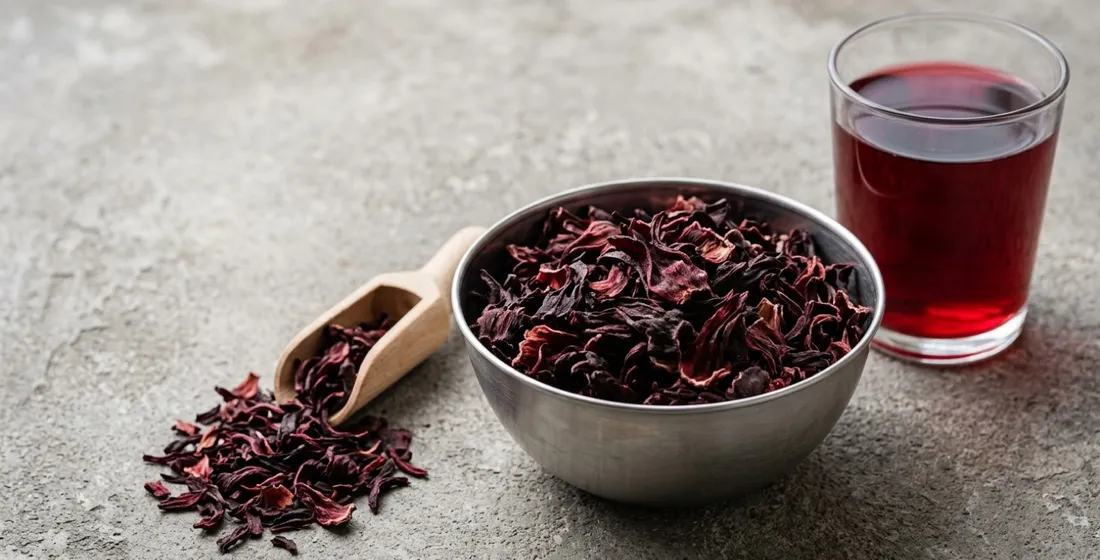
No. The hibiscus used in tea and beverages is Hibiscus sabdariffa, known in the trade as roselle or sour tea, and the part used is the dried calyx (the fleshy red cup left behind after the petals drop), not the large ornamental bloom of Hibiscus rosa-sinensis sold as a garden plant. The calyx is the edible, brewable part, and it is what every hibiscus tea and beverage spec refers to.
That distinction is the first line of a clean RFQ. A buyer who writes “hibiscus flower” invites confusion; a buyer who writes “Hibiscus sabdariffa dried calyx, cut” has specified the species, the plant part, and the format in five words. The calyx is harvested roughly 15 to 20 days after flowering, when it is fleshy and deep red, then dried and cut (PlantNet Pl@ntUse / PROSEA reference). Everything that follows on the spec sheet describes that dried calyx.
Why anthocyanin colour and total acidity are the two numbers buyers screen
A hibiscus lot lives or dies on two measurements: anthocyanin content, which drives the ruby-red colour, and total titratable acidity, which drives the tartness. Roselle calyces carry anthocyanins such as delphinidin-3-glucoside and cyanidin-3-sambubioside, and total titratable acidity typically runs 21 to 36 g malic acid per 100 g dry weight (Journal of Applied Research on Medicinal and Aromatic Plants, 2018). A formulator who specifies both gets a predictable brew; one who specifies neither gets lot-to-lot drift.
Colour is the headline because hibiscus is often in a blend precisely to colour it. Anthocyanins are also heat and light sensitive, so a lot that tests well at intake can fade in storage or in a hot-fill line. The practical move is to specify a minimum colour target (measured as anthocyanin content or as absorbance at the relevant wavelength) and to pair it with a moisture ceiling, because moisture above the low single digits accelerates colour loss in dried calyx. Acidity is the second axis: it is what makes hibiscus read as “tart and refreshing” rather than flat, and it is why hibiscus anchors so many caffeine-free iced blends.
There is a third reason buyers reach for hibiscus, and it belongs in a sourcing post only as context, not as a claim. In a 2022 meta-analysis published in Nutrition Reviews (Oxford Academic), Hibiscus sabdariffa lowered systolic blood pressure by about 7.1 mmHg versus placebo, with the largest effect in people who started with elevated pressure. That body of evidence is why heart-health positioning is common in the category. It is the brand’s claim to make or not make under its own regulatory advice; the raw material spec stays about colour, acidity, and safety.
Choosing a cut grade: tea-bag cut, coarse cut, or whole calyx
Cut size is the specification most often left blank, and it controls more of the finished result than origin does. Herbs for bagged tea are typically cut to a particle range from about US mesh #10 (2 mm) down to #60 (0.25 mm), with “fine cuts” landing around 0.315 to 2.00 mm (Frontiers in Pharmacology, 2022). Finer cuts give more surface area and faster extraction, but they also generate dust and fines that cloud a clear bottled drink and sift through some filter papers. The cut is a trade-off, and the right answer depends entirely on the end format.
A tea-bag line wants a uniform, free-flowing tea-bag cut that extracts inside the few minutes a consumer steeps a bag. A loose-leaf or visible-botanical blend wants a coarser cut where the deep-red pieces are part of the look on the shelf. A cold-brew or ready-to-drink beverage line usually wants a coarser cut too, because it cold-extracts over hours and a coarse cut keeps fines out of the finished liquid. Whole or near-whole calyx sits at the premium end for loose blends and infusions where appearance carries the price.
| End format | Suggested hibiscus cut | Why this cut | Watch-out |
|---|---|---|---|
| Tea bags (pyramid, paper) | Tea-bag cut, ~0.3 to 2 mm, uniform | Fast extraction in 3 to 5 min steep; free-flowing for filling | Excess fines sift through filter paper and cloud the cup |
| Loose-leaf / visible-botanical blend | Coarse cut, ~3 to 8 mm | The red pieces are part of the on-shelf look | Too coarse can slow extraction; specify a colour minimum |
| Cold-brew / RTD beverage | Coarse cut | Cold extraction over hours; coarse keeps fines out of clear liquid | Fine cut clouds a bottled drink and shortens filter life |
| Extract / concentrate feedstock | Fine cut | Maximum surface area for fast, complete extraction | Higher dust; handle for dust control, not for appearance |
Source: cut-to-application guidance synthesised from Frontiers in Pharmacology (2022) and SRV trade-desk practice.
Hot brew, cold brew, and what the cut has to do with extraction
The cut and the brew method work together, and the data is specific. A hot infusion pulls roughly 47% more total anthocyanins than a cold one, and the same anthocyanin concentration reached at 90°C in about 16 minutes takes around 240 minutes at 25°C, a clean time-versus-temperature trade-off (Journal of Food Measurement and Characterization, Springer, 2021). For a formulator, that means the cut and the process have to be specified as a pair, not separately.
The same study found that hot-brewed hibiscus, while richer at the moment of brewing, degraded faster in storage: after 48 hours at 5°C, anthocyanin content fell about 48% in the hot infusion versus about 30% in the cold. A ready-to-drink brand chasing shelf colour stability often lands on a cold or warm extraction with a coarse cut, accepting slightly lower initial colour for slower fade. A hot-fill tea brand optimises the other way. Neither is “better” in the abstract; the cut spec follows the process decision.
SRV finding: in the first quarter of 2026, the SRV trade desk saw the same pattern three times: a beverage brand ordered “hibiscus, food grade” with no cut spec, received a fines-heavy lot suited to tea bags, and watched it cloud a clear bottled product on the line. The fix each time was not a new supplier. It was a coarse-cut spec and a fines ceiling written into the next PO.
The food-safety spec: heavy metals, pesticide residue, and microbial
Hibiscus carries one sourcing risk that buyers underweight: it is an efficient accumulator of soil and water contaminants, which is why dried calyx needs a per-batch heavy-metals panel rather than a one-time certificate. Research on roselle has repeatedly used the plant as a heavy-metal bio-adsorber, and field studies report that calyx metal levels track the growing environment. A per-batch lead and cadmium result by a validated method is the control, not an annual sample.
Pesticide residue is the second gate, especially for EU-bound volume. Under the European Union’s Regulation (EC) No 396/2005, a default maximum residue level of 0.01 mg/kg applies wherever a pesticide is not specifically listed, and because hibiscus is dried, the European Commission’s Article 20 concentration rule and the European Spice Association dehydration factors come into play when converting fresh-basis limits to the dried calyx (European Commission, EU MRL legislation). Microbial load (total plate count, yeast and mould, and absence of Salmonella) rounds out the panel, since dried botanicals destined for a cold-brew or an unpasteurised blend get no kill step downstream.
Spec snapshot: hibiscus cut (Hibiscus sabdariffa dried calyx)
- Species and part: Hibiscus sabdariffa, dried calyx (roselle), confirmed in writing
- Cut: tea-bag cut (~0.3 to 2 mm) or coarse cut (~3 to 8 mm), specified to end format
- Colour: minimum anthocyanin / absorbance target, paired with a moisture ceiling
- Acidity: total titratable acidity stated where tartness is a formulation target
- Safety: per-batch heavy metals (lead, cadmium), pesticide MRL to destination market, microbial panel
- Supply: bulk cut from Matale under BRCGS and FSSC 22000 V6; 50 kg first-order MOQ; COA per batch
Specifying Ceylon hibiscus cut on an RFQ
Roselle grows in the tropics between about 7°S and 23°N, in the 25 to 30°C band that covers much of Sri Lanka, and export-quality Sri Lankan roselle is an emerging origin rather than a centuries-old one: the first Sri Lankan grower of export-grade roselle, Ceylon Hibiscus, was established only in 2021 (Daily FT, 2024). The world’s large-volume roselle still comes from Egypt, Sudan, Nigeria, China, and Thailand. For a buyer, the honest framing is that Sri Lanka is a quality-and-traceability origin for hibiscus, processed to spec, not the cheapest tonnage source.
That is where Silk Route Ventures (SRV) and its manufacturing arm, Silk Foods Ceylon (SFC), fit. SFC processes hibiscus to cut grades on its herb and spice line at the Matale facility, which runs at 100 to 200 kg per hour and sits within the facility’s BRCGS and FSSC 22000 V6 scope. The value is a clean cut spec, a per-batch COA, organic options where the buyer needs USDA Organic or EU Organic on the lot, and a documentation pack that survives a destination-market audit. A buyer specifies the species, the plant part, the cut, the colour and acidity targets, and the safety panel, and the lot is built to that brief.
Buyer’s checklist: ordering hibiscus cut
- Species and part confirmed in writing (Hibiscus sabdariffa dried calyx, not ornamental hibiscus)
- Cut grade specified to the end format (tea-bag cut vs coarse cut), with a fines ceiling for beverages
- Colour target (anthocyanin or absorbance) plus a moisture ceiling for colour stability
- Total titratable acidity stated where tartness matters to the formulation
- Per-batch heavy metals (lead, cadmium) by a validated method
- Pesticide MRL panel aligned to the destination market (EU default 0.01 mg/kg where unlisted)
- Microbial panel (TPC, yeast and mould, Salmonella absence)
- Organic transaction certificate if the SKU carries USDA Organic or EU Organic
- Sample dispatched against the written spec before any PO
Frequently asked questions
Is hibiscus tea made from the flower or the calyx?
It is made from the dried calyx of Hibiscus sabdariffa (roselle), the fleshy red cup left after the petals fall, not from the ornamental hibiscus flower. The calyx is the edible, brewable part and the one every hibiscus tea and beverage specification refers to. Naming the calyx on the RFQ prevents the most common species and plant-part mix-up.
What cut size of hibiscus should I order for tea bags versus a cold-brew drink?
Tea bags want a uniform tea-bag cut, roughly 0.3 to 2 mm, which extracts inside a 3 to 5 minute steep (Frontiers in Pharmacology, 2022). A cold-brew or ready-to-drink beverage usually wants a coarser cut, around 3 to 8 mm, because it extracts over hours and a coarse cut keeps fines out of the clear bottled liquid. Specify the cut to the format, not to a generic grade.
Why does hibiscus need per-batch heavy-metals testing?
Roselle is an efficient accumulator of soil and water contaminants, so calyx metal levels track the growing environment and can vary lot to lot. That is why a per-batch lead and cadmium result by a validated method is the right control rather than a single annual certificate, particularly for an unpasteurised blend or a cold-brew with no downstream kill step.
Does Silk Route Ventures supply bulk or private-label hibiscus cut with organic certification?
Yes. Silk Foods Ceylon supplies bulk hibiscus cut as raw material from a BRCGS and FSSC 22000 V6 audited facility in Matale, with USDA Organic and EU Organic available on qualifying lots, a 50 kg first-order MOQ, and COA per batch. Functional tea-bag formats can be run as private label on the facility’s tea-bag line. Contact SRV for a sample against your written spec.
How Silk Route Ventures can help
Silk Route Ventures (SRV) supplies bulk hibiscus cut (Hibiscus sabdariffa dried calyx) and a broad range of Ceylon herbs and functional botanicals to wellness-tea and beverage brands across the US, EU, and Australia. The hibiscus cut is processed to the buyer’s tea-bag or coarse-cut spec on the herb line at the BRCGS and FSSC 22000 V6 audited Silk Foods Ceylon (SFC) facility in Matale, with USDA Organic and EU Organic available on qualifying lots, a 50 kg first-order MOQ, COA per batch, and a heavy-metals and pesticide panel to the destination market. For brands building a finished tea SKU, hibiscus and herb blends can also run as private-label functional tea bags on the same site. Contact us to send an inquiry or request a sample against your spec.