
Private Labelling Spices
Market: USA primary; EU and UK secondary; AU tertiary
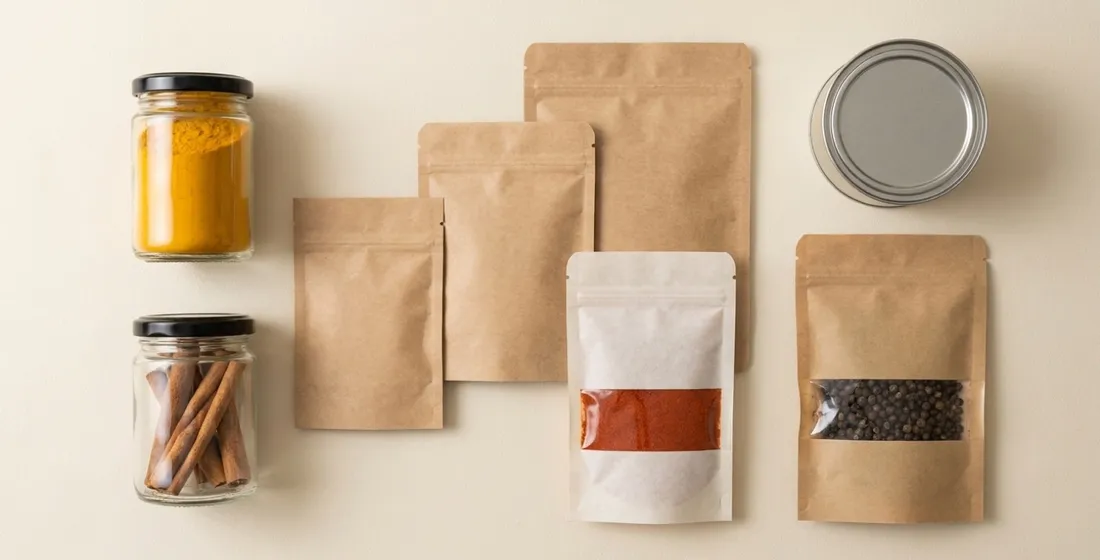
Private label packaging menu: brown and white kraft pouches, window pouches, glass spice jars, glass jars with metal lids, round tin can. Higgsfield-generated, visual QC passed (no branding, packages match SRV brochure formats).
By Silk Route Ventures Trade Team. 12 May 2026.
Buyer's snapshot
|
The economics of launching a private-label spice line are usually decided before the buyer’s first sample request. Format choice (kraft pouch vs glass jar vs tin can) accounts for somewhere between 60 and 80% of finished unit cost. Spice grade and origin account for 15 to 25%. Labelling, finish, and inner packaging account for the rest.
Most first-time buyers spend their time choosing between cassia and Ceylon, between organic and conventional, between Indian and Sri Lankan turmeric. Those decisions matter. But the structural decision, the one that locks in margin for the next two years, is the package the brand will sit on.
This piece walks through how private label spice manufacturing actually works from a buyer’s perspective: what the service covers, what packaging menu the buyer is choosing from, how MOQs work, the seven-step workflow from RFQ to dispatch, and the four things first-time private label buyers most commonly underestimate.
What does private labelling cover, and how is it different from OBM or ingredient supply?
Three services often get conflated in B2B spice trade. Buyers ask for one and end up needing another. The distinction:
| What the buyer brings | Ingredient Supply | Private Labelling | Total OBM |
|---|---|---|---|
| Brand | Their own; SRV is invisible | Their own; SRV-manufactured | SRV-developed under buyer’s brand |
| Product spec | Buyer-specified | Buyer-specified or SRV-suggested | SRV-developed |
| Packaging design | Not in scope (bulk only) | Buyer’s design or SRV in-house design | SRV in-house design |
| Formulation work | None | Light (blend ratios, fill weight) | Full (recipe, claims, label) |
| MOQ (first order) | 50 kg per SKU | 50 kg per SKU | Negotiated per project |
| Best fit persona | A, B, C, D (any) | A, B, D primarily | First-time founder, A or B |
Ingredient Supply is bulk RM, B2B-to-B2B, the buyer’s downstream brand is invisible. Private Label is finished retail-ready SKUs under the buyer’s brand. Total OBM is end-to-end product and brand development; SRV builds the spec, the formulation, the label, and the launch pack.
****Private Label and OBM both result in a buyer-branded finished product on shelf. The difference is who owns the IP on the formulation. Private Label means the buyer’s spec, the buyer’s recipe, the buyer’s design (or SRV’s design submitted as work-for-hire). Total OBM means SRV developed the product and is licensing it to the buyer’s brand. The MOQ math is similar; the contractual position is very different. First-time buyers should always ask: am I licensing a recipe, or am I owning one?
The spice packaging format menu (what your label will actually live on)
The Silk Foods Ceylon (SFC) packaging menu maps to the format choices most US, EU, UK, and Australian specialty grocers actually stock. The full matrix:
| Format | Sizes available | Best for | Typical category fit |
|---|---|---|---|
| Brown kraft pouch (plain) | 50g, 100g, 250g, 500g, 1kg | Whole spices, herbal teas, fruit powders | Specialty, organic, natural-channel retail |
| White kraft pouch | 50g, 100g, 250g, 500g, 1kg | Premium retail SKUs, lighter brand aesthetic | Health-food retail, gifting |
| Kraft window pouch (with clear window) | 50g, 100g, 250g, 500g, 1kg | Whole peppercorns, cinnamon quills, dried herbs (visual selling) | Specialty grocery, deli, farmers market |
| Glass spice jar (clear, with metal or plastic lid) | 40g spice bottle | Premium ground spices, retail-ready table format | Specialty, gifting, premium grocery |
| Glass jar (white, black, gold lid) | 50ml, 220ml, 330ml, 500ml, 1L | Spice blends, herbal teas, pre-mixed curry powders | Retail, foodservice |
| Round tin can | 400ml | Tea, premium spice blends, gifting | Specialty, premium retail |
| Glass square bottle | 420ml | Liquid blends, infused oils, spice extracts | Specialty retail |
| Tea bag formats | Pyramid, round paper, string-and-tag, filter paper | Single-spice teas (ginger, cinnamon, turmeric) | Wellness retail, foodservice |
| Bulk sack | 25 kg, 50 kg brown sack with LDPE inner | Foodservice, B2B intermediate | Foodservice, repacker |
| Custom (Total OBM) | Any format | Buyers needing a non-stock pack format | Founder-led launches with strong design |
Source: Silk Foods Ceylon packaging line specifications, 2026. Custom (Total OBM) availability varies by format and tooling; the SFC design team scopes feasibility within the first RFQ pass.
Spec snapshot: format choices that quietly decide the unit-cost math Brown kraft pouch, 50g: the highest-margin starting format. Specialty grocery shelf-friendly; lowest per-unit packaging cost in the menu. Kraft window pouch: the same paper economics as the plain kraft, plus a clear film window that lets the spice sell itself. Best for whole spices and visually distinctive grades. Glass spice jar, 40g: the premium-table format. Per-unit cost runs 4 to 6x the kraft pouch, but the shelf-price uplift typically more than compensates. Glass jar with metal or plastic lid, 50ml to 1L: the format for blends and pre-mixed curry powders. Tooling lead times are longer than pouch lead times; plan accordingly. Round tin can, 400ml: the gifting and premium-retail option. Often used for tea-spice crossover SKUs (cinnamon tea, ginger tea, turmeric latte blends). Bulk sack, 25 to 50 kg: the foodservice and repacker format. Volume economics with limited finishing work. |
How MOQs work for private label spice manufacturing
The private label minimum at Silk Foods Ceylon is 50 kg of raw material per SKU. That’s the most important number on the page, and the one most first-time buyers get wrong when they price the launch in their head.
Per SKU, not per total order. A buyer running six different spices in 50g kraft pouches needs at least 50 kg of each spice. Total RM commitment for the first launch: 300 kg. That converts to roughly 1,000 finished units per SKU, or about 6,000 units across the launch. Enough to seed multiple specialty grocers, a DTC website, and a foodservice account or two.
Drop to three SKUs and the floor halves to 150 kg total. Three SKUs in 220ml glass jars (which take more spice per unit by weight, roughly 80 to 120 grams depending on the spice) yields about 500 to 600 jars per SKU. Different shelf strategy, different cash-flow profile.
Volume-tier pricing breaks at 500 kg, 1,000 kg, and 2,500 kg per SKU. The biggest unit-cost step is between 50 kg and 500 kg, which is where most second-run buyers land once their first launch sells through. Beyond 2,500 kg per SKU per run, terms become custom. That’s the volume where a buyer asks for a multi-year supply arrangement rather than a per-PO quote.
****Across the last year of first-time private label launches at SFC, the typical buyer started with 4 to 6 SKUs at 50 to 80 kg per SKU, and reordered within 10 to 14 weeks of dispatch.
The 7-step workflow from RFQ to dispatch
First-run timeline averages 8 to 12 weeks. Subsequent runs collapse to 3 to 4 weeks because artwork, spec, and supplier paperwork are already locked. The seven steps:
- RFQ and spec brief (week 1). Buyer sends a brief covering target SKUs, target package formats, target retail price points, target launch market, and any spec constraints (organic claim, allergen sensitivity, specific MRL ceiling, halal or kosher requirements). Silk Route Ventures (SRV) responds with a feasibility note and a sample plan within two business days.
- Initial sample run (week 1 to 2). Samples ship door-to-door by international courier (DHL, FedEx, UPS), 3 to 5 business days transit, in the buyer’s target format and grade. The buyer evaluates against their own end-product or against a competitor benchmark. Sample payment is settled by bank transfer or PayPal; PayPal is accepted for sample payments only.
- Spec lock and pricing (week 3 to 4). Buyer confirms grade, format, blend ratios if any, and fill weights. SRV provides a FOB Colombo quote and an indicative landed-cost estimate to the buyer’s destination port.
- Artwork submission and packaging proofing (week 4 to 7). Buyer submits print-ready artwork against the SFC dieline specifications, or briefs the in-house design team. Multiple rounds of digital proofing followed by a physical pre-production sample.
- PO and production run (week 7 to 10). Buyer issues PO with the appropriate advance: orders under $10,000 are 100% advance by bank transfer; orders of $10,000 or above run 50% advance with the 50% balance against scanned shipping documents. PayPal is not accepted for production orders. Production line scheduled within 5 business days of advance receipt. The cellular manufacturing layout allows multiple buyer runs in the same window, which keeps per-unit cost competitive at lower volumes.
- QA and COA (week 10 to 11). Every batch receives an in-house COA. Specific parameters tested per the buyer’s spec through an external lab if required (typically heavy metals, microbial, pesticide MRL panel aligned to the destination market).
- Freight and dispatch (week 11 to 12). Sea freight transit times: AU 3 to 4 weeks; EU 3 to 4 weeks; US 4 to 5 weeks. Air freight (port to port) is 3 to 4 days transit if the buyer prioritizes speed over cost. The standard shipping documentation pack at BL or AWB release: Commercial Invoice, Packing List, Bill of Lading or Air Waybill, Certificate of Origin, Phytosanitary Certificate, Organic Transaction Certificate if applicable, and Batch COA. Additional documents (fumigation declaration, halal certificate, kosher certificate) are available on request.
Four things first-time private label spice buyers underestimate
****Watching first-time buyers through the seven-step workflow makes the same four mistakes visible across persona types. None of these are about spice. All of them are about packaging operations the buyer didn’t know they were signing up for.
- Artwork dielines and bleed for kraft pouches. The buyer’s designer often ships artwork sized to the front face of the pouch. The pouch has a back, a gusset, and a seal area. The dieline includes bleed and safe zones that aren’t obvious from a flat mockup. Plan for one round of dieline correction before pre-press, even with a competent design team.
- Lead time for custom glass jar tooling. Stock glass formats (50ml, 220ml, 330ml, 500ml, 1L) ship from existing inventory. Custom jar tooling adds 6 to 10 weeks to the first-run timeline and a non-trivial tooling fee. Buyers who fall in love with a unique jar shape often quietly switch back to stock formats during budget review.
- Multi-SKU production scheduling. Running six SKUs in a single production window means six format change-overs. The cellular manufacturing layout absorbs most of that, but the buyer should expect a 5 to 10% scheduling premium relative to a single-SKU run of equivalent total volume.
- Documentation pack for customs. First-time buyers often discover during the first import that their destination customs broker wants documents they didn’t think to ask for: a specific phytosanitary certificate format, an organic transaction certificate matching their country’s import register, sometimes a fumigation declaration. The standard SFC documentation pack covers US, EU, UK, and AU import requirements out of the box. Non-standard markets (Brazil, Saudi Arabia, India) need a pre-run check.
The pattern that captures all four. A UK-based specialty spice brand launched a six-SKU private label range with Silk Route Ventures in Q3 2024. They picked plain brown kraft pouches in 50g for five SKUs and a kraft window pouch in 100g for their hero SKU (a fresh-ground green peppercorn). At the 50 kg per-SKU floor, with an extra 20 kg on the hero pouch, total raw material across the launch came to 320 kg. Their artwork team needed two rounds to get the gusset bleed right. The window pouch needed one round of film-clarity adjustment. The full launch dispatched 11 weeks after the first RFQ. They reordered 9 weeks after that, this time at 500 kg per SKU (hitting the first volume-tier break), with no artwork changes. The unit-cost step from run one to run two was 22%.
Buyer's checklist: are you ready to launch a private label spice line?
|
Frequently asked questions
Does Silk Route Ventures offer private label spice manufacturing for both kraft pouches and glass jars?
Yes. The Silk Route Ventures (SRV) private label service covers brown and white kraft pouches (50g to 1kg, with or without window), 40g spice bottles, glass jars from 50ml to 1L with white, black, or gold lids, round tin cans (400ml), glass square bottles (420ml), multiple tea bag formats (pyramid, round paper, string and tag, filter paper), and bulk 25 to 50kg sacks. Total OBM service includes custom packaging formats developed against the buyer’s spec.
What’s the MOQ for a 6-SKU private label spice run?
The first-order MOQ is 50 kg of raw material per SKU. A 6-SKU private label launch therefore starts at 300 kg total RM. In 50g kraft pouches that converts to roughly 1,000 finished units per SKU, or about 6,000 units across the launch. Volume-tier pricing breaks at 500, 1,000, and 2,500 kg per SKU.
Can I provide my own packaging design, or use the SRV in-house design team?
Both. Buyers with established branding submit print-ready artwork against Silk Foods Ceylon (SFC) dieline specifications for the chosen package format. Buyers without internal design capability use the SFC in-house design team for label creation under either Private Label or Total OBM service modes. First-round artwork lead time is typically 2 to 3 weeks.
How long does the first private label run take from RFQ to dispatch?
For first-time buyers, the end-to-end timeline runs 8 to 12 weeks: 1 to 2 weeks for sample (door-to-door by international courier), 1 to 2 weeks for spec lock and pricing, 2 to 3 weeks for artwork and packaging proofing, and 2 to 3 weeks for the production run and QA. Subsequent reorders collapse to 3 to 4 weeks because artwork and spec are already locked.
Can Silk Route Ventures source the packaging itself, or work with our overseas packaging supplier?
Yes to both. If the buyer has their own packaging design and an overseas packaging supplier (a UK printer, a European glass-jar manufacturer, a US-based tin can supplier), SRV handles the entire flow: ordering, importing, customs clearance at Colombo, intake at the Silk Foods Ceylon facility, and packing under the production run. Buyers without a packaging supplier work from the SFC stock format menu, or develop a custom format with the in-house design team under Total OBM. The consolidation moves the packaging supply chain into one operator, which collapses two or three relationship lines into one PO.
How Silk Route Ventures can help
Silk Route Ventures (SRV) runs end-to-end private label and Total OBM spice manufacturing from the Silk Foods Ceylon (SFC) facility in Matale, Sri Lanka, operating under FSSC 22000 V6 and BRCGS. Packaging formats from 50g kraft pouches to 1L glass jars to 25 to 50kg bulk sacks; custom formats under Total OBM. First-order MOQ is 50 kg of raw material per SKU. Samples ship door-to-door by international courier (DHL, FedEx, UPS) at 3 to 5 business days. Production lead time from PO advance to dispatch is 2 to 3 weeks. Volume-tier pricing breaks at 500, 1,000, and 2,500 kg per SKU. Payment terms: orders under $10,000 are 100% advance by bank transfer; orders of $10,000 or above run 50% advance with the 50% balance against scanned shipping documents; PayPal accepted for sample payments only. In-house design team available for buyers without an existing design partner; packaging-sourcing service available for buyers with their own overseas packaging supplier. Contact us to send an inquiry or request a sample pack and the packaging dieline reference set.
Sources
- Sri Lanka Export Development Board, “Ceylon Spices and Spice Products sector overview.” Retrieved 2026-05-12. https://www.srilankabusiness.com/spices/
- US Food and Drug Administration, Food Safety Modernization Act (FSMA) Rule 204: Requirements for Additional Traceability Records for Certain Foods. Retrieved 2026-05-12. https://www.fda.gov/food/food-safety-modernization-act-fsma/fsma-final-rule-requirements-additional-traceability-records-certain-foods
- European Commission, Regulation (EU) 1169/2011 on the provision of food information to consumers. Retrieved 2026-05-12. https://eur-lex.europa.eu/legal-content/EN/TXT/?uri=CELEX:02011R1169-20180101
- ITC Trade Map, HS 0904 (pepper) and HS 0906 (cinnamon) export volumes from Sri Lanka. Retrieved 2026-05-12. https://www.trademap.org/
Further reading
- Specialty Food Association, Private Label Trends Report. specialtyfood.com
- The Grocer (UK), Private Label market analysis. thegrocer.co.uk
About the author
Written by the Silk Route Ventures Trade Team. Silk Route Ventures (E-Silk Route Ventures Ltd, T/A Silk Route Ventures) is a Sri Lankan B2B supply-chain operator for the Food, Beverage, Wellness, and Nutraceuticals sectors. The Silk Foods Ceylon manufacturing arm in Matale operates under FSSC 22000 V6 and BRCGS. Questions or to request a sample: Contact us or email info@esilkroute.com.lk.