
Sarsaparilla (Iramusu) Powder and Tea Cut: A B2B Sourcing Spec
Buyer’s snapshot
- “Sarsaparilla” names at least two unrelated plants. Iramusu, the Sri Lankan root, is Hemidesmus indicus (family Apocynaceae). True or Jamaican sarsaparilla is a Smilax species (family Smilacaceae). Different plants, different aroma chemistry, different label-claim paths.
- The aroma of Iramusu comes from one compound, 2-hydroxy-4-methoxybenzaldehyde, about 91% of the root’s volatile oil and a positional isomer of vanillin (Flavour and Fragrance Journal, 2001). It reads sweet and woody, not earthy like Smilax.
- The US FDA flavouring listing for sarsaparilla (21 CFR 172.510) names Smilax species only. A brand building a beverage on Iramusu should confirm its own regulatory basis rather than assume that entry covers it.
- Adaptogen drinks were worth roughly USD 1.5 billion in 2025 and are forecast to grow near 6.5% a year (Future Market Insights, 2025), which is pulling botanical roots like Iramusu into Western functional beverages.
- Silk Foods Ceylon (SFC) supplies Iramusu as root powder and tea cut from a BRCGS and FSSC 22000 V6 audited facility in Matale, at a 50 kg first-order MOQ with a Certificate of Analysis on every batch.
Most Western brands that ask a Sri Lankan supplier for “organic sarsaparilla” have not yet settled which plant they mean. One group wants the Ayurvedic cooling-root story and the sweet, vanilla-adjacent aroma of Iramusu (Hemidesmus indicus). Another wants the old root-beer note, which comes from Smilax. The two are not interchangeable on a spec sheet, in a flavour house, or on a US label. This piece is for the procurement and R&D teams sourcing the Sri Lankan root, Iramusu, and it sets out what to specify, which format to order, and where the regulatory edges sit.
What is Iramusu, and is it the same as true sarsaparilla?
Iramusu is the Sinhala name for Hemidesmus indicus, a slender twining shrub in the family Apocynaceae whose woody, aromatic roots are the traded part. It is not the same plant as true or Jamaican sarsaparilla, which is a Smilax species in the unrelated family Smilacaceae (Journal of Ethnopharmacology, 2020). The shared English name hides a botanical gap that matters for flavour and for compliance.
In Ayurvedic texts Iramusu appears as Sariva or Anantamula, recorded in the Charaka and Sushruta compendia as a cooling, blood-purifying root and grouped among the rasayana (tonic) plants (Journal of Ethnopharmacology, 2020). Iramusu sits in the same sourcing conversation as Sri Lanka’s other functional herbs and Ayurvedic botanicals. South Asian nannari sherbet, the sweet pink cooling cordial, is brewed from this root, not from Smilax. For a buyer, the takeaway is plain: the word on the purchase order fixes the plant only when it carries the botanical name. “Sarsaparilla” on its own does not.
| Attribute | Iramusu (Indian sarsaparilla) | True / Jamaican sarsaparilla |
|---|---|---|
| Botanical name | Hemidesmus indicus | Smilax spp. (e.g., S. ornata, S. regelii) |
| Plant family | Apocynaceae | Smilacaceae |
| Local and trade names | Iramusu (Sinhala); Sariva, Anantamula (Sanskrit); nannari | Sarsaparilla, sarsa, Jamaican sarsaparilla |
| Part traded | Root and root bark | Root and rhizome |
| Key aroma marker | 2-hydroxy-4-methoxybenzaldehyde (about 91% of volatile oil; a vanillin isomer) | Steroidal saponins (sarsasapogenin, smilagenin); low aroma |
| Sensory profile | Sweet, woody, vanilla-adjacent | Earthy, mild, faintly bitter |
| US FDA flavouring listing (21 CFR 172.510) | Not named under the sarsaparilla entry | Listed (Smilax species) |
| Traditional positioning | Ayurvedic cooling tonic, blood purifier; nannari cordial | Tonic; historical root-beer and sarsaparilla-soda flavour |
Table 1. Iramusu (Hemidesmus indicus) vs true sarsaparilla (Smilax spp.). Source: Journal of Ethnopharmacology (2020); Flavour and Fragrance Journal (2001); US FDA 21 CFR 172.510.
Why the species distinction changes the spec
The aroma of Hemidesmus indicus root is carried almost entirely by 2-hydroxy-4-methoxybenzaldehyde, reported at about 91% of the steam-distilled volatile oil (Flavour and Fragrance Journal, 2001). It is a structural isomer of vanillin, which is why Iramusu reads sweet and woody. Smilax root, by contrast, is built on steroidal saponins and carries little of that aroma.
That single-compound aroma profile is why Iramusu works as a beverage base and a flavour note, while Smilax is used more for its saponins and its tonic positioning. The same aldehyde turns up in Decalepis hamiltonii, another root sold regionally as nannari, so a careful buyer also confirms the supplier is shipping Hemidesmus indicus and not a Decalepis substitute (PubMed, 2003). Botanical identity, stated in writing and backed by documentation, is the first line on a defensible Iramusu spec.
In Q1 2026, the Silk Route Ventures (SRV) procurement desk fielded three US functional-beverage briefs in two months that all asked for “organic sarsaparilla” without naming a species. Two wanted the Ayurvedic cooling-root narrative, which is Iramusu. One wanted the root-beer flavour, which is Smilax. Same word on three RFQs, two different plants, two different sourcing and labelling paths. The briefs that named the botanical moved to sample in days. The one that did not spent three weeks deciding what it had actually asked for.
Should you order Iramusu as powder or tea cut?
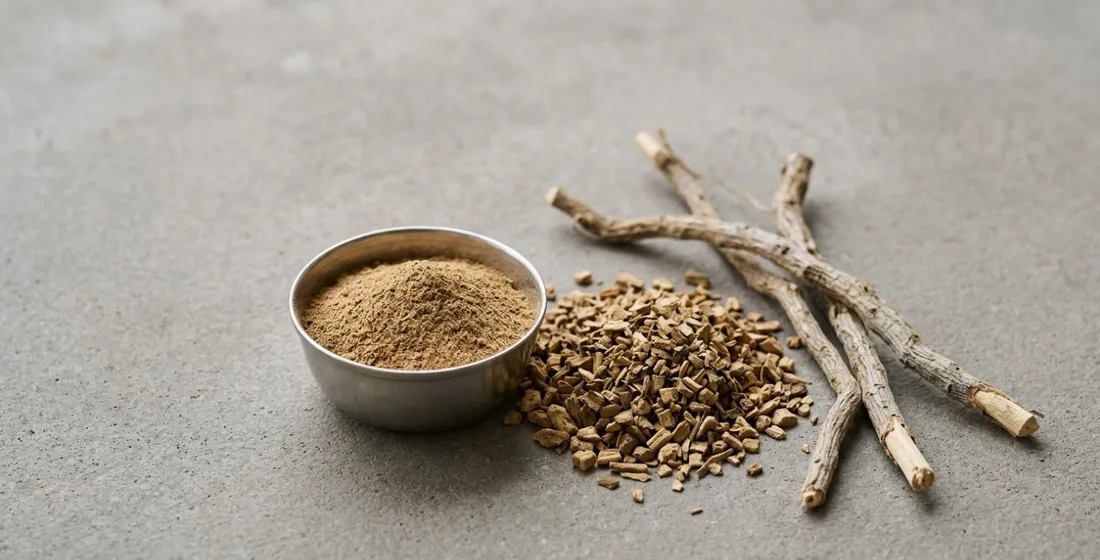
Iramusu trades in two main formats. Fine root powder suits capsules, stick-pack premixes, and instant beverage bases. A 1 to 2 mm tea cut suits tea bags, loose infusions, and cold-brew or decoction beverage extraction. Format decides extraction behaviour, sediment load, and dosing accuracy more than it changes the chemistry. Silk Foods Ceylon mills and cuts both on its spice and herb line at 100 to 200 kg per hour.
Powder is the format for two-piece capsules, smoothie and functional-powder blends, and instant cordial bases where the root is consumed or fully dispersed. A finer mesh improves capsule fill uniformity and premix dispersibility, at the cost of more fines and a heavier sediment load in a clear drink. For brands taking the capsule route, capsule MOQ economics decide whether a first run pencils out. Tea cut is the format for tea bags, loose-leaf infusions, cold brew, and decoction-style cordials where the root is steeped and strained. A coarser cut extracts cleaner, drops less sediment, and suits a clear or lightly hazy beverage.
| Format | Typical applications | Why it fits |
|---|---|---|
| Root powder | Two-piece capsules, stick-pack premixes, smoothie and functional-powder blends, instant cordial bases | Full dispersion and accurate dosing; a finer mesh improves capsule fill and premix uniformity |
| Tea cut (1 to 2 mm) | Tea bags, loose infusions, cold brew, decoction-style cordials | Cleaner extraction with less sediment; suits a clear or lightly hazy beverage |
Table 2. Iramusu format selection by application. Source: Silk Foods Ceylon production data.
What to put in an Iramusu sourcing RFQ
A defensible Iramusu RFQ names the botanical (Hemidesmus indicus root), the format and mesh or cut, moisture and ash ceilings, a full microbial panel, a heavy-metals panel, and a pesticide-residue panel matched to the destination market. Silk Foods Ceylon ships a Certificate of Analysis on every batch and tests to the buyer’s specific parameters on request.
Buyer’s checklist: specifying Iramusu
- Botanical identity confirmed in writing as Hemidesmus indicus root, not Smilax and not Decalepis hamiltonii
- Format and particle size: powder mesh, or tea cut dimension (for example 1 to 2 mm)
- Moisture and total ash ceilings
- Microbial panel: total plate count, yeast and mould, Salmonella, E. coli
- Heavy-metals panel (lead, arsenic, cadmium, mercury) by ICP-MS, with limits matched to the destination market
- Pesticide-residue panel aligned to the destination-market MRLs
- Foreign matter and the root-versus-stem fraction
- Per-batch Certificate of Analysis, plus an organic transaction certificate where the SKU is USDA Organic or EU Organic
Heavy metals are the contaminant that most often pulls Ayurvedic botanicals off US shelves. The FDA has linked certain unapproved Ayurvedic products to lead, mercury, and arsenic exposure and lists offending products through its import-alert system (US FDA, 2024). For a root crop like Iramusu, a per-batch lead result by ICP-MS is the test a US or EU buyer’s own auditor will expect to see.
Can you label Iramusu as sarsaparilla in a US beverage?
The US FDA flavouring regulation, 21 CFR 172.510, lists sarsaparilla as Smilax species only: Smilax aristolochiaefolia, S. regelii, S. febrifuga, and undetermined Smilax spp. Hemidesmus indicus is not named in that entry. A brand using Iramusu should not assume the sarsaparilla flavouring listing covers it, and should confirm its own regulatory basis for the intended use and market.
This is a labelling and substantiation question, not a quality one. Iramusu has a long food-use history in South Asia, and the root sells as a dietary botanical and a beverage base, but the specific FDA flavouring entry for sarsaparilla points at Smilax. The cleaner path is to name the botanical, “Indian sarsaparilla (Hemidesmus indicus), Iramusu,” and let the regulatory team match the use, whether as a flavour, a dietary ingredient, or a tea, against the destination market’s rules. The naming discipline that protects the spec also protects the label.
What the evidence does and does not support
Adaptogen is a marketing-category term, not a regulatory one, and Iramusu is not a classically defined adaptogen. Its documented positioning is as a cooling tonic and a blood-purifying root, and the modern pharmacology, anti-inflammatory, antioxidant, hepatoprotective, and antimicrobial activity, sits mostly at the in-vitro and animal stage (Journal of Ethnopharmacology, 2020). Human clinical evidence is limited.
For a wellness or nutraceutical brand, that means a structure-function claim has to be written for the finished product and substantiated, not borrowed from the herb’s traditional reputation. The same discipline applies across the cabinet, from gotukola for cognitive SKUs to gurmar for blood-sugar SKUs. Iramusu earns its place in a formula on flavour, heritage narrative, and a clean contaminant profile. The clinical story is still early, and the honest brief says so.
Sourcing Iramusu from Sri Lanka
Silk Route Ventures supplies Iramusu root powder and tea cut from the Silk Foods Ceylon facility in Matale, the historic spice-and-herb belt at the geographic centre of Sri Lanka. The site is audited to BRCGS and FSSC 22000 V6, runs its herb line at 100 to 200 kg per hour, and holds a 50 kg first-order MOQ per SKU with a Certificate of Analysis on every batch.
Most Iramusu is wild-collected or smallholder-grown across South Asia, which makes traceability and contaminant control the binding sourcing constraints, not availability. Before a first order, it is worth knowing how to evaluate a Sri Lankan supplier on documentation rather than price alone. SFC mills the root to powder and cuts the tea grade in-house under one audit, ships door-to-door samples by international courier in 3 to 5 business days, and runs production to dispatch in 2 to 3 weeks. A standardized 2-hydroxy-4-methoxybenzaldehyde extract is a separate, sourced-to-spec request rather than an installed line; whole-root powder and tea cut carry the intact aroma profile most beverage and supplement briefs need.
Frequently asked questions
Is Iramusu the same as sarsaparilla?
No. Iramusu is Hemidesmus indicus, family Apocynaceae. True or Jamaican sarsaparilla is a Smilax species, family Smilacaceae (Journal of Ethnopharmacology, 2020). They share an English name, not a botany or an aroma chemistry, so any spec or label should carry the botanical name.
What gives Iramusu root its flavour?
One compound: 2-hydroxy-4-methoxybenzaldehyde, reported at about 91% of the root’s volatile oil and a positional isomer of vanillin (Flavour and Fragrance Journal, 2001). It gives Iramusu a sweet, woody, vanilla-adjacent aroma, which is why the root works as a cordial and beverage base as well as a supplement ingredient.
Can I label Iramusu as sarsaparilla on a US drink?
Treat it with care. The FDA flavouring listing 21 CFR 172.510 names Smilax species for sarsaparilla, not Hemidesmus indicus. A brand using Iramusu should confirm its own regulatory basis for the use and market, and the safer route is to name the botanical (Indian sarsaparilla, Hemidesmus indicus) on the spec and label.
Does Silk Route Ventures supply bulk Iramusu and private-label capsules?
Yes. Silk Foods Ceylon supplies Iramusu powder and tea cut at a 50 kg first-order MOQ per SKU, plus private-label Iramusu capsules at a 180-bottle MOQ, from a BRCGS and FSSC 22000 V6 audited facility in Matale, with a Certificate of Analysis on every batch and USDA Organic or EU Organic on the relevant SKUs.
How Silk Route Ventures can help
Silk Route Ventures (SRV) supplies bulk Iramusu (Hemidesmus indicus) and other Ayurvedic and functional botanicals, including moringa, triphala, ashwagandha, gotukola, and gurmar, to wellness and beverage brands globally. The Silk Foods Ceylon (SFC) facility is audited to BRCGS and FSSC 22000 V6, with FSSC 22000 V6 covering encapsulation and USDA Organic and EU Organic on the relevant SKUs. Bulk RM MOQ is 50 kg per SKU; private-label Iramusu capsules run at a 180-bottle MOQ; samples ship door-to-door by international courier in 3 to 5 business days. For early-stage brands without a co-packer, the SRV R&D and NPD team also develops custom blends and beverage bases in-house. Contact us to send an inquiry or request a sample. Certifications, MOQs and lead times are listed on our Sri Lankan herbs supplier.