
Ceylon Cloves: Whole, Powder, Tea Cut, or Pyramid Cut for Formulators
Buyer’s snapshot
- A whole clove bud carries roughly 15 to 20 percent volatile oil, and eugenol makes up 75 to 85 percent of that oil (peer-reviewed clove composition data, 2018). The format you buy decides how much of that survives to your finished product.
- In 2024, Asia supplied 65.6 percent of the world’s clove export value, and the top five exporters moved 87.5 percent of traded volume (World’s Top Exports, 2024). Format and grade, not headline price, are where a specialty buyer actually competes.
- Whole bud, ground powder, tea cut, and pyramid cut are four different specs with four different shelf-life and process consequences, not four labels for one product.
- Silk Foods Ceylon (SFC) supplies hand-picked Ceylon cloves as whole No.1 bud, powder, tea cut, and pyramid cut from a Matale facility under BRCGS and FSSC 22000 V6, at 50 kg first-order MOQ per format.
- This post is the format-selection spec for spice formulators, tea blenders, and private-label brand owners. For lowest-shelf commodity ground clove, a high-volume Indonesian processor is the more honest answer.
Most procurement briefs for clove still say one word: “cloves.” Then the sample arrives, the formulation team grinds it, the aroma reads thin against the reference, and the supplier qualification call reopens. The problem usually isn’t the origin. It’s that whole bud, powder, tea cut, and pyramid cut were treated as interchangeable when they behave like four separate raw materials. This piece is the format-selection spec, one slice of sourcing Ceylon spices, for buyers who want to put the right one in the next RFQ.
What format of clove should a spice formulator actually buy?
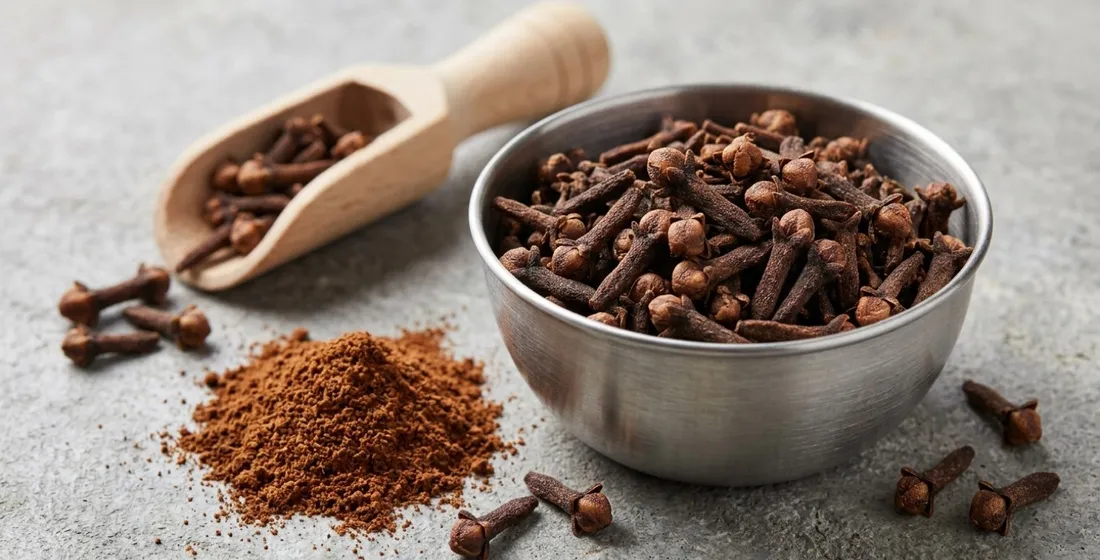
Clove is the dried, unopened flower bud of Syzygium aromaticum, and ISO 2254:2004 is the international specification that defines whole and ground clove for trade (International Organization for Standardization, 2004). The format decision comes down to four options: whole bud for maximum aroma retention and visible quality, ground powder for direct dosing into blends, tea cut for controlled infusion, and pyramid cut for premium sachet tea where visible botanical pieces matter. Each carries a different volatile-oil retention curve and a different shelf life.
The starting point is the application, not the price sheet. A bakery or sauce formulator dosing clove at a fraction of a percent needs powder that disperses without specking. A whole-spice retail brand needs intact No.1 buds with the four-headed nail shape and round head still attached. A tea blender splitting the difference needs a cut that releases flavor in a short steep without throwing dust through the bag seam. Specifying the format up front saves the requalification loop that an open “cloves” brief almost guarantees.
Why whole clove buds hold their eugenol better than powder
A whole clove bud is a sealed package. The volatile oil that carries the aroma, 15 to 20 percent of the bud by steam-distillation yield with eugenol at 75 to 85 percent of that oil, stays locked inside intact plant tissue until the bud is broken (Volatile Composition and Antioxidant Properties of Clove Products, BioMed Research, 2018). Grinding ruptures that structure, exposes the oil to air, and starts the clock on aroma loss. Ground clove also shifts in profile: eugenol still dominates, but the heavier, less volatile beta-caryophyllene becomes more prominent in the headspace as the lighter notes escape first.
For a buyer, that physics has a direct procurement consequence. Whole buds tolerate longer storage and longer supply lead times with less spec drift. Powder is more convenient on the production line but demands a tighter shelf-life window, protective packaging, and ideally a nitrogen flush or foil-laminate barrier to slow the loss. The honest version of a clove powder spec names a minimum volatile-oil content on arrival and a retest cadence, with mesh size as only one line of the spec. Buy powder for convenience, but pay for it with packaging and turnover discipline.
Spec snapshot: Ceylon clove formats
- Botanical: Syzygium aromaticum, hand-picked, sun-dried
- Whole bud: No.1 hand-picked selected, four-headed nail shape, low stem and headless fraction
- Volatile oil (whole bud): typically 15 to 20 percent
- Powder: dosed to a mesh spec, volatile-oil minimum stated on arrival, foil-barrier pack
- Tea cut: coarse particle for short-steep infusion, controlled dust
- Pyramid cut: larger visible pieces for transparent pyramid sachets
- SRV MOQ: 50 kg per format, first order; COA per batch
Matching clove format to application and shelf life
The table below maps the four formats to the buyer profile, the application, and the shelf-life reality. It is the comparison most “cloves” briefs skip.
| Format | Best-fit application | Volatile-oil retention | Practical shelf life | Best-fit buyer |
|---|---|---|---|---|
| Whole bud (No.1) | Whole-spice retail, mulling blends, brining, visible-quality SKUs | Highest, oil sealed in intact bud | Longest of the four | Specialty spice brand, retail packer |
| Ground powder | Baking, sauces, seasoning blends, curry powder, beverages | Lowest, oil exposed on grinding | Shortest, needs barrier pack and turnover | Blend formulator, CPG manufacturer |
| Tea cut | Tea bags, chai blends, infusion sachets, short-steep extraction | Moderate, controlled particle | Medium | Tea blender, beverage co-packer |
| Pyramid cut | Premium transparent pyramid sachets, whole-leaf-style tea | Moderate to high, larger pieces | Medium to long | Premium tea brand, gifting and HORECA |
Source: SRV facility format data plus ISO 2254:2004 clove specification, 2024 to 2026.
Read the table as a spec-writing tool. A curry-powder private-label run wants powder with a stated volatile-oil floor. A premium chai brand selling through transparent pyramid bags wants pyramid cut, because the visible clove piece is part of what the shopper is paying for. Forcing one format across all of those applications is where margin and quality both leak.
Tea cut versus pyramid cut: choosing a clove format for infusions
Tea cut and pyramid cut both serve infusion, but they answer different briefs. Tea cut is a coarse, controlled particle sized for the short steep of a standard tea bag, releasing flavor quickly while keeping fine dust low enough to protect the bag seal and the cup clarity (ISO 2254:2004 frames the particle and extraneous-matter limits buyers reference). Pyramid cut is larger and deliberately visible, made for the transparent pyramid sachet where the shopper sees whole-leaf-style botanicals through the mesh.
The decision is half sensory, half merchandising. A mass tea bag hides its contents, so tea cut optimizes for extraction and free flow on a high-speed bagging line. A premium pyramid sachet sells the look, so the clove piece has to read as a recognizable, hand-quality botanical, not a crumb. A blender choosing between them is really choosing between extraction speed and shelf appeal, and the right answer follows the pack format, not the other way around.
What makes hand-picked Ceylon cloves different at the spec level
Ceylon cloves are hand-picked and sun-dried, and the top grade trades as HPS, Hand Picked Selected, with a high oil content and a low stem and headless fraction (Sri Lanka Export Development Board, 2024). That matters because much of the world’s clove volume is harvested and dried for scale rather than for intact-bud quality. Sri Lanka holds only about 4 percent of global clove export value, so the country competes on grade and oil content, the same grade-over-price logic that shapes Ceylon cinnamon and Ceylon black pepper sourcing, not on undercutting Madagascar or Indonesia on price. As with cardamom grading, the grade name alone is not the spec; the oil content and stem ceiling are.
The trade structure explains why. Indonesia grows the majority of the world’s cloves, more than 60 percent of global production, yet exports only a small share because its domestic clove cigarette industry absorbs most of the crop (World’s Top Exports and Tridge trade data, 2024). Madagascar was the largest clove exporter in 2024. Against that backdrop, a Ceylon buyer is paying for hand-picked selection and oil content, which is exactly the spec a whole-bud retail brand or a high-eugenol formulator needs.
In the first quarter of 2026, the Silk Route Ventures (SRV) trade desk fielded the same correction three times in a month: a US seasoning brand had bought “cloves” on price, received a stem-heavy mixed grade, and watched its whole-spice jar fail its own visual standard on the retail shelf. The fix each time was not a new origin. It was writing the grade and the format into the spec, hand-picked No.1 whole bud with a stated stem ceiling, so the sample and the production lot finally matched.
How microbial treatment changes the clove format decision
Whole spices carry a real pathogen risk, and microbial reduction method is part of the format decision, not a separate technicality. Steam, irradiation, and fumigation are the main industry methods, and thermal treatment can strip the very volatile oils that make clove valuable (Institute of Food Technologists, microbial loads in spices). For a high-oil spice, the treatment choice and the format interact directly.
Destination market sets the constraint. The United States permits ethylene oxide treatment within a residue tolerance, while the European Union does not approve ethylene oxide and relies on steam treatment for microbial reduction (US EPA, ethylene oxide regulation under FIFRA). A buyer shipping clove powder into the EU has to plan for steam-compatible handling and the destination’s pesticide MRL rules, and accept some volatile-oil trade-off, which is one more reason whole bud, treated and held intact, often protects aroma better than a powder that has been heat-treated and then ground. Specify the treatment alongside the format, and the COA stops surprising the quality team.
Frequently asked questions
Which clove format keeps the most flavor, whole or ground?
Whole clove buds retain the most flavor. The volatile oil, 15 to 20 percent of the bud with eugenol at 75 to 85 percent of that oil, stays sealed inside intact tissue until grinding (BioMed Research clove composition study, 2018). Ground clove is more convenient to dose but loses aroma faster and needs barrier packaging and quicker turnover to hold its spec.
What is the difference between clove tea cut and pyramid cut?
Tea cut is a coarse, controlled particle sized for fast extraction in a standard tea bag while keeping dust low. Pyramid cut is larger and visible, made for transparent pyramid sachets where the shopper sees the botanical piece. ISO 2254:2004 frames the particle and extraneous-matter limits buyers reference for both (ISO, 2004).
What grade of Ceylon clove should I specify?
For whole-bud retail and high-oil formulation, specify hand-picked No.1, traded in Sri Lanka as HPS, Hand Picked Selected, with a stated stem and headless ceiling and a volatile-oil floor on the COA (Sri Lanka Export Development Board, 2024). Naming the grade and the format is part of how buyers evaluate a Sri Lankan supplier and prevents the stem-heavy mixed-grade substitution that an open “cloves” brief invites.
Does Silk Route Ventures supply private-label and bulk cloves to US and EU brands?
Yes. Silk Route Ventures supplies hand-picked Ceylon cloves as whole bud, powder, tea cut, and pyramid cut from the BRCGS and FSSC 22000 V6 audited Silk Foods Ceylon facility in Matale, at 50 kg first-order MOQ per format with a COA on every batch. Bulk ingredient supply and private-label packing both run from the same site.
How Silk Route Ventures can help
Silk Route Ventures supplies hand-picked, single-origin Ceylon cloves to specialty spice brands, tea blenders, and formulators across the US, EU, and Australia. Bulk raw material ships against the buyer’s spec from the BRCGS and FSSC 22000 V6 audited Silk Foods Ceylon facility in Matale, in whole No.1 bud, powder, tea cut, or pyramid cut, with a COA on every batch. First-order MOQ is 50 kg per format, and samples ship door-to-door by international courier in 3 to 5 business days. For brands ready to launch a whole-spice jar or a clove-forward tea under their own label, SRV runs private-label packing from the same site. Contact us to send an inquiry or request a sample pack.