
Dried Orange and Lemon Peel: Cuts and Powders for Tea and Bakery
By the Silk Route Ventures Trade Team | 18 October 2026
Buyer’s snapshot
- Dried peel reaches a blender in four working formats: coarse or whole pieces, fine cut, tea-bag cut and powder. The format decides how fast the oil reaches the cup or the batter, not how good the fruit was.
- A published US tea-cut orange peel sheet (Spices, Inc., October 2025) sets moisture at 10% maximum, 7% maximum over a US #10 sieve and 15% maximum through a #40. That is what a tea-cut spec looks like.
- The European Commission’s 2025 guidance says no EU list of processing factors exists, so a dried peel lot is judged against the fresh citrus MRL multiplied by a drying factor.
- Silk Route Ventures (SRV) supplies orange peel in dehydrated, fine-cut, tea-bag-cut and powder formats and lemon peel in coarse-cut, tea-bag-cut and powder formats, with a first-order MOQ of 100 kg per SKU and trial quantities from 10 kg.
- This is for tea blenders, bakers and distributors writing a peel RFQ. It is not for buyers who choose peel on lowest landed price alone.
Most peel RFQs read “dried orange peel, 500 kg” and stop there. That sentence leaves four decisions with the supplier: how the peel is cut, how dry it is, how much white pith rides along, and how the residue limits are read. Each one changes the ingredient. A coarse piece built for a mulled-drink pack behaves nothing like a fine powder that disappears into a cake crumb. This piece sets out the four formats, the numbers that carry the aroma, and the residue question buyers most often get wrong.
What are the working formats for dried orange and lemon peel?
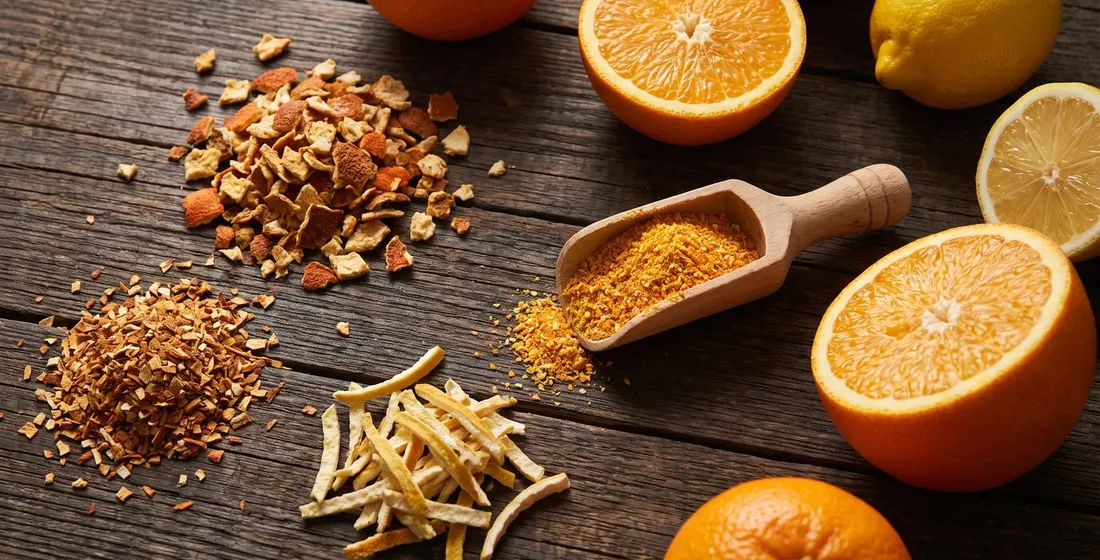
Four formats cover almost every peel application: coarse or whole pieces, fine cut, tea-bag cut and powder. Silk Route Ventures lists orange peel as dehydrated pieces, fine cut, tea-bag cut and powder, and lemon peel as coarse cut, tea-bag cut and powder, each supplied in bulk and for private-label fill. Cut size sets extraction speed and visual impact, so it belongs on the spec as a sieve window, not as an adjective.
| Format | What it is | Best-fit use | What to write on the spec |
|---|---|---|---|
| Coarse cut or dehydrated pieces | Larger dried pieces with visible zest flecks | Mulled drinks, syrups, stocks, loose-leaf blends where the peel is meant to be seen | Piece-size window, colour range, pith limit |
| Fine cut | Small, even pieces that release oil quickly | Tea mixes, spice blends, marinades, cake batters | Sieve window, fines ceiling |
| Tea-bag cut | Uniform grade sized for fast, even steeping and consistent filling | Fruit and herbal infusions, tea-bag and pyramid formats | Sieve window, fines ceiling, moisture |
| Powder | Finely milled peel in a dry, free-flowing form | Bakery premixes, seasonings, beverage mixes, confectionery | Mesh or sieve spec, moisture, anticaking if any |
Cut standards for peel are bilateral between buyer and supplier rather than set by a single ISO or Codex text. The Spices, Inc. sheet for dried orange peel (Citrus sinensis) shows the pattern: “Tea Cut - 10/40” means no more than 7% retained on a US #10 sieve (2.00 mm) and no more than 15% passing a US #40 sieve (0.425 mm), with moisture at 10% maximum and a minimum 12-month shelf life under cool, dry storage. A blender copying that structure with its own numbers has a spec any two suppliers can quote against. The tisane buyer’s guide covers how cut ranges and fines ceilings get agreed across botanicals.
How dry should dried peel be, and what does drying do to the oil?
Dry peel to about 10% moisture, not as low as the dryer will go. A 2016 study in the International Journal of Food Engineering (Marey and Shoughy) dried citrus peel in a hot-air dryer at 40 to 70 C and found the best balance at 50 to 60 C and a final moisture of 10 +/- 0.2% wet basis. Over-drying to 5.4% at higher temperatures sharply increased the loss of essential oils, vitamin C and carotenoids.
That cuts against the procurement instinct to write the lowest possible moisture into the spec. A ceiling protects against mould and caking, and 10% maximum is a sensible one. A target set near the floor can push a processor toward harder, hotter drying, and the aroma is what pays. The spec line that works is a ceiling plus a question: ask for the drying temperature range and the final moisture on the certificate of analysis.
Drying method shifts the oil profile less than people expect. In a 2020 comparison on Thomson navel orange peel in Food Science and Nutrition (Farahmandfar and colleagues), limonene made up 71.5% of the oil in fresh peel and between 76.3% and 81.9% across freeze, vacuum, oven, microwave, shade and sun drying. The limonene share barely moves between conventional methods, so the lever worth pulling is final moisture and storage, not exotic drying.
Two ways peel specs go wrong: pith and packaging
Two lines on the spec sheet catch the failures that the numbers above do not. The first is pith. Aroma lives in the coloured outer zest, while the white layer underneath adds weight and a dull bitterness. A lot with heavy pith carries less citrus per kilogram and tastes flat in the cup. Ask for a visual pith limit agreed on a sample before the order, since pith is not a number most suppliers report by default. The same applies to colour: dried orange peel ranges from light to dark orange and brown, and a colour window agreed on a retained sample prevents argument at the dock.
The second is packaging. Dried peel is hygroscopic, so a lot that passes at 10% moisture in Matale can drift upward through a humid sea freight leg if the liner is wrong. Specify a food-grade liner inside the outer case and state the net case weight. Powder is the most exposed format, because its surface area is the largest.
Spec snapshot (tea-bag-cut peel, buyer-written)
Product: dried orange peel or dried lemon peel, tea-bag cut Cut: sieve window agreed per pack (for example no more than 7% over US #10, no more than 15% through US #40) Moisture: 10% maximum, with drying temperature range and final moisture reported on the COA Pith and colour: visual limits agreed on a retained sample Residues: reported against the EU fresh citrus MRL with a stated drying factor Packing: food-grade liner inside the outer case, net case weight stated
How do EU MRLs apply to dried citrus peel?
EU residue limits apply to dried peel through the fresh fruit limit and a drying factor, and no official list of factors exists. Article 20 of Regulation (EC) No 396/2005 says that where no MRL is set for a processed product, the limit for the raw commodity applies, adjusted for the changes processing causes. The Commission’s information note on that article, SANTE/10704/2021 Rev 1, confirms that the Commission has not used its power to publish an Annex VI of processing factors.
Here is where it bites in practice. The Commission’s revised note of 19 March 2025 is plain about the consequence: there is no figure to look up. It describes a drying factor as the dry matter of the dried commodity divided by the dry matter of the starting material, takes dry matter values from the producer, and multiplies the unprocessed MRL by that factor. Because residues can degrade during drying, it treats the factor as a starting point, not a guarantee.
A worked example, with illustrative figures only: if fresh peel sat at 25% dry matter and the dried lot at 90% (10% moisture), the factor is 3.6, and a fresh-fruit MRL of 0.1 mg/kg becomes 0.36 mg/kg on the dried lot. Real values vary by fruit and process, so ask the supplier for the dry matter of the starting peel and the finished lot, and agree with your own laboratory which factor it applies. That conversation belongs before the first order, not after a border test. For how to read the residue panel once it arrives, the guide to per-lot heavy metal and pesticide testing walks through a COA line by line, and the broader EU botanical sourcing rules piece covers where MRL and novel food rules bite.
Using peel in tea blends and in bakery
Peel earns its place in a blend by lifting the top note, and in a bake by adding aroma and fibre at low inclusion. In tea, a fine or tea-bag cut sits alongside hibiscus, rooibos, cinnamon and other fruit pieces; the hibiscus cut grades guide covers the colour and acidity side of that same blend. A coarse piece steeps slowly, while a heavy fine fraction clouds the cup.
In bakery the question is inclusion rate. Marey and Shoughy tested cakes made with 15% dried orange or mandarin peel, dried to 10% moisture, and found them highly acceptable, with dietary fibre, crude fat and ash up and protein and total carbohydrate slightly down. Powder suits that use because it disperses through a batter without flecks, while a fine cut gives a visible zest speckle. Peel powder also pairs with the sour notes in lime and black lime powder for beverage bases, and bakers wanting a visible fruit piece can compare the dried mango formats.
Silk Route Ventures (SRV) supplies orange peel in tea-bag cut, alongside lemon peel in tea-bag cut, from the Silk Foods Ceylon (SFC) facility in Matale, 1 km from Nalanda Gedige, where the site holds BRCGS and FSSC 22000 V6. Certification scope is confirmed per SKU on request, so a distributor already buying spices from SRV’s Ceylon spice range adds peel without opening a second supplier file.
Where SRV’s pricing doesn’t fit
If dried peel is bought as an undifferentiated commodity on landed price, and neither the cut window, the drying temperature, the pith limit nor the residue reporting changes the buying decision, a high-volume citrus processor will beat SRV on price. SRV is built for buyers who write a spec and want it held lot after lot.
Writing the peel RFQ
A defensible peel RFQ names the ingredient tightly enough that any two suppliers quote the same thing. Eight lines cover it.
- Fruit and species (sweet orange or lemon) and, if it matters to the label, the origin.
- Format: coarse, fine, tea-bag cut or powder.
- Particle window as a sieve spec (percent over and through named sieves).
- Moisture ceiling at 10% maximum, plus drying temperature range reported on the COA.
- Pith limit, colour window and a retained sample for both.
- Residue reporting: the destination-market MRL, the stated drying factor and the laboratory method.
- Microbiology limits for the destination market (for example total plate count, coliform, E. coli, Salmonella).
- Packing: liner, case weight and shelf-life target, with a minimum of 12 months as the reference point.
FAQ
What is the difference between fine cut and tea-bag cut peel? Both are small dried pieces, but tea-bag cut is graded to a tighter, uniform window so it fills pyramid and round bags evenly and steeps predictably. Fine cut is sized for fast oil release in tea mixes, spice blends and batters, where filling consistency matters less. The spec for either is a sieve window, such as 7% maximum over a US #10 sieve.
How do EU pesticide limits apply to dried orange or lemon peel? The EU applies the fresh citrus limit under Article 20 of Regulation (EC) No 396/2005, adjusted for processing. The Commission’s SANTE/10704/2021 Rev 1 note says no Annex VI list of factors exists, so buyers use a drying factor based on dry matter. Agree the factor with your laboratory before the first order.
Does SRV offer private label and contract manufacturing for dried peel? Yes. Silk Route Ventures supplies orange and lemon peel in bulk and for private-label fill from the BRCGS and FSSC 22000 V6 audited Silk Foods Ceylon facility in Matale. Standard SKUs dispatch in 2 to 3 weeks from purchase order, and private label or custom specifications take 4 to 6 weeks. Certification scope is confirmed per SKU.
What is the minimum order for bulk dried orange peel from Sri Lanka? The first-order MOQ is 100 kg per SKU, with trial quantities from 10 kg. Samples are free for evaluation (you cover the courier), and a certificate of analysis is available on request.
How Silk Route Ventures can help
Silk Route Ventures (SRV) consolidates dried fruit peel, spice, herb, coconut and tea-format supply under one supplier, one certification set (BRCGS and FSSC 22000 V6, with USDA Organic and EU Organic on selected SKUs, confirmed per SKU) and one set of customs documents for distributors and blenders running multi-category programmes. Orange and lemon peel ship in bulk from the Silk Foods Ceylon (SFC) facility in Matale against the buyer’s written spec, with a first-order MOQ of 100 kg per SKU, trial quantities from 10 kg and free evaluation samples (you cover the courier). Standard SKUs dispatch 2 to 3 weeks from purchase order; private label and custom specifications take 4 to 6 weeks. Contact us to send an inquiry or request a sample, and see the Ceylon spices supplier page for certifications and lead times.
Sources
- European Commission, Directorate-General for Health and Food Safety, “Information note on Article 20 of Regulation (EC) No 396/2005 as regards processing factors, processed and composite food and feed,” SANTE/10704/2021 Rev 1, 19 March 2025. https://food.ec.europa.eu/system/files/2022-02/pesticides_mrl_guidelines_proc_imp_sante-2021-10704.pdf (retrieved 18 October 2026).
- Marey, S. and Shoughy, M., “Effect of Temperature on the Drying Behavior and Quality of Citrus Peels,” International Journal of Food Engineering 12(7):661-671, 2016. https://doi.org/10.1515/ijfe-2015-0296 (retrieved 18 October 2026).
- Farahmandfar, R., Tirgarian, B., Dehghan, B. and Nemati, A., “Changes in chemical composition and biological activity of essential oil from Thomson navel orange (Citrus sinensis L. Osbeck) peel under freezing, convective, vacuum, and microwave drying methods,” Food Science and Nutrition 8:124-138, 2020. https://pmc.ncbi.nlm.nih.gov/articles/PMC6977496 (retrieved 18 October 2026).
- Spices, Inc., “Product Specification: Dried Orange Peel, Item 100350,” revised 22 October 2025. https://spicesinc.com/sites/default/files/2025-10/PS_100350.pdf (retrieved 18 October 2026).
Written by the Silk Route Ventures Trade Team. Silk Route Ventures (E-Silk Route Ventures (Pvt) Ltd) is a Sri Lankan B2B supply-chain operator for the Food, Beverage, Wellness, and Nutraceuticals sectors. The Silk Foods Ceylon manufacturing arm holds BRCGS and FSSC 22000 V6 certifications. Questions or to request a sample: info@esilkroute.com.lk.