
Ceylon Herbal Infusions and Tea-Bag Cuts: A B2B Buyer's Guide for Tisane Brands
Buyer’s snapshot
- Herbal tea was a USD 5.72 billion category in 2025, and Europe is its largest region at 36.43% of sales (Mordor Intelligence, 2026). The same region sets the strictest contaminant rules a tisane brand will meet.
- Under Commission Regulation (EU) 2020/2040, now carried in Regulation (EU) 2023/915, dried herbal infusions may carry no more than 200 µg/kg of pyrrolizidine alkaloids, and 400 µg/kg for chamomile, peppermint, lemon balm and a short list of others.
- “Tea-bag cut” is a trade term, not a standard. The millimetre range, the fines ceiling and the moisture limit have to be written into the contract.
- Silk Foods Ceylon supplies eight Ceylon botanicals in tea-bag or fine cut from a BRCGS and FSSC 22000 V6 audited facility in Matale, with a 50 kg first-order MOQ per SKU.
- This guide is for tisane brands and distributors building a Ceylon herbal range. For a lowest-price commodity infusion, it is not the right supplier.
A brand that launches a tisane usually starts with the blend: which botanicals, in what ratio, with what story on the pack. The ingredient brief tends to be one line per herb. Then the first lot arrives and the real questions begin. How fine is “tea-bag cut”? How much dust is acceptable? Does the lot clear the European limit for pyrrolizidine alkaloids? Which of the eight herbs in the blend is the one that fails a test? This guide is the category-level answer for Ceylon botanicals: which ones are available in tea-bag cut, how to specify the cut, and which contaminant checks tisanes attract more than almost any other product on a spice or herb line.
Which Ceylon botanicals come in tea-bag cut?
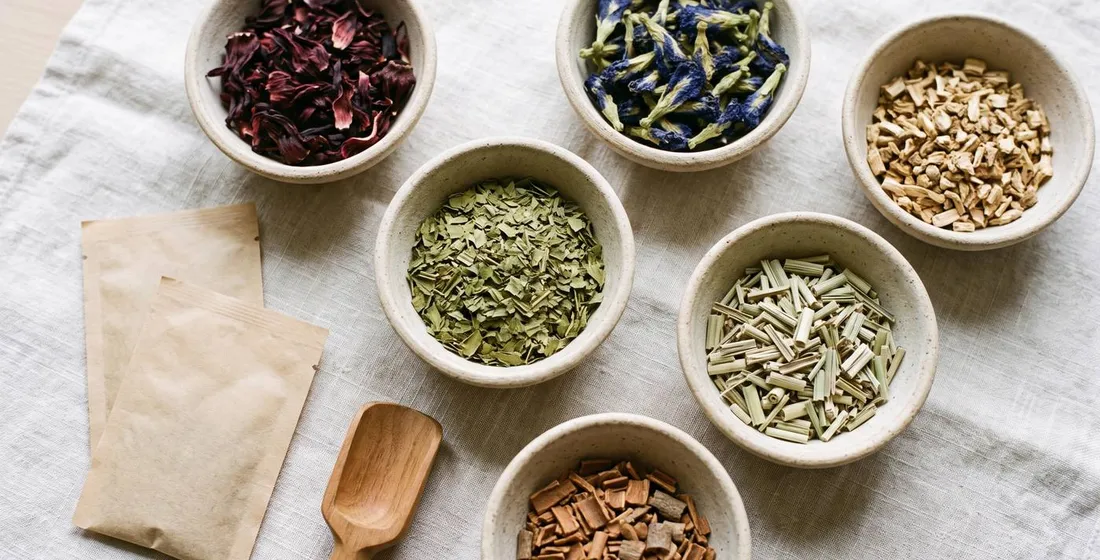
Silk Foods Ceylon (SFC) mills and cuts eight botanicals that suit a tisane range on its herb and spice line, which runs at 100 to 200 kg per hour. Each has a different plant part, a different failure mode and a different reason to be in a blend. Naming the plant part and the species on the RFQ is the first control, because common names collide: iramusu is not true sarsaparilla, and ornamental hibiscus is not roselle.
| Botanical | Plant part | Role in a tisane | What to specify or watch |
|---|---|---|---|
| Iramusu (Hemidesmus indicus) | Root | Sweet, earthy, faintly vanilla base | Species confirmed in writing; 1 to 2 mm tea cut; root ash and moisture ceilings |
| Gotukola (Centella asiatica) | Leaf and stem | Mild green, bitter finish | Soil-contact contaminants: heavy metals, microbial load, weed co-harvest |
| Moringa (Moringa oleifera) | Leaf | Green colour, grassy body | Fines ceiling, since leaf cuts shed dust; colour retention |
| Lemongrass (Cymbopogon citratus) | Leaf and stalk | Citral-driven lemon top note | Volatile oil floor by EN ISO 6571; moisture maximum 10% |
| Blue pea (Clitoria ternatea) | Flower | Colour, and the blue-to-purple shift when acid is added | Colour target; flower cut breakage |
| Hibiscus (Hibiscus sabdariffa) | Dried calyx | Red colour and tartness | Anthocyanin colour target and acidity |
| Ceylon cinnamon (Cinnamomum verum) | Bark | Warm, sweet spice | Species verification; coumarin result on the COA |
| Ginger (Zingiber officinale) | Rhizome | Pungent heat | Gingerol or oil target; moisture ceiling |
Seven of these have their own sourcing posts on this site. The hibiscus cut grades guide covers colour and acidity. The lemongrass spec primer sets out the European Spice Association minima. Iramusu is in the sarsaparilla sourcing spec, gotukola in the gotukola spec and evidence post, and moringa in the moringa leaf powder spec. Ginger has its own format guide, and the cinnamon grades sheet covers the bark. This post is the layer above them: what the eight have in common, and what a blend adds.
How is a tea-bag cut actually specified?
A tea-bag cut is a particle-size range, not a grade. Herbs for bagged tea are commonly cut between about US mesh #10 (2 mm) and #60 (0.25 mm), and “fine cuts” sit at roughly 0.315 to 2.00 mm (Frontiers in Pharmacology, 2022). No published standard defines the term, so the range belongs in the contract.
That matters more than it sounds. Cut size sets extraction speed, how the material meters on a bagging line, and how much dust ends up in the cup. A finer cut brews faster and gives a stronger first infusion, but it also generates fines that sift through filter paper and settle as sediment. A coarser cut shows the botanical and cold-brews cleanly, but it extracts slowly in a three-to-five-minute steep. The right answer depends on the bag, which is why cut and format are one decision and not two. The tea bag formats guide matches each bag construction to a cut range, and the same guide explains why a nylon pyramid is a regulatory problem in the EU from February 2028.
For the herb RFQ itself, six clauses do the work.
| Clause | What to write | Why it belongs in the contract |
|---|---|---|
| Species and plant part | Latin binomial and part, for example Centella asiatica, dried leaf and stem | Prevents common-name substitution |
| Cut range | Millimetre range, such as 1 to 2 mm, with the sieve method named | No standard defines “tea-bag cut” |
| Fines ceiling | A maximum percentage passing the finest sieve, agreed per botanical | Controls sediment and bagging-line dust |
| Moisture and water activity | Moisture ceiling by ISO 939; water activity of 0.65 or below | Governs shelf life and microbial growth |
| Extraneous matter | A ceiling of 2% by weight, no foreign object above 2 mm | Matches the ESA minima for herbs |
| Treatment | Whether microbial reduction, such as steam, is applied | Treated material falls outside the ESA document, so the spec becomes bilateral |
The moisture, extraneous matter and water activity figures come from the European Spice Association’s Quality Minima Document (Rev. 5, 2018), which sets dried lemongrass at 10% maximum moisture and recommends a water activity target of 0.65 for dried herbs. The document sets reference values for only a few herbs. For most of the botanicals above, including gotukola, blue pea and iramusu, every number is bilateral. That is not a gap in the supplier’s service. It is how the category works, and a buyer who writes the numbers down gets them.
Spec snapshot: a Ceylon herb in tea-bag cut Species and plant part: stated on every COA Cut: 1 to 2 mm range agreed per botanical Moisture: ISO 939, ceiling agreed per botanical (lemongrass 10% maximum) First-order MOQ: 50 kg per SKU Volume tiers: 500 kg, 1,000 kg and 2,500 kg per SKU Lead time: 2 to 3 weeks from PO to dispatch
Which contaminant checks do tisanes attract?
Tisanes attract contaminant checks that a bulk spice rarely meets, because the whole dried plant is infused and drunk. Pyrrolizidine alkaloids, heavy metals, pesticide residues and microbial load all need a per-batch result. The first of those has a legal limit that most herb buyers meet only after a lot has already failed.
On 1 July 2022, the European Union’s pyrrolizidine alkaloid limits began to apply to tea and herbal infusions. Before that date a tisane lot was judged on colour, aroma and a pesticide panel. After it, a lot above the limit stopped being a quality complaint and became a product that could not be placed on the market. The Commission’s own recitals concluded that tea and herbal infusions are the main contributors to human exposure to these compounds, drawing on the European Food Safety Authority’s 2017 statement on the risk to human health.
Pyrrolizidine alkaloids are produced by weeds such as Senecio and Heliotropium species. They are not a property of the herb itself. They arrive when a weed is cut and dried together with the crop, which is why leaf and aerial-part botanicals, harvested low to the ground, carry the most exposure. The limits in Regulation 2020/2040, now carried in Regulation (EU) 2023/915, are set on the dried product.
| Product category | Maximum, sum of listed alkaloids |
|---|---|
| Herbal infusions (dried product), general | 200 µg/kg |
| Rooibos, anise, lemon balm, chamomile, thyme, peppermint, lemon verbena and similar | 400 µg/kg |
| Tea (Camellia sinensis) and flavoured tea, dried | 150 µg/kg |
| Tea and herbal infusions for infants and young children, dried | 75 µg/kg |
The same regulation notes that for powdered instant extracts a concentration factor of four applies, so an extract is judged against a tighter effective limit. A tisane buyer building a children’s range should read the infant row twice.
The practical controls are agronomic and analytical. Ask for a pyrrolizidine alkaloid result on the dried herb, by a method that reports the full list of regulated compounds, and ask what the grower does about weed control and manual sorting before drying. A COA that reports heavy metals and pesticides but not pyrrolizidine alkaloids is incomplete for any leaf or aerial-part herb.
The other three checks are more familiar. Lead and cadmium results should be per batch, by a validated method, particularly for roots and leaves in direct soil contact. Pesticide residues are judged against the destination market, and in the EU the 0.01 mg/kg default maximum residue level applies wherever a specific limit is not set. Microbial results should include total plate count, yeast and mould, and Salmonella absence. Novel-food and traditional-herbal status also differ by botanical and by market, so confirm each herb’s standing in the launch market before the blend is finalised.
What does a tisane blend add to the specification?
A blend multiplies the specification, because every ingredient carries its own limits and the finished lot is only as compliant as its weakest herb. A single COA for a six-herb blend tells a buyer almost nothing. Per-ingredient results are the control, and blend uniformity is the next one.
Uniformity is a cut-size problem before it is anything else. When a heavy root piece and a light leaf fragment share a bag, the denser particles settle during transport and the first bags off a bagging line carry a different ratio from the last. Matching cut ranges across the herbs in a blend, so that their bulk densities sit close together, is cheaper than discovering the segregation in a retail complaint. Colour matters in the same way: blue pea and hibiscus give a blend its visible character, and both are sensitive to moisture and light in storage.
Three decisions are worth making early, before the first sample is requested.
- Blend at source or at the bagging line. Single-herb lots with their own COAs give the cleanest audit trail and let a brand re-ratio without a new minimum. A pre-blended lot is simpler to run but harder to trace back.
- Organic status per ingredient. USDA Organic and EU Organic apply to selected SKUs and qualifying lots, so a certified blend needs every component to be certified.
- Bag and cut together. Choose the bag format first, then ask for the cut range it needs.
Buyer’s checklist: qualifying a Ceylon tisane supplier
- Species and plant part confirmed in writing for every herb, by Latin binomial
- Cut range in millimetres, sieve method named, fines ceiling agreed per botanical
- Moisture by ISO 939 and a water activity target of 0.65 or below
- A per-batch pyrrolizidine alkaloid result on the dried herb for leaf and aerial-part botanicals
- Per-batch lead and cadmium by a validated method
- Pesticide panel aligned to the destination market
- Microbial panel: total plate count, yeast and mould, Salmonella absence
- Disclosure of any microbial reduction treatment
- Organic transaction certificate per lot where the SKU claims USDA Organic or EU Organic
- A sample dispatched against the written spec before any PO
Where Silk Route Ventures walks away
Briefs that want one certificate of analysis for an entire multi-herb blend, with no per-ingredient results, and briefs that treat per-batch pyrrolizidine alkaloid and heavy-metal testing as a cost to cut. A brand shopping hibiscus or gotukola on lowest price per kilo will find cheaper material from a reseller who does not test. For a tisane that carries a health-adjacent story, that is the more expensive lot.
Frequently asked questions
What is a tea-bag cut for herbal infusions?
A tea-bag cut is a particle-size range, usually about 0.3 to 2 mm, chosen so the herb extracts within a three-to-five-minute steep and meters cleanly on a bagging line (Frontiers in Pharmacology, 2022). No standard defines the term, so the buyer should write the millimetre range and fines ceiling into the contract rather than rely on the supplier’s label.
What is the EU limit for pyrrolizidine alkaloids in herbal tea?
Dried herbal infusions are limited to 200 µg/kg, and rooibos, anise, lemon balm, chamomile, thyme, peppermint and lemon verbena to 400 µg/kg (Commission Regulation (EU) 2020/2040, now carried in Regulation (EU) 2023/915). Dried tea made from Camellia sinensis is capped at 150 µg/kg, and products for infants and young children at 75 µg/kg.
Which Ceylon herbs can be supplied in tea-bag cut?
Silk Foods Ceylon cuts iramusu, gotukola, moringa leaf, lemongrass, blue pea flower, hibiscus calyx, Ceylon cinnamon and ginger for tisane use. Each ships with a per-batch COA, a 50 kg first-order MOQ per SKU and volume tiers at 500, 1,000 and 2,500 kg. Cut range, fines ceiling and moisture are agreed per botanical before the first order.
Does Silk Route Ventures offer private-label herbal tea bags?
Yes. Silk Route Ventures runs private-label herbal tea programmes from the Silk Foods Ceylon facility in Matale, including single-herb sachets and caffeine-free blends, in pyramid, round paper and string-and-tag formats. A custom blend moves from signed brief to approved formulation in 3 to 4 weeks at most, with production 2 to 3 weeks from PO to dispatch.
How Silk Route Ventures can help
Silk Route Ventures (SRV) supplies Ceylon herbs and spices in tea-bag cut, fine cut, coarse cut and powder to tisane brands and multi-category distributors across the US, EU and Australia, drawing on 47 herb SKUs from one certified site. The BRCGS and FSSC 22000 V6 audited Silk Foods Ceylon facility in Matale mills each botanical to the buyer’s written cut and moisture spec, with USDA Organic and EU Organic available on qualifying lots, a 50 kg first-order MOQ per SKU, and a COA on every batch. Samples ship by international courier in 3 to 5 business days, and sea freight runs 3 to 4 weeks to the EU and Australia and 4 to 5 weeks to the US. Distributors can consolidate several herb programmes into one supplier relationship, and brands without a formulation can use the R&D team for a custom blend. Contact us to send an inquiry or request a sample pack, or start with the Sri Lankan herbs supplier range and the iramusu tea-bag cut specification.