
Ceylon Cinnamon Grades: Alba to C5 Spec Sheet
Buyer’s snapshot
- SLS 81:2021 sorts Ceylon cinnamon quills into 13 grades on one primary variable, quill diameter, running from Alba at 6 mm maximum to H3 at 38 mm maximum (Sri Lanka Standards Institution).
- Grade is a physical spec, not a chemical one. The moisture, ash and volatile-oil limits are identical across the ladder, so paying up for Alba buys appearance, not assay.
- Cassia cinnamon averages roughly 3,000 mg of coumarin per kg and has been measured as high as 10,000 mg/kg (German Federal Institute for Risk Assessment). True Ceylon cinnamon sits far below the 0.02 percent ceiling most US and EU specs write in.
- Silk Foods Ceylon supplies quills and milled powder from Matale under FSSC 22000 V6, with a COA available on request and a 100 kg first-order MOQ per SKU.
- The grade ladder, the chemical table and the MOQ ladder below are written to be lifted straight into a sourcing brief.
Most cinnamon RFQs that reach a Sri Lankan exporter name a grade and stop there. Alba, or C5, or “best quality Ceylon.” The grade letter answers exactly one question, how thick the quill is, and it answers nothing about moisture, volatile oil, coumarin or heavy metals. Buyers who learn that early stop overpaying for a cosmetic parameter and start writing the four lines that actually govern the batch. This piece is the grade-by-grade spec sheet for US and EU procurement teams buying true Ceylon cinnamon (Cinnamomum verum) as quills or as powder. The species-level argument for Ceylon over cassia is already covered in the Ceylon cinnamon vs Vietnamese cassia comparison, and the RFQ wording itself in specifying Cinnamomum verum on a sourcing RFQ. What follows is the layer underneath both, and it sits inside the wider B2B buyer’s guide to Ceylon spices in 2026: the grade table.
What the Ceylon cinnamon grade letters actually measure
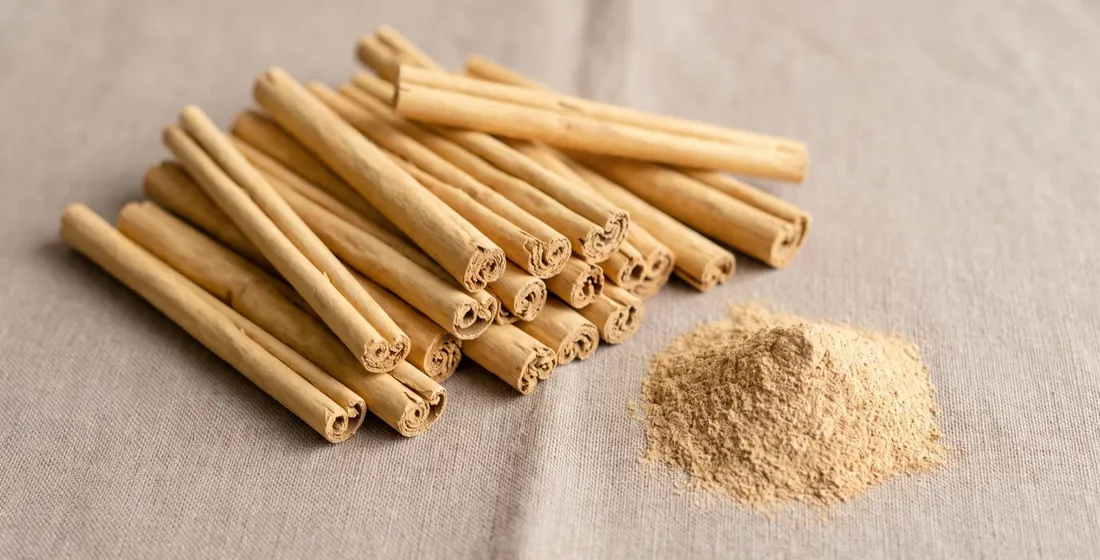
SLS 81:2021, the Sri Lanka Standards Institution specification for Ceylon cinnamon, classifies quills into 13 grades and grades them on three physical criteria: quill diameter, the number of whole quills per kilogram, and the extent of foxing (surface discolouration). Diameter is the driver. Alba is capped at 6 mm and H3 at 38 mm, with the quill count falling from a minimum of 45 per kg at Alba to 6 per kg at H3.
The ladder splits into two families. Continental grades (Alba through C3) carry a minimum permissible quill length of 200 mm in the bale. Hamburg grades (M5 special through H3) drop to 150 mm. The naming is a legacy of the two European entrepot markets that set the trade’s conventions, and it still governs how a bale is presented today.
| Grade | Family | Max quill diameter | Typical buyer use |
|---|---|---|---|
| Alba | Continental | 6 mm | Retail gift packs, visible garnish, top-tier tea and dessert SKUs |
| C5 extra special | Continental | 8 mm | Premium retail sticks, visible-format bakery |
| C5 special | Continental | 10 mm | Retail sticks, high-visibility applications |
| C5 | Continental | 12 mm | The workhorse export grade for whole-stick retail |
| C4 | Continental | 16 mm | Grinding stock where appearance still matters |
| C3 | Continental | 18 mm | Grinding stock, foodservice |
| M5 special | Hamburg | 16 mm | Bulk grinding, blends |
| M5 | Hamburg | 18 mm | Bulk grinding, blends |
| M4 | Hamburg | 21 mm | Bulk grinding, extraction feedstock |
| H1 | Hamburg | 23 mm | Extraction, oleoresin, bulk powder |
| H2 special | Hamburg | 25 mm | Extraction, oleoresin, bulk powder |
| H2 | Hamburg | 32 mm | Extraction, oleoresin, bulk powder |
| H3 | Hamburg | 38 mm | Extraction, industrial volume |
Diameter is a maximum, not a range, so each grade is bounded below by the grade beneath it. Foxing tolerance tightens as you climb. That is the entire logic of the ladder, and it explains why two lots with the same COA can sit four grades apart on price.
The chemical spec that sits under every grade
SLS 81:2021 sets four chemical requirements for Ceylon cinnamon quills, and they do not change as you move up or down the grade ladder: moisture at 14.0 percent maximum, total ash at 5.0 percent maximum, acid-insoluble ash at 1.0 percent maximum, and volatile oil at a minimum of 1.0 ml per 100 g. ISO 6539:2014 covers the same material internationally, for whole and ground cinnamon of the Sri Lankan, Madagascan and Seychelles types.
Those four lines are what a buyer should actually negotiate. Acid-insoluble ash is the one most RFQs omit and the one most worth holding: it is the practical proxy for sand and soil carried in from the drying yard, and a supplier who cannot hold 1.0 percent is telling you something about post-harvest handling that no grade letter will.
Volatile oil is the flavour line. A minimum of 1.0 ml per 100 g is the floor, not the target, and well-handled Ceylon quills usually clear it comfortably. Cinnamaldehyde is the dominant constituent in the bark oil, and it is also the compound that degrades first under heat and light in bulk storage. Specify the volatile-oil minimum against the point of delivery rather than the point of dispatch if the sea leg is long.
Ground cinnamon carries an additional parameter that whole quills do not: mesh. Most bakery and beverage formulators land somewhere between 40 and 80 mesh, and the choice interacts with the volatile-oil result, because finer milling raises surface area and accelerates loss. That trade-off deserves a line in the spec, not a phone call after the first container.
How much coumarin is in Ceylon cinnamon compared with cassia?
Coumarin is where the species question turns from botany into a procurement cost. The German Federal Institute for Risk Assessment reports that cassia cinnamon contains on average about 3,000 mg of coumarin per kg, with the highest measured levels reaching 10,000 mg/kg. True Ceylon cinnamon contains only low levels, frequently below the analytical detection limit in authenticated Cinnamomum verum samples. Both BfR and EFSA work to a tolerable daily intake of 0.1 mg of coumarin per kg of body weight per day.
Put that in spec language. The 0.02 percent ceiling that US and EU buyers commonly write into a cinnamon spec is 200 mg/kg. Cassia at its 3,000 mg/kg average sits fifteen times above that line. Authenticated Ceylon quills sit so far below it that the parameter functions as a species-authentication test rather than a quality threshold, which is precisely how a careful procurement team should use it.
The downstream limits are set by Regulation (EC) No 1334/2008, Annex III, which caps coumarin in finished foods at 50 mg/kg for traditional and seasonal bakery ware that references cinnamon on the label, 20 mg/kg for breakfast cereals including muesli, and 15 mg/kg for fine bakery ware. A formulator working with cassia has to model the inclusion rate against those ceilings. A formulator working with authenticated Ceylon cinnamon usually does not, which is a reformulation cost avoided rather than an ingredient premium paid.
“Ceylon Cinnamon” has been a registered EU Protected Geographical Indication since Commission Implementing Regulation (EU) 2022/144 took effect on 23 February 2022. The label phrase is legally reserved, and the production area is the whole island of Sri Lanka.
Which grade should you actually buy?
Here is the part most grade guides leave out. If the cinnamon is going to be milled, the grade letter stops mattering at the hammer mill. Diameter, quill count and foxing are visual and handling attributes. None of them survive grinding. A buyer paying an Alba premium for material destined for a spice blend, a capsule fill or an extraction run is paying for a cosmetic property that the process destroys.
The decision rule is short. Buy Continental grades when the quill is visible to the end consumer: retail sticks, gift packs, tea sets, plated dessert garnish. Buy Hamburg grades when the material is going into a mill, an extractor or a blend, and put the money you save into a tighter acid-insoluble ash limit and a fuller heavy-metals panel. Buy powder directly when the mill is not yours and the volatile-oil result at delivery is what you are underwriting. Capsule programmes are a separate case again, because the fill weight and the claim platform drive the spec rather than the format, as set out in cinnamon capsules for blood-sugar-claim SKUs.
Where this gets misread is in private-label programmes that span both. A brand running a whole-stick retail SKU alongside a ground SKU often specifies one grade across the range for procurement simplicity, then absorbs the Alba price on the ground line for years. Splitting the spec across two grades typically recovers more margin than any freight negotiation on the same volume. The mechanics of running a multi-SKU spice range sit in the private-label spice blend range guide.
Spec snapshot: true Ceylon cinnamon (Cinnamomum verum) Species: Cinnamomum verum, verified per shipment Origin: Matale and the Central Province growing belt, Sri Lanka Grades supplied: Alba through H2 quills (H3 on request), plus milled powder to buyer mesh Moisture: 14.0 percent maximum (SLS 81:2021) Volatile oil: 1.0 ml/100 g minimum (SLS 81:2021) Coumarin: specified below 0.02 percent, typically far lower First-order MOQ: 100 kg per SKU
What a Ceylon cinnamon COA should carry, and how often
On a Wednesday at the end of July 2024, the US FDA opened a public health alert on ground cinnamon products carrying elevated lead. The alert was still being updated in December 2025, by which point the listed products spanned lead concentrations from 2.14 ppm up to 10.7 ppm. It did not close. It kept growing. For a procurement team, that is not a news item, it is the new baseline question on every cinnamon supplier qualification call: what does your per-batch heavy-metals panel actually test, and who signs it.
A defensible Ceylon cinnamon COA carries the four SLS parameters, a species confirmation, a heavy-metals panel with a stated lead action level, and a pesticide residue panel aligned to the destination market. Cadence matters as much as content. Silk Foods Ceylon issues a COA on request, with heavy metals, pesticide residues and coumarin tested through an external laboratory on request against customer-specific parameters, and lots traceable from raw material intake to shipment through our batch coding. Reading one properly is its own discipline, covered in how to read a per-lot heavy metal and pesticide COA.
One line to add that most buyers forget: state your own lead action level in the spec. FDA has not set a numeric action level for lead in spices, so the number in your contract is the number that governs. Leaving it blank means inheriting whatever the supplier’s internal limit happens to be.
MOQ ladder and lead time for a Ceylon cinnamon order
First-order MOQ at Silk Foods Ceylon is 100 kg per SKU, and the per-SKU part is where launch budgets get misread. A brand launching Alba sticks, C5 sticks and ground cinnamon is running three SKUs, so the raw-material floor is 300 kg, not 100 kg. Volume pricing then breaks at 500 kg, 1,000 kg and 2,500 kg per SKU.
| Stage | Ceylon cinnamon, quills or powder |
|---|---|
| First-order MOQ | 100 kg per SKU |
| Volume price breaks | 500 kg, 1,000 kg, 2,500 kg per SKU |
| Samples | Free for evaluation (you cover the courier) |
| PO to dispatch | 2 to 3 weeks for standard SKUs (4 to 6 weeks for private label, custom specifications and organic orders) |
| Sea freight to the US | 4 to 5 weeks |
| Sea freight to the EU | 3 to 4 weeks |
| Documentation | Commercial invoice, packing list, bill of lading, certificate of origin, phytosanitary certificate where the destination requires it, COA on request, the organic import certificate the destination requires on organic SKUs |
Both organic programmes are available on the relevant cinnamon SKUs, and the choice between USDA Organic, EU Organic or both is a labelling decision rather than a sourcing one. The buyer’s guide to organic certifications sets out where dual certification pays back and where it does not.
Where SRV’s pricing does not fit Lowest-shelf-price retail. Mass-discount channels. Brands competing on per-unit invoice price below the Ceylon premium. For those briefs, cassia from a competent Vietnamese or Indonesian processor is the more honest answer than stretched Ceylon at a squeezed price.
Sri Lanka supplies roughly 80 percent of the world’s true cinnamon, and the price environment has moved sharply. Cinnamon and cinnamon-based products earned close to Rs. 80 billion in 2025, the highest annual figure on record, and Alba reached a record Rs. 7,000 per kg in May 2026, according to the Department of Cinnamon Development. Buyers holding a fixed annual Alba budget from two years ago should reprice before the next tender, or move the ground line down the ladder and keep the sticks where they are.
Frequently asked questions
What is the difference between Alba and C5 Ceylon cinnamon?
Alba and C5 are both Continental grades under SLS 81:2021 and differ on quill diameter: Alba is capped at 6 mm, C5 at 12 mm. The chemical requirements are identical, at 14.0 percent maximum moisture and 1.0 ml/100 g minimum volatile oil. Alba commands the premium on appearance and quill count, not on assay.
Does Ceylon cinnamon meet a 0.02 percent coumarin specification?
Yes, comfortably. A 0.02 percent ceiling equals 200 mg/kg. Authenticated Cinnamomum verum is frequently below the analytical detection limit, while cassia averages around 3,000 mg/kg and reaches 10,000 mg/kg at the top end, per the German Federal Institute for Risk Assessment. In practice the parameter works as a species-authentication check.
Which Ceylon cinnamon grade should be used for ground cinnamon?
Hamburg grades, typically M5 through H2. Diameter, quill count and foxing are visual attributes that do not survive milling, so an Alba premium is spent on a property the hammer mill destroys. The savings are better redirected into a tighter acid-insoluble ash limit and a fuller per-batch heavy-metals panel.
Does Silk Route Ventures supply bulk Ceylon cinnamon under USDA Organic and EU Organic?
Yes. Silk Foods Ceylon supplies quills across the Alba to H2 ladder (H3 on request) and milled powder to buyer mesh from its Matale facility, under FSSC 22000 V6, with USDA Organic and EU Organic on the relevant SKUs. First-order MOQ is 100 kg per SKU, and samples are free for evaluation (you cover the courier).
How Silk Route Ventures can help
Silk Route Ventures (SRV) supplies single-origin Ceylon cinnamon, with USDA Organic and EU Organic on selected SKUs, confirmed per SKU, to specialty brands across the US, EU and Australia, in quills from Alba through H2 (H3 on request) and in powder milled to the buyer’s mesh. Bulk raw material ships against the buyer’s spec from the BRCGS and FSSC 22000 V6 audited Silk Foods Ceylon (SFC) facility in Matale, with a COA available on request. First-order MOQ is 100 kg per SKU, and samples are free for evaluation (you cover the courier). For brands ready to launch a retail SKU under their own label, SRV runs end-to-end private label manufacturing from the same site. Contact us to send an inquiry or request a sample pack. For MOQ and packaging, see our Ceylon cinnamon quills listing.
Sources
- Sri Lanka Standards Institution, “SLS 81:2021 Specification for Ceylon cinnamon,” (2021). Retrieved 2026-09-01. https://www.slsi.lk/
- International Organization for Standardization, “ISO 6539:2014 Cinnamon (Cinnamomum zeylanicum Blume) Specification,” (2014). Retrieved 2026-09-01. https://www.iso.org/standard/64797.html
- German Federal Institute for Risk Assessment (BfR), “FAQ on coumarin in cinnamon and other foods,” (2012). Retrieved 2026-09-01. https://www.bfr.bund.de/en/service/frequently-asked-questions/topic/faq-on-coumarin-in-cinnamon-and-other-foods/
- European Parliament and Council, “Regulation (EC) No 1334/2008 on flavourings, Annex III,” (2008). Retrieved 2026-09-01. https://eur-lex.europa.eu/eli/reg/2008/1334/oj/eng
- European Commission, “Commission Implementing Regulation (EU) 2022/144 registering Ceylon Cinnamon as a Protected Geographical Indication,” (2022). Retrieved 2026-09-01. https://eur-lex.europa.eu/legal-content/EN/TXT/HTML/?uri=CELEX%3A32022R0144
- US Food and Drug Administration, “More Ground Cinnamon Products Added to FDA Public Health Alert Due to Presence of Elevated Levels of Lead,” (original alert 30 July 2024, updated 10 December 2025). Retrieved 2026-09-01. https://www.fda.gov/food/alerts-advisories-safety-information/more-ground-cinnamon-products-added-fda-public-health-alert-due-presence-elevated-levels-lead
- Newswire.lk, “Record cinnamon prices reported as exports rise,” reporting the Department of Cinnamon Development, (10 July 2026). Retrieved 2026-09-01. https://www.newswire.lk/2026/07/10/record-cinnamon-prices-reported-as-exports-rise/
Further reading
- Sri Lanka Export Development Board, “Ceylon Cinnamon geographical indication” → https://www.srilankabusiness.com/spices/ceylon-cinnamon-geographical-indication.html
- US Food and Drug Administration, “Lead in Food and Foodwares” → https://www.fda.gov/food/environmental-contaminants-food/lead-food-and-foodwares
- Silk Route Ventures, “The B2B buyer’s guide to Ceylon spices in 2026” → https://esilkroute.com.lk/blog/the-b2b-buyers-guide-to-ceylon-spices-in-2026/
Written by the Silk Route Ventures Trade Team. Silk Route Ventures (E-Silk Route Ventures (Pvt) Ltd) is a Sri Lankan B2B supply-chain operator for the Food, Beverage, Wellness and Nutraceuticals sectors. The Silk Foods Ceylon manufacturing arm holds BRCGS and FSSC 22000 V6 certification. Questions or to request a sample: Contact us or email info@esilkroute.com.lk.