
Specifying Cinnamomum verum on a Sourcing RFQ for Ceylon Cinnamon
Published: 2026-05-26 Last updated: 2026-05-26
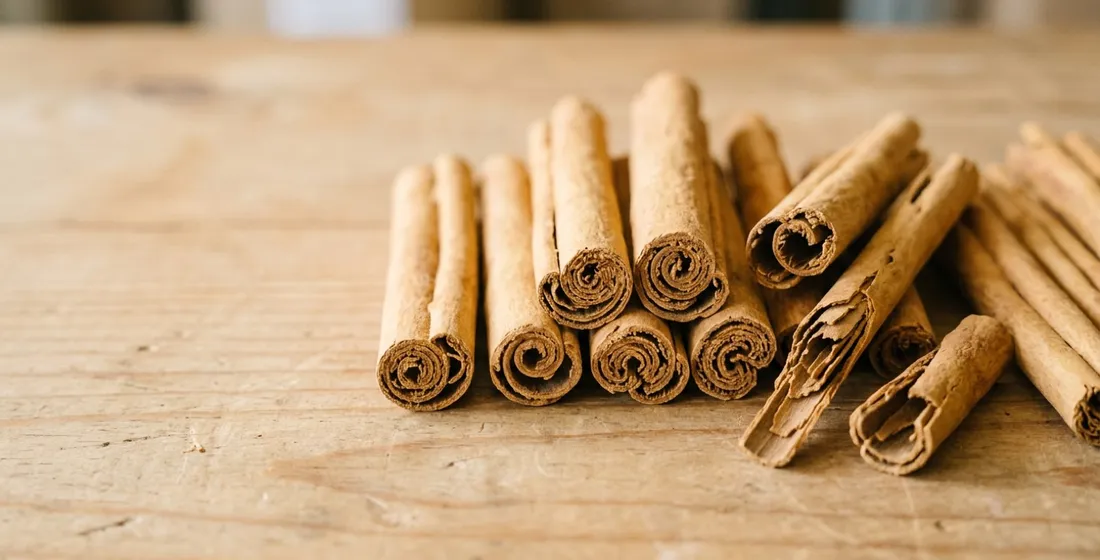
Hero: editorial close-up of true Ceylon cinnamon quills (Cinnamomum verum) on a plain unmarked light wooden surface, showing the characteristic thin papery multi-layered bark and feathery internal curl at the quill ends.
Buyer’s snapshot
Buyer's snapshot Sri Lanka shipped roughly 19,600 metric tonnes of cinnamon in 2024 and holds the dominant share of true Ceylon (Cinnamomum verum) supply globally (Sri Lanka Export Development Board, 2024 trade data). "Ceylon Cinnamon" is an EU Protected Geographical Indication, registered 2 February 2022 under Implementing Regulation (EU) 2022/144. The label phrase is legally reserved for product compliant with the registered Sri Lankan specification. Coumarin content separates the two products at roughly two orders of magnitude. True Ceylon cinnamon typically tests below 0.4 mg/kg; cassia (C. cassia, C. burmannii, C. loureiroi) runs 700 to 12,000 mg/kg per the EFSA 2008 coumarin opinion. Through 2024 and 2025 the US FDA expanded its public health alert on ground cinnamon to 16-plus brands for elevated lead. Every recalled SKU traced back to cassia stocks; no true Ceylon cinnamon was implicated. Silk Route Ventures supplies bulk Cinnamomum verum and finished private-label retail SKUs from the BRCGS and FSSC 22000 V6 audited Silk Foods Ceylon facility in Matale. First-order MOQ is 100 kg per SKU; samples are free for evaluation (you cover the courier). |
The default RFQ template most procurement teams used through the 2010s asked for “Ceylon cinnamon” by name, attached a target unit price, and left the rest to the supplier. After the US FDA cinnamon lead recalls of 2024 and 2025, that template no longer survives the audit cycle. The 16-plus ground cinnamon brands the FDA pulled between November 2023 and October 2025 (US FDA, public health alerts, 2025) all traced back to cassia stocks, with lead levels between 2.03 and 7.68 parts per million. None of the recalled product was true Ceylon cinnamon. For procurement, the lesson sat at the top of the RFQ: species verification on the cover page, not the appendix.
This piece is the working RFQ template for true Ceylon cinnamon in 2026. Silk Route Ventures (SRV) trades the Ceylon cinnamon catalogue out of Sri Lanka, and the Silk Foods Ceylon (SFC) facility in Matale processes the bark under FSSC 22000 V6. The post walks through the seventeen RFQ clauses that matter, why the EU PGI status changes the label claim math, how the coumarin spread between Cinnamomum verum and cassia decides the destination-market opportunity, and what an honest supplier response looks like when the clauses are tight.
What does *Cinnamomum verum* mean on a procurement RFQ?
Cinnamomum verum is the botanical name for true Ceylon cinnamon, the species native to Sri Lanka and registered under the EU Protected Geographical Indication “Ceylon Cinnamon” (Implementing Regulation (EU) 2022/144, registered 2 February 2022). On an RFQ, the binomial replaces the trade name. “Ceylon cinnamon” is a marketing label that any supplier can write into a quote; Cinnamomum verum is the species the supplier must verify on every batch, with the verification on the COA the buyer receives.
The distinction matters because three closely related species are commonly sold as “cinnamon” on the global market: Cinnamomum cassia (Chinese cinnamon), C. burmannii (Indonesian or Korintje), and C. loureiroi (Saigon, also called Vietnamese cassia). All three are cassia. None qualifies for the EU PGI. All three carry coumarin levels two orders of magnitude higher than C. verum, with downstream consequences for the EU coumarin MRL framework (EU Reg 1334/2008 Annex III). A “Ceylon cinnamon” line on a purchase order, without the binomial and without a per-batch species check, is a label claim waiting for an audit finding.
For a brand exporting into the EU, the PGI converts the species line on the RFQ into a legally defensible origin claim instead of a marketing one. The European Commission Joint Research Centre published a September 2025 study finding that more than 66% of cinnamon samples on the EU market either failed an international quality standard, breached EU food safety law, were suspected of fraud, or potentially exceeded the legal coumarin ceiling (JRC, 2025). The cleanest defense against ending up in that 66% is a species clause that names Cinnamomum verum and a COA clause that requires the species to be verified per batch.
The seventeen clauses every true Ceylon cinnamon RFQ should carry
A well-built 2026 RFQ for Cinnamomum verum covers four families of clauses: identity and origin, quality and contaminants, certification and documentation, and commercial terms. Below is the checklist a procurement team can lift verbatim into the next supplier brief. Each clause is short, written to be answered yes or no plus a number, and ordered so the supplier cannot skip the identity line on the way to the price line.
Buyer's checklist: the seventeen clauses every Ceylon cinnamon RFQ should carry 1. Botanical species: Cinnamomum verum, verified per batch. 2. EU PGI eligibility statement (Reg (EU) 2022/144), if the line item is destined for the EU. 3. Grade (Alba, C5 Special, C5, C4 / Continental, quillings No 1 to 3, featherings, chips, powder, tea cut, pyramid cut). 4. Form and origin (whole quill, cut quill, ground; named district within Sri Lanka where credibility supports it). 5. Quill diameter and length (mm and cm) and uniformity tolerance. 6. Moisture (%), volatile oil content (%) where relevant, color, mesh size for powder. 7. Microbial panel: total plate count, yeast and mould, Salmonella, E. coli, Coliforms. 8. Coumarin assay per batch (target value plus method). 9. Heavy metals panel with lead and chromium aligned to FDA action levels post-2024 recall. 10. Pesticide MRL panel aligned to the destination market (EU Reg 396/2005, US FDA tolerances, FSANZ for Australia). 11. Aflatoxin and ochratoxin A where relevant to the destination market. 12. Certification dossier: BRCGS and FSSC 22000 V6 covering the processing scope, plus USDA Organic and EU Organic for organic SKUs. 13. Traceability back to the garden or estate for organic and PGI SKUs. 14. Packaging spec (25 kg or 50 kg multi-wall paper sacks for bulk; retail packaging spec if private label). 15. Shelf life with storage conditions stated. 16. Lead time (PO to dispatch, plus sea or air freight to destination market). 17. Commercial terms: MOQ per SKU, Incoterm (FOB Colombo by default), payment terms, sample policy. |
The three clauses worth defending hardest are the species clause (line 1), the EU PGI clause (line 2 for EU-bound product), and the per-batch coumarin assay (line 8). The species clause closes the door on cassia substitution. The PGI clause locks the label claim. The coumarin clause anchors the destination-market opportunity, since the EU coumarin caps for finished foods sit at 5 mg/kg for desserts, 15 mg/kg for fine bakery, 20 mg/kg for breakfast cereals, and 50 mg/kg for traditional or seasonal bakery containing a reference to cinnamon in the labelling (EU Reg 1334/2008 Annex III). With Cinnamomum verum typically testing below 0.4 mg/kg, a brand has spec-level headroom; with cassia at 700 to 12,000 mg/kg, the same brand does not.
Coumarin, the EU MRL framework, and why this parameter sets the label claim
Coumarin is the naturally occurring compound that puts a hard ceiling on how much cinnamon a finished food can carry in the EU. EFSA established a Tolerable Daily Intake of 0.1 mg coumarin per kg of body weight in 2004, based on hepatotoxicity in a two-year canine study and held at the same value through the 2008 re-evaluation. That TDI translates into the category-specific food limits in EU Reg 1334/2008 Annex III, which are the numbers that actually govern formulation. A finished food can be safely formulated against the C. verum coumarin profile and miss the cap by a wide margin; the same formulation built on cassia is structurally vulnerable to a non-compliance finding.
Cinnamomum verum vs cassia at the RFQ-spec level (2026)
| Spec dimension | C. verum (true Ceylon) | C. cassia / C. burmannii / C. loureiroi |
| Botanical species | Cinnamomum verum | Cinnamomum cassia, C. burmannii, C. loureiroi |
| Origin (commercial scale) | Sri Lanka (Matale and southern wet zone) | China, Indonesia, Vietnam |
| EU PGI status | Registered (Reg (EU) 2022/144, 2 Feb 2022) | Not registered |
| Bark physical form | Thin, papery, multi-layered quill; feathery curl visible at ends | Thick, woody, single-layer roll; tight single curl |
| Quill wall thickness | Under 1 mm | 2 to 4 mm |
| Color | Light tan to golden brown | Dark reddish-brown to mahogany |
| Coumarin (mg/kg, typical) | 0.017 to 0.4 | 700 to 12,000 |
| EU coumarin MRL exposure | Wide spec-level headroom against EU Reg 1334/2008 Annex III caps | Structurally vulnerable to non-compliance |
| FDA lead recall exposure (2023 to 2025) | Zero recalled brands | 16-plus recalled brands |
| Typical FOB Colombo or origin price band (USD/kg, mid-grade) | 5 to 21 (Sri Lanka EDB, 2024 to 2025) | 1.5 to 3.5 |
Source: Implementing Regulation (EU) 2022/144 (Ceylon Cinnamon PGI register entry, 2022); EU Reg 1334/2008 Annex III on coumarin in food; EFSA 2008 coumarin scientific opinion; US FDA public health alerts on ground cinnamon (2023 to 2025); Sri Lanka Export Development Board sector data (2024 to 2025); Joint Research Centre EU cinnamon market study (2025); SRV procurement-desk pricing notes (2026).
Two practical consequences. First, the Cinnamomum verum coumarin profile, paired with the EU PGI, is what makes the “Ceylon cinnamon” line on a premium-bakery RFQ worth the price spread over cassia. Second, the spread is not theoretical. The September 2025 JRC study estimated that 14% of cinnamon samples on the EU market potentially exceeded the legal coumarin limit (JRC, 2025), almost entirely on the cassia side of the line.
How does a procurement team verify the supplier is shipping *Cinnamomum verum*?
Verification sits on three legs: documentary, physical, and analytical. The documentary leg is the COA per batch, which should name the species in the analyte block and reference the test method used (visual identification per ISO 6539:2014 at minimum, DNA barcoding or HPLC profiling on request). The physical leg is the sample itself, since true Ceylon quills carry a distinctive feathery multi-layered curl that cassia does not. The analytical leg is the coumarin assay, which functions as a species-verification proxy because the value bands for C. verum and the cassia species do not overlap.
A buyer who only verifies on documentation is one supplier-swap away from a problem. The Ecuador-to-US lead-chromate fraud that triggered the 2023 WanaBana applesauce recall, and the 16-plus ground cinnamon brand recalls that followed through 2024 and 2025, sat downstream of supply chains where the species check was assumed, not performed. The CDC documented over 560 children with elevated blood lead levels tied to that single supply chain. Procurement teams that built species verification into their post-2024 RFQ template did not appear in the recall list.
Spec snapshot: true Ceylon cinnamon (*C. verum*) verification points Species: Cinnamomum verum, verified per batch (visual ISO 6539:2014; HPLC or DNA barcoding on request). Origin: Sri Lanka (PGI scope; named district such as Matale on request). Coumarin: typically below 0.4 mg/kg; tested through an external laboratory on request. EU PGI: registered 2 February 2022 (Reg (EU) 2022/144); label-phrase reservation enforceable across the EU single market. Grades typically supplied: Alba, C5 Special, C5, C4, quillings No 1 to 3, plus powder, tea cut, pyramid cut. Documentation pack: Certificate of Origin, phytosanitary certificate where the destination requires it, the organic import certificate the destination requires where applicable, packing list, BL or AWB; COA on request. |
Procurement-desk observation SRV procurement-desk observation: In the six weeks after the FDA expanded its public health alert in October 2025, the Silk Route Ventures procurement desk fielded fifteen US specialty and premium-bakery brands rebuilding their cinnamon spec. Almost every brief asked the same three new questions: how is species verified per batch, what is the coumarin assay turnaround, and what is the supplier-side traceability back to the garden. None of the briefs asked about price first, which was the pattern through 2022 and 2023. |
Grade selection, packaging, and lead-time clauses on the RFQ
Ceylon cinnamon grades follow SLS 81:2021 and the international ISO 6539:2014 standard. The grading is mostly a function of quill diameter and uniformity. Alba sits at the top (typically 6 to 8 mm diameter in the strict SLS spec, often 9 to 11 mm in commercial export practice). C5 Special and C5 follow at 7 to 10 mm. C4 (Continental) caps at 13 mm. Below the whole-quill grades sit quillings (broken quill fragments), featherings, chips, and powder forms (powder, tea cut, pyramid cut), each of which serves a different end-application. A bakery formulator buying for blend-level use will often save margin by specifying C5 or quillings rather than Alba; a premium gift-pack brand will hold out for Alba or C5 Special.
Where Silk Route Ventures pricing doesn't fit Lowest-shelf-price retail. Mass-discount channels. White-label dropshippers. Brands competing on per-unit invoice price below the Ceylon premium. For those briefs, cassia from a competent processor in Vietnam or Indonesia is the more honest answer than mislabelled Ceylon at a stretched price. |
Packaging and lead-time clauses are where most RFQ frictions surface. Bulk RM at the Silk Foods Ceylon site ships in 25 kg or 50 kg multi-wall paper sacks with food-grade liner; finished private-label retail formats include 50 g to 1 kg kraft pouches, 40 g spice glass jars, and 220 ml to 1 L glass containers. Lead time runs 2 to 3 weeks from PO to dispatch for standard SKUs (4 to 6 weeks for private label, custom specifications and organic orders), plus 3 to 5 weeks of sea freight (US 4 to 5 weeks, EU 3 to 4 weeks, AU 3 to 4 weeks). Air freight is available for early formulation work at 3 to 4 days transit. Samples ship door-to-door by international courier (DHL, FedEx, UPS) and are free for evaluation (you cover the courier).
MOQ, payment terms, and the commercial clauses that anchor the RFQ close
First-order MOQ at Silk Foods Ceylon is 100 kg per SKU on bulk RM, with volume-tier price breaks at 500 kg, 1,000 kg, and 2,500 kg. The per-SKU floor matters because cinnamon SKUs multiply by grade and format: a brand launching Alba quills, C5 quills, and cinnamon powder commits 300 kg minimum across the three lines, not 100 kg in total. For finished private-label retail, unit minimums depend on packaging tooling and are confirmed on your quote. Pricing is quoted FOB Colombo by default, with CFR and CIF on request and landed-cost framing available when the buyer is benchmarking against a US or EU distributor quoting DDP.
Payment terms are short and consistent across the customer book. Orders under USD 10,000 are payable 100% in advance by bank transfer. Orders of USD 10,000 or above run 50% advance by bank transfer with the 50% balance settled against scanned shipping documents. PayPal is accepted for sample payments only. The team does not negotiate alternative terms regardless of buyer tenure, which is itself a trust signal: the discipline is applied uniformly, and the post-shipment risk lives with neither side longer than the documents take to clear.
The lean-route argument for Cinnamomum verum is not that the FOB Colombo price beats every Vietnamese cassia quote. It will not. The argument is that the EU PGI line, the coumarin profile, and the FSSC 22000 V6 audit chain collapse a brand’s risk surface in a way the cassia substitute cannot. For a brand using “Ceylon cinnamon” on the label, the procurement spec is the legal defense for the label claim. The right RFQ writes that defense into the supplier contract on day one.
Frequently asked questions
What does *Cinnamomum verum* mean on a Ceylon cinnamon RFQ?
Cinnamomum verum is the botanical species name for true Ceylon cinnamon, the only species qualifying for the EU “Ceylon Cinnamon” Protected Geographical Indication (Implementing Regulation (EU) 2022/144, 2 February 2022). On an RFQ, the binomial replaces the trade name and obliges the supplier to verify the species per batch on the COA. Cassia (C. cassia, C. burmannii, C. loureiroi) does not qualify.
What coumarin level should a sourcing RFQ specify for *Cinnamomum verum*?
True Ceylon cinnamon typically tests below 0.4 mg/kg coumarin, with much of the export-grade stock from Sri Lanka falling below detection. Cassia runs 700 to 12,000 mg/kg per the EFSA 2008 coumarin opinion. The EU coumarin caps in finished foods range from 5 mg/kg for desserts to 50 mg/kg for traditional bakery (EU Reg 1334/2008 Annex III). A C. verum spec gives a brand wide formulation headroom against those caps.
Does Silk Route Ventures supply bulk *Cinnamomum verum* and finished private-label cinnamon SKUs under FSSC 22000 V6?
Yes. The Silk Foods Ceylon facility in Matale processes true Ceylon cinnamon quills from Alba to H2 (H3 on request), graded to SLS 81:2021 and ISO 6539:2014, plus quillings, powder and cut formats, with the line under FSSC 22000 V6. USDA Organic and EU Organic apply to selected SKUs, confirmed per SKU. Bulk RM ships against the buyer’s spec; finished private-label retail SKUs ship in 50 g to 1 kg kraft pouches, 40 g glass jars, or 220 ml to 1 L glass containers.
What is the first-order MOQ for true Ceylon cinnamon from Silk Route Ventures?
First-order MOQ is 100 kg per SKU on bulk RM, with volume-tier price breaks at 500 kg, 1,000 kg, and 2,500 kg. The 100 kg floor is per product, so a launch covering Alba, C5, and powder commits 300 kg minimum across the three lines. Samples are free for evaluation (you cover the courier); PO-to-dispatch lead is 2 to 3 weeks for standard SKUs; sea freight to the US is 4 to 5 weeks.
How did the 2024 to 2025 US FDA cinnamon lead recalls change supplier qualification?
The FDA expanded its public health alert on ground cinnamon to 16-plus brands between November 2023 and October 2025 (US FDA, 2025) with lead levels of 2.03 to 7.68 ppm, all traced to cassia stocks. Procurement teams have since added per-batch species verification, coumarin assay, and lead and chromium testing aligned to FDA action levels into the standard cinnamon RFQ template. No true Ceylon cinnamon was implicated in the recall set.
How Silk Route Ventures can help
Silk Route Ventures (SRV) supplies single-origin true Ceylon cinnamon (Cinnamomum verum), with USDA Organic and EU Organic on selected SKUs, confirmed per SKU, to specialty spice brands, premium-bakery formulators, and multi-category distributors across the US, UK, EU, and Australia. Bulk RM is shipped against the buyer’s RFQ from the BRCGS and FSSC 22000 V6 audited Silk Foods Ceylon (SFC) facility in Matale, with a COA available on request covering species verification, and coumarin, heavy metals and the destination-market pesticide panel tested through an external laboratory on request. First-order MOQ is 100 kg per SKU; samples are free for evaluation (you cover the courier) and ship door-to-door by international courier (DHL, FedEx, UPS). For brands ready to launch a private-label retail cinnamon SKU under their own label, SRV runs end-to-end private-label manufacturing from the same site. Contact us to send an inquiry or request a sample pack.
Sources
1. European Commission, 2022, “Implementing Regulation (EU) 2022/144 of 2 February 2022, Ceylon Cinnamon PGI register entry”, retrieved 2026-05-26. https://eur-lex.europa.eu/legal-content/EN/TXT/HTML/?uri=CELEX:32022R0144
2. European Commission, 2008, “Regulation (EC) No 1334/2008 on flavourings, Annex III maximum levels of coumarin in foods”, retrieved 2026-05-26. https://eur-lex.europa.eu/legal-content/EN/TXT/?uri=CELEX%3A32008R1334
3. EFSA, 2008, “Coumarin in flavourings and other food ingredients with flavouring properties, Scientific Opinion (TDI 0.1 mg/kg bw)”, retrieved 2026-05-26. https://www.efsa.europa.eu/en/efsajournal/pub/793
4. US FDA, 2025, “FDA Public Health Alert for Additional Ground Cinnamon Product Due to Presence of Elevated Levels of Lead”, retrieved 2026-05-26. https://www.fda.gov/food/alerts-advisories-safety-information/fda-public-health-alert-additional-ground-cinnamon-product-due-presence-elevated-levels-lead
5. European Commission JRC, 2025, “Cinnamon marketed in the EU: a study on quality, safety, and fraud (September 2025)”, retrieved 2026-05-26. https://publications.jrc.ec.europa.eu/repository/handle/JRC141914
6. Sri Lanka Export Development Board, 2024, “Ceylon Cinnamon and Spices sector data (2024 to 2025), Sri Lanka exports”, retrieved 2026-05-26. https://www.srilankabusiness.com/spices/ceylon-cinnamon-geographical-indication.html
7. ISO, 2014, “ISO 6539:2014, Cinnamon (Cinnamomum zeylanicum Blume), Specification”, retrieved 2026-05-26. https://www.iso.org/standard/55748.html
8. Sri Lanka Standards Institution, 2021, “SLS 81:2021, Sri Lanka Standard for Ceylon Cinnamon (4th revision)”, retrieved 2026-05-26. https://www.slsi.lk/
Further reading
- oriGIn, 2022, “Recognition of Ceylon Cinnamon as a PGI in the European Union” -> https://www.origin-gi.com/10-02-2022-recognition-of-ceylon-cinnamon-as-a-pgi-in-the-european-union/
- CBI / Netherlands, 2025, “Entering the European market for cinnamon” -> https://www.cbi.eu/market-information/spices-herbs/cinnamon-0/market-entry
- npj Science of Food, 2025, “High rate of safety and fraud issues in commercially available cinnamon” -> https://www.nature.com/articles/s41538-025-00485-w
Written by the Silk Route Ventures Trade Team. Silk Route Ventures (E-Silk Route Ventures (Pvt) Ltd, T/A Silk Route Ventures) is a Sri Lankan B2B supply-chain operator for the Food, Beverage, Wellness, and Nutraceuticals sectors. The Silk Foods Ceylon manufacturing arm in Matale holds BRCGS and FSSC 22000 V6 certifications, with USDA Organic and EU Organic on selected SKUs, confirmed per SKU. Questions or to request a sample: Contact us or email info@esilkroute.com.lk.