
Cinnamon Capsules for Blood-Sugar-Claim SKUs: Spec and Cinnamomum verum Sourcing Discipline
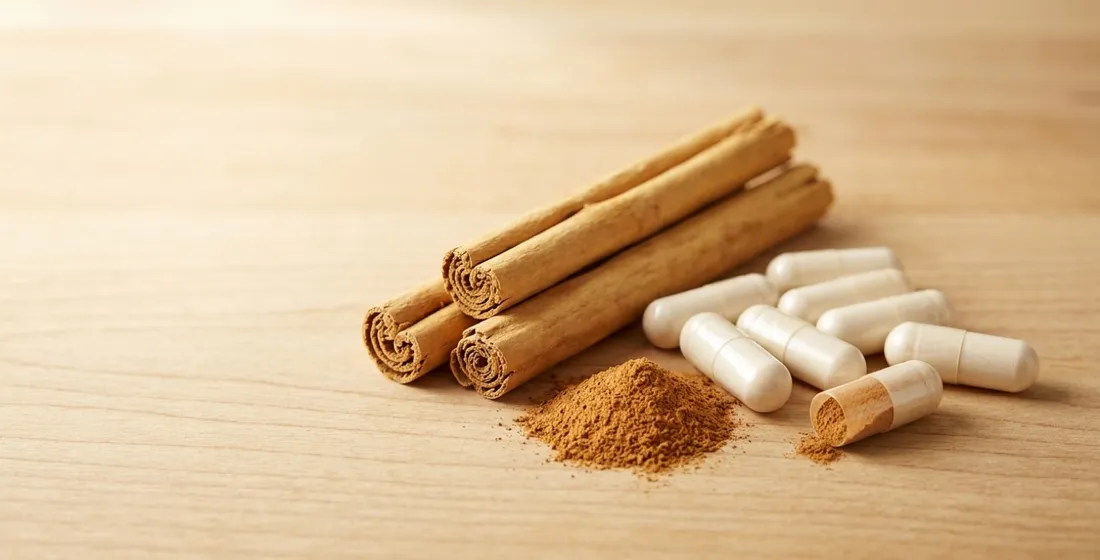
Buyer’s snapshot
- True Ceylon cinnamon (Cinnamomum verum) and cassia (C. cassia, C. burmannii, C. loureiroi) differ in coumarin content by roughly a hundredfold. Cassia averages near 3,000 mg/kg and has been measured up to 10,000 mg/kg; Ceylon runs to a maximum around 185 mg/kg (AGES, 2025). For a capsule taken daily, that gap is the whole safety argument.
- The coumarin tolerable daily intake is 0.1 mg per kg of body weight (BfR, 2024), about 6 mg for a 60 kg adult. Roughly 2 g of average cassia already reaches it, so a daily cassia capsule can approach the limit while a Ceylon capsule stays far below.
- In 2023 and 2024, lead-adulterated cassia cinnamon ground in Ecuador triggered a US recall of nearly 3 million applesauce pouches and 566 reported lead-exposure cases, 55% in children under two (CDC MMWR, 2025). None involved Ceylon cinnamon.
- Silk Route Ventures supplies true Ceylon cinnamon and encapsulated cinnamon SKUs from the BRCGS and FSSC 22000 V6 certified Silk Foods Ceylon facility in Matale, with a COA available on request, coumarin and heavy metals tested through an external laboratory on request, and the capsule MOQ confirmed on your quote.
- For a brand putting a healthy-blood-sugar claim on a daily capsule, this post is the spec. For a one-time seasonal bakery inclusion competing on price, cassia is the more honest answer.
Most US wellness brands specifying cinnamon for a blood-sugar-support capsule are buying cassia (Cinnamomum cassia or C. burmannii), not true Ceylon cinnamon (Cinnamomum verum). For a spice a consumer sprinkles on oatmeal once a week, the distinction is academic. For a capsule a consumer swallows every day for a year, it becomes a coumarin-load and a label-risk decision. The two barks differ in coumarin by two orders of magnitude, and the 2024 US lead recalls put cinnamon supplier qualification back on every nutraceutical procurement checklist. This piece is the sourcing spec for brands that already suspected the gap.
Why does the cinnamon species matter for a blood-sugar capsule?
True Ceylon cinnamon (Cinnamomum verum) and cassia are different species with different chemistry. The Austrian food-safety agency AGES (2025) measured coumarin at 1,880 to 3,260 mg/kg in cassia against a maximum near 185 mg/kg in Ceylon. For a supplement dosed daily, that hundredfold gap moves coumarin from a non-issue to a real formulation constraint.
Four species are commonly sold under the single word cinnamon. Cassia (C. cassia from China, C. burmannii from Indonesia, C. loureiroi from Vietnam) is cheaper, darker, and woodier. True Ceylon cinnamon is C. verum, thin and papery, and around 90% of the world’s true-cinnamon supply comes from Sri Lanka (IFC and Sri Lanka Export Development Board, 2024). On a retail shelf both simply say cinnamon.
Coumarin is a naturally occurring compound linked to liver toxicity at sustained high intake. In a food a consumer eats occasionally, the difference between the two barks rarely matters. In a capsule taken twice a day for months, the input species stops being a marketing preference and becomes a spec parameter. The comparison below is the version a procurement team can put in a sourcing brief.
Coumarin and the daily-dose math a supplement carries
The coumarin tolerable daily intake is 0.1 mg per kg of body weight per day (BfR, 2024). A 60 kg adult reaches 6 mg. Because average cassia runs near 3,000 mg/kg, roughly 2 g of bark reaches the limit. A 500 mg cassia capsule taken twice daily is 1 g of bark, so the exposure is cumulative and real, not hypothetical.
Regulators already treat coumarin as a food-safety ceiling. EU Regulation 1334/2008 Annex III caps coumarin in finished foods, from 50 mg/kg in seasonal cinnamon bakery down to 5 mg/kg in desserts (BfR, 2024). Supplements sit under different rules market by market, but the direction of travel is the same: coumarin is a controlled compound, and a daily dose is exactly the exposure pattern regulators worry about.
The math points one way for a long-term daily SKU. Ceylon cinnamon, at a maximum near 185 mg/kg, keeps coumarin exposure low even at a 1 g daily dose. Cassia does not. If the product is a seasonal bakery premix or a single-serving stick, cassia is defensible. If it is a bottle a consumer works through over two months, Ceylon is the input the spec should name.
| Parameter | True Ceylon (C. verum) | Cassia (C. cassia / burmannii) | Why it matters for a daily capsule |
|---|---|---|---|
| Coumarin | up to ~185 mg/kg | ~1,880 to 3,260 mg/kg avg, up to 10,000 | cumulative liver load; the core safety spec |
| Bark structure | thin, papery, multi-layer, light tan | thick, woody, single-layer, dark | visual identity check at intake |
| EU Ceylon Cinnamon PGI | eligible (registered 2022) | not eligible | label-claim and provenance integrity |
| 2023-24 US lead recalls | none implicated | implicated (Ecuador-ground) | supplier-qualification risk |
| Typical landed price | higher | lower | the honest cost trade-off |
Source: BfR 2024, AGES 2025, EUR-Lex Reg. (EU) 2022/144, CDC MMWR 2025, and SRV facility data.
The 2024 lead recalls changed the supplier-qualification question
In 2023 and 2024, cassia cinnamon ground in Ecuador and adulterated with lead chromate contaminated applesauce sold across the US. The recall expanded to nearly 3 million pouches, and the CDC (2025) logged 566 lead-exposure cases, 55% of them in children under two. The implicated cinnamon tested as high as 5,110 mg/kg lead.
In the months after the 2024 alerts, the SRV procurement desk saw the same request arrive from three US wellness brands in a single quarter: rebuild the cinnamon spec, add a per-batch lead assay by ICP-MS, and confirm the species in writing. The recall did not just pull applesauce off shelves. It rewrote the first question a supplement buyer asks a new cinnamon supplier.
The pattern was not isolated. In 2024 the FDA also recommended recalls of ground cinnamon from several distributors at 2 to 3.4 mg/kg lead (FDA, 2024). For a capsule, where the whole bottle is the product rather than a pinch on a plate, the defensible screen is a per-batch lead assay by ICP-MS held below the California Proposition 65 limit of 0.5 micrograms of lead per daily serving. Heavy metals are no longer a certificate to file; they are the first question a supplement buyer now asks a new cinnamon supplier.
Does cinnamon actually support healthy blood sugar?
A 2024 dose-response meta-analysis of 24 randomized trials (Phytotherapy Research) found cinnamon supplementation lowered fasting blood glucose (standardized mean difference minus 1.32) and HbA1c (minus 0.67), with no significant change in serum insulin. The authors positioned cinnamon as a potential adjunct, not a replacement for glycemic medication. The trials did not separate Ceylon from cassia.
That last point is the formulator’s dilemma. Much of the clinical material used cassia, which is higher in cinnamaldehyde and cheaper to source in trial quantities. But cassia is also the coumarin problem for daily use. So the evidence base leans on the species that is least suited to long-term supplementation, and the safe-for-daily species has thinner trial coverage of its own.
The defensible position for a daily SKU resolves the tension in one direction: source true Ceylon cinnamon, keep coumarin low, and frame the benefit in honest structure-and-function language rather than borrowing a clinical result the product’s own material did not generate. That is a formulation decision and a claims decision at the same time.
What you can legally put on a cinnamon blood-sugar label
Under the US Dietary Supplement Health and Education Act, a structure-and-function claim such as supports healthy blood sugar already within the normal range is permitted; a disease claim such as treats diabetes or lowers blood sugar is reserved for drugs (FDA). The label must carry the FDA disclaimer, the claim must be substantiated, and the FDA must be notified within 30 days of first marketing (21 CFR 101.93).
The line is narrow and enforced. Supports healthy glucose metabolism is a structure-and-function claim. Lowers blood sugar in diabetics is a drug claim that reclassifies the product. A blood-sugar SKU sits close to that line by design, which is exactly why the sourcing dossier matters: a clean species identification, a coumarin assay, and a heavy-metals panel are part of what makes the claim defensible if a regulator or a retailer asks for the file.
Specifying Ceylon cinnamon capsule fill in an RFQ
A capsule fill spec is tighter than a bulk-spice spec because the consumer ingests the whole thing, daily. The parameters below are the ones a nutraceutical buyer should confirm in writing before the first sample, not discover on a COA after a PO.
Spec snapshot: true Ceylon cinnamon capsule fill
- Species: Cinnamomum verum, verified per shipment
- Origin: Sri Lanka (Matale and Central Province growing belt)
- Coumarin: typically below 185 mg/kg, assayed by HPLC through an external laboratory on request
- Lead and heavy metals: by ICP-MS, below Proposition 65 daily-serving level
- Microbial: TPC, yeast and mould, Salmonella, E. coli
- Capsule shell: vegetable HPMC or gelatin, confirmed with buyer
- SRV capsule MOQ: confirmed on your quote; bulk powder 100 kg per SKU
Buyer’s checklist: qualifying a cinnamon capsule supplier
- Botanical species identification (Cinnamomum verum) confirmed in writing
- Per-batch coumarin assay by HPLC, with a stated ceiling
- Per-batch lead and heavy-metals panel by ICP-MS, below the Prop 65 daily-serving level
- Microbial panel (TPC, yeast and mould, Salmonella, E. coli)
- Moisture and fill weight against a target daily dose
- Capsule shell declared (vegetable HPMC vs gelatin)
- COA on every batch, not on request
- Traceability to origin for organic SKUs
Silk Foods Ceylon issues a COA on request covering the assayed parameters, with coumarin, heavy metals and microbiology tested through an external laboratory on request against the customer-specific panel, and lots traceable from raw material intake to shipment through our batch coding. Specifying the panel up front is what keeps a blood-sugar SKU out of the two failure modes that matter: a coumarin surprise and a lead surprise.
How the capsule MOQ math works for an early-stage brand
Silk Foods Ceylon’s encapsulation line at the Matale facility runs 100,000 capsules per single shift and 200,000 per day, with the private-label capsule MOQ confirmed on your quote. The facility holds BRCGS and FSSC 22000 V6, with encapsulation covered under FSSC 22000 V6, and USDA Organic and EU Organic on qualifying SKUs.
For an early-stage brand, a small first capsule run is the difference between validating a blood-sugar SKU on a real retail shelf and being told to come back with a 5,000-unit purchase order. The cellular manufacturing layout means the same audited facility can run a cinnamon capsule pilot alongside an ashwagandha or gymnema line without a separate audit cycle for each new SKU.
Where SRV’s pricing does not fit
Lowest-shelf-price retail, mass-discount channels, and sub-MOQ hobbyists competing below the Ceylon premium. For a product where the cinnamon is a token inclusion and price is the only lever, cassia from a competent processor is the more honest answer than true Ceylon at a stretched price.
Frequently asked questions
Is Ceylon cinnamon better than cassia for a blood-sugar supplement?
For a daily long-term capsule, yes on safety. Ceylon (C. verum) carries coumarin around or below 185 mg/kg versus roughly 3,000 mg/kg in cassia (AGES, 2025). Both barks show glycemic activity in trials, but only Ceylon keeps coumarin exposure low across daily dosing.
How much coumarin is safe per day?
The tolerable daily intake is 0.1 mg per kg of body weight (BfR, 2024), about 6 mg for a 60 kg adult. Roughly 2 g of average cassia reaches it, so a daily cassia capsule can approach the limit while a Ceylon cinnamon capsule of the same dose stays well below.
Does Silk Route Ventures manufacture cinnamon capsules under private label?
Yes. Silk Foods Ceylon encapsulates true Ceylon cinnamon at its Matale facility under FSSC 22000 V6, at 100,000 capsules per shift, with the capsule MOQ confirmed on your quote. A COA is available on request, with coumarin and heavy metals tested through an external laboratory on request. Bulk Ceylon cinnamon powder is also available at 100 kg per SKU.
What lead level should a cinnamon supplement meet?
For a daily supplement, spec lead well below the California Proposition 65 limit of 0.5 micrograms per daily serving and require ICP-MS testing on every batch. The 2024 US recalls hit ground cinnamon at 2 to 3.4 mg/kg lead (FDA, 2024), so per-batch intake screening is the defensible baseline.
Can I claim my cinnamon capsule lowers blood sugar?
No. Under DSHEA, supports healthy blood sugar already within the normal range is a permitted structure-and-function claim; lowers blood sugar or treats diabetes is a drug claim (FDA). The label must carry the FDA disclaimer and the claim must be substantiated.
How Silk Route Ventures can help
Silk Route Ventures (SRV) manufactures nutraceutical capsules and supplies bulk Ayurvedic and functional botanicals to wellness brands globally, including true Ceylon cinnamon for blood-sugar-support SKUs. The Silk Foods Ceylon (SFC) facility holds FSSC 22000 V6 covering encapsulation, with USDA Organic and EU Organic on the relevant SKUs, and issues a COA on request, with coumarin and heavy metals tested through an external laboratory on request. The capsule MOQ is confirmed on your quote; bulk cinnamon powder MOQ is 100 kg per SKU; samples are free for evaluation (you cover the courier). For early-stage brands without a co-packer relationship, the SRV R&D and NPD team also develops custom blends in-house. Contact us to send an inquiry or request a sample. Full specs and MOQs are on our true cinnamon from Sri Lanka.
Sources
- BfR (German Federal Institute for Risk Assessment), “FAQ on coumarin in cinnamon and other foods,” (2024). Retrieved 2026-07-01. https://www.bfr.bund.de/en/service/frequently-asked-questions/topic/faq-on-coumarin-in-cinnamon-and-other-foods/
- AGES (Austrian Agency for Health and Food Safety), “Coumarin,” (2025). Retrieved 2026-07-01. https://www.ages.at/en/human/nutrition-food/residues-contaminants-from-a-to-z/coumarin
- CDC, “MMWR Vol. 74 No. 14: Lead and Chromium Exposure After Consumption of Contaminated Cinnamon-Containing Applesauce,” (2025). Retrieved 2026-07-01. https://www.cdc.gov/mmwr/volumes/74/wr/mm7414a2.htm
- US FDA, “Investigation of Elevated Lead and Chromium Levels: Cinnamon Applesauce Pouches (November 2023),” (2024). Retrieved 2026-07-01. https://www.fda.gov/food/outbreaks-foodborne-illness/investigation-elevated-lead-chromium-levels-cinnamon-applesauce-pouches-november-2023
- US FDA, “Alert Concerning Certain Cinnamon Products Due to Presence of Elevated Levels of Lead,” (2024). Retrieved 2026-07-01. https://www.fda.gov/food/alerts-advisories-safety-information/fda-alert-concerning-certain-cinnamon-products-due-presence-elevated-levels-lead
- Phytotherapy Research, “Cinnamon supplementation and glycemic control: a dose-response meta-analysis of 24 RCTs,” (2024). Retrieved 2026-07-01. https://pubmed.ncbi.nlm.nih.gov/37818728/
- US FDA, “Structure/Function Claims,” (2024). Retrieved 2026-07-01. https://www.fda.gov/food/nutrition-food-labeling-and-critical-foods/structurefunction-claims
- EUR-Lex, “Commission Implementing Regulation (EU) 2022/144 (Ceylon Cinnamon PGI),” (2022). Retrieved 2026-07-01. https://eur-lex.europa.eu/legal-content/EN/TXT/?uri=CELEX%3A32022R0144
- IFC and Sri Lanka Export Development Board, “Ceylon Cinnamon exports and GI certification,” (2024). Retrieved 2026-07-01. https://www.ifc.org/en/pressroom/2024/ifc-partnership-drives-ceylon-cinnamon-exports-to-reach-high-val
Further reading
- Mordor Intelligence, “Cinnamon Market: Size, Share and Industry Analysis,” (2025). https://www.mordorintelligence.com/industry-reports/cinnamon-market
- ConsumerLab, “Cinnamon Supplements Review methodology,” (2026). https://www.consumerlab.com/methods/cinnamon-supplements-review/cinnamon/
Written by the Silk Route Ventures Trade Team. Silk Route Ventures (E-Silk Route Ventures (Pvt) Ltd) is a Sri Lankan B2B supply-chain operator for the Food, Beverage, Wellness, and Nutraceuticals sectors. The Silk Foods Ceylon manufacturing arm holds BRCGS and FSSC 22000 V6 certifications. Questions or to request a sample: Contact us or email info@esilkroute.com.lk.