
Lime and Black Lime Powder: Souring Agent and Beverage Base Spec
By the Silk Route Ventures Trade Team | 22 July 2026
Buyer’s snapshot
- Lime juice is one of the most acidic culinary citrus inputs: about 45.8 g of citric acid per litre, at a pH of 2.00 to 2.35 (Penniston et al., Journal of Endourology, 2008; US FDA pH data).
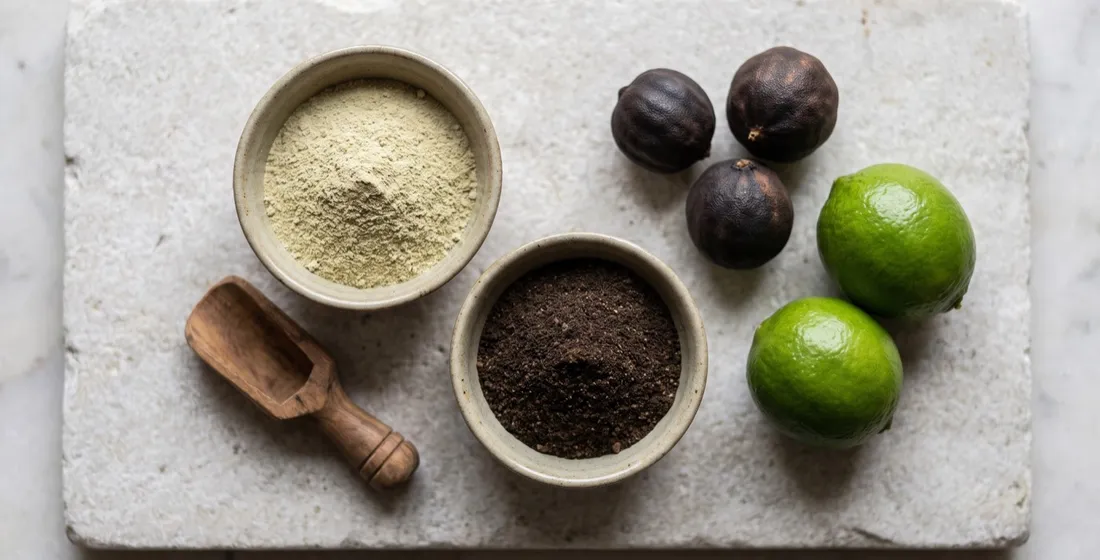
- Two distinct ingredients share the “lime” name on a spec sheet: bright, sour lime powder (fresh flavour, acidulant function) and black lime, or loomi, a brine-boiled sun-dried lime with a fermented, smoky, sour profile used in Gulf and Persian cooking.
- For beverage R&D, the choice between lime powder and liquid citric acid is a clean-label and flavour-complexity decision, not only a cost decision.
- Silk Route Ventures supplies bulk lime, black lime, lemon, and orange-peel powder from a Matale facility under BRCGS and FSSC 22000 V6, at a 50 kg first-order MOQ per SKU.
- This post is the spec and application brief. The two comparison tables below are where the procurement-actionable content sits.
Most beverage developers reach for liquid citric acid when a formula needs to be pulled down in pH. It is cheap, predictable, and GRAS. The problem shows up on the label and on the palate: a mono-acid tartness that reads as “sour” but carries no origin, no aromatics, and nothing a clean-label brand can put a provenance story behind. Lime powder and black lime powder answer a different brief. This piece is for the sourcing buyers and product developers weighing a citrus-derived souring system against a synthetic acidulant, and specifying it for US and EU launches.
What lime powder and black lime powder actually are
Lime powder and black lime powder are not the same ingredient with two finishes. Lime powder is dried, milled lime (juice, pulp, or whole fruit of Citrus aurantifolia) carrying the fruit’s native citric acid and volatile top notes. Black lime, known as loomi in Oman, is a whole lime boiled in brine then sun-dried until the interior turns black (TasteAtlas, Loomi reference). Dehydration reshapes the aroma chemistry: a 2004 Food Chemistry study on dehydrated Citrus aurantifolia found the volatile oil shifts to over 90% limonene as fresh-lime aldehydes fall away, which is why dried lime reads muted, resinous, and darker rather than bright.
The functional split matters at the formulation bench. Lime powder behaves as an acidulant with citrus aromatics attached: it lowers pH and adds a fresh, bright sourness. Black lime powder behaves as a flavour system first and a mild acidulant second. Its sourness is muted and darker, and its aroma carries the musky, tea-like, fermented character that defines Iraqi, Iranian, and Gulf stews, spice blends, and increasingly, functional beverages and mocktail bases.
Provenance is a live sourcing question here. Loomi is historically an Omani and Iraqi product (noomi basra, meaning limes from Basra). The drying method, not a unique cultivar, makes the ingredient, so black lime can be produced wherever sound limes and reliable sun-drying or controlled dehydration exist. Sri Lanka grows Citrus aurantifolia across its dry and intermediate zones, which is why a Sri Lankan supplier can offer both fresh-profile lime powder and black lime powder from the same fruit base. For buyers building a broader citrus line, this connects to the wider sourcing guide for Sri Lankan fruit powders.
Why lime works as an acidulant: citric acid, pH, and the clean-label angle
Lime earns its place as a souring agent on chemistry. In 2008, a Journal of Endourology study by Penniston and colleagues measured fresh lime juice at a mean of 45.8 g of citric acid per litre, close behind lemon at 48.0 g/L and well ahead of orange at about 17 g/L. US FDA pH data puts lime juice at 2.00 to 2.35, acidic enough to function as an acidifier in beverages and acidified foods. Citric acid itself is affirmed GRAS under 21 CFR 184.1033.
That regulatory footing is what makes the clean-label swap defensible. A brand replacing “citric acid (E330)” on a European label, or a synthetic acidulant on a US label, with “lime powder” or “dried lime” is making a labelling and marketing choice, not stepping outside food-additive law. In the EU, citric acid is approved as acidity regulator E330 under Regulation (EC) No 1333/2008, and the EFSA re-evaluation (EFSA Journal, 2014) set no numerical ADI, treating it as a substance of no safety concern at reported use levels. Lime-derived acidity gets a buyer the same functional pull-down with a fruit name on the deck.
The trade-off is control. Liquid citric acid delivers exact, repeatable titratable acidity per batch. Lime powder delivers acidity plus aromatics plus natural batch variation, which is a feature for a premium beverage and a liability for a tightly specified isotonic drink. The table below frames the decision.
| Parameter | Lime powder | Black lime (loomi) powder | Liquid citric acid |
|---|---|---|---|
| Primary function | Acidulant plus fresh citrus aroma | Flavour base plus mild acidity | Acidulant only |
| Sourness character | Bright, sharp, fresh | Muted, dark, fermented | Clean, one-dimensional |
| Aroma contribution | Citrus top notes | Smoky, musky, tea-like | None |
| Typical citric acid basis | 45.8 g/L in parent juice (2008 study) | Lower; drying and brine alter profile | ~100% functional acid |
| Label read | ”Lime powder / dried lime" | "Black lime / dried lime" | "Citric acid” or “E330” |
| Batch consistency | Moderate (natural variation) | Moderate to variable | High |
| Best-fit application | Sour beverage bases, seasonings, sherbets | Broth-style, spiced, or functional drinks; baharat | Precise-acidity beverages, confectionery |
Buyers usually land in one of two camps: brand owners specifying an ingredient against an existing co-packer, and CPG teams building a finished private-label or contract-manufactured beverage. The comparison above holds either way. The lime spec is the same whether it ships as bulk RM or arrives inside a finished bottled base.
Spray-dried, freeze-dried, or milled: choosing the lime powder process
Process choice sets the price and the sensory ceiling for a citrus powder. In a 2023 study on Citrus reticulata powder published in the journal Foods, researchers compared drying methods and found freeze-dried citrus powder retained more vitamin C and volatile aroma compounds than spray-dried powder, while spray drying stayed cheaper and more scalable and typically relied on a maltodextrin carrier to prevent stickiness. For lime, that is the whole trade-off in one sentence.
Spray drying suits juice-based lime powders at volume: the juice is concentrated, blended with a carrier (commonly 10 to 30% maltodextrin on solids), and atomised into hot air, yielding a free-flowing powder at low moisture. Freeze drying suits premium, carrier-free or low-carrier lime powders where the brief protects aroma and vitamin C, at a higher cost and lower throughput. Milled dried powder, where whole dried lime or black lime is ground, is the standard route for black lime, since loomi is defined by whole-fruit drying before grinding.
| Attribute | Spray-dried | Freeze-dried | Milled dried (whole fruit) |
|---|---|---|---|
| Aroma and vitamin C retention | Lower (hot air) | Highest | Moderate |
| Carrier needed | Yes (maltodextrin 10 to 30%) | Little or none | None |
| Final moisture | Low, free-flowing | Very low, friable | Low |
| Relative cost | Lowest | Highest | Low to moderate |
| Throughput | High | Low | Moderate to high |
| Best-fit lime product | Juice-based lime powder at volume | Premium aroma-led lime powder | Black lime and whole-fruit lime powder |
Source basis: three-drying-method comparison of citrus powder, Foods (2023).
Spec snapshot: lime powder (juice-based, spray-dried) Fruit: Citrus aurantifolia, Sri Lankan origin Carrier: maltodextrin, typically 10 to 30% on solids (declare on spec) Moisture: target below 5%; water activity below 0.6 for microbial stability Mesh: 60 to 100 mesh typical; confirm against dosing equipment Function: acidulant plus fresh citrus aroma SFC route: spray-dry line at 50 kg/day, or spice line at 100 to 200 kg/hr for milled dried powder
The powder spec logic here mirrors the one used for other spray-dried lines; the same carrier, mesh, and dispersibility questions drive the brief in spray-dried powder spec and dispersibility and in selecting coconut milk powder for CPG R&D. Silk Foods Ceylon runs both routes, spray-drying at 50 kg/day and milling on the spice line at 100 to 200 kg/hr, so a buyer can trial a freeze-quality aroma profile against a spray-dried cost profile before committing a run.
What black lime (loomi) brings to a beverage flavour base
Black lime is the ingredient that turns a sour drink into a flavour story. Loomi originated as a preserved lime in Oman, boiled in salt water and sun-dried until black (TasteAtlas, Loomi reference), and drying concentrates the profile: the 2004 Food Chemistry analysis of dehydrated lime showed the aroma oil moving to a limonene-dominant, resinous character as fresh citral aldehydes decline, the chemistry behind loomi’s musky, faintly bitter depth. In beverage R&D, that profile reads as depth: a base that tastes aged and complex rather than simply acidic, which is why it is moving from Gulf kitchens into craft sodas, functional tonics, and non-alcoholic spirit bases.
Here is the pattern the SRV product desk keeps seeing. Over the past year, beverage developers asking for a “natural souring system” have split into two requests within the same call: one for a clean, bright lime acidulant to replace citric acid, and one for a black lime note to carry the aroma that citric acid strips out. The two ingredients solve two halves of the same brief. A tonic or shrub base built on lime powder for acidity and a small black lime fraction for aroma outperforms either alone, and it does it with two fruit names on the label instead of one additive code. That is not a hypothetical formulation; it is the most common lime-adjacent question the R&D team now fields.
Black lime also cross-sells into savoury. It is a core note in baharat and in broth-style and spiced beverages, so a distributor or CPG buyer sourcing it for a drink line often finds a second home for it in a seasoning SKU.
Specifying lime and black lime powder for US and EU buyers
Getting a citrus powder past a US or EU buyer’s quality gate comes down to a short, defensible spec. Water activity is the controlling food-safety parameter: no microbial growth occurs below a water activity of 0.60 (Kansas State University Research and Extension, Water Activity of Foods), so a dried lime or black lime powder should be specified and released below that threshold, with moisture typically under 5% for free-flowing behaviour. Citric acid’s GRAS status (21 CFR 184.1033) and E330 approval under Regulation (EC) No 1333/2008 cover the acidulant function on both sides of the Atlantic.
Buyer’s checklist: lime and black lime powder
- Botanical identity (Citrus aurantifolia) and product form (juice powder, whole-fruit powder, or black lime) stated in writing
- Carrier declared and quantified (maltodextrin percentage on solids), or “carrier-free” confirmed
- Moisture below 5% and water activity below 0.6 on the release COA
- Mesh size matched to your dosing and dispersion equipment
- Microbial panel (total plate count, yeast and mould, Salmonella, E. coli) aligned to destination market
- Pesticide residue panel aligned to US or EU MRL limits for citrus
- Titratable acidity or citric acid basis stated if the powder carries an acidulant claim
- Sample dispatched against the spec before any PO
For EU-bound powders, pesticide MRLs on dried citrus are the parameter most likely to move, and the briefing logic there is the same as for other dried botanicals, covered in EU MRL changes for dried herbs and spices. The certification question sits alongside it: buyers using a GFSI gate can read what the audit covers in what FSSC 22000 V6 covers. Context on scale: FAOSTAT recorded roughly 23.6 million tonnes of lemons and limes produced globally in 2023, so lime is a deep, liquid raw-material market, not a niche crop, which keeps citrus-powder input pricing competitive against synthetic acidulants at volume.
Frequently asked questions
What is the difference between lime powder and black lime powder? Lime powder is dried, milled lime carrying fresh citrus aroma and native citric acid, 45.8 g/L in the parent juice (Penniston et al., Journal of Endourology, 2008). Black lime, or loomi, is a brine-boiled sun-dried whole lime whose aroma oil turns limonene-dominant on drying, giving a darker, muted sourness (Food Chemistry, 2004). One is an acidulant; the other is a flavour base.
Is lime or citric-acid powder approved as an acidulant in the US and EU? Yes. Citric acid is affirmed GRAS in the US under 21 CFR 184.1033 and approved in the EU as acidity regulator E330 under Regulation (EC) No 1333/2008, with EFSA’s 2020 re-evaluation placing it among substances of no safety concern. Lime-derived acidity provides the same function under a fruit name.
Spray-dried or freeze-dried lime powder for a beverage flavour base? Freeze-dried lime powder retains more vitamin C and aroma volatiles, per a 2023 Citrus reticulata study in the journal Foods, but costs more and uses little or no carrier. Spray-dried lime powder is cheaper, scalable, and usually carries 10 to 30% maltodextrin. Premium aroma leans freeze-dried; cost and volume lean spray-dried.
Does Silk Route Ventures supply bulk lime and black lime powder or private-label beverage bases? Yes to both. SRV ships bulk lime, black lime, lemon, and orange-peel powder as ingredient supply at a 50 kg first-order MOQ per SKU, and contract-manufactures finished beverage bases on a line running 2,500 bottles per day. Samples dispatch by international courier in 3 to 5 business days.
What moisture and microbial spec should I set for lime powder? Set moisture below 5% and water activity below 0.60, the threshold under which no microbial growth occurs (Kansas State University Research and Extension). Pair that with a total plate count, yeast and mould, Salmonella, and E. coli panel aligned to your destination market, released on a per-batch COA.
How Silk Route Ventures can help
Silk Route Ventures (SRV) supplies bulk lime, black lime, lemon, and orange-peel powder to beverage, seasoning, and CPG brands across the US, EU, and UK, shipped against the buyer’s spec from the Silk Foods Ceylon (SFC) facility in Matale, 1 km from Nalanda Gedige. The site holds BRCGS and FSSC 22000 V6, with a spray-dry line at 50 kg/day and a spice line at 100 to 200 kg/hr, so both juice-based and milled dried powders run under one audit, with a COA on every batch. First-order MOQ is 50 kg per SKU, and samples ship door-to-door by international courier in 3 to 5 business days. For teams building a finished souring or citrus-forward drink, SRV also runs private label and contract manufacturing on a beverage line at 2,500 bottles per day, with the R&D team scoping the formulation in parallel. Contact us to send an inquiry or request a sample. First-time buyers can start with the 12-point Sri Lankan supplier evaluation checklist and what to expect from sample request to first PO.
Written by the Silk Route Ventures Trade Team. Silk Route Ventures (E-Silk Route Ventures (Pvt) Ltd) is a Sri Lankan B2B supply-chain operator for the Food, Beverage, Wellness, and Nutraceuticals sectors. The Silk Foods Ceylon manufacturing arm holds BRCGS and FSSC 22000 V6 certifications. Questions or to request a sample: Contact us or email info@esilkroute.com.lk.