
Oat vs Soy vs Rice Milk Powder: Sourcing for Global Distribution
Buyer’s snapshot
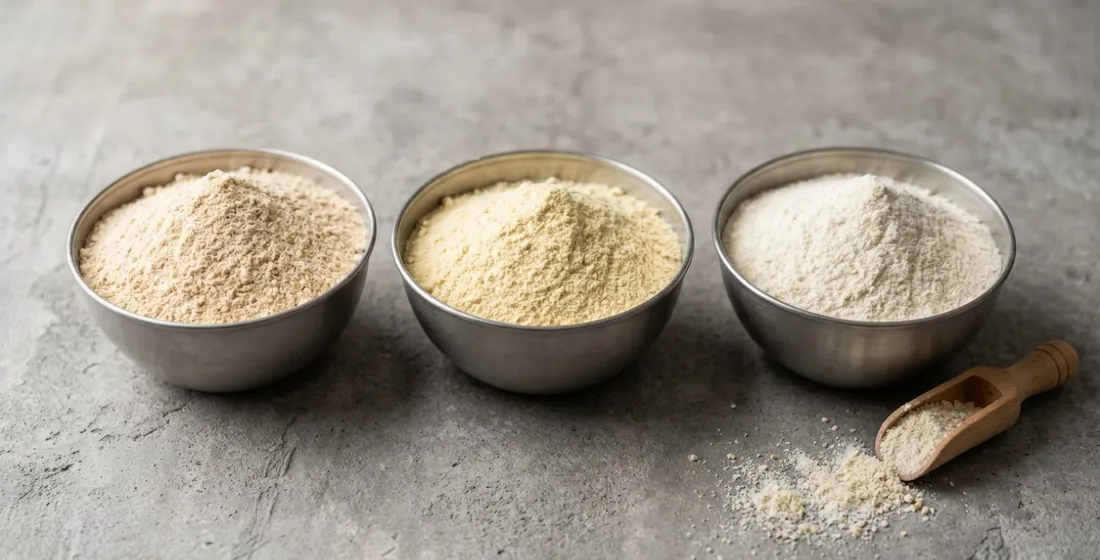
Three spray-dried bases, three different reasons to pick them. Soy milk powder carries the most protein, near 3.3 g per 100 ml reconstituted, and reads as the protein-claim base. Oat milk powder is the fastest-growing plant milk worldwide and wins on coffee performance and clean-label sweetness, but a gluten-free claim needs dedicated low-gluten oats below 20 ppm. Rice milk powder is naturally allergen-free and gluten-free, which makes it the free-from base, yet it carries an inorganic-arsenic burden that the EU caps at 0.03 mg/kg for rice-based drinks. For powder destined for global distribution, the choice of base sets the protein claim, the allergen declaration, the contaminant gate, and how much carrier the spray dryer needs. Silk Foods Ceylon (SFC) co-manufactures plant milk powders, including coconut-blend formats, under BRCGS and FSSC 22000 V6.
A buyer choosing a plant milk powder for export rarely has a flavour problem. They have a positioning problem. The brief usually arrives as “we want a plant milk powder,” and the real questions sit one layer down: how much protein does the label need to carry, which allergens and contaminants will gate the destination markets, and what does the powder cost to ship and reconstitute on the other side of the world. Oat, soy, and rice answer those three questions in three different ways.
This guide compares the three spray-dried bases on the specs that decide a global-distribution program, then sets out where a Sri Lankan manufacturer fits and, just as usefully, where it does not.
Three plant milks, three different reasons to choose them
Plant milk is no longer a single category a buyer enters, it is a shelf of bases that each own a different shopper. The global plant-based milk market sat near USD 19.5 billion in 2025 by Fortune Business Insights’ estimate, and oat milk is the fastest-growing slice, projected by Grand View Research to compound in the low-double-digits and already accounting for roughly 40 percent of plant-milk volume in Britain by early 2025. Soy is the incumbent protein base, rice is the free-from base, and oat is the growth base. A sourcing decision starts by naming which of those three jobs the powder has to do.
That framing matters because the bases are not interchangeable on a spec sheet. Swapping rice for soy to chase a protein claim changes the allergen declaration. Swapping soy for oat to chase coffee performance opens a gluten-free question. Each move that helps one part of the brief usually triggers a new requirement somewhere else.
Protein, fat, and flavour: what separates the three bases
The single widest gap between the three bases is protein. Testing published by the Hong Kong Consumer Council in 2021 put soy milk at an average 3.26 g of protein per 100 ml, far ahead of every other plant milk it measured, with rice milk among the lowest at 0.19 g per 100 ml. Oat sits in between, with most commercial oat milks landing near 0.8 to 1.7 g per 100 ml once reconstituted. For a brand that wants a front-of-pack protein claim without fortification, soy is effectively the only one of the three that gets there on its own.
Fat and flavour separate them next. Oat reads naturally sweet because the process hydrolyses oat starch into maltose, and it delivers a creamy mouthfeel that performs in coffee, which is the engine behind its growth. Soy brings the fullest body and the most protein, paired with a characteristic note that formulators mask with vanilla, salt, or a touch of sweetener. Rice is light, sweet, and thin, with very little fat or protein to build body, which is why rice milk SKUs often lean on added oil or stabiliser to avoid reading as sweet water. Each base simply has its own personality, and the spray-dried powder inherits it.
Oat vs soy vs rice milk powder, side by side
The table below compares the three spray-dried bases on the attributes that drive a sourcing and distribution decision. Figures are typical reconstituted values for unfortified bases and will shift with formulation.
| Attribute | Oat milk powder | Soy milk powder | Rice milk powder |
|---|---|---|---|
| Protein (per 100 ml) | Low to moderate, ~0.8 to 1.7 g | Highest, ~3.3 g | Lowest, ~0.2 g |
| Body and fat | Creamy from beta-glucan, low fat | Full body, moderate fat | Thin, very low fat |
| Flavour | Naturally sweet, coffee-friendly | Protein-forward, masks well | Light, sweet, watery |
| Allergen status | Not a major allergen, but gluten cross-contact risk | Declared major allergen (US and EU) | Naturally allergen-free |
| Gluten | Needs dedicated oats below 20 ppm to claim gluten-free | Gluten-free | Gluten-free |
| Contaminant to watch | Pesticide and mycotoxin per grain | Hexane-extraction and GMO questions | Inorganic arsenic (EU drink cap 0.03 mg/kg) |
| Carrier load to spray-dry | Moderate | Lowest (protein self-carries) | Highest (low solids) |
| Best-fit positioning | Barista, clean-label creamer, RTD | Protein and meal-replacement SKUs | Free-from and hypoallergenic SKUs |
The carrier-load trap: why low-protein bases drink up more maltodextrin
Here is the part that does not show up until the first production run. Spray drying a plant milk needs a carrier, usually maltodextrin, to turn a thin slurry into a free-flowing powder. Peer-reviewed work on plant-based spray drying runs inlet air near 150 to 170 °C with carrier loads around 10 to 20 percent, and notes that maltodextrin, while it lifts encapsulation and bulk density, is hygroscopic and sticky and often has to be balanced with protein to dry cleanly. A base that already carries its own protein and solids, like soy, needs less added carrier. A thin, low-protein base like rice needs more.
That is the carrier-load trap. The leaner the base looks nutritionally, the more maltodextrin the dryer wants, and that carbohydrate lands on the finished label and dilutes the very profile the buyer was selling. A rice milk powder can leave the dryer reading more like a sweetened starch powder than a milk. The fix is not to fight the chemistry, it is to choose the base with the distribution claim in mind and to specify the carrier ceiling on the RFQ, not discover it on the certificate of analysis.
Allergen and contaminant rules travel with the base
The base a buyer picks does not just set flavour, it sets the regulatory file. Soy is one of the major allergens that must be declared on-pack in the United States under the Food Allergen Labeling and Consumer Protection Act and across the EU under the Annex II allergen list, so a soy milk powder ships with a mandatory allergen declaration and the cross-contact controls that come with it. Oat is not a named allergen, but oats pick up gluten in the field and the supply chain, and any gluten-free claim under FDA and Codex rules requires the finished product to stay below 20 ppm gluten, which means dedicated low-gluten oats and batch testing, not ordinary commodity oats.
Rice trades the allergen problem for a contaminant one. Rice concentrates inorganic arsenic from soil and water, and the EU tightened its limits under Commission Regulation 2023/465, applicable from March 2023, setting 0.03 mg/kg for rice-based drinks, 0.15 mg/kg for milled rice, and 0.02 mg/kg for infant formula. A rice milk powder reconstituted into a drink has to land under the drink ceiling, and any SKU aimed at young children sits against the tightest limits of all. One private-label buyer SFC’s trade desk worked with in early 2026 had built a rice milk powder for the EU on lowest-cost commodity rice, then watched a pre-shipment arsenic result climb toward the drink limit and had to re-source the rice and re-test before a single pallet moved. The lesson was not that rice is unsafe, it is that the contaminant gate belongs in the sourcing spec from day one, not in the pre-shipment lab report.
Spec snapshot: plant milk powder, any base
Hold these regardless of which base you choose, then layer the base-specific line on top.
- Moisture: typically 3 to 5 percent for shelf stability
- Particle size and mesh: specify for the reconstitution and mouthfeel you want
- Solubility and dispersibility: instantised or lecithin-agglomerated where cold reconstitution matters
- Bulk density and scoopability: set for the sachet or canister fill
- Microbial: total plate count, yeast and mould, Enterobacteriaceae, pathogen-negative
- Carrier declaration: name the maltodextrin or carbohydrate carrier and cap its percentage
- Base-specific: allergen declaration for soy, gluten-free certificate for oat, inorganic-arsenic result for rice
- COA per batch, with the contaminant or allergen line that matches the base
Powder, not liquid: what changes for global distribution
For a program that ships across oceans, powder is usually the format that makes the economics work. Drying a plant milk removes the water that a buyer would otherwise pay to freight and refrigerate, turns a chilled, short-life liquid into an ambient-stable powder, and lets the brand reconstitute close to the consumer. That is why powder, rather than aseptic liquid, is the default for plant milk sold into distant or warm-climate markets where cold chain is expensive or unreliable.
The trade-off is reconstitution. A powder only sells the second time if it disperses cleanly in cold water without lumping, so dispersibility moves from a nice-to-have to a core spec, and instantising steps such as lecithin agglomeration earn their cost. This is the same discipline covered in the SRV guide to spray-dried plant milk powder for global distribution, and it applies whether the base is oat, soy, rice, or a coconut blend. Buyers weighing format and shelf-life math will also find the plant-based and functional food contract manufacturing guide a useful companion, since the powder line and the finished-format line are often quoted together.
Where Sri Lanka fits, and where it does not
Now the honest part. Oats, soybeans, and rice are not Sri Lanka’s native raw materials the way coconut is, so a buyer who wants a pure single-grain oat milk powder at the lowest possible landed cost will often be served best by a processor sitting on the oat or soy belt in Europe or North America, where the grain is local and the freight is short. Silk Route Ventures (SRV) says that plainly rather than pretending otherwise.
Where a Sri Lankan manufacturer earns the work is in three places. First, coconut and coconut-blend plant milk powders, where the coconut fraction is indigenous, traceable to Central Province estates, and carries the fat and creaminess that a lean oat or rice base lacks. Second, dual-cert co-manufacturing for brands distributing into Asia, the Middle East, and Australia, where a BRCGS and FSSC 22000 V6 facility close to those lanes shortens the route. Third, low-MOQ private label and contract manufacturing for brands testing a plant milk powder before they commit to a full container, the same lean-route logic SRV applies across its co-manufacturing work. SFC mills, blends, and spray-dries to format under BRCGS and FSSC 22000 V6, with a certificate of analysis per batch and single-origin coconut traceability, and it will tell a buyer when a grain-belt processor is the better answer for a pure single-grain brief.
Buyer’s checklist: choosing a plant milk powder base
- Name the job first: protein claim (soy), growth and coffee (oat), or free-from (rice)
- Set the protein floor on the label and check the unfortified base can reach it
- Confirm the allergen declaration (soy) or gluten-free certificate (oat) the destination needs
- For rice, put the inorganic-arsenic limit in the sourcing spec, not the pre-shipment test
- Cap the maltodextrin carrier percentage so it does not dilute the claim
- Specify dispersibility for cold reconstitution, with instantising where needed
- Ask whether a coconut blend solves the body or fat gap a lean base leaves
- Match certification (BRCGS and FSSC 22000 V6) and MOQ to your launch volume
FAQ
Which plant milk powder has the most protein, oat, soy, or rice?
Soy milk powder carries the most protein by a wide margin. Hong Kong Consumer Council testing in 2021 measured soy milk at about 3.26 g of protein per 100 ml, against roughly 0.19 g for rice and 0.8 to 1.7 g for oat. For an unfortified front-of-pack protein claim, soy is effectively the only one of the three that reaches it.
Why does rice milk powder face an arsenic limit when oat and soy do not?
Rice concentrates inorganic arsenic from soil and water in a way oats and soybeans do not. EU Commission Regulation 2023/465, applicable from March 2023, caps inorganic arsenic at 0.03 mg/kg for rice-based drinks and 0.02 mg/kg for infant formula. A rice milk powder reconstituted into a drink must meet the drink ceiling, so the limit belongs in the sourcing spec.
Does a gluten-free oat milk powder need special oats?
Yes. Oats are not a named allergen, but they pick up gluten through shared fields and supply chains. To claim gluten-free under FDA and Codex rules, the finished product must stay below 20 ppm gluten, which requires dedicated low-gluten oats and batch testing rather than ordinary commodity oats. Build that requirement into the RFQ.
Can a Sri Lankan manufacturer make oat, soy, or rice milk powder, not just coconut?
Yes, as a contract manufacturer and co-packer. Silk Foods Ceylon spray-dries and blends plant milk powders, including oat, soy, rice, and coconut-blend formats, under BRCGS and FSSC 22000 V6 with a certificate of analysis per batch. Its sharpest edge is coconut and coconut-blend powders, and it will flag when a grain-belt processor better fits a pure single-grain, lowest-cost brief.
How Silk Route Ventures can help
Silk Route Ventures and Silk Foods Ceylon co-manufacture plant milk powders for brands distributing globally, from coconut and coconut-blend powders built on indigenous, traceable raw material to oat, soy, and rice formats run as contract manufacturing on dual-cert spray-drying lines. The team works to a published spec stack: BRCGS and FSSC 22000 V6 certification, a certificate of analysis per batch, named carrier ceilings, the allergen or contaminant line that matches the base, and low-MOQ private-label runs for brands testing a powder before they commit to a container. Buyers comparing bases can send a target protein claim, destination markets, and launch volume, and the team will return a base recommendation, a draft spec, and an honest read on whether a coconut blend or a grain-belt processor better fits the brief.