
Contract Manufacturing
Market: USA primary; EU and UK secondary; AU tertiary
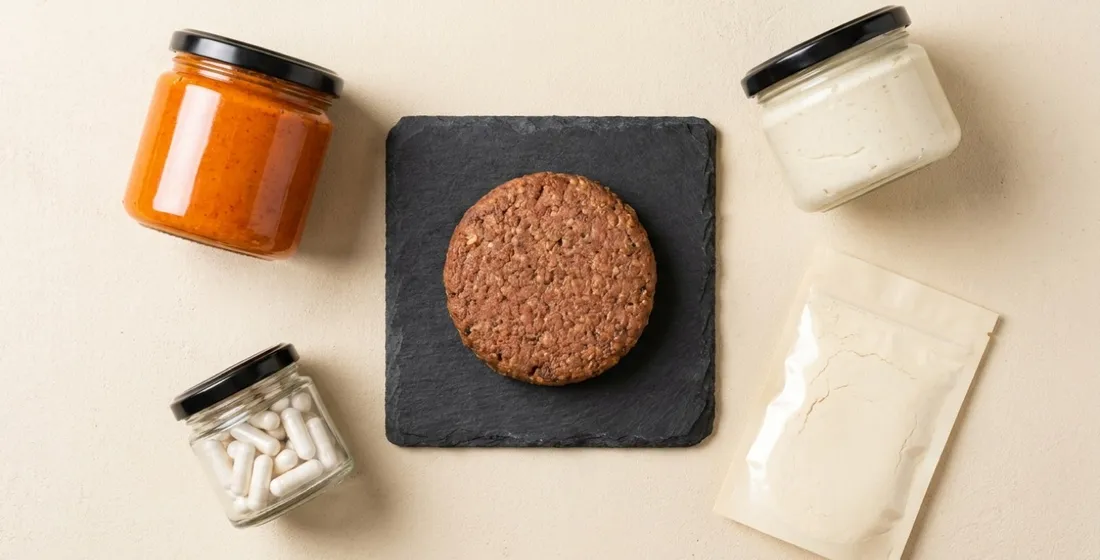
A snapshot of finished output from a single contract manufacturing facility: plant-based patty, retorted spread, non-dairy cheese, spray-dried plant milk powder, and herbal capsules. All five formats produced under one cert stack at Silk Foods Ceylon, Matale. Higgsfield-generated; visual QC passed (zero branding).
By Silk Route Ventures Trade Team. 12 May 2026.
Buyer's snapshot
|
Picking a contract manufacturer is the single decision that locks in two years of CPG unit cost. Founders agonize over recipe and packaging. Procurement leads stress over MRL and audit. The factory partner ties both, and the wrong pick ends with a brand stuck explaining a recall to a Whole Foods buyer or watching margin evaporate at the second freight cycle.
Most CPG scale-up buyers evaluating Asia start with Vietnam or Thailand for plant-based meat, India for botanicals, and Indonesia for coconut. That habit makes sense when each platform is sourced separately. It breaks when a single brand wants to ship a spread, a nugget, a plant milk, and a capsule under the same brand and the same audit. The supplier count quietly hits four, and four supplier audits become the buyer’s full-time job.
This piece walks through what contract manufacturing actually covers at Silk Route Ventures and its Matale-based manufacturing arm, Silk Foods Ceylon. The service stack. The production-line capability matrix. The five product platforms SFC ships against. The engagement workflow from first feasibility call to dispatched container. And the brief profiles where SFC is the right CM partner and the brief profiles where it isn’t.
What does contract manufacturing actually cover at Silk Foods Ceylon?
Five service modes, often combined in a single buyer engagement:
| Service mode | What the buyer brings | What SFC does | Best fit |
|---|---|---|---|
| Co-Development | An idea, target spec, target market | Formulation work, recipe development, pilot batches, scale-up plan, regulatory mapping | First-time founders and brands launching a new SKU category |
| Co-Processing | Raw material, sourced by the buyer or SFC | Washing, sorting, drying, peeling, dicing, crushing, grading, sieving against the buyer’s spec | Brands needing intermediate processing before finished-product work |
| Contract Manufacturing | Locked formulation and spec | End-to-end production: prep, cooking, retort or freeze, packaging, QA, dispatch | CPG scale-ups moving beyond founder-kitchen or small US/EU co-packer |
| Co-Packing | Finished or semi-finished product, sometimes packaging too | Filling, capping, labeling, batch coding, secondary packing for shipment | Brands with a finished product that need a packaging partner |
| Private Labelling | Brand and label | SFC-developed product manufactured under buyer’s brand | Specialty retailers and distributors launching own-label SKUs |
Source: Silk Foods Ceylon service specifications, 2026. Co-Development engagements run as a parallel workstream alongside production planning, not as a sequential phase.
Most buyer engagements combine three of the five. A typical CPG scale-up brings a locked formulation (no Co-Development), uses SFC sourcing for raw material (Co-Processing covered upstream), runs full production at SFC (Contract Manufacturing), and ships finished retail-ready SKUs (Co-Packing rolled in). The pricing is per finished unit, not per service line.
The production-line capability matrix
The Silk AgTech Park facility runs eight integrated production lines. Each line carries the equipment listed in the Silk Foods Ceylon brochure (2026); capacity is what the equipment actually outputs in a single-shift production day.
| Production line | Equipment + process | Output capacity |
|---|---|---|
| Cooking and preparation (solid foods) | Vegetable peeler, bubble washer, dicing machine, jackfruit peeler, fruit and veg crusher, steam-jacketed and standard kettles, mixing tank, battering, breading, and frying machines | Plant-based patties: 15,000 units/day; nuggets: 30,000 units/day |
| Retort line (jars, cans, retort pouches) | Retort machine for bottled, canned, and retort-packed items; CIP unit; pipe-type duplex filters; water cooling tower; jacketed kettles upstream | Glass jar spreads, sauces, semi-liquids: 3,000 × 300g jars/day |
| Liquid filling line | Homogenizer, colloid mill / wet grinder (adjustable particle size), liquid filling machine, glass bottle capping machine | Beverage / liquid products: 2,500 × 200ml bottles/day |
| Spray drying line | Preparation tank, pipe-type duplex filter, colloid mill / wet grinder, spray drier machine | Spray-dried plant milks and powders: 50 kg/day |
| Non-dairy cheese line | Cheese vat, cheese press, dedicated CIP | Vegan cheese spreads, blocks, and shreds (capacity scoped per SKU) |
| Dry processing line (spices, herbs, capsule fill) | Industrial blender, universal crusher (BSU 40), pulverizer (BSP 450), coarse crusher (BSC 300), sieve machines, destoner, grading machine, screw feeder, drying machine, capsule machine | Spices, herbs, fruit powders: 100 to 200 kg/hour, or 1 to 2 MT/day. Capsules: 100,000/single shift, 200,000/day |
| Packaging (primary) | Form-fill packing machine (auto-form, adjustable weight), liquid filling and capping, capsule bottle filling, vacuum sealer, band sealer | Aligned to production line throughput |
| Storage and utilities | Reefer storage (frozen and chilled), boiler (steam supply), generator (backup power), air compressor | Cold chain supported through dispatch |
Source: Silk Foods Ceylon equipment register and production capacity sheet, 2026. The cellular layout means equipment moves between platform runs without dedicated re-audit; FSSC 22000 V6 scope covers all eight lines under one certification.
****The capability matrix is the differentiator most procurement teams don’t think to ask about until their second SKU launch. Single-platform CM partners (Vietnamese plant-based meat specialists, Indonesian coconut processors, Indian botanical co-packers) optimize one line and lock the buyer in. The cellular layout at SFC means new SKU introductions don’t need a separate supplier qualification cycle. The same audit that cleared the patty line clears the spread, the cheese, the powder, and the capsule.
The five product platforms Silk Foods Ceylon ships against
Buyers usually approach SFC with a single product in mind. Across the five platforms, the same engagement framework applies; the formats and the MOQs differ.
| Platform | Examples (formats SFC ships against) | Primary line | MOQ / capacity |
|---|---|---|---|
| Plant-based meat alternatives | Burger patties; nuggets; sausage; chicken alternative; pre-minced mix; seitan; jackfruit-in-brine (chunks, pulled, minced); ready-to-heat retort SKUs (curry, smokey BBQ, teriyaki, tomato + basil) | Cooking + prep, retort | Unit minimums confirmed on your quote; 15K patties/day, 30K nuggets/day at scale |
| Retorted spreads, sauces, semi-liquids | Vegan cheese spreads (classic, with spices); vegan cashew cheese; coconut spread; vegan mayo; coconut jam (original, ginger, cinnamon, cocoa, pineapple); kithul + coconut treacle in jars | Retort + semi-liquid | Unit minimums confirmed on your quote; 3,000 jars/day at scale |
| Non-dairy cheese | Vegan cashew cheese, vegan cheese spreads (block or jar formats) | Non-dairy cheese line | Scoped per SKU; shares retort capacity |
| Spray-dried plant milks and powders | Oat, soy, coconut, rice milk powders; fruit and vegetable powders; functional botanical powders | Spray drying | 50 kg/day single-day batch; 100 kg per SKU first-run minimum |
| Functional beverages and capsules | Kombucha (classic, mint chocolate); vegan plant milks (oat, soy, rice, retorted glass bottles); herbal capsules across 18+ SKUs (ashwagandha, moringa, triphala, etc.) | Liquid filling, capsule line | Beverages: unit minimums confirmed on your quote, 2,500/day at scale. Capsules: capsule MOQ confirmed on your quote; 200,000/day at scale |
Source: Silk Foods Ceylon product platform sheet, 2026. Per-SKU MOQs scale up volume-tier pricing at 500, 1,000, and 2,500 kg for bulk; per-unit equivalents for finished SKUs (jars, bottles, capsules) scale similarly.
Spec snapshot: the 5-platform CM offer in one view Plant-based meat: patties, nuggets, sausages, chicken alternatives, seitan, jackfruit-in-brine. Retort-ready or frozen formats. Unit minimums confirmed on your quote. Retorted spreads, sauces, semi-liquids: glass-jar finished SKUs. 300g standard fill, retort-stabilized for ambient shelf life. Unit minimums confirmed on your quote. Non-dairy cheese: vegan cashew cheese, spreadable formats, block cheese. Dedicated non-dairy line with CIP between SKUs. Spray-dried plant milks and powders: oat, soy, coconut, rice; fruit and vegetable powders. 50 kg single-day batch capacity. Shelf-stable, freight-efficient. Functional beverages and capsules: kombucha, retorted plant milks in glass; 60-count capsule bottles for botanicals. Capsule MOQ confirmed on your quote. Across all five: one cert stack (FSSC 22000 V6 and BRCGS, with USDA Organic and EU Organic on selected SKUs, confirmed per SKU). One audit. One PO. One container. |
The 7-step contract manufacturing engagement
First-run timeline averages 10 to 14 weeks. Subsequent reorders collapse to 4 to 6 weeks once formulation, artwork, and supplier paperwork are locked. The seven steps:
- Discovery and feasibility (week 1). Buyer briefs SRV on target product, target market, target shelf format, target retail price points, regulatory constraints (claim platform, MRL, allergen, halal or kosher). SFC responds with a feasibility note: which platform fits, which line will run the SKU, indicative MOQ and pricing, and any flag for equipment SFC doesn’t operate yet (extrusion-based meat analogs, freeze-drying at industrial scale, aseptic filling).
- Samples. Samples are free for evaluation (you cover the courier). For complex SKUs, samples are produced from existing stock formulations; for new formulations, sample dispatch waits on pilot batch.
- Spec lock and pricing (week 3). Buyer confirms formulation, fill weight, packaging format, label claim platform. SRV provides a FOB Colombo quote with breakdown of RM cost, processing cost, packaging cost, and indicative landed-cost estimate to the buyer’s destination port.
- Pilot run if needed (week 4 to 6). For new formulations, a pilot production run validates the spec at small batch. The pilot output is shipped to the buyer for retail-context evaluation (taste panel, shelf-life test, packaging audit). Co-Development engagements add this step; pure CM engagements skip it.
- Locked formulation and PO (week 6 to 7). Buyer issues PO with the appropriate advance: orders under $10,000 are 100% advance by bank transfer; orders of $10,000 or above run 50% advance with the 50% balance against scanned shipping documents. PayPal is accepted for sample payments only, not for production orders. Production line scheduled within 5 business days of advance receipt.
- Full production with QA (week 7 to 11). The production run executes on the relevant line. A COA is available on request; specific parameters are tested per buyer’s spec through an external laboratory on request (typically heavy metals, microbial panel, pesticide MRL aligned to destination market, allergen verification for plant-based meat SKUs sharing equipment with non-allergen lines).
- Freight and dispatch (week 11 to 14). Sea freight transit: AU 3 to 4 weeks; EU 3 to 4 weeks; US 4 to 5 weeks. Air freight (port-to-port) 3 to 4 days for urgent reorders. Standard shipping documentation pack at BL or AWB release: Commercial Invoice, Packing List, Bill of Lading or Air Waybill, Certificate of Origin, a Phytosanitary Certificate where the destination requires it, and, if applicable, the organic import certificate the destination requires (EU or GB Certificate of Inspection, USDA NOP Import Certificate). A COA and additional documents are available on request.
The pattern most CPG scale-ups follow
****First-time CM buyers at SFC tend to land at one of three scale moments. The pattern most common: a brand has run six to twelve months on a small US, EU, or Australian co-packer, hit a capacity wall (the co-packer can’t take the next month’s volume), and discovered that the co-packer’s pricing got better when they had bargaining power but doesn’t get better when the brand grows.
An anonymized example. A US-based coconut spread brand started with Silk Foods Ceylon in 2021. The first run was 5,000 jars of a single SKU, retort-stabilized in 300g glass with a plain kraft label. Three weeks of prep, two days of production, and a 4-week sea freight to the East Coast. By 2024, the same brand had moved to multi-container monthly orders across three SKUs and was the longest-running CM relationship at the Matale site. The trigger that scaled the relationship wasn’t price. It was the second SKU launch. When the brand added a chocolate-coconut variant in 2022, they didn’t need to qualify a new supplier. The same SFC audit, the same regulatory documentation, the same freight schedule absorbed the SKU expansion. That’s the cellular manufacturing advantage in practical terms.
Where Silk Foods Ceylon is the right CM partner, and where it isn’t
The four buyer profiles where SFC is the right fit:
- Multi-platform CPG scale-ups. Brands launching across two or more of the five platforms (e.g., a vegan spread + a plant milk powder + a botanical capsule line). One audit covers all three.
- Brands with EU or US retail listings requiring GFSI. FSSC 22000 V6 clears the gating filter without an extra supplier qualification cycle.
- Founders who want Co-Development without locking in single-platform supplier. The R&D team scopes formulation in parallel with production planning, not as a separate consulting engagement.
- Brands rebuilding spec after a recall or audit event. Particularly after the 2024 FDA cinnamon lead recall, brands rebuilding around clean documentation prefer dual-cert facilities that share full COA and traceability records.
And the buyer profiles where SFC walks away, named honestly:
Where SFC's CM doesn't fit Mass-market private label for discount retail. Walmart, Aldi, Lidl, dollar stores. The pricing those programmes demand sits below the cost of producing under FSSC 22000 V6 audit and shipping with the standard documentation pack. High-volume single-SKU commodity production. If the brief is 100 containers a year of one SKU at sub-Ceylon FOB pricing, a single-platform Vietnamese or Indonesian CM partner with dedicated lines wins on per-unit cost. SFC's cellular flexibility is the wrong optimization for that brief. Formulations requiring equipment SFC doesn't operate yet. Twin-screw extrusion for textured vegetable protein (some specialized meat analogs need it). Industrial-scale freeze drying. Aseptic filling for shelf-stable beverages without retort. SFC names the gap honestly in the feasibility note and points the buyer toward CM partners that fit. Pre-revenue brands without a formulation or a route to market. Co-Development requires the buyer to have an end-customer and a distribution plan. SFC is a manufacturer, not a brand-building consultancy. |
Buyer’s checklist: are you ready for a CM engagement at SFC?
CM-readiness checklist
|
Frequently asked questions
What does food and beverage contract manufacturing in Sri Lanka actually cover?
Silk Foods Ceylon (SFC) covers five service modes under one cert stack (FSSC 22000 V6 and BRCGS, with USDA Organic and EU Organic on selected SKUs, confirmed per SKU): Co-Development (formulation work and pilot batches), Co-Processing (washing, sorting, drying, peeling, dicing of raw material), Contract Manufacturing (end-to-end production against a locked spec), Co-Packing (filling, capping, labeling), and Private Labelling (SFC-developed product under the buyer’s brand). The same facility scope ships plant-based meat alternatives, retorted spreads and sauces, non-dairy cheese, spray-dried plant milks, functional beverages, and herbal capsules.
What’s the MOQ for contract manufacturing across the five product platforms?
Plant-based patties and nuggets: unit minimums confirmed on your quote; capacities scale to 15,000 patties/day and 30,000 nuggets/day. Retorted spreads in glass jars: unit minimums confirmed on your quote, 3,000 jars/day at scale. Beverages in glass bottles: unit minimums confirmed on your quote, 2,500/day at scale. Spray-dried plant milk powder: 100 kg per SKU first-run minimum, 50 kg/day single-day batch. Herbal capsules: capsule MOQ confirmed on your quote, scaling to 200,000/day. Bulk spices and herbs: 100 kg per SKU first order (dried herbs from 25 kg per SKU), scaling to 100 to 200 kg/hour throughput.
What does a contract manufacturing engagement look like end-to-end?
Seven steps over 10 to 14 weeks for a first-time buyer: discovery and feasibility (week 1); samples, free for evaluation (you cover the courier); spec lock and pricing (week 3); pilot run if needed (week 4 to 6); locked formulation and PO with appropriate advance (week 6 to 7); full production with QA (week 7 to 11); freight and dispatch (week 11 to 14). Reorders collapse to 4 to 6 weeks once formulation, artwork, and supplier paperwork are locked.
Where does Silk Foods Ceylon walk away as a CM partner?
Mass-market private label for discount retail (Walmart, Aldi, dollar stores). High-volume single-SKU commodity production at sub-Ceylon FOB pricing. Brands with formulations requiring equipment SFC doesn’t yet operate (twin-screw extrusion for textured meat analogs, industrial-scale freeze drying, aseptic filling for shelf-stable beverages without retort). For those briefs, SFC names the gap honestly and points the buyer toward Vietnamese, Thai, or Indonesian CM partners that fit.
Can Silk Foods Ceylon source the packaging and ingredients itself, or work with our existing suppliers?
Both, with full flexibility. Buyers with their own ingredient or packaging suppliers brief Silk Foods Ceylon on the supplier and the spec, and SFC handles ordering, importing, customs clearance at Colombo, intake, and packing under the production run. Buyers without supplier relationships use the SFC sourcing network (spices and herbs at origin, organic certified on selected SKUs and confirmed per SKU; coconut from approved Sri Lankan coconut processors; glass and kraft packaging from regional suppliers). The consolidation moves the supply chain into one operator, which is often the breakthrough for a brand whose current CM partner forces split-supplier complexity.
How Silk Route Ventures can help
Silk Route Ventures (SRV) runs end-to-end food, beverage, and functional CPG contract manufacturing through the Silk Foods Ceylon (SFC) facility in Matale, Sri Lanka. The site holds FSSC 22000 V6 and BRCGS, with spices covered under FSSC 22000, across the processing scope: plant-based meat alternatives (15,000 patties/day, 30,000 nuggets/day); retorted spreads and sauces (3,000 × 300g jars/day); non-dairy cheese; spray-dried plant milks (50 kg/day); functional beverages (2,500 × 200ml bottles/day); herbal capsules (200,000/day); bulk spices and herbs (1 to 2 MT/day). USDA Organic and EU Organic on selected SKUs, confirmed per SKU. Samples are free for evaluation (you cover the courier). Production lead time from PO advance to dispatch is 2 to 3 weeks for standard SKU reorders (4 to 6 weeks for private label, custom specifications and organic orders), 10 to 14 weeks for first-time engagements with Co-Development. Payment terms: 100% advance under $10,000 by bank transfer; 50/50 above $10,000 against scanned shipping documents. In-house design team available for Private Labelling and Total OBM. Contact us to send an inquiry for a CM capability briefing tailored to your SKU and target launch volume. For a first-order quote, start with our Ceylon spices supplier.
Sources
- Silk Foods Ceylon (Pvt) Ltd, Food and Beverage Contract Manufacturing Brochure, 2026. Internal source documenting equipment register, services, certifications, and product platforms.
- FSSC Foundation, FSSC 22000 V6 standard documentation. Retrieved 2026-05-12. https://www.fssc.com/
- US Food and Drug Administration, Food Safety Modernization Act (FSMA) Rule 204: Requirements for Additional Traceability Records for Certain Foods. Retrieved 2026-05-12. https://www.fda.gov/food/food-safety-modernization-act-fsma/fsma-final-rule-requirements-additional-traceability-records-certain-foods
- The Good Food Institute, Plant-Based State of the Industry Report 2024. Retrieved 2026-05-12. https://gfi.org/marketresearch/
Further reading
- Sri Lanka Export Development Board, Food and Beverage Export Sector data. srilankabusiness.com
- Global Food Safety Initiative (GFSI), recognized schemes overview. mygfsi.com
- BRCGS Global Standard for Food Safety overview. brcgs.com
About the author
Written by the Silk Route Ventures Trade Team. Silk Route Ventures (E-Silk Route Ventures (Pvt) Ltd, T/A Silk Route Ventures) is a Sri Lankan B2B supply-chain operator for the Food, Beverage, Wellness, and Nutraceuticals sectors. The Silk Foods Ceylon manufacturing arm in Matale operates under FSSC 22000 V6 and BRCGS. Questions or to request a sample: Contact us or email info@esilkroute.com.lk.