
Spray-Dried Plant Milk Powder for Global Distribution
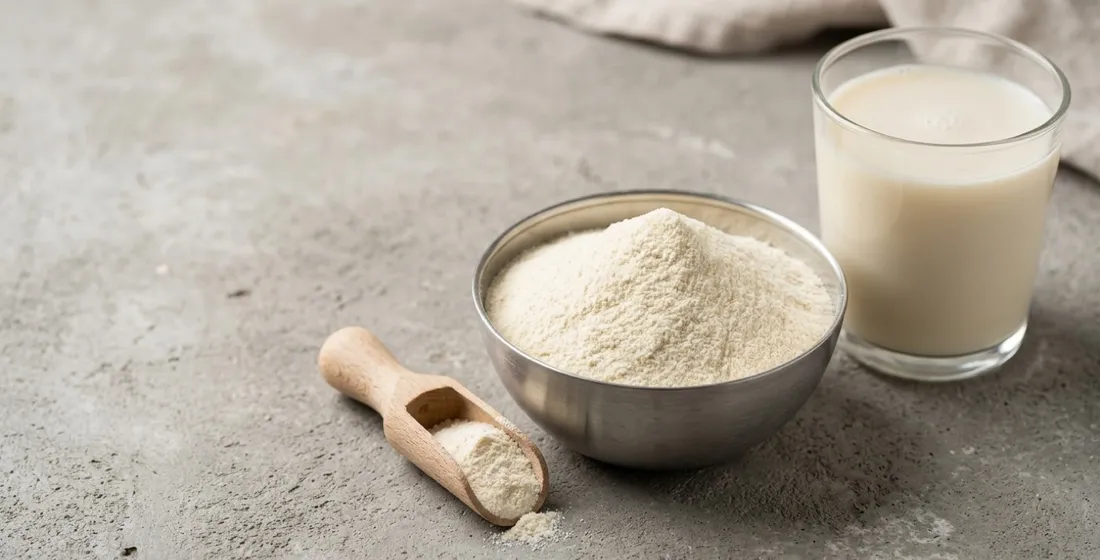
Fine spray-dried plant milk powder with a glass of reconstituted plant milk.
Buyer’s snapshot
- The global plant-based milk market was valued at roughly USD 22.53 billion in 2025 and is projected to reach about USD 46.57 billion by 2035, a 7.53% CAGR (Precedence Research, 2025). Oat is the fastest-growing segment.
- Shelf-stable formats took 61.3% of the oat milk market in 2025 (Future Market Insights, 2025). For a brand shipping across oceans, powder removes the water, the reefer, and most of the freight bill.
- One 800 g pouch of oat milk powder reconstitutes to roughly 8 litres. Shipping the powder instead of the carton means moving 800 g instead of about 8 kg per 8 litres of finished drink.
- Silk Foods Ceylon (SFC) spray-dries oat, soy, rice, and coconut milk powder at 50 kg/day under BRCGS and FSSC 22000 V6, with a 100 kg first-order MOQ.
- This post is the spec sheet for CPG R&D and procurement teams choosing a powder format for global distribution. For chilled, fresh-format domestic brands, liquid is still the better answer.
Most brands evaluating plant milk powder start with the wrong question. They ask what the powder costs per kilogram. The question that actually decides the project is what the powder costs to land in the destination market, reconstituted, on a shelf that does not need refrigeration. Liquid plant milk is mostly water. Shipping water from a Sri Lankan or Southeast Asian plant to a US or EU distributor means paying ocean freight, duty, and often a refrigerated supply chain to move a product that is 85 to 92% water by weight. Spray-dried powder strips that water out at origin and lets the buyer add it back where the drink is consumed. The math is harder than the marketing makes it sound, and it does not favour powder in every case. This piece walks through the spec parameters, the mesh and dispersibility question, the water-activity ceiling that protects shelf life, and the cold-chain economics that decide whether powder is the right format for a given route to market.
What is spray-dried plant milk powder, and how is it different from liquid?
Spray-dried plant milk powder is a plant-milk base (oat, soy, rice, or coconut) concentrated and then atomized into a hot air stream that flashes off the water, leaving a dry powder that reconstitutes when a buyer or consumer adds water back. In a 2024 study published in Cereal Chemistry, researchers developing a stable oat milk powder found the optimal spray-drying inlet temperature was 160°C at a feed rate of 14 mL/min (Tian et al., Wiley, 2024). For procurement teams, the format difference is simple: liquid ships as finished drink and needs aseptic packaging or a cold chain, while powder ships as a shelf-stable ingredient and gets reconstituted downstream.
The trade-off sits in the processing energy. Spray drying is one of the most energy-intensive steps in food manufacturing, using up to 7 kWh per kilogram of water evaporated (Food Navigator, 2021). That cost is real, and it lands on the powder unit price. The buyer’s job is to weigh that processing premium against the freight and cold-chain savings on the other side. For a short domestic supply chain, the powder premium usually loses. For a 40-foot container crossing an ocean to a distributor who then sells ambient, the freight math frequently flips the decision. The same logic shows up in coconut milk powder fat-percentage selection, where the format decision drives the freight model more than the spec does.
Spec snapshot: spray-dried plant milk powder
Base options: oat, soy, rice, coconut (single-base or blended)
Moisture: typically below 4%, water activity close to 0.2 at 25°C
Particle size: agglomerated instant grade for dispersibility; fine grade for inclusion
Carrier: maltodextrin or native starch where dispersibility or drying yield requires it
Reconstitution: roughly 1 part powder to 7 to 9 parts water, base-dependent
SFC capacity: 50 kg/day spray-dry line; 100 kg first-order MOQ; BRCGS and FSSC 22000 V6
Which spec parameters actually matter on a plant milk powder RFQ?
The four parameters that decide whether a plant milk powder performs are moisture and water activity, particle size and mesh, dispersibility and wettability, and the carrier system. Moisture below 4% and a water activity near 0.2 at 25°C protect against caking and microbial growth; particle size governs how the powder reconstitutes; the carrier governs both drying yield and the clean-label claim. A spec that names all four protects the buyer from receiving a powder that clumps in the warehouse or refuses to disperse at the consumer’s kitchen counter.
Water activity is the parameter most brands underspecify. Spray-dried powders show a critical water activity inflection around 0.42 to 0.43, above which caking and clumping accelerate, and a second critical point between 0.7 and 0.8 where crystallization begins (research summarized by Neutec and AQUALAB, 2023). Holding the finished powder near 0.2 water activity at 25°C is what delivers the 12 to 18 month shelf life that makes the format worth shipping in the first place. A buyer who specs moisture percentage but not water activity has specified half the stability picture.
Powder format is not a quality upgrade over liquid. It is a logistics decision that happens to also extend shelf life. A brand that markets “powder because it is better” rather than “powder because it ships dry and stores ambient” usually ends up defending a claim the spec sheet does not support.
How do mesh, dispersibility, and agglomeration affect reconstitution?
Dispersibility is governed by particle structure, not just particle size. The porous structure of a spray-dried powder lets water penetrate the particle during reconstitution, which is why spray-dried plant milk powders generally reconstitute faster than ground or drum-dried equivalents. Agglomeration, clustering fine particles into larger porous granules, improves wettability and dispersibility further, which is the difference between a powder that sinks and dissolves on a quick shake and one that floats, clumps, and leaves lumps. The buyer specs an instant agglomerated grade for direct-to-consumer reconstitution and a finer grade for industrial inclusion.
The initial interaction with water is determined by the powder’s surface area, particle size, and hydrophobicity, and adding maltodextrin significantly changes wettability by modifying the particle surface (Food and Nutrition Journal, 2023). This is why two oat milk powders with identical protein and fat on the COA can perform completely differently in a glass: one was agglomerated and carrier-balanced for dispersibility, the other was spray-dried to a fine non-instant powder optimized for drying yield. Both are legitimate. They are not interchangeable, and the RFQ has to say which one the application needs.
In Q1 2026, the SRV trade desk fielded a recurring pattern: brands sending a competitor’s liquid oat milk and asking for “the same thing as a powder.” The reconstitution behaviour, not the nutritional panel, is what they were actually chasing. The spec conversation that follows is always about mesh, agglomeration, and carrier, never about the headline protein number.
What does the cold-chain math actually look like for global distribution?
The cold-chain math is the core reason a brand chooses powder for export. Liquid plant milk is 85 to 92% water; shipping it across an ocean means paying freight on that water and, for fresh formats, paying for a refrigerated supply chain on top. One 800 g pouch of oat milk powder reconstitutes to about 8 litres of drink, so the powder route moves 800 g where the carton route moves roughly 8 kg of finished liquid for the same 8 litres (Food Navigator, reporting on Blue Farm, 2021). On a 40-foot container, that weight ratio reshapes the entire landed-cost model.
Consider the comparison directly.
| Factor | Shelf-stable liquid (aseptic carton) | Spray-dried powder |
|---|---|---|
| Water shipped | 85 to 92% of payload | Near zero (added at destination) |
| Cold chain required | No for aseptic; yes for chilled fresh | No (ambient stable) |
| Shelf life | 6 to 12 months aseptic | 12 to 18 months at water activity near 0.2 |
| Processing energy | Lower (no water removal) | Higher (up to 7 kWh per kg water evaporated) |
| Freight per litre finished | High (shipping water) | Low (water added downstream) |
| Best-fit route | Short domestic supply chains | Long ocean export, e-commerce, foodservice |
Source: SFC production data + Food Navigator (2021) + Future Market Insights (2025)
The honest read is that powder wins on freight and shelf life and loses on processing energy and reconstitution convenience. For a distributor importing from Asia into North America or the EU, where ocean freight and ambient storage dominate the cost stack, powder usually wins the landed-cost comparison decisively. For a chilled, fresh-format domestic brand with a refrigerated logistics network already in place, liquid is the more honest answer. SRV says so when that is the case, the same way it weighs format against unit cost on a vegan cheese spread retort co-pack or a functional beverage and kombucha co-pack.
Where the powder format does not fit
Chilled, fresh-format domestic brands with an existing refrigerated supply chain. Brands whose entire positioning is “fresh, never powdered.” Applications where reconstitution friction at the consumer’s end would hurt the product more than freight savings help the margin. For those briefs, an aseptic liquid co-pack is the more honest recommendation than forcing a powder format.
What base and carrier system should a buyer specify?
Base selection follows the application and the clean-label target, and the carrier follows the base. Oat is the fastest-growing base and reconstitutes to a creamy mouthfeel that suits coffee and direct-drinking; soy carries the highest protein; rice is the hypoallergenic neutral-flavour option; coconut delivers fat and a distinct flavour profile that suits dessert and culinary applications. Each base spray-dries differently, and high-sugar or high-fat bases often need a carrier such as maltodextrin or native starch to achieve a free-flowing, dispersible powder and an acceptable drying yield.
The carrier is where a clean-label claim can quietly break. Maltodextrin improves dispersibility and drying yield, but it becomes a declared ingredient on the finished pack, and for some retail positioning a maltodextrin line is a problem. A buyer chasing a two-ingredient clean-label oat powder needs to know upfront whether the formulation can hit the dispersibility target without a carrier, or whether the carrier-free version will reconstitute less cleanly. That trade-off is a formulation question for R&D, not a line item to discover at artwork stage. SRV scopes it at the sample stage so the clean-label decision is made before the first production run, not after. This format work sits inside the broader plant-based and functional food contract manufacturing capability, alongside plant-based patty co-manufacturing and the question of when a low-MOQ contract manufacturer is worth it.
Frequently asked questions
What is the shelf life of spray-dried plant milk powder?
Spray-dried plant milk powder typically holds a 12 to 18 month shelf life when finished moisture sits below 4% and water activity is held near 0.2 at 25°C (research summarized by AQUALAB, 2023). Shelf life is highly storage-dependent: heat and humidity push water activity toward the 0.42 to 0.43 caking threshold and shorten it. Specify water activity, not just moisture, on the COA.
Does spray-dried plant milk powder reconstitute as well as liquid?
It depends on the grade. An agglomerated instant grade disperses on a quick shake because its porous particle structure lets water penetrate quickly, while a fine non-instant grade optimized for drying yield reconstitutes more slowly. The 2024 Cereal Chemistry oat milk study confirms stabilizers and process parameters drive reconstitution quality (Tian et al., Wiley, 2024). Specify the grade for the application.
Is powder cheaper than liquid for global distribution?
For long ocean export it usually is, on a landed-cost basis. Powder removes 85 to 92% of the shipped weight (the water) and the cold chain, which dominate freight from Asia to North America or the EU (Food Navigator, 2021). It carries a higher processing cost (up to 7 kWh per kg water evaporated), so for short domestic supply chains liquid often wins. Compare landed cost per litre reconstituted, not powder price per kilogram.
Does Silk Route Ventures contract-manufacture private-label plant milk powder?
Yes. The Silk Foods Ceylon facility in Matale spray-dries oat, soy, rice, and coconut milk powder at 50 kg/day under BRCGS and FSSC 22000 V6, with a 100 kg first-order MOQ per SKU and a 2 to 3 week PO-to-dispatch lead time for standard SKUs (4 to 6 weeks for private label, custom specifications and organic orders). The SRV R&D team scopes base, carrier, and mesh against the buyer’s reconstitution target before the first run. Contact SRV for a sample.
What certifications cover plant milk powder manufacturing at SRV?
Silk Foods Ceylon holds BRCGS and FSSC 22000 V6, with the FSSC scope explicitly covering spray-dried plant-based milk powder, plus USDA Organic and EU Organic on relevant SKUs. For US, EU, and Australian buyers, that dual-cert coverage clears the GFSI gating filter most retailers require for Asian suppliers without an additional supplier audit. For the full picture, see what FSSC 22000 V6 actually covers and when USDA Organic and EU Organic dual certification pays back.
How Silk Route Ventures can help
Silk Route Ventures (SRV) supplies and contract-manufactures spray-dried plant milk powder (oat, soy, rice, coconut) for CPG brands and distributors building shelf-stable, export-ready formats. The Silk Foods Ceylon (SFC) facility in Matale runs a 50 kg/day spray-dry line under BRCGS and FSSC 22000 V6, with USDA Organic and EU Organic on relevant SKUs, a 100 kg first-order MOQ per SKU, and a 2 to 3 week PO-to-dispatch lead time for standard SKUs (4 to 6 weeks for private label, custom specifications and organic orders). The SRV R&D and NPD team scopes base, carrier system, mesh, and dispersibility against the buyer’s reconstitution and clean-label targets before the first run, so the format decision is settled at the sample stage. Contact us to send an inquiry for a co-manufacturing capability briefing or to request a sample. For grades, packaging and lead times, see our coconut products supplier.
Sources
- Precedence Research, “Plant-based Milk Market Size, Share, and Trends 2025 to 2035,” (2025). Retrieved 2026-06-08. https://www.precedenceresearch.com/plant-based-milk-market
- Future Market Insights, “Oat Milk Market Size, Trends, Demand and Forecast 2025 to 2035,” (2025). Retrieved 2026-06-08. https://www.futuremarketinsights.com/reports/oat-milk-market
- Tian, et al., “Development of spray-dried oat milk powder with improved stability,” Cereal Chemistry, Wiley (2024). Retrieved 2026-06-08. https://onlinelibrary.wiley.com/doi/10.1002/cche.10792
- Food Navigator, “Disrupting alt milk with oat powder: Blue Farm cuts packaging waste and transport miles,” (2021). Retrieved 2026-06-08. https://www.foodnavigator.com/Article/2021/05/03/Disrupting-alt-milk-with-oat-powder-Blue-Farm-cuts-packaging-waste-and-transport-miles/
- Food and Nutrition Journal, “Impact of Drying Techniques and Maltodextrin as a Carrier on the Flow and Reconstitution Properties of Oat Milk Powder,” (2023). Retrieved 2026-06-08. https://www.foodandnutritionjournal.org/volume13number2/impact-of-drying-techniques-and-maltodextrin-as-a-carrier-on-the-flow-properties-and-reconstitution-properties-of-oat-milk-powder/
- AQUALAB, “The food manufacturer’s complete guide to shelf life,” (2023). Retrieved 2026-06-08. https://aqualab.com/education-guides/food-manufacturers-complete-guide-shelf-life
Further reading
- Neutec, “Shelf Life Simplified: A Water Activity Based Approach” → https://www.neutecgroup.com/resource-library/water-activity/white-papers/228-shelf-life-simplified-a-water-activity-based-approach/
- Grand View Research, “Plant-based Milk Market Size, Share and Growth Report, 2030” → https://www.grandviewresearch.com/industry-analysis/plant-based-milk-market-report
Written by the Silk Route Ventures Trade Team. Silk Route Ventures (E-Silk Route Ventures (Pvt) Ltd) is a Sri Lankan B2B supply-chain operator for the Food, Beverage, Wellness, and Nutraceuticals sectors. The Silk Foods Ceylon manufacturing arm holds BRCGS and FSSC 22000 V6 certifications. Questions or to request a sample: [Contact us](https://www.esilkroute.com.lk/contact) or email info@esilkroute.com.lk.