
Plant-Based and Functional Food Contract Manufacturing in Sri Lanka
Plant-Based and Functional Food Contract Manufacturing in Sri Lanka
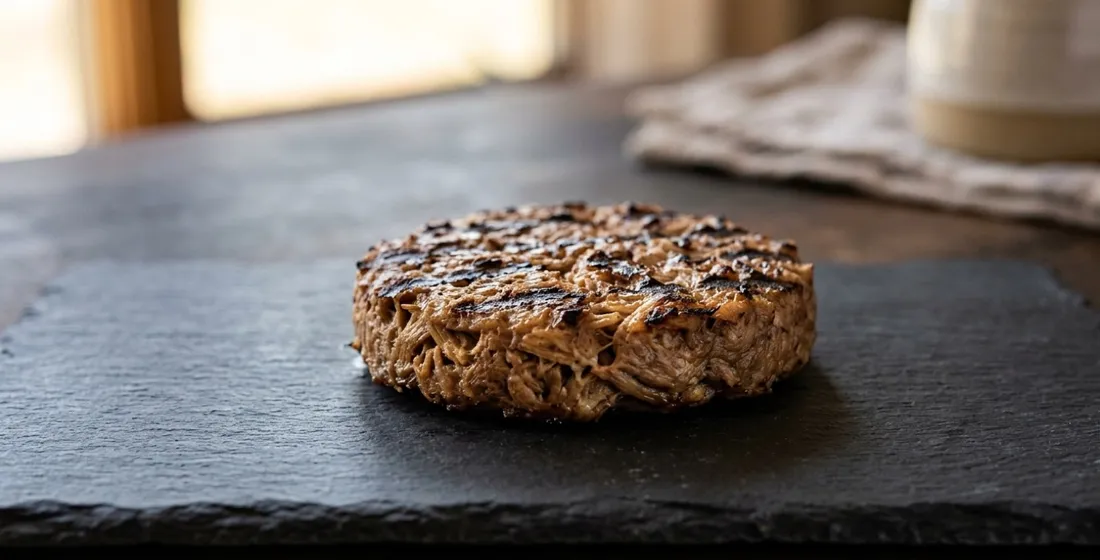
Hero: plant-based patty on a dark slate slab, editorial trade-publication styling. Higgsfield nano_banana_2.
Buyer's snapshot
|
Most contract manufacturers in South Asia quote one plant-based format well. A frozen patty line, or a retort spread line, or a spray-dryer for plant milk powder. A smaller number quote two. A facility that runs frozen plant-based meat, retort glass-jar spreads, spray-dried plant milks, and functional beverages on one site, on one audit, is rare in the region and almost unheard of in Sri Lanka. This guide walks through what Silk Route Ventures (SRV) and its manufacturing arm, Silk Foods Ceylon (SFC), actually produce in the plant-based and functional food category, which process line each format runs on, what certifications cover them, and the MOQ and lead-time math a CPG scale-up needs before sending a brief.
What plant-based and functional food formats can a Sri Lankan contract manufacturer make?
Silk Foods Ceylon manufactures four broad plant-based and functional food families from its Matale facility: frozen plant-based meat (patties, nuggets, sausage, chicken alternative, seitan, pre-minced mix), retort and glass-jar semi-liquids (vegan cheese spread, cashew cheese, mayonnaise, coconut spread), spray-dried and liquid plant milks (oat, soy, rice, coconut), and functional beverages (kombucha). The patty line runs at 15,000 units per day; the nuggets line at 30,000.
The breadth matters because a scale-up brand rarely launches one SKU and stops. A plant-based brand that lands a retail listing for a burger patty usually wants a nugget, a sausage, and a spread within eighteen months. The cellular manufacturing layout at the Matale facility means a new format does not trigger a separate audit cycle, so the second and third SKU launch against the same certification scope the first one cleared.
| Format family | Example SKUs | Process line | Capacity |
| Frozen plant-based meat | Vegan patty, nuggets, sausage, chicken alternative, seitan, pre-minced mix | Frozen / vacuum-pack line | Patty 15,000/day; nuggets 30,000/day |
| Retort and glass-jar semi-liquids | Vegan cheese spread, cashew cheese, mayonnaise, coconut spread | Semi-liquid retort line | 3,000 × 300 g jars/day |
| Plant milks | Oat, soy, rice, coconut (liquid or spray-dried powder) | Beverage line; spray-dryer | Beverage 2,500 × 200 ml/day; spray-dry 50 kg/day |
| Functional beverages | Kombucha (classic, mint chocolate) | Beverage line | 2,500 × 200 ml/day |
Source: Silk Foods Ceylon facility data, 2026.
For the format-level detail, the cluster carries dedicated specs on plant-based patty co-manufacturing at 15,000 units per day, vegan cheese spread retort manufacturing, spray-dried plant milk powder for global distribution, and kombucha and functional beverage co-packing.
Why Asia-Pacific matters for plant-based sourcing in 2026
Asia-Pacific is no longer the back office of the plant-based category. In 2024, the region generated USD 8.9 billion in retail sales of plant-based meat, seafood, and dairy, behind Europe at USD 9.7 billion and ahead of North America at USD 7.3 billion (Good Food Institute, 2024 State of the Industry). Global plant-based retail sales reached USD 28.6 billion that year, up roughly 5% on 2023. The growth is uneven by category, but the manufacturing base is shifting east regardless.
That shift has a procurement consequence. A brand sourcing finished plant-based product in Asia gains on freight and unit cost, but the certification and traceability bar set by EU and US retail does not relax because the factory moved. The supplier still has to clear the same food-safety gate. Sri Lanka is under-shortlisted here: buyers think Vietnam and Thailand for plant-based meat by reflex, and a Matale facility holding BRCGS and FSSC 22000 V6 for plant-based meat alternatives gets overlooked because nobody expected it to exist.
| Region | 2024 plant-based meat, seafood, and dairy retail sales |
| Europe | USD 9.7 billion |
| Asia-Pacific | USD 8.9 billion |
| North America | USD 7.3 billion |
Source: Good Food Institute, 2024 State of the Industry.
The longer-run number supports the build-out. The global plant-based food market is projected to reach roughly USD 103.75 billion by 2034, growing at about 8.29% a year from 2025 (Precedence Research, 2025). Plant-based milk specifically had Asia-Pacific as its largest regional market in 2024, with oat milk the fastest-growing segment (Grand View Research, 2024).
The certified-organic and specialty exporter category in Sri Lanka has a few established names. Econutrena (operating since 1989, coconut-led) and Joint Agri Products Ceylon, or JAPC (a heavyweight European organic stack, private-label-led), are both well known to buyers sourcing spices, tea, and coconut. Where Silk Route Ventures sits differently is the plant-based and functional food scope: vegan meat alternatives, retort spreads, spray-dried plant milks, and functional beverages under one cellular manufacturing footprint. Each exporter fits a different brief. SRV is most often the right answer when the brief includes plant-based meat, retort spreads, or a low first-run volume that a high-tonnage plant will not entertain.
Matching format to process: frozen, retort, spray-dried, and beverage lines
The format a buyer wants determines the process line, and the process line determines shelf life, MOQ, and freight method. Frozen plant-based meat ships cold-chain and holds long frozen shelf life. Retort semi-liquids in glass jars are shelf-stable at ambient temperature after thermal processing, which removes the cold-chain cost for spreads and cheeses. Spray-dried plant milk powder is the lightest to freight per serving and the easiest to distribute into markets without reliable cold logistics.
The format decision is a logistics decision before it is a product decision. A brand fixated on a chilled plant milk often discovers that a spray-dried powder reconstituted at the destination cuts landed cost more than any factory-gate price negotiation could. The procurement desk has watched this play out: in Q1 2026, two separate brands arrived asking for liquid oat milk co-packing, and both ended up specifying spray-dried powder once the freight math on shipping water across an ocean was on the table. The product did not change. The format did, and the unit economics followed.
| Process line | Plant-based formats | Shelf-life profile | Freight method |
| Frozen / vacuum-pack | Patties, nuggets, sausage, seitan, mince | Long, frozen | Reefer container |
| Retort semi-liquid (glass jar) | Cheese spread, cashew cheese, mayo, coconut spread | Ambient, shelf-stable | Dry container |
| Spray-dryer | Oat, soy, rice, coconut milk powder | Ambient, long dry | Dry container, lightest per serving |
| Beverage (glass bottle) | Liquid plant milks, kombucha | Ambient (retorted) or chilled | Dry or reefer |
Source: Silk Foods Ceylon facility data, 2026.
Jackfruit sits adjacent to this category as a whole-food plant protein. SRV runs jackfruit-in-brine for plant-based meat formats on the retort line, which suits brands building a pulled-style meat alternative without a soy or pea base.
What certifications cover plant-based meat and dairy manufacturing?
For plant-based and functional food manufacturing aimed at UK and EU retail, BRCGS is usually the gating certification, and FSSC 22000 V6 sits alongside it as the GFSI-recognized food-safety management standard. Silk Foods Ceylon holds both: BRCGS covers the plant-based, retort, and semi-liquid lines, and FSSC 22000 V6 covers the full processing scope including plant-based meat alternatives. For organic-claim SKUs, USDA Organic and EU Organic apply per product.
The scope statement is the part procurement teams should read closely. A facility can hold FSSC 22000 V6 and still not have plant-based meat alternatives inside the audited scope. At the Matale facility, the scope explicitly names burger patty, nuggets, sausage, and chicken alternative, which is what lets a buyer list the product without commissioning a fresh supplier audit for the category.
Certification snapshot: Silk Foods Ceylon, Matale BRCGS (covers the plant-based, retort, and semi-liquid product lines) FSSC 22000 V6 (covers the full processing scope, including plant-based meat alternatives) USDA Organic and EU Organic (per relevant SKU) Sri Lanka EDB-registered, US FDA-registered facility |
The cluster carries a deeper explainer on the FSSC 22000 V6 scope for procurement teams that want the line-by-line. The short version: name the standard, then ask for the scope statement, because the scope is where plant-based meat either is or is not covered.
How do plant-based labelling rules differ across the US, EU, and Australia?
Labelling is where a plant-based SKU passes or fails at the border, and the rules diverge by market. In 2023, the US FDA issued draft guidance recommending that plant-based milk alternatives using the word “milk” name the specific plant source (soy milk, oat milk) and carry a voluntary nutrient statement comparing the product to dairy milk (US FDA, Draft Guidance on Labeling of Plant-Based Milk Alternatives, 2023). The EU is stricter on dairy terms: “milk,” “cheese,” and “yoghurt” are reserved for animal-origin products, so a plant-based equivalent sells as a “drink” or a “spread” in the EU even where it could use the dairy term in the US.
This is why the format and the destination market should be locked before the formulation is, not after. A brand that develops a “vegan cheese” for the US and then expands to the EU has to relabel, and sometimes reformulate, to sell the same jar as a “spread.” Plant-based meat naming is more permissive in both markets, but the descriptor still has to avoid implying the product is conventional meat. Australia sits closer to the EU on dairy terms than to the US. Briefing the manufacturer on the destination market at the sample stage means the artwork and the spec are built right the first time.
MOQ, lead time, and the co-manufacturing economics for a scale-up
The MOQ for plant-based co-manufacturing at Silk Foods Ceylon is set per format, not as a single facility floor. Frozen patties and nuggets run a 5,000 to 10,000 unit first run per SKU. For glass-jar spreads, semi-liquids and glass-bottle beverages, unit minimums are confirmed on your quote. Spray-dried plant milk powder runs a 100 kg first order. These are first-order minimums; volume tiers bring the unit cost down as the order scales.
Spec snapshot: plant-based co-manufacturing Patties / nuggets (frozen): first-run minimum confirmed on your quote Spreads / semi-liquids (glass jar): unit minimums confirmed on your quote Beverages (glass bottle): unit minimums confirmed on your quote Spray-dried plant milk powder: 100 kg Samples: free for evaluation (you cover the courier) PO to dispatch: 2 to 3 weeks for standard SKUs (4 to 6 weeks for private label, custom specifications and organic orders); formulation work adds 2 to 4 weeks upfront Sea freight: EU and AU 3 to 4 weeks; US 4 to 5 weeks |
The lead-time stack is straightforward. Samples are free for evaluation (you cover the courier). Once a PO is placed, production to dispatch runs 2 to 3 weeks for standard SKUs (4 to 6 weeks for private label, custom specifications and organic orders), with custom formulation work adding 2 to 4 weeks at the front. Sea freight runs 3 to 4 weeks to the EU and Australia, and 4 to 5 weeks to the US. For a brand weighing whether a low-MOQ contract manufacturer is worth the unit-cost trade against a high-volume plant, the answer turns on launch risk: a smaller first run de-risks a new SKU that has not proven its shelf velocity yet.
Payment terms are consistent across the customer book. Orders under USD 10,000 are payable 100% in advance by bank transfer. Orders of USD 10,000 or above run 50% in advance by bank transfer, with the 50% balance against scanned shipping documents. PayPal is accepted for sample payments only. SRV does not offer deferred or consignment terms, and the discipline is part of how the lean route stays lean.
The unit-cost trade is real and worth stating plainly. A 5,000-unit first run of a plant-based patty carries a higher per-unit cost than a 100,000-unit run at a high-volume plant. For a brand validating a new SKU against uncertain shelf velocity, that premium is the price of not committing capital to inventory that may not move. Once the SKU proves out, the volume tiers narrow the gap. The math is harder than the marketing makes it sound, and the honest framing is that low first-run volume is a launch-risk tool, not a permanent cost structure.
Where SRV's co-manufacturing doesn't fit Brands chasing the lowest possible per-unit price on a proven, high-velocity SKU at six-figure volumes. At that scale, a dedicated high-tonnage plant in a larger plant-based hub is the more honest answer. SRV's plant-based co-manufacturing is built for the launch, the test market, the second and third SKU, and the multi-format brand that values one audited site over the lowest line rate. |
FAQ
Who contract-manufactures plant-based patties at scale in Asia with BRCGS and FSSC certification?
Silk Foods Ceylon in Matale, Sri Lanka, manufactures plant-based patties at 15,000 units per day and nuggets at 30,000 per day, under BRCGS on the relevant lines and FSSC 22000 V6 covering plant-based meat alternatives. First-run MOQ is confirmed on your quote. The cellular layout means new formats clear without a separate audit.
What plant-based and functional food formats can Silk Foods Ceylon produce?
The Matale facility produces frozen plant-based meat (patties, nuggets, sausage, chicken alternative, seitan, mince), retort glass-jar semi-liquids (vegan cheese spread, cashew cheese, mayonnaise, coconut spread), liquid and spray-dried plant milks (oat, soy, rice, coconut), and functional beverages including kombucha, all under BRCGS and FSSC 22000 V6 on the relevant lines.
What is the MOQ for vegan cheese spread or plant-based co-packing from Sri Lanka?
Frozen patty and nugget minimums are confirmed on your quote, and spray-dried plant milk powder at 100 kg; for glass-jar spreads, semi-liquids and beverages, unit minimums are confirmed on your quote. Volume-tier pricing reduces unit cost as the order scales. Samples are free for evaluation (you cover the courier).
Can Silk Route Ventures develop a custom plant-based formulation?
Yes. The SRV R&D and NPD team scopes custom plant-based formulations in-house, in parallel with the production plan, so a brand can bring an idea rather than a finished spec. Formulation work adds 2 to 4 weeks upfront before the production lead (2 to 3 weeks for standard SKUs). Sample runs are available before a buyer commits to volume.
Does spray-dried plant milk powder reduce freight cost versus liquid?
In most cases, yes. Spray-dried powder removes the water weight that liquid plant milk carries across an ocean, so the landed cost per reconstituted serving usually falls below shipping liquid, and the powder distributes into markets without reliable cold-chain logistics. Silk Foods Ceylon spray-dries oat, soy, rice, and coconut milk powders at 50 kg per batch.
How Silk Route Ventures can help
Silk Route Ventures (SRV) contract-manufactures finished plant-based and functional food SKUs (vegan patties at 15,000 units/day, nuggets at 30,000 units/day, retort glass-jar spreads and cheeses, spray-dried and liquid plant milks, kombucha, and jackfruit-in-brine for plant-based meat formats) under one roof at the Silk Foods Ceylon (SFC) facility in Matale. The site holds FSSC 22000 V6 covering the full processing scope including plant-based meat alternatives, plus BRCGS for the relevant lines, with USDA Organic and EU Organic on selected SKUs, confirmed per SKU. The cellular manufacturing layout means new SKU introductions do not require a separate audit cycle, and the SRV R&D and NPD team scopes the formulation in parallel with the production plan. Contact us to send an inquiry for a co-manufacturing capability briefing tailored to your SKU and target launch volume. Samples and bulk quotes run through our coconut products supplier.
Sources
- Good Food Institute, 2024 State of the Industry Report: Plant-Based, retrieved 2026-05-22, https://gfi.org/resource/plant-based-meat-eggs-and-dairy-state-of-the-industry-report/
- Good Food Institute, 2024 State of the Industry (regional and category data via Green Queen summary), retrieved 2026-05-22, https://www.greenqueen.com.hk/gfi-state-of-the-industry-report-2024/
- Grand View Research, Plant-based Milk Market Size, Share & Growth Report, retrieved 2026-05-22, https://www.grandviewresearch.com/industry-analysis/plant-based-milk-market-report
- Precedence Research, Plant-based Food Market Size, retrieved 2026-05-22, https://www.precedenceresearch.com/plant-based-food-market
- US Food and Drug Administration, Draft Guidance for Industry: Labeling of Plant-Based Milk Alternatives and Voluntary Nutrient Statements (2023), retrieved 2026-05-22, https://www.fda.gov/regulatory-information/search-fda-guidance-documents/draft-guidance-industry-labeling-plant-based-milk-alternatives-and-voluntary-nutrient-statements
Written by the Silk Route Ventures Trade Team. Silk Route Ventures (E-Silk Route Ventures (Pvt) Ltd) is a Sri Lankan B2B supply-chain operator for the Food, Beverage, Wellness, and Nutraceuticals sectors. The Silk Foods Ceylon manufacturing arm holds BRCGS and FSSC 22000 V6 certifications, with USDA Organic and EU Organic on relevant SKUs. Questions or to request a sample: [Contact us](https://www.esilkroute.com.lk/contact) or email info@esilkroute.com.lk.