
Fruit Powders and Bars from Sri Lanka
Fruit Powders and Bars from Sri Lanka: A B2B Sourcing Reference for Nutraceutical, Bakery, and Beverage R&D
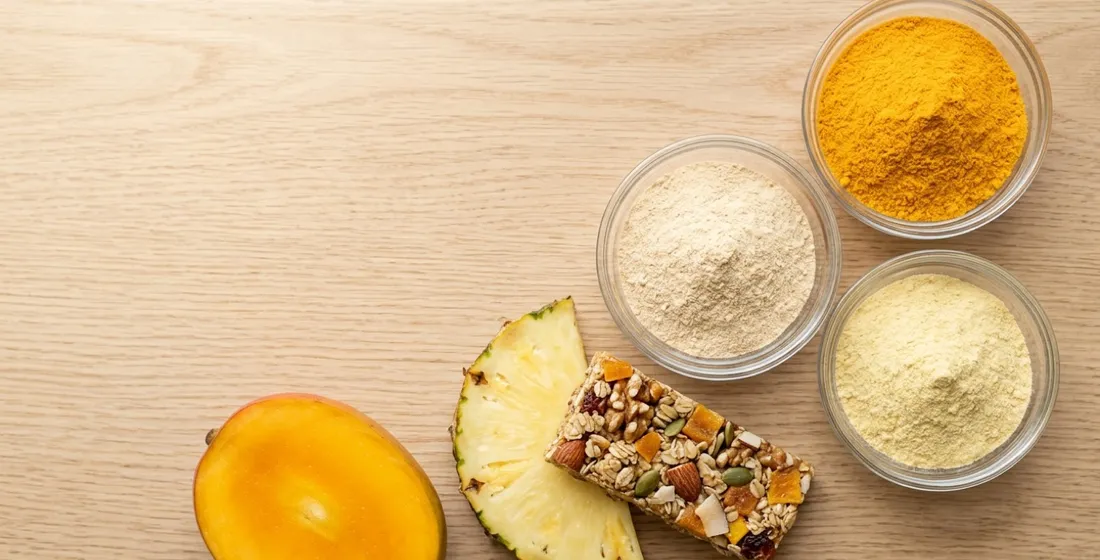
Hero: tropical fruit powders (mango, banana, pineapple) and a whole-food fruit-and-nut bar, editorial flat-lay. Alt text: Three bowls of fine tropical fruit powders beside fresh mango and pineapple and a pressed fruit-and-nut bar on a plain wooden surface.
Buyer's snapshot
|
Most suppliers quoting “fruit powder” are quoting one drying method and one price. The buyer’s actual decision is harder than that, because the drying method changes the nutrient profile, the powder changes the label claim, and the carrier agent changes what a brand can legally call “clean.” A mango powder spray-dried with maltodextrin and a mango powder made from pulverized whole fruit are different ingredients with different procurement consequences, even when the bag says the same word. This guide walks through what Silk Route Ventures (SRV) and its manufacturing arm, Silk Foods Ceylon (SFC), produce in the fruit powder and bar category, which process suits which application, how the US added-sugar rule treats each, and the MOQ and lead-time math an R&D team needs before sending a brief.
What fruit powders and bars can a Sri Lankan supplier actually produce?
Silk Foods Ceylon supplies a fruit powder range covering tropical and specialty fruits grown in or near Sri Lanka, plus contract-manufactured fruit-and-nut bars. The powder list includes mango, banana, pineapple, papaya, soursop (anoda), avocado, lime and black lime, and mangosteen, alongside starch-source powders such as cassava and arrowroot. Bars are produced on the finished-goods line as private-label or contract-manufactured SKUs. The spray-dryer runs at 50 kg per batch.
The breadth matters because a fruit ingredient rarely launches alone. A beverage brand that lands a mango premix usually wants pineapple and soursop within a year, and a nutraceutical brand building a greens-and-fruits blend wants four or five fruit powders to one spec. The cellular manufacturing layout at the Matale facility means a new fruit powder or a new bar format clears against the same certification scope the first SKU passed, with no separate audit cycle.
| Category | Example SKUs | Primary application | Format |
| Tropical fruit powders | Mango, banana, pineapple, papaya, soursop | Bars, smoothie premix, beverage, bakery inclusion | Spray-dried or whole-fruit-pulverized |
| Specialty fruit powders | Avocado, mangosteen, lime, black lime | Premium beverage, color and flavor base, nutraceutical blend | Spray-dried or freeze-dried |
| Starch-source powders | Cassava, arrowroot | Gluten-free bakery, binding, texture | Milled |
| Fruit-and-nut bars | Custom-formulated functional bars | Retail snack, nutraceutical bar | Contract-manufactured / private label |
Source: Silk Foods Ceylon facility data, 2026.
For the product-level detail, the cluster carries dedicated specs on banana powder for CPG drying method and shelf-life math, pineapple powder spray-dried versus freeze-dried, and mango powder for bars, smoothies, and snack inclusions.
Spray-dried, freeze-dried, or whole-fruit-pulverized: which process should you specify?
The drying method is the first spec decision, and it sets cost, nutrient retention, and label outcome. Spray drying blasts a fruit puree or juice into hot air and is fast and low-cost, but the heat reduces some heat-sensitive vitamins and volatile flavor. Freeze drying removes moisture by sublimation under vacuum at low temperature, retains more vitamin C and delicate phytonutrients, and costs more per kilogram. Pulverizing dehydrated whole fruit keeps the fruit’s full matrix, including fiber, which carries a distinct label advantage covered in the next section.
The carrier agent is where most fruit powder specs go wrong. High-sugar fruit juices are sticky and hygroscopic and will not spray-dry cleanly on their own, so a carrier is added to raise the powder’s glass transition temperature and stop it caking. Maltodextrin is the standard carrier, typically dosed at 7 to 20%, with the resulting powder showing a glass transition temperature in the 47 to 54°C range depending on inlet temperature and dextrose equivalent (peer-reviewed spray-drying research, 2022). A brand chasing a “no maltodextrin, no added carrier” clean label cannot use a standard spray-dried juice powder and should specify a whole-fruit-pulverized powder or a freeze-dried powder instead. The process is not a back-office detail; it is a label decision made at the sample stage.
| Process | Nutrient retention | Relative cost | Carrier needed | Best application |
| Spray-dried | Moderate (heat-sensitive loss) | Lowest | Usually (maltodextrin 7-20%) | High-volume beverage, premix, bakery |
| Freeze-dried | Highest (low-temperature) | Highest | No | Premium nutraceutical, color, flavor |
| Whole-fruit-pulverized | High (full fruit matrix, fiber retained) | Mid | No | Clean-label bars, blends, no-added-sugar claims |
Source: Silk Foods Ceylon facility data and published spray-drying literature, 2026.
Does a fruit powder count as “added sugar” on the label?
This is the question that decides label claims, and the answer turns entirely on process. Under the US FDA’s added-sugars definition, a fruit powder made by extracting and dehydrating the juice of the fruit counts as added sugar, while a fruit powder made by pulverizing a dehydrated whole fruit does not (US FDA, Added Sugars on the Nutrition Facts Label). Concentrated purees and pastes that stay close to the whole fruit are likewise not treated as added sugar. For a brand building a “no added sugar” bar or beverage, the drying-and-extraction method is the difference between a compliant claim and a relabel.
The procurement desk has watched this play out more than once. In Q1 2026, two separate US bar brands sent the same brief: a tropical fruit bar with a “no added sugar” front-of-pack claim, both assuming any mango powder would qualify. One had been quoted a juice-extracted spray-dried powder by another supplier, which would have put added sugar on the panel and killed the claim. The fix was not a new flavor. It was specifying a whole-fruit-pulverized mango powder against the FDA definition. The label claim survived because the spec was written to the rule, not to the marketing.
The honest framing for buyers: ask the supplier in writing how the powder is made, because “mango powder” on a quote sheet does not tell you which side of the FDA line it sits on. SRV states the process on every fruit powder spec sheet for exactly this reason, and pairs heat-sensitive SKUs with the freeze-dried or whole-fruit option when the buyer’s claim platform needs it.
Specifying a fruit powder in a sourcing RFQ
A defensible fruit powder spec runs past the fruit name to the parameters that determine how the powder behaves in a formulation and at the border. Particle size and mesh decide dispersibility and mouthfeel. Moisture and water activity decide shelf life and caking risk. Carrier type and percentage decide the clean-label claim. Color and Brix decide visual and flavor consistency batch to batch. The microbial panel, heavy metals, and a pesticide residue panel aligned to the destination market decide whether the shipment clears.
Buyer's checklist: a fruit powder RFQ to a Sri Lankan supplier
|
Every dispatched order ships with the standard documentation pack: commercial invoice, packing list, bill of lading or air waybill, certificate of origin, phytosanitary certificate, organic transaction certificate where the SKU is certified, and the batch COA. The cluster carries a deeper primer on how to evaluate a Sri Lankan supplier before the first RFQ for teams sourcing from the country for the first time.
Why source fruit powders and bars from Sri Lanka rather than India or Vietnam?
Sri Lanka is under-shortlisted for fruit powders, which is a sourcing gap rather than a capability gap. In 2024, Sri Lanka’s fruit and nut preparation exports were valued at roughly USD 255 million, with mango, banana, pineapple, and papaya the commercially grown base and rising European inquiry for organic dried and processed fruit (Sri Lanka Export Development Board). Buyers reflexively think India for mango powder and Vietnam for tropical fruit, and a Matale facility holding BRCGS and FSSC 22000 V6 for fruit powder and bar manufacturing gets overlooked because nobody expected it to be there.
The Matale facility sits 1 km from Nalanda Gedige, the geographic centre of Sri Lanka, in a growing belt that supplies the fruit and the spice trade. The procurement argument is not romance about origin. It is that the same cellular manufacturing site holds BRCGS, FSSC 22000 V6, USDA Organic, and EU Organic, supplies the fruit powder as bulk RM, and can finish a fruit-and-nut bar under one audit. The certified-organic exporter field in Sri Lanka has established names, and each fits a different brief. SRV is most often the right answer when the brief pairs fruit powder supply with a finished bar, or asks for a low first-run volume that a high-tonnage plant will not entertain.
Where SRV's pricing doesn't fit Lowest-shelf-price retail and commodity-grade fruit powder bought purely on per-kilogram invoice price. For a buyer whose end product competes below the certified-origin premium, a high-volume commodity processor is the more honest answer. SRV's fruit powder and bar supply is built for brands competing on certification, clean label, and origin, not for the lowest line rate on a proven high-velocity SKU. |
MOQ, lead time, and the bar co-manufacturing economics
The MOQ for bulk fruit powder at Silk Foods Ceylon is 50 kg per SKU for a first order, with volume-tier price breaks at 500 kg, 1,000 kg, and 2,500 kg. A multi-fruit launch multiplies the minimum: a five-fruit smoothie blend needs at least 50 kg of each, so 250 kg of RM in total. Fruit-and-nut bars are quoted as a finished-goods contract run with the MOQ set per SKU at the briefing stage. Samples ship door-to-door by international courier in 3 to 5 business days.
Spec snapshot: fruit powder and bar supply Bulk fruit powder MOQ: 50 kg per SKU first order Volume-tier breaks: 500 kg, 1,000 kg, 2,500 kg Spray-dry batch: 50 kg Sample dispatch: 3 to 5 business days by international courier PO to dispatch: 2 to 3 weeks; custom bar formulation adds 2 to 4 weeks upfront Sea freight: EU and AU 3 to 4 weeks; US 4 to 5 weeks |
The lead-time stack is straightforward. Once a PO is placed, production to dispatch runs 2 to 3 weeks for bulk powder, with custom bar formulation adding 2 to 4 weeks at the front. Sea freight runs 3 to 4 weeks to the EU and Australia and 4 to 5 weeks to the US; air freight is 3 to 4 days transit for early formulation iterations. Payment terms are consistent across the customer book: orders under USD 10,000 are payable 100% in advance by bank transfer, and orders of USD 10,000 or above run 50% in advance with the 50% balance against scanned shipping documents. PayPal is accepted for sample payments only.
For a brand weighing whether the unit-cost premium of a low first run is worth it, the answer turns on launch risk. A 50 kg first order of a fruit powder, or a small first bar run, carries a higher per-unit cost than a multi-tonne order at a commodity plant. For a new SKU with unproven shelf velocity, that premium is the price of not committing capital to inventory that may not move. Once the SKU proves out, the volume tiers narrow the gap. Brands that pair the fruit powder with a finished bar usually route through SRV’s R&D and NPD process, which scopes the formulation in parallel with the production plan, and the plant-based and functional food contract manufacturing cluster covers the finished-goods lines in detail. The functional bar opportunity is real on the demand side: the global protein bar market was valued at roughly USD 15.80 billion in 2025 and is projected to reach USD 24.21 billion by 2033 at a 5.5% CAGR (Grand View Research, Protein Bar Market).
FAQ
Where can I source bulk fruit powders like mango, banana, and pineapple from Sri Lanka?
Silk Foods Ceylon in Matale, Sri Lanka, supplies bulk mango, banana, pineapple, papaya, soursop, lime, and other fruit powders under BRCGS and FSSC 22000 V6, with USDA Organic and EU Organic on relevant SKUs. First-order MOQ is 50 kg per SKU, with volume tiers at 500 kg, 1,000 kg, and 2,500 kg. Samples ship in 3 to 5 business days.
Does a fruit powder count as added sugar on the US Nutrition Facts label?
It depends on the process. A powder made by pulverizing dehydrated whole fruit is not added sugar under the US FDA definition, while a powder made by drying extracted fruit juice is. For a “no added sugar” claim, a whole-fruit-pulverized or freeze-dried powder is the safe specification. SRV states the drying method on every fruit powder spec sheet.
What is the difference between spray-dried and freeze-dried fruit powder?
Spray drying uses hot air and is faster and lower-cost but reduces some heat-sensitive nutrients, and usually needs a maltodextrin carrier at 7 to 20%. Freeze drying removes moisture by sublimation at low temperature, retains more vitamin C and delicate compounds, needs no carrier, and costs more. The application and label claim decide which to specify.
Can Silk Route Ventures contract-manufacture private-label fruit-and-nut bars?
Yes. The Silk Foods Ceylon facility produces fruit-and-nut bars as private-label or contract-manufactured SKUs, with the SRV R&D and NPD team scoping custom formulations in-house. MOQ is set per SKU at the briefing stage, formulation adds 2 to 4 weeks upfront before the 2 to 3 week production lead, and sample runs are available before a buyer commits to volume.
Can SRV ship fruit powders to the US, EU, and Australia under USDA Organic or EU Organic?
Yes. Relevant fruit powder SKUs carry USDA Organic and EU Organic certification, and each order ships with the organic transaction certificate required to keep the buyer’s downstream organic claim valid, alongside the certificate of origin, phytosanitary certificate, and batch COA. Sea freight runs 3 to 4 weeks to the EU and Australia and 4 to 5 weeks to the US.
How Silk Route Ventures can help
Silk Route Ventures (SRV) supplies bulk fruit powders (mango, banana, pineapple, papaya, soursop, lime, and more) and contract-manufactures fruit-and-nut bars from the Silk Foods Ceylon (SFC) facility in Matale. The site holds BRCGS and FSSC 22000 V6, with USDA Organic and EU Organic on relevant SKUs, and states the drying method on every spec sheet so a brand can match the powder to its label claim. First-order MOQ is 50 kg per SKU for bulk powder, samples ship door-to-door by international courier at 3 to 5 business days, and the SRV R&D and NPD team develops custom bar formulations in-house. Contact us to send an inquiry or request a sample pack and the fruit powder spec sheet.
Sources
- Mordor Intelligence, “Fruit Powder Market Size, Growth Drivers, Trends Report 2025-2030,” (2025). Retrieved 2026-05-23. https://www.mordorintelligence.com/industry-reports/fruit-powder-market
- US Food and Drug Administration, “Added Sugars on the Nutrition Facts Label,” (2024). Retrieved 2026-05-23. https://www.fda.gov/food/nutrition-facts-label/added-sugars-nutrition-facts-label
- US Food and Drug Administration, “Guidance for Industry: Nutrition and Supplement Facts Labels Questions and Answers Related to the Compliance Date, Added Sugars, and Declaration of Quantitative Amounts of Vitamins and Minerals,” (2018). Retrieved 2026-05-23. https://www.fda.gov/regulatory-information/search-fda-guidance-documents/guidance-industry-nutrition-and-supplement-facts-labels-questions-and-answers-related-compliance
- Akhavan Mahdavi et al., “Effect of maltodextrin with different dextrose equivalents on the physicochemical properties of spray-dried barberry juice,” Journal of Food Science and Technology (via NCBI/PMC), (2022). Retrieved 2026-05-23. https://pmc.ncbi.nlm.nih.gov/articles/PMC9206958/
- Sri Lanka Export Development Board, “The Potential of Fresh Vegetable and Fruit Exports from Sri Lanka” and processed-fruit exporter data, (2024-2025). Retrieved 2026-05-23. https://www.srilankabusiness.com/fruits-and-vegetables/
- Grand View Research, “Protein Bar Market Size And Share, Industry Report 2025-2033,” (2025). Retrieved 2026-05-23. https://www.grandviewresearch.com/industry-analysis/protein-bar-market-report
Further reading
- US FDA, “Changes to the Nutrition Facts Label” → https://www.fda.gov/food/nutrition-food-labeling-and-critical-foods/changes-nutrition-facts-label
- Mordor Intelligence, “Protein Bar Market” → https://www.mordorintelligence.com/industry-reports/protein-bar-market
- CBI (Netherlands Enterprise Agency), “Exporting processed fruit and vegetables to Europe” → https://www.cbi.eu/market-information/processed-fruit-vegetables-edible-nuts
Written by the Silk Route Ventures Trade Team. Silk Route Ventures (E-Silk Route Ventures (Pvt) Ltd) is a Sri Lankan B2B supply-chain operator for the Food, Beverage, Wellness, and Nutraceuticals sectors. The Silk Foods Ceylon manufacturing arm holds BRCGS and FSSC 22000 V6 certifications, with USDA Organic and EU Organic on relevant SKUs. Questions or to request a sample: [Contact us](https://www.esilkroute.com.lk/contact) or email info@esilkroute.com.lk.