
Dried Mango Formats: Tidbit, Tea-Bag-Cut and Strip for Bakery
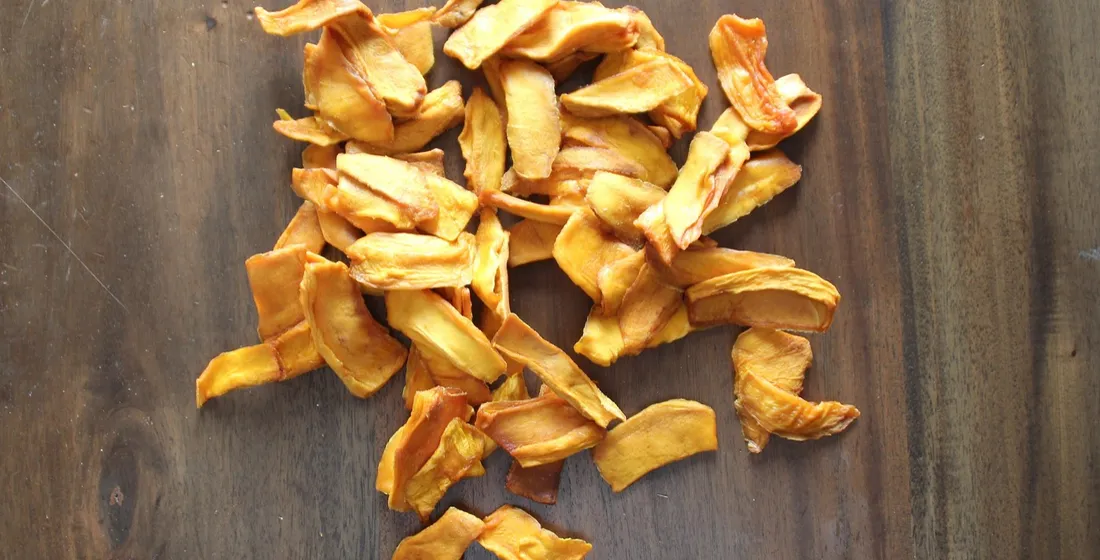
By the Silk Route Ventures Trade Team | 16 July 2026
Buyer’s snapshot
- Three cut formats do most of the work in bakery and snack lines: tea-bag-cut (roughly 1 to 3 mm), tidbit dice (roughly 6 to 10 mm), and strip (roughly 40 to 60 mm).
- Cut format decides bake stability and dispersion. Sulphur status and sweetening decide the label declaration, not the cut.
- Bake-stable inclusions sit at a water activity at or below 0.60 and moisture under 15 percent, which osmotic (sugar) infusion reaches without preservatives.
- Fruit-based snacks reached about 14 percent of global snack launches in 2026 (Innova Market Insights), so the format decision now carries real volume.
- Silk Route Ventures (SRV) ships bulk dried mango against the buyer’s written spec at a first-order MOQ of 50 kg per SKU, with a certificate of analysis on every batch.
Most brands sourcing dried mango write “dried mango, X kg” on the RFQ and stop there. That hands three decisions to the supplier: which cut, how much sugar, and how much sulphur dioxide. Each one changes the ingredient. A strip built for a resealable snack pouch behaves nothing like a diced tidbit built to survive a 190 C oven, and a bright, soft, sulphured piece carries a label declaration that an unsulphured one does not. The fruit is the same. The finished ingredient, the application, and the packaging claim are not. This piece is for the procurement and product teams who want a defensible dried mango spec before the first sample lands.
The three dried mango formats, mapped to application
Cut format is the first line on a dried mango spec because it sets both the eating experience and the manufacturing behaviour. Tea-bag-cut disperses and rehydrates fast, tidbit dice holds its shape through mixing and baking, and strip reads as visible whole fruit. Piece dimensions follow dried-fruit trade convention rather than a single ISO or Codex standard, so the window belongs on the spec sheet.
| Format | Typical piece size | Behaviour in use | Best-fit applications |
|---|---|---|---|
| Tea-bag-cut | ~1 to 3 mm fine dice | Disperses evenly, high surface area, rehydrates fast | Infusion and tisane blends, cereal and granola dust, yoghurt sprinkles, seasoning bases |
| Tidbit (dice) | ~6 to 10 mm dice | Holds shape through mixing and a 180 to 190 C bake | Muffins, cookies, cereal and snack bars, trail mix, chocolate inclusions |
| Strip / slice | ~40 to 60 mm strips | Visible whole-fruit cue, chewy eating texture | Direct snacking packs, bar and bakery toppings, mixed-fruit selections |
The tidbit dice at 3/8 inch, plus or minus 1/8 inch, is the diced tropical-fruit convention most bakery inclusion lines already run, which is why a mango tidbit slots into an existing muffin or bar recipe with little rework. For a wider view of the range these formats sit inside, see the dehydrated fruit overview and the sister pineapple format guide.
What is the difference between dehydrated, sugar-infused and freeze-dried mango?
Three drying routes produce three different ingredients. Air or tunnel dehydration removes water with heat and gives a chewy, dense piece. Osmotic or sugar infusion soaks the fruit in a high-sugar solution before low-temperature drying, which lowers water activity and yields a pliable, bake-stable piece. Freeze-drying sublimates the water and gives a light, crisp, fully porous piece that shatters rather than chews.
For inclusions that ride through a batter or dough, osmotic infusion is the workhorse. A peer-reviewed 2024 review of osmotic dehydration in PMC (National Library of Medicine) reports that osmotically infused fruit holds water activity below 0.60 and moisture under 15 percent, which keeps pieces microbiologically stable and bake-stable without added preservatives. That low free-water level is also what stops a piece from bleeding moisture into a biscuit dough or migrating colour into a pale crumb. Freeze-dried mango, by contrast, rehydrates on contact and belongs in dry systems: it goes into a mango powder blend or a no-bake topping, not into a wet batter.
The two specs that decide your label, and neither is the cut
Two lines on the spec sheet control the packaging declaration: sulphur dioxide and added sugar. Get these wrong and a compliant recipe fails at label review, whatever the cut. Under the US Food and Drug Administration rule, any food containing 10 ppm or more of sulphur dioxide must declare sulphites on the label, and the EU allergen rule (Regulation 1169/2011) sets the same 10 mg/kg declaration trigger.
Conventionally sulphured dried fruit carries roughly 200 to 2,000 mg/kg of sulphur dioxide, well above both thresholds (California OEHHA, sulphur dioxide in dried fruit guideline). Sulphur holds the bright orange colour and extends shelf life, so a sulphured mango looks more appealing on shelf, but it forces an allergen declaration and closes the door on a clean-label claim.
Here is where it bites in practice. A product team signs off a granola bar recipe, the sample looks and tastes right, and then legal review flags that the dried mango, sulphured to hold its colour, pushes the finished SKU over the sulphite declaration line. Now the pack needs a “contains sulphites” call-out that the marketing brief never planned for, and the launch slips a cycle while procurement re-sources an SO2-free lot. Specifying “no added sulphur” up front, and accepting the deeper amber colour that comes with it, avoids the whole detour. Added sugar runs the same way: an unsweetened piece supports a “no added sugar” front-of-pack claim, a sugar-infused piece does not, so the sweetening decision belongs in the brief, not in the sample stage.
How do dried mango formats behave in snack versus bakery applications?
The application decides which format earns its place. In snacking, the strip and the larger tidbit do the work because the eating texture and the visible fruit cue are the product. In bakery, the tidbit dice dominates because it survives mixing and the oven while dispersing evenly through crumb. The commercial reason to get this right is scale: the global dried fruit market was valued at about USD 12.02 billion in 2024 and is projected to reach USD 16.55 billion by 2030, a 5.6 percent compound annual growth rate (Grand View Research).
Snacking demand is pulling the category. Fruit-based snacks reached roughly 14 percent of global snack launches, and about 60 percent of younger consumers now snack twice a day or more (Innova Market Insights, 2026). Clean-label pressure sits alongside it: close to one in three new food and drink launches now carries a clean-label claim (Mintel, 2025), which is exactly why the sulphur and added-sugar decisions above move from a technical footnote to a positioning choice. For teams building bars specifically, the fruit powders and bars guide pairs with this format work.
Writing the dried mango spec on your RFQ
A defensible dried mango RFQ names the ingredient tightly enough that any two suppliers quote the same thing. Nine lines cover it, and a buyer who supplies all nine removes the guesswork that turns a first sample into three.
- Cut format and piece-size window (tea-bag-cut, tidbit or strip, with the mm range).
- Sulphur status (SO2-free or no added sulphur, or a stated maximum ppm).
- Sweetening (unsweetened or sugar-infused, with Brix or added-sugar percentage).
- Moisture and water activity ceiling (for bake-stable inclusions, moisture at or below 15 percent and aw at or below 0.60).
- Variety and origin (for example Karthakolomban or TJC, Sri Lanka).
- Colour and appearance target (deeper amber for SO2-free, brighter for sulphured).
- Microbiological and pesticide-residue limits for the destination market (FDA or EU MRL).
- Certification requirement (organic, Halal or Kosher as the market needs).
- Pack format, case weight and shelf-life target.
Spec snapshot (bake-stable inclusion)
Dried mango tidbit, 6 to 10 mm dice, no added sulphur, unsweetened, moisture ≤15 percent, water activity ≤0.60, Karthakolomban or TJC variety, Sri Lanka origin, packed in food-grade liner within fibreboard cases, 10 kg net. Certificate of analysis per batch.
On origin, variety is not decoration. Sri Lankan commercial varieties such as Karthakolomban carry high sugar at around 19 degrees Brix with low acidity, which suits drying, while TJC offers a long harvest window from roughly June to January that supports continuous processing supply (Sri Lanka Department of Agriculture; Specialty Produce). Silk Route Ventures (SRV) processes fruit through the Silk Foods Ceylon (SFC) facility at Nalanda, Matale, roughly one kilometre from the Nalanda Gedige, where the dehydration line runs the tidbit, tea-bag-cut and strip formats off a single traceable supply chain. Buyers who want the certification logic behind that supply chain can read the buyer’s guide to organic certifications.
Where SRV’s pricing does not fit
If dried mango is an undifferentiated line bought on lowest landed cost, and neither sulphur status, variety nor traceability changes the buying decision, a high-volume Southeast Asian packer will beat SRV on price. SRV earns its place when spec control, BRCGS and FSSC 22000 V6 certification, a 50 kg per SKU entry MOQ, batch-level traceability, and single-supplier consolidation across fruit, spice and coconut lines carry more weight than a few cents per kilogram.
That consolidation point is the practical differentiator for multi-category distributors. A buyer already sourcing spices, coconut chips or papaya from SRV adds dried mango without opening a second supplier relationship, a second certificate-of-analysis cadence, or a second set of customs documents. The differentiator is not the length of the fruit list. It is the single audited supply stack behind it.
FAQ
What is the difference between mango tidbit, tea-bag-cut and strip? They are cut sizes. Tea-bag-cut is a fine 1 to 3 mm dice for infusions and even dispersion, tidbit is a 6 to 10 mm dice for bakery and bars, and strip is a 40 to 60 mm piece for direct snacking and toppings. The variety and drying method can be identical across all three; only the cut changes.
Does sulphur dioxide have to be declared on a dried mango label? Yes, above the threshold. Both the US FDA (10 ppm) and the EU allergen rule (Regulation 1169/2011, 10 mg/kg) require a sulphite declaration when the finished food is at or above that level. Conventionally sulphured dried fruit runs far higher, around 200 to 2,000 mg/kg, so an SO2-free lot is the route to avoid the declaration.
Does SRV offer private label and contract manufacturing for dried mango? Yes. Silk Route Ventures runs private label and contract manufacturing for dried mango from the BRCGS and FSSC 22000 V6 audited Silk Foods Ceylon facility in Matale, producing tidbit, tea-bag-cut and strip formats under a buyer’s own brand and spec, with a certificate of analysis on every batch and traceability to farm level.
What is the minimum order quantity for bulk dried mango from Sri Lanka? The first-order MOQ is 50 kg per SKU, with volume breaks at 500, 1,000 and 2,500 kg. Samples ship door to door by international courier within 3 to 5 business days, and a purchase order typically dispatches within 2 to 3 weeks depending on format and certification.
How Silk Route Ventures can help
Silk Route Ventures (SRV) supplies certified dried mango and dehydrated fruit to bakery, snack and distribution buyers across the US, EU and Australia. Bulk is shipped against the buyer’s written spec from the BRCGS and FSSC 22000 V6 audited Silk Foods Ceylon (SFC) facility in Matale, in tidbit, tea-bag-cut and strip formats, SO2-free or sulphured, unsweetened or sugar-infused. First-order MOQ is 50 kg per SKU, and samples ship door to door by international courier (DHL, FedEx, UPS) within 3 to 5 business days. For brands consolidating suppliers or launching a private-label SKU under their own label, SRV runs end-to-end private label and contract manufacturing from the same site, across fruit, spice and coconut lines on one audited supply stack. Contact us to send an inquiry or request a sample pack.
Sources
- Grand View Research, “Dried Fruit Market Size, Share & Trends Analysis Report,” 2024/2025. https://www.grandviewresearch.com/industry-analysis/dried-fruit-market (retrieved 16 July 2026).
- Innova Market Insights, “Consumer Snacking Trends 2026,” 2026. https://www.innovamarketinsights.com/trends/novelty-nutrition-convenient-formats-consumer-snacking-trends-2026/ (retrieved 16 July 2026).
- Mintel, “A Year of Innovation in Salty Snacks and Fruit Mixes,” 2025. https://store.mintel.com/report/a-year-of-innovation-in-salty-snacks-fruit-mixes (retrieved 16 July 2026).
- National Library of Medicine (PMC), “Exploring Osmotic Dehydration for Food Preservation,” 2024. https://pmc.ncbi.nlm.nih.gov/articles/PMC11394940/ (retrieved 16 July 2026).
- California OEHHA, “Sulfur Dioxide in Dried Fruit Interpretive Guideline,” 2012. https://oehha.ca.gov/sites/default/files/media/downloads/crnr/so2driedfruitig.pdf (retrieved 16 July 2026).
- Sri Lanka Department of Agriculture, “Fruit Crops: Mango.” https://doa.gov.lk/fruit-crops-mango-e/ (retrieved 16 July 2026).
- Specialty Produce, “Karthakolomban (KC) Mangoes” and “TJC Mangoes.” https://specialtyproduce.com/produce/TJC_Mangoes_23851.php (retrieved 16 July 2026).
- Sri Lanka Export Development Board, “Fruit and Vegetable Export Performance,” 2024. https://www.srilankabusiness.com/fruits-and-vegetables/fruit-and-vegetable-export-performance.html (retrieved 16 July 2026).
Written by the Silk Route Ventures Trade Team. Silk Route Ventures (E-Silk Route Ventures (Pvt) Ltd) is a Sri Lankan B2B supply-chain operator for the Food, Beverage, Wellness, and Nutraceuticals sectors. The Silk Foods Ceylon manufacturing arm holds BRCGS and FSSC 22000 V6 certifications. Questions or to request a sample: info@esilkroute.com.lk.