
Mango Powder for Bars, Smoothies, and Snacks: A Sourcing Spec
By the Silk Route Ventures Trade Team | 10 June 2026
Buyer’s snapshot
- The two most common mango powders, spray-dried and freeze-dried, are not interchangeable. Freeze-dried retains the most vitamin C and carotenoid colour; spray-dried trades some of that for lower cost and easier handling.
- Mango is sugar-rich and sticky to dry, so spray-dried mango powder almost always carries a maltodextrin carrier. That carrier becomes a label declaration, which matters for a clean-label claim.
- In 2025 the global fruit powder market was about USD 16.23 billion, forecast to reach USD 22.01 billion by 2030 at a 6.28 percent CAGR, with Asia-Pacific holding the largest share (Mordor Intelligence).
- The right powder depends on the application: colour and dispersibility for smoothies, flavour and flow for bars, particle and moisture control for snack inclusions.
- Silk Route Ventures (SRV) supplies bulk and private-label mango powder from a BRCGS and FSSC 22000 V6 audited facility in Matale, with a 100 kg MOQ per SKU and free samples for evaluation (you cover the courier).
Most buyers ask for “mango powder” and get quoted three different products at three different prices without being told why. The gap between a spray-dried powder on a maltodextrin carrier and a pure freeze-dried powder is not a marketing distinction. It changes the colour on the shelf, the vitamin retention on the COA, the carrier line on the ingredient declaration, and the landed cost by a wide margin. This piece is the spec behind the quote.
What is mango powder, and how is it made?
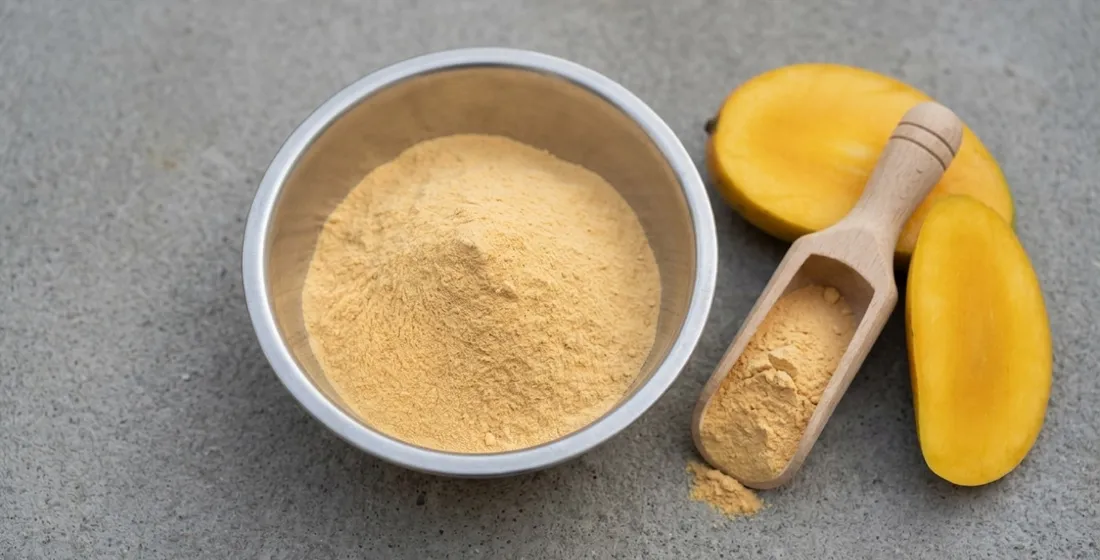
Mango powder is dried, milled ripe mango, produced by spray drying mango pulp with a carrier, by freeze drying mango pieces or puree, or by drum drying. Its character comes from what survives the process: natural sugars, soluble fibre, vitamin C, and the carotenoids that give the powder its yellow-to-apricot colour. Mango pulp is high in sugar and low in molecular weight, which makes it hygroscopic and sticky to dry, the single fact that drives most of the processing choices downstream.
That stickiness is why “mango powder” is rarely just mango. The drying method, the carrier, and the variety together decide colour, flavour intensity, particle size, and shelf stability. Two powders labelled identically can differ by an order of magnitude in vitamin C and visibly in colour.
What’s the difference between spray-dried and freeze-dried mango powder?
Drying method is the largest single variable in a mango powder spec. Freeze drying uses low temperatures that preserve heat-sensitive compounds, and freeze-dried mango powder retains the most ascorbic acid, reported in the range of 97 to 225 mg per 100 g on a dry basis, along with the highest carotenoid levels (drying-methods studies, Journal of Food Engineering, 2012). Spray drying runs hot and fast with a carrier, costs less per kilo, and flows well, but it degrades more of the vitamin C and colour.
Neither is “better” in the abstract. The question is what the finished product needs to carry on its label and its shelf.
| Attribute | Spray-dried (with carrier) | Freeze-dried |
|---|---|---|
| Vitamin C / carotenoid retention | Lower (heat exposure) | Highest of the methods |
| Colour | Paler, carrier-diluted | Strongest, closest to fresh |
| Carrier needed | Yes (maltodextrin typical) | Usually none |
| Cost per kg | Lower | Higher |
| Flow / dispersibility | Good, free-flowing | Good but can be hygroscopic |
| Best fit | Volume bars, beverages on cost | Premium clean-label, colour-led |
Why mango powder usually needs a maltodextrin carrier
Spray drying a sugar-rich fruit like mango fails without help. The low glass transition temperature of mango sugars makes the powder stick to the dryer wall and clump rather than flow. Adding maltodextrin, a higher molecular weight carbohydrate, raises the glass transition temperature and lets the powder form and flow (drying-methods studies, Journal of Food Engineering, 2012). It is a processing necessity, not an adulteration.
The consequence sits on the label. A spray-dried mango powder is mango plus maltodextrin, and both have to be declared. For a brand whose entire pitch is a short, clean ingredient list, that second word can be the problem. A buyer chasing a one-ingredient “mango powder” claim needs freeze-dried or a carrier-free process, and should expect to pay for it. That is the trade most quotes never spell out.
Matching the powder to the application
The application decides the spec, not the other way around. A smoothie premix is sold partly on colour and has to disperse cleanly in cold liquid, so carotenoid retention and particle size lead. A nutritional bar needs flavour impact and consistent flow into a dry blend, where a carrier-bearing spray-dried powder is often the honest, cost-right choice. A snack inclusion, baked or coated, lives or dies on moisture and particle control, because a hygroscopic powder will pick up water and soften the matrix around it.
Spec snapshot: bulk mango powder
- Source: ripe mango (Mangifera indica), variety stated on the COA
- Process: spray-dried (carrier declared) or freeze-dried (carrier-free)
- Screening: moisture, water activity, particle size / mesh, colour, microbial (TPC, yeast and mould, Salmonella, E. coli), heavy metals
- Carrier: maltodextrin percentage stated where used
- Certification: BRCGS and FSSC 22000 V6; USDA Organic and EU Organic on selected SKUs, confirmed per SKU
- SRV MOQ: 100 kg per SKU; samples free for evaluation (you cover the courier)
Sourcing mango powder: variety, origin, and the RFQ
A defensible mango powder spec starts before the drying method. Variety drives colour and sugar-acid balance, so the RFQ should name it rather than leave “mango” open. The COA should report moisture and water activity, because a sugar-rich powder that absorbs water in transit will cake regardless of how well it was dried. Silk Foods Ceylon (SFC) spray-dries fruit powders in-house at 50 kg per day under BRCGS and FSSC 22000 V6, with a COA on request; freeze-dried mango is supplied sourced-to-spec through the SRV trade desk where a project needs the carrier-free route.
In Q1 2026, the Silk Route Ventures procurement desk saw the same correction twice in one month: two brands that had specified “mango powder” on price alone, then found the spray-dried lot too pale for a smoothie pack that sold on colour. The fix was not a better supplier. It was naming the drying method and the carrier ceiling on the RFQ before the first sample. The powder had been doing exactly what its spec allowed.
Buyer’s checklist: specifying mango powder
- State the drying method required: spray-dried or freeze-dried.
- Set a carrier ceiling and require the maltodextrin percentage on the COA.
- Name the mango variety, or set a colour and Brix target.
- Specify moisture and water activity for cake resistance in transit.
- Match particle size to the application: fine for beverages, controlled for inclusions.
- Require the cert stack and, for organic SKUs, the organic transaction certificate.
FAQ
What is the difference between spray-dried and freeze-dried mango powder?
Freeze-dried mango powder uses low temperatures and retains the most vitamin C, reported at 97 to 225 mg per 100 g dry basis, plus the strongest colour, and usually needs no carrier. Spray-dried mango powder runs hot with a maltodextrin carrier, costs less, and flows well, but loses more vitamin C and colour (Journal of Food Engineering, 2012).
Why does mango powder contain maltodextrin?
Mango is sugar-rich with a low glass transition temperature, so spray-dried mango sticks and clumps without a carrier. Maltodextrin raises the glass transition temperature and lets the powder form and flow. It is a processing aid, not an adulterant, but it must be declared on the label, which affects clean-label claims.
Which mango powder is best for bars versus smoothies?
Smoothie premixes favour freeze-dried or high-retention spray-dried powder for colour and cold dispersibility. Nutritional bars often suit a carrier-bearing spray-dried powder for flavour and flow at lower cost. Snack inclusions need tight moisture and particle control because hygroscopic powder softens the surrounding matrix.
Does Silk Route Ventures supply bulk organic mango powder?
Yes. Silk Route Ventures supplies bulk and private-label mango powder from the BRCGS and FSSC 22000 V6 audited Silk Foods Ceylon facility in Matale, with USDA Organic and EU Organic on selected SKUs, confirmed per SKU, and the organic import certificate the destination requires. Spray-dried is produced in-house at 50 kg per day; MOQ is 100 kg per SKU and samples are free for evaluation (you cover the courier).
How Silk Route Ventures can help
Silk Route Ventures supplies fruit powders and the wider Ceylon ingredient range to specialty brands and multi-category distributors across the US, EU, and Australia. Bulk mango powder is shipped against the buyer’s spec from the BRCGS and FSSC 22000 V6 audited Silk Foods Ceylon facility in Matale, with a COA on request, the maltodextrin percentage declared where a carrier is used, and the organic import certificate the destination requires on the certified SKUs. Spray-dried fruit powders are produced in-house at 50 kg per day, with freeze-dried supplied sourced-to-spec through the trade desk; MOQ is 100 kg per SKU and samples are free for evaluation (you cover the courier). For brands ready to launch a private-label mango powder SKU under their own label, SRV runs end-to-end private label manufacturing from the same site. Contact us to send an inquiry or request a sample. For volume pricing, see our spices from Sri Lanka.