
Dehydrated Fruits from Sri Lanka
Dehydrated Fruits from Sri Lanka: Spec, Grade, and Shelf-Life Math for Snack and Bakery Formulators
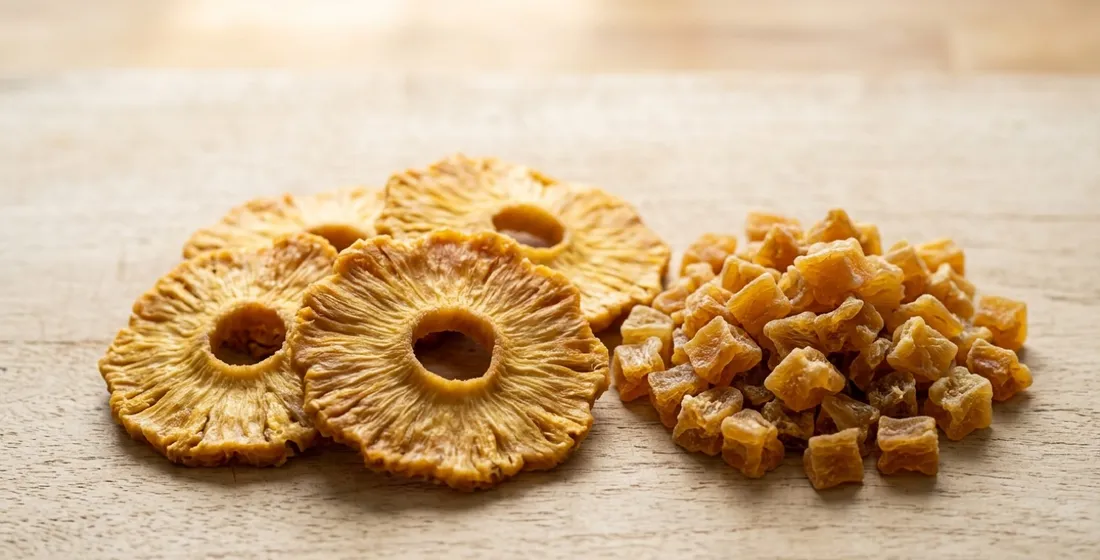
Hero: dehydrated pineapple rings and mango strips, editorial flat-lay. Alt text: Dried pineapple rings and mango strips on a plain wooden surface, showing cut-format range for snack and bakery use.
Buyer’s snapshot
- Dehydrated fruit is a different ingredient category from spray-dried fruit powder: it is whole or cut fruit with water removed, not a fine powder, and it carries its own moisture, water activity, and format spec.
- Water activity, not moisture percentage alone, is what governs shelf life. Most dried fruit needs an aw at or below 0.65 to stay stable against xerophilic (dry-tolerant) mold at ambient temperature.
- Sulfites are the default preservative for light-colored dried fruit (mango, banana, papaya) and must be declared on a US label at 10 ppm SO2 or above; unsulfured runs are available at a browning trade-off.
- Silk Foods Ceylon (SFC) dehydrates pineapple, mango, papaya, banana, and lime/black lime on a dedicated dehydration line under FSSC 22000 V6, in ring, tidbit, tea-bag-cut, strip, and chip/coin formats, with a 50 kg first-order MOQ per SKU.
- The right cut format depends on the end application. This guide is the spec and format reference for snack, bakery, and beverage formulators scoping a first dehydrated-fruit order from Sri Lanka.
Most RFQs for “dried fruit” arrive without a moisture number, a water activity target, or a cut spec, because the buyer is quoting the finished snack bag in their head, not the raw material sheet. That gap is where shelf-life failures and format mismatches start. A tidbit cut for a granola bar and a ring cut for a retail snack pouch are not the same purchase order, even when the fruit and the supplier are identical. This guide sets out what a Sri Lankan dehydration line actually produces, the moisture and water-activity numbers worth specifying, the sulfite question, and which cut format fits which end use.
What dehydrated fruit formats does a Sri Lankan supplier actually produce?
Silk Foods Ceylon runs pineapple, mango, papaya, banana, and lime or black lime through a dedicated dehydration line at the Matale facility, cut to the format the end application calls for rather than a single default shape. The line sits inside the same FSSC 22000 V6 scope that covers the rest of the finished-goods floor, which means a new fruit or a new cut format clears against certification the site already holds instead of triggering a separate audit cycle.
| Fruit | Formats available | Typical use |
|---|---|---|
| Pineapple | Rings, tea-bag cut, tidbit, strip | Retail snack rings; tidbit for trail mix and bakery inclusion; tea-bag cut for infusions |
| Mango | Tidbit, tea-bag cut, strip | Tidbit and strip for snack and trail mix; tea-bag cut for fruit-tea blends |
| Papaya | Strip, tea-bag cut, tidbit | Strip for snack bars; tidbit for granola and cereal inclusion |
| Banana | Strip, tea-bag cut, chips/coins | Chips/coins for retail snack; strip for bakery inclusion |
| Lime / black lime | Whole, cut | Beverage garnish and infusion; culinary/spice-adjacent use |
Source: Silk Foods Ceylon dehydration-line product range, 2026.
The format list matters more than it looks on a spec sheet. A single fruit, cut four different ways, serves four different customers: a retail snack brand wants rings or chips with visual identity intact, a bakery formulator wants tidbit or dice sized to survive baking without scorching, and a beverage or tea brand wants a tea-bag cut sized for infusion. Quoting “dried mango” without a cut spec leaves that decision to the supplier, and the supplier’s default is rarely the buyer’s actual application. The same format-first logic already runs through SFC’s pineapple rings, tidbit, tea-bag, and strip range, and it extends across the fruit list to mango, papaya, and banana.
What moisture and water activity should a buyer specify?
Moisture percentage is the number most RFQs ask for, but water activity (aw) is the number that actually predicts shelf life. Two lots of dried mango can carry the same 18% moisture reading and still behave differently in storage if the free (unbound) water differs, because water activity measures how much of that moisture is available to microorganisms, not how much water is present in total.
The Codex Alimentarius Commission’s General Standard for Dried Fruits (CXS 360-2020) sets moisture ceilings by fruit type and format, and the companion Code of Hygienic Practice for Low-Moisture Foods (CXC 75-2015) covers the hygiene and water-activity control expectations for exactly this category. A buyer’s RFQ should ask the supplier to confirm both documents as the governing spec, then request the batch-level moisture and aw figures on the certificate of analysis rather than accepting a single blended number for a whole SKU.
The water-activity number that matters operationally is 0.65. Most spoilage molds stop growing below aw 0.80, but a smaller group of xerophilic, dry-tolerant molds can still grow down to roughly 0.60 to 0.65, which is why dried fruit needs to clear that lower threshold, not the higher one that applies to less dry foods. Below aw 0.60, microbial growth is essentially arrested. A supplier quoting “shelf stable” without an aw figure on the COA has not actually answered the question.
Spec snapshot: dehydrated fruit RFQ
- Fruit and cultivar: confirmed by botanical name and, where relevant, cultivar
- Cut format: ring, tidbit, tea-bag cut, strip, or chip/coin, with target dimension in mm
- Moisture: batch-level percentage against CXS 360-2020 ceiling for the fruit and format
- Water activity: batch-level aw reading, target at or below 0.65
- Sulfite status: sulfured (with ppm SO2) or unsulfured
- Microbial: total plate count, yeast and mold, Salmonella
- Certification: FSSC 22000 V6; USDA Organic and EU Organic where the SKU is certified
Does dehydrated fruit need declared sulfites?
Sulfur dioxide and sulfite salts are the standard preservative and anti-browning agent for light-colored dried fruit; mango, banana, and papaya all brown faster without them, because the enzymatic browning that sulfites suppress is the same reaction that darkens a cut apple. Under US labeling rules, any food containing 10 ppm total SO2 or more must declare the sulfite on the ingredient statement, a threshold set because sulfite-sensitive consumers, including some asthmatics, can react at levels below what earlier labeling rules required. The EU applies a parallel declaration requirement under its allergen and additive labeling rules, using the E220 to E228 series numbers.
Unsulfured runs are available and are increasingly what clean-label snack and bakery brands specify, but they come with a visible trade-off: unsulfured dried mango and banana darken faster in storage and typically show a shorter color-stable shelf life than a sulfured equivalent, even when moisture and water activity are identical. Neither option is a food-safety difference; sulfites in dried fruit are a color and shelf-appearance choice; the safety spec is still moisture and water activity. A buyer building a clean-label claim needs to decide on that trade-off before the first production run, not after a customer complaint about a browned pouch.
Shelf-life math: what water activity buys in storage months
Water activity at or below 0.65, combined with a barrier pack, is what turns a fresh dehydration run into a shelf-stable SKU. In practice, that means two different shelf-life outcomes depending on packaging, not the fruit itself:
- Barrier packaging (foil laminate or metallized pouch, nitrogen-flushed or vacuum-sealed): dried fruit at aw 0.65 or below typically holds color, texture, and microbial stability for 12 to 18 months at ambient temperature.
- Permeable packaging (clear poly bag, no gas flush): the same fruit at the same aw picks up ambient moisture over time in humid climates, shortening the practical shelf life to roughly 6 to 9 months before texture and color drift outside spec.
The gap between those two numbers is packaging, not raw material quality, which is why a buyer comparing quotes should ask what packaging format the shelf-life claim assumes. A supplier quoting “12 months” without naming the pack format is quoting the barrier-pack number and hoping the buyer doesn’t ask.
Which cut format fits which application?
| Application | Best-fit format | Why |
|---|---|---|
| Retail snack pouch (single-serve) | Rings, chips/coins | Visual identity intact; recognizable shape sells on-shelf |
| Bakery inclusion (granola bar, muffin, cereal) | Tidbit, dice, strip | Sized to disperse evenly and survive bake without scorching |
| Trail mix / snack blend | Tidbit, strip | Bite-sized, mixes cleanly with nuts and seeds |
| Fruit tea / infusion blend | Tea-bag cut | Sized for infusion basket or pyramid bag, faster steep |
| Beverage garnish | Lime/black lime, whole or cut | Visual and flavor function, not a bulk ingredient |
A format mismatch is one of the more common first-order corrections the SRV trade desk sees: a bakery R&D team specs a ring cut because that is the format they saw in a retail aisle, then discovers at pilot scale that rings do not disperse evenly through a bar matrix and need re-cutting to tidbit or dice. Naming the end application on the RFQ, not just the fruit, is what prevents that rework.
How dehydrated fruit differs from spray-dried fruit powder
Dehydrated fruit and fruit powder both start from the same raw fruit and solve different formulation problems. Dehydrated fruit keeps the fruit’s physical structure (a mango stays a piece of mango, cut to a format), which is what a snack bag, bakery inclusion, or trail mix needs. Fruit powder, whether spray-dried or freeze-dried, breaks the fruit down to a fine particle for beverage, smoothie, and premix formats where a piece of fruit would not disperse. A buyer building a snack SKU wants dehydrated fruit; a buyer building a beverage premix wants powder. The two categories share a supplier and a certification stack but not a spec sheet. The same piece-versus-powder distinction applies one category over, where jackfruit-in-brine keeps a whole-piece format for plant-based meat applications rather than reducing to a powder or paste.
Where SRV’s dehydrated fruit range fits against Sri Lankan competitors
JAPC and Econutrena both export dehydrated fruit from Sri Lanka, and both name mango and pineapple among their core lines, cut to strip, tidbit, and dice formats in the low-teens to 20 mm range. That overlap is real: the raw-material base and cut vocabulary are similar across Sri Lankan dehydration exporters, because the same fruit calendar and processing methods apply island-wide. The differentiation buyers should screen on is the certification and audit stack behind the SKU, not the fruit list. SFC’s dehydration line runs inside the same FSSC 22000 V6 scope and cellular manufacturing layout as the rest of the finished-goods floor, so a private-label buyer adding dehydrated fruit to an existing SRV order (spices, coconut, capsules) does not add a second supplier relationship, a second COA cadence, or a second customs document set.
MOQ, lead time, and certification
Dehydrated fruit ships bulk or private-label from the Silk Foods Ceylon facility in Matale under FSSC 22000 V6, with USDA Organic and EU Organic transaction certificates available on the certified SKUs. First-order MOQ is 50 kg per SKU, in line with the rest of the fruit category; samples ship by international courier in 1 to 2 weeks. Distributors consolidating a multi-category order (spices, herbs, coconut, dehydrated fruit) under one supplier reach volume-tier pricing at 500 kg, 1,000 kg, and 2,500 kg breaks, the same ladder that applies across SRV’s bulk RM catalogue. Brands that want a finished, co-packed SKU rather than bulk raw material can route the same fruit range through SRV’s contract manufacturing service instead.
Frequently asked questions
What moisture content should a buyer specify for dried mango or pineapple?
Moisture ceilings are set by fruit and format under Codex CXS 360-2020, and vary by cut; the more decisive number for shelf life is water activity, which should be specified at or below 0.65 on the batch COA regardless of the moisture percentage.
Does dehydrated fruit need declared sulfites on the label?
Only if sulfite is added and the finished product contains 10 ppm total SO2 or more, which is the US declaration threshold; sulfured mango, banana, and papaya typically fall above that line, while unsulfured runs do not, at the cost of faster browning in storage.
How long does dehydrated fruit last at ambient temperature?
At water activity 0.65 or below, dried fruit in barrier packaging (foil laminate, nitrogen-flushed or vacuum-sealed) typically holds 12 to 18 months ambient; the same fruit in permeable packaging in a humid climate typically holds 6 to 9 months before texture and color drift.
Which dehydrated fruit format fits a bakery inclusion versus a retail snack bag?
Tidbit, dice, and strip formats disperse evenly through a bar or muffin matrix and survive baking without scorching, which suits bakery inclusion; ring and chip/coin formats keep the fruit’s visual identity intact, which suits a retail snack pouch sold on shelf appeal.
Does SRV offer private label dehydrated fruit under contract?
Yes. Silk Route Ventures runs private-label dehydrated fruit (pineapple, mango, papaya, banana, lime/black lime) from the FSSC 22000 V6 audited Silk Foods Ceylon facility in Matale, with a 50 kg first-order MOQ per SKU and samples shipping by international courier in 1 to 2 weeks.
How Silk Route Ventures can help
Silk Route Ventures (SRV) supplies certified dehydrated fruit (pineapple, mango, papaya, banana, lime/black lime) to snack, bakery, and beverage brands across the US, EU, and Australia, cut to the ring, tidbit, tea-bag, strip, or chip/coin format the application calls for. Bulk and private-label product ships from the FSSC 22000 V6 audited Silk Foods Ceylon (SFC) facility in Matale, with a batch COA covering moisture, water activity, and microbial spec on every lot. First-order MOQ is 50 kg per SKU; samples ship by international courier in 1 to 2 weeks. Distributors consolidating multiple fruit and spice categories under one supplier reach volume-tier pricing at 500 kg, 1,000 kg, and 2,500 kg breaks. Contact us to send an inquiry or request a sample.
Sources
- Codex Alimentarius Commission, “General Standard for Dried Fruits,” CXS 360-2020, FAO/WHO. Retrieved 2026-07-13. https://www.fao.org/fao-who-codexalimentarius/sh-proxy/en/?lnk=1&url=https%3A%2F%2Fworkspace.fao.org%2Fsites%2Fcodex%2FStandards%2FCXS+360-2020%2FCXS_360e.pdf
- Codex Alimentarius Commission, “Code of Hygienic Practice for Low-Moisture Foods,” CXC 75-2015, FAO/WHO. Retrieved 2026-07-13. https://www.fao.org/fao-who-codexalimentarius/codex-texts/en/
- US Food and Drug Administration, sulfite declaration threshold (10 ppm total SO2), 21 CFR 130.9 and related guidance. Retrieved 2026-07-13. https://www.ecfr.gov/current/title-21/chapter-I/subchapter-B/part-130/subpart-A/section-130.9
- Neutec Group, “Shelf Life Simplified: A Water Activity Based Approach.” Retrieved 2026-07-13. https://www.neutecgroup.com/resource-library/water-activity/white-papers/228-shelf-life-simplified-a-water-activity-based-approach/
- Mordor Intelligence, “Dry Fruits Market Size, Share and Trends,” 2025-2026 estimates. Retrieved 2026-07-13. https://www.mordorintelligence.com/industry-reports/dry-fruits-market
Written by the Silk Route Ventures Trade Team. Silk Route Ventures (E-Silk Route Ventures (Pvt) Ltd) is a Sri Lankan B2B supply-chain operator for the Food, Beverage, Wellness, and Nutraceuticals sectors. The Silk Foods Ceylon manufacturing arm holds BRCGS and FSSC 22000 V6 certifications. Questions or to request a sample: Contact us or email info@esilkroute.com.lk.