
Jackfruit-in-Brine and Tender Jackfruit Curry SKUs
SEO title tag: Jackfruit-in-Brine Contract Manufacturing: A CPG Guide (2026)
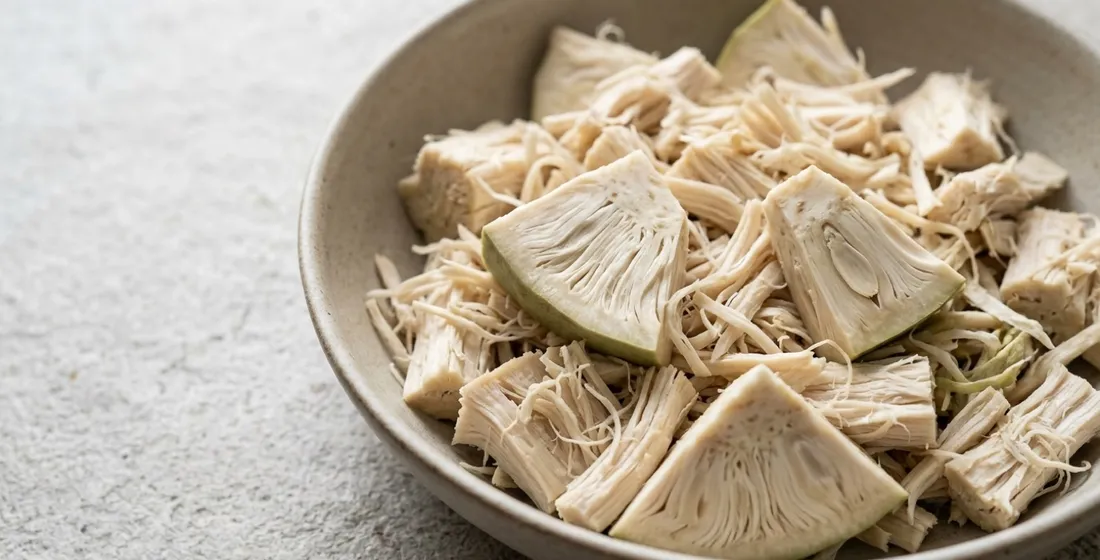
Hero alt text: Young (unripe) green jackfruit in pale, fibrous, shredded pieces in a neutral stoneware bowl, the savoury pulled-meat texture used in plant-based meat-alternative SKUs.
Buyer's snapshot • Young (unripe) jackfruit is a textural meat analogue, not a protein source. It carries about 1.5 to 1.7 g protein per 100 g (USDA FoodData Central). The appeal is the pulled, fibrous structure, not the nutrition panel. • The jackfruit products market reached USD 1.17 billion in 2025 and is forecast to grow at a 5.9% CAGR to USD 1.54 billion by 2030 (Future Market Insights, 2025), with plant-based meat substitutes the largest end use. • Jackfruit in brine is a low-acid canned food (finished pH above 4.6), so it requires a full retort thermal process under US FDA 21 CFR 113, not the simpler acidified-food route. • Silk Foods Ceylon (SFC) contract-manufactures chunks, pulled, and minced jackfruit in brine, plus ready-to-eat tender jackfruit curry SKUs, in glass jars and retort formats under BRCGS and FSSC 22000 V6. • This guide is for CPG scale-ups and distributors building a plant-based meat-alternative line. For fresh whole jackfruit, the bulky logistics make a processed format the more honest export answer. |
Most plant-based meat alternatives start with a protein isolate: soy, pea, or wheat. Young jackfruit takes the opposite route. It brings the texture first and lets the brand build flavor and protein around it. That single structural fact is why a tropical fruit most Western buyers had never cooked a decade ago now anchors pulled-pork, shredded-chicken, and carnitas-style SKUs across US and EU retail. This guide covers the formats, the food-safety classification that governs how the product is canned, and what a contract manufacturing brief for jackfruit in brine actually needs to specify.
What is young jackfruit in brine, and why has it become a plant-based meat staple?
Young, unripe jackfruit has a neutral flavor and a fibrous, stringy flesh that shreds into a pulled-meat texture when cooked, which is why it stands in for pulled pork, shredded chicken, and tuna in plant-based dishes. Packed in brine rather than syrup, it stays savory. Drained and rinsed, it carries marinades and sauces without added sugar.
The maturity stage is the whole game. Ripe jackfruit is sweet, golden, and aromatic, the version sold as a dessert fruit. Harvested young and green, the same fruit is starchy and bland, with a firm core and stringy bulbs that pull apart under a fork. Packing media matters just as much: brine or water preserves the savory profile, while syrup packs (common in the dessert trade) make the fruit useless for a meat application.
One honest caveat belongs in every jackfruit brief. Young jackfruit is a texture, not a protein. It carries roughly 1.5 to 1.7 g of protein per 100 g (USDA FoodData Central), against 20 g or more for the animal proteins it visually replaces. Brands that build around it either accept a low-protein, clean-label whole-food positioning or fortify the formulation with pea, soy, or legume protein. The fruit’s contribution is dietary fiber, potassium, and a structure no isolate can fake. Different starting point. Different formulation logic. Different label claim.
How big is the jackfruit and plant-based meat-alternative opportunity in 2026?
The jackfruit products market reached USD 1.17 billion in 2025 and is projected to grow at a 5.9% CAGR to USD 1.54 billion by 2030 (Future Market Insights, 2025), with plant-based meat substitutes the largest end-use segment. In the US, plant-based meat and seafood retail was about USD 1.2 billion in 2024 (Good Food Institute, 2024).
The wider plant-based meat numbers are doing two things at once, and a buyer should read both. In the US, retail dollar sales fell 7% and unit sales fell 11% in 2024, with only 13% of households buying the category and most doing so every couple of months (Good Food Institute and SPINS, 2024). The first-generation, ultra-processed burger-and-nugget wave has cooled. In Europe, the picture is steadier: value sales across six plant-based categories in the six largest markets reached EUR 4.7 billion in 2024, up 1.7% in value and 4.5% in volume year on year (GFI Europe and Circana, 2024).
Figure 1: Approximate market scale across the jackfruit products category and US and EU plant-based segments. Source: Future Market Insights 2025; Good Food Institute 2024; GFI Europe / Circana 2024 (EUR converted to USD, approximate).
Jackfruit sits in a useful spot inside that correction. Its pitch is the opposite of the lab-built analogue: a single recognizable ingredient, minimal processing, a short label. For a CPG brand reading the 2024 retail softness as a signal that shoppers want clean-label rather than hyper-engineered, jackfruit is a hedge. The category that grows from here rewards the whole-food story, and jackfruit was telling that story before the marketing caught up.
Why Sri Lanka is a structural sourcing advantage for jackfruit SKUs
In the 1940s, while famine killed hundreds of thousands in Bengal, Sri Lanka leaned on a tree. Arthur V. Dias ran a jackfruit planting campaign so persistent that the country renamed him Kos Mama, Uncle Jackfruit. Jackfruit is the national fruit, known locally as kos and as bath gaha, the rice tree, and it remains legally protected: you cannot fell a mature jackfruit tree in Sri Lanka without cause (Export Development Board Sri Lanka). That history is not decoration. For a contract manufacturer, it shows up as raw-material density.
Jackfruit grows in home gardens and smallholdings across Sri Lanka’s wet zone, which keeps green-stage fruit close to the manufacturing floor and the intake cost low. The SFC facility sits in Matale, in the country’s Central Province spice and herb belt, near that supply. The constraint is the fruit itself: a whole jackfruit is large, perishable, and damage-prone, which is why fresh exports run at only about 20 metric tonnes a month and stay hostage to phytosanitary rules (EconomyNext, 2023).
That constraint is the opportunity. The export-viable format for Sri Lankan jackfruit is processed, not fresh. Cut, brined, and retorted at origin, the fruit ships shelf-stable in glass or cans, clears the phytosanitary friction that dogs fresh whole fruit, and lands as a finished or near-finished SKU rather than a bulky raw material. The manufacturing value is captured in Sri Lanka, and the buyer receives a product that is already most of the way to a retail shelf. The same origin-processing logic underpins the facility’s coconut ingredient and contract manufacturing program, where the value-add also happens before the product leaves the country.
The format menu: chunks, pulled, minced, and ready-to-eat curry SKUs
Silk Route Ventures (SRV) supplies young jackfruit in two broad families: plain in-brine formats that a brand finishes into its own recipe, and ready-to-eat retort curry SKUs that ship as a complete meal component. The cut decides the end use. Chunks suit visible pieces in a tray bake or a taco filling; pulled suits a pulled-pork or barbecue line; minced suits a ground-meat replacement in bolognese, keema, or filling applications.
| Format | Best end use | Typical pack | Cert coverage |
| Jackfruit chunks in brine | Tacos, tray bakes, visible-piece dishes | Glass jar, retort, or bulk bucket | BRCGS, FSSC 22000 V6 |
| Pulled jackfruit in brine | Pulled-pork and barbecue-style SKUs | Glass jar, retort, or bulk bucket | BRCGS, FSSC 22000 V6 |
| Minced jackfruit in brine | Ground-meat replacement (keema, bolognese) | Glass jar, retort, or bulk bucket | BRCGS, FSSC 22000 V6 |
| Tender jackfruit curry (also smokey BBQ, teriyaki, tomato and basil) | Ready-to-eat retail meal component | Glass jar, retort | FSSC 22000 V6 |
Source: Silk Foods Ceylon product catalogue, 2026.
The plain in-brine SKUs are the volume play for a scale-up that wants control of its own recipe. The ready-to-eat curry range is the faster route to a finished retail SKU for a distributor or brand that wants the flavor work done at origin. Both run on the same retort capability, so a buyer can start with one and add the other without re-qualifying the supplier.
Is jackfruit in brine a low-acid canned food, and what does that mean for retort?
Jackfruit in brine has a finished pH above 4.6, which classifies it as a low-acid canned food (LACF) under US FDA 21 CFR 113, not an acidified food under 21 CFR 114. The practical consequence: it cannot rely on acidity for safety and must receive a full retort thermal process validated against Clostridium botulinum, with the scheduled process and the facility filed with the FDA.
This is the single most important technical fact in a jackfruit-in-brine brief, and it is the one most often missed. An acidified food (think a pickle or a tomato product brought below pH 4.6) can be held shelf-stable on acidity alone, with a milder heat process. Plain jackfruit in brine cannot. Its near-neutral pH and high water activity put it squarely in the low-acid category, where commercial sterility depends on a validated retort schedule, not on vinegar (US FDA, 21 CFR 113 and 114).
| Attribute | Low-acid canned food (21 CFR 113) | Acidified food (21 CFR 114) |
| Finished equilibrium pH | Above 4.6 | 4.6 or below |
| Jackfruit in brine falls here | Yes | No |
| Safety basis | Validated retort thermal process | Acidity plus milder heat |
| Target organism | Clostridium botulinum spores | Restricted by low pH |
| US filing | Process and facility filed with FDA | Process and facility filed with FDA |
Source: US FDA, 21 CFR Parts 113 and 114.
For a US-bound program, that means the manufacturer must operate as a registered low-acid canned food processor, run a scheduled process set by a competent process authority, and keep the production records 21 CFR 113 requires. For EU-bound product, the equivalent expectation is documented commercial sterility and a validated thermal process. A buyer evaluating a jackfruit supplier should treat retort validation and LACF process filing as gating questions, not afterthoughts.
Buyer's checklist: qualifying a jackfruit-in-brine supplier 1. Confirmation that the product is handled as a low-acid canned food, with a validated retort schedule 2. Evidence of a scheduled process set by a recognized process authority (for US-bound product) 3. Per-batch Certificate of Analysis covering microbial, pH, and drained weight 4. Maturity and variety statement (young, unripe, savory-grade fruit) 5. Brine specification: salt percentage and target finished pH 6. Pack format, fill weight, and drained weight tolerances 7. Destination-market cert stack and shelf-life statement 8. Sample run dispatched against the spec before any production PO |
Contract manufacturing capacity, MOQ, and lead times at Silk Foods Ceylon
Silk Foods Ceylon manufactures jackfruit in brine and tender jackfruit curry on the same retort and semi-liquid lines that run its wider plant-based range. The glass-jar line produces up to 3,000 jars per day; the plant-based meat lines run vegan patties at 15,000 units per day and vegan nuggets at 30,000 units per day on a shared cellular manufacturing footprint. That layout matters for a scale-up: a new jackfruit SKU does not need its own audited line, and the certifications already cover the process.
The Matale facility holds BRCGS and FSSC 22000 V6 across the relevant lines, with the chunks, pulled, and minced in-brine formats covered under both standards. For US and EU CPG buyers, that pairing clears both a GFSI-recognized food-safety bar and the BRCGS standard most UK and EU grocers gate supplier listings on, without commissioning a separate audit.
| Format | First-order MOQ | Notes |
| Jackfruit in brine, glass jar | 1,500 jars | Half-day production run; glass tooling adds about 1 week lead |
| Tender jackfruit curry, glass jar (retort) | 1,500 jars | Per recipe variant |
| Jackfruit in brine, bulk bucket | By volume quote | For buyers finishing the product downstream |
Source: Silk Foods Ceylon MOQ ladder, 2026.
Certification snapshot: Silk Foods Ceylon, Matale • BRCGS (covers the jackfruit in-brine lines, plus spice, herb, coconut, plant-based, and retorted product lines) • FSSC 22000 V6 (covers the full processing scope, including retort and plant-based meat formats) • USDA Organic and EU Organic (per-SKU) • Sri Lanka EDB-registered, US FDA-registered facility |
Lead times are practical to plan against. Samples dispatch door-to-door by international courier in 3 to 5 business days; production runs 2 to 3 weeks from PO to dispatch, with an extra 2 to 4 weeks upfront when a new curry recipe needs formulation. Sea freight runs 3 to 4 weeks to the EU and Australia and 4 to 5 weeks to the US, and every order ships with the standard documentation pack: commercial invoice, packing list, bill of lading or air waybill, certificate of origin, phytosanitary certificate, and the batch Certificate of Analysis. Payment terms are consistent across the customer book: orders under USD 10,000 are 100% advance by bank transfer, and orders of USD 10,000 or above run 50% advance with the balance against scanned shipping documents.
Buyers approaching this comparison usually fall into one of two camps: distributors who want a finished retort curry SKU under their own label, and CPG scale-ups exploring full plant-based contract manufacturing in Sri Lanka. The jackfruit lines serve both, and the same retort capability sits behind the vegan cheese spread retort program and the plant-based patty line at 15,000 units per day. For the cross-category view, the food and beverage contract manufacturing buyer’s guide frames where jackfruit fits in the full SFC line-up.
What should you specify in a jackfruit-in-brine RFQ?
The most common gap the SRV procurement desk sees in first jackfruit briefs is a missing maturity statement: a buyer asks for “jackfruit” without specifying young and unripe, then is surprised when a sample tastes sweet. A clean RFQ closes that gap upfront and makes the first sample useful. Specify the following:
1. Maturity and variety. State young, unripe, savory-grade fruit explicitly. This is the parameter that separates a meat analogue from a dessert ingredient.
2. Cut. Chunk size, pulled, or minced, matched to the end-use dish.
3. Packing medium. Brine (state target salt percentage) or water. Not syrup.
4. Drained weight and fill weight. Give the target drained weight and tolerance, since this is what the retail pack claim is built on.
5. Pack format and size. Glass jar (220 ml, 330 ml, 420 ml, 500 ml, or 1 L), tin, or bulk bucket, with the closure type.
6. Shelf life and process basis. State the required shelf life and confirm the low-acid canned food retort basis.
7. Destination market and cert stack. Name the market so the supplier maps the right cert and documentation (BRCGS and FSSC 22000 V6, plus organic where the SKU carries it).
8. Label claims. Flag any clean-label, vegan, or organic claims early, since they drive sourcing and documentation.
A brief that answers these eight points turns a vague “do you do jackfruit” inquiry into a quotable spec, and it lets the manufacturer ship a first sample that actually reflects the intended product. For the broader supplier-evaluation workflow, the Sri Lankan supplier evaluation checklist extends this into a full due-diligence pass.
Frequently asked questions
Does Silk Route Ventures offer private label and contract manufacturing for jackfruit in brine?
Yes. Silk Foods Ceylon contract-manufactures young jackfruit in brine (chunks, pulled, minced) and ready-to-eat tender jackfruit curry SKUs at its Matale facility under BRCGS and FSSC 22000 V6, in glass jars and retort formats. First-order MOQ for glass-jar SKUs is 1,500 jars. Samples ship by international courier in 3 to 5 business days.
What is the MOQ for jackfruit in brine or tender jackfruit curry?
First-order MOQ for glass-jar jackfruit in brine and tender jackfruit curry is 1,500 jars per SKU, roughly a half-day production run, with glass tooling adding about one week of lead time. Bulk-bucket formats for buyers finishing the product downstream are quoted by volume. Production runs 2 to 3 weeks from PO to dispatch.
Is jackfruit in brine a low-acid canned food?
Yes. Jackfruit in brine has a finished pH above 4.6, classifying it as a low-acid canned food under US FDA 21 CFR 113 rather than an acidified food under 21 CFR 114. It requires a validated retort thermal process against Clostridium botulinum, with the scheduled process and facility filed with the FDA for US-bound product.
How much protein does young jackfruit have?
Young jackfruit carries about 1.5 to 1.7 g of protein per 100 g (USDA FoodData Central), far below the animal proteins it replaces texturally. It is a fibrous, low-protein, clean-label carrier. Brands targeting a protein claim fortify the formulation with pea, soy, or legume protein around the jackfruit base.
Can SRV ship jackfruit SKUs to the US and EU under BRCGS and FSSC 22000 V6?
Yes. The Matale facility holds BRCGS and FSSC 22000 V6 across the relevant jackfruit lines, covering both a GFSI-recognized food-safety standard and the BRCGS bar that most UK and EU grocers require for listing. Sea freight runs 3 to 4 weeks to the EU and 4 to 5 weeks to the US, with the full export documentation pack on every order.
How Silk Route Ventures can help
Silk Route Ventures (SRV) contract-manufactures young jackfruit in brine and ready-to-eat tender jackfruit curry SKUs under one roof at the Silk Foods Ceylon (SFC) facility in Matale, alongside vegan patties at 15,000 units per day, vegan nuggets at 30,000 units per day, and retorted spreads and beverages. The site holds BRCGS and FSSC 22000 V6 across the relevant lines, and the cellular manufacturing layout means a new jackfruit SKU does not trigger a separate audit cycle. The SRV R&D and NPD team scopes any custom curry recipe in parallel with the production plan. Payment terms run 100% advance under USD 10,000, or 50% advance with the balance against shipping documents at or above USD 10,000. Contact us to send an inquiry for a co-manufacturing capability briefing tailored to your jackfruit SKU and target launch volume.
Sources
1. Future Market Insights, “Jackfruit Products Market Outlook 2025 to 2035,” (2025). Retrieved 2026-05-25. https://www.futuremarketinsights.com/reports/jackfruit-products-market
2. Good Food Institute, “Analyzing plant-based meat and seafood sales (US retail, 2024),” (2024). Retrieved 2026-05-25. https://gfi.org/resource/analyzing-plant-based-meat-and-seafood-sales/
3. GFI Europe, “European plant-based sales data (2024),” (2024). Retrieved 2026-05-25. https://gfieurope.org/european-plant-based-sales-data/
4. US Food and Drug Administration, “21 CFR Part 113: Thermally Processed Low-Acid Foods Packaged in Hermetically Sealed Containers,” (current). Retrieved 2026-05-25. https://www.ecfr.gov/current/title-21/chapter-I/subchapter-B/part-113
5. US Food and Drug Administration, “21 CFR Part 114: Acidified Foods,” (current). Retrieved 2026-05-25. https://www.ecfr.gov/current/title-21/chapter-I/subchapter-B/part-114
6. Export Development Board Sri Lanka, “Benefits and Uses of Jackfruit,” (current). Retrieved 2026-05-25. https://www.srilankabusiness.com/faq/fruits-and-vegetables/benefits-of-jackfruit.html
7. EconomyNext, “Sri Lanka sees export potential for jackfruit amid planting drive,” (2023). Retrieved 2026-05-25. https://economynext.com/sri-lanka-sees-export-potential-for-jackfruit-amid-planting-drive-117627/
Further reading
Good Food Institute, “Plant-based meat in US retail: pricing and promotion insights” -> https://gfi.org/resource/analyzing-plant-based-meat-and-seafood-sales/
US FDA, “Acidified and Low-Acid Canned Foods guidance and regulatory information” -> https://www.fda.gov/food/guidance-documents-regulatory-information-topic-food-and-dietary-supplements/acidified-low-acid-canned-foods-guidance-documents-regulatory-information
Written by the Silk Route Ventures Trade Team. Silk Route Ventures (E-Silk Route Ventures (Pvt) Ltd) is a Sri Lankan B2B supply-chain operator for the Food, Beverage, Wellness, and Nutraceuticals sectors. The Silk Foods Ceylon manufacturing arm holds BRCGS and FSSC 22000 V6 certifications. Questions or to request a sample: contact us at https://www.esilkroute.com.lk/contact or email info@esilkroute.com.lk.