
Pineapple Rings, Tidbits, Tea-Bag-Cut and Strip Formats: Format Selection for Snack and Bakery
By the Silk Route Ventures Trade Team | 7 July 2026
Buyer’s snapshot
- Global dried fruit demand reached about USD 12.02 billion in 2024 and is forecast to hit USD 16.55 billion by 2030 (Grand View Research), yet most dried pineapple RFQs name the fruit and leave the format, the sugar, and the sulphur dioxide blank. Those three lines decide the application and the label.
- Rings, tidbits, tea-bag-cut, and strips are the same fruit cut four ways. Format is an application decision: rings and strips for retail snacking, tidbits and tea-bag-cut for bakery and cereal inclusion.
- Two specs gate the label: added sugar (sweetened, sugar-infused, or unsweetened) and sulphur dioxide. Both the EU and the US require sulphites to be declared once they reach 10 mg/kg in the finished product.
- Silk Foods Ceylon (SFC) dehydrates Mauritius-variety pineapple in Matale into rings, tidbits, tea-bag-cut, and strip formats under BRCGS and FSSC 22000 V6, with a 100 kg first-order MOQ per format and a COA available on request.
- For snack and bakery brands specifying dried pineapple on a retail label, this post is the spec. For lowest-cost candied filler sold on price alone, a bulk commodity supplier is the more honest answer.
Most brands sourcing dried pineapple write “dried pineapple, X kg” on the RFQ and stop there. That leaves three decisions to the supplier: which cut, how much sugar, and how much sulphur dioxide. Each one changes the ingredient. A ring built for a resealable snack pouch behaves nothing like a diced tidbit built to survive a 190 C oven, and a bright, soft, sulphured strip carries a label declaration that an unsulphured one does not. The fruit is identical. The finished ingredient, the application, and the packaging claim are not. This piece is for the procurement and product teams who want a defensible dried pineapple spec before the first sample lands.
The four dehydrated pineapple formats, mapped to application
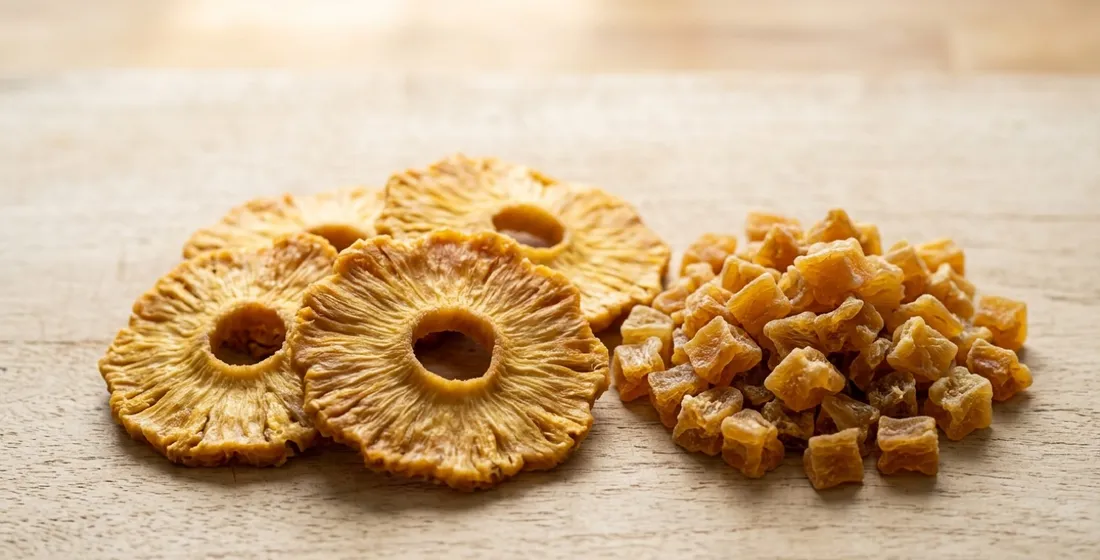
Dehydrated pineapple ships in four standard cuts: rings, tidbits, tea-bag-cut, and strips. Rings and strips serve retail snacking and grab-and-go packs; tidbits at 6 to 12 mm and tea-bag-cut at 2 to 5 mm serve bakery, cereal, and infusion applications. The cut is not a quality tier. It is a match between piece geometry and the machine, the mouth, or the oven it feeds.
| Format | Typical piece size | Best-fit applications | Why the format wins there |
|---|---|---|---|
| Rings | 40 to 70 mm disc, 5 to 8 mm thick, centre hole | Retail snack packs, premium display, cake and dessert topping | Whole-fruit visual cue, portionable, premium shelf presence |
| Tidbits | 6 to 12 mm dice | Granola, muesli, trail mix, muffins, cakes, snack bars, yoghurt toppings | Disperses evenly through a batter or mix without dominating |
| Strips | 5 to 10 mm wide, 40 to 80 mm long | Grab-and-go chewy snacking, lunchbox packs, mixed dried-fruit bags | Chewy bite, pouches and portions cleanly |
| Tea-bag-cut | 2 to 5 mm cut | Fruit tea and infusion blends, instant mixes, fine bakery inclusion | Small enough to steep, sift, or fold into a fine crumb |
Source: SRV facility format data and application mapping.
Which cut to lead with follows where the fruit is eaten, not a price list. There is a yield point worth knowing: rings are cut from the cored slice and lose the centre to the corer, so they carry the highest cost per kilogram of usable fruit. Tidbits and strips take the whole slice or the ring offcuts, which is why diced and strip formats usually land cheaper than rings for the same fruit and the same drying run. A snack brand paying for the whole-fruit ring look is paying for geometry, not for better pineapple.
The same logic runs through the coconut chip snack formats and the seedless versus with-seeds tamarind decision: the format is a procurement lever, not a cosmetic one.
What is the difference between dehydrated, sugar-infused, and freeze-dried pineapple?
Dehydrated pineapple is air or tunnel dried to a chewy, pliable piece and holds more residual moisture than freeze-dried fruit. Sugar-infused (osmotically dehydrated) pineapple is steeped in sucrose syrup before drying to stabilise texture and colour. Freeze-dried pineapple is a separate, crisp, low-moisture ingredient at a higher price point. This post covers the dehydrated and sugar-infused routes, not freeze-dried.
Sugar-infusion is why so much diced dried tropical fruit is not a single-ingredient product. Steeping the fruit in syrup before final drying lowers its water activity, firms the texture, and stabilises colour and pigment, which extends storage life and helps the piece survive a bakery mix. The peer-reviewed literature on osmotic dehydration of pineapple documents exactly these effects (Journal of Food Science and Technology). The trade-off lands on the label: an infused piece reads “pineapple, sugar,” not “pineapple.”
A brand chasing a single-ingredient clean label needs unsweetened dehydrated fruit and should expect a firmer, darker, more tart piece. A brand chasing a bright, soft, sweet snack usually wants the infused route. If the target is a fine powder or a cold-beverage inclusion instead of a whole piece, that is a different ingredient again, covered in the pineapple powder spray-dried versus freeze-dried comparison.
Sulphur dioxide and added sugar: the two specs that decide your label
Two specs, not the cut, decide a dried pineapple label. Sulphur dioxide (E220) preserves colour and shelf life but must be declared as an allergen once it reaches 10 mg/kg in the finished food, under both EU Regulation (EU) No 1169/2011 and US FDA rules. Added sugar decides whether the ingredient statement reads “pineapple” or “pineapple, sugar.” Both are buyer decisions, not supplier defaults.
Sulphur dioxide keeps dried pineapple bright golden and extends shelf life by slowing browning and mould. Unsulphured pineapple is darker, browner, and shorter-lived. The trade-off is the label and the growing share of buyers who want no added sulphites. In the US, the FDA requires any sulfiting agent to be declared once it is present at 10 ppm (10 mg/kg) or more, and prohibits sulfites on produce sold raw (21 CFR 101.100). The EU applies the same 10 mg/kg declaration trigger under Regulation (EU) No 1169/2011. Maximum permitted SO2 levels in dried fruit are set by fruit type under Regulation (EC) No 1333/2008; name the destination-market ceiling and your own house limit on the RFQ rather than accepting a default.
Added sugar is the second gate. Sugar reduction is now a defining force in snacking: Innova Market Insights reports that no-added-sugar and reduced-sugar claims keep growing across sweet snacks, with fruit-based snacks gaining as a more natural option (2024 to 2025). That splits the category cleanly. An unsweetened, unsulphured dried pineapple is the clean-label story at a firmer, darker eat. A sugar-infused, sulphured piece is the bright, soft, long-shelf-life commodity. Price and label both move with that one choice.
In 2025, the US FDA classified a recall of Floria-brand dried apricots as Class I, its most serious category, after state sampling found sulfites that were not declared on the label; more than 14,000 packs across 19 states were affected (Newsweek, 2025). None of that was a failure in the drying step. It was a documentation and labelling failure, the exact risk a buyer inherits when the SO2 line is left blank on the RFQ and never lands on the COA. That is why the sulphur dioxide assay belongs on every batch certificate of analysis, and not on the first-article sample alone.
How do rings, tidbits, tea-bag-cut, and strips behave in snack versus bakery applications?
In snacking, piece integrity and chew drive the choice: rings and strips give a whole-fruit eat and pouch cleanly. In bakery, dispersion and bake-stability drive it: tidbits and tea-bag-cut fold through a batter and hold shape through the oven. Sugar-infused dice resist moisture migration into a crumb better than untreated dried fruit, which is why inclusion-grade pineapple is usually infused.
The inclusion channel is large and growing. The global cereal bar market was estimated at about USD 17.88 billion in 2024 and is projected to reach USD 28.12 billion by 2030, a 7.9% CAGR, with granola and muesli bars the largest segment (Grand View Research). That is the pull-through demand for diced and strip pineapple as an inclusion, alongside the mango and other fruit inclusions brands blend beside it.
The bakery failure mode to design against is moisture migration. A dried inclusion held at a higher water activity than the surrounding crumb will trade moisture with the dough, softening the product or drying the fruit over shelf life. Sugar-infusion lowers the fruit’s water activity and narrows that gradient, which is the technical reason inclusion-grade pineapple is usually infused rather than plain-dried. For a cracker or low-moisture bar an unsweetened piece can work; for a soft muffin or cookie, the infused dice usually holds the eat.
Writing the dehydrated pineapple spec on your RFQ
A defensible dried pineapple RFQ names nine things: variety, format and piece dimensions, moisture and water activity, sulphur dioxide limit, added-sugar status, colour, microbial panel, pesticide panel to the destination market, and origin with traceability. Water activity below about 0.60 inhibits the moulds that spoil dried fruit; specify it, not moisture percentage alone.
Buyer’s checklist: specifying dehydrated pineapple
- Variety (Mauritius / Queen-type, or MD2) and country of origin
- Format: rings, tidbits, tea-bag-cut, or strips, with target piece dimensions
- Moisture percentage and water activity (aw target, for example below 0.65)
- Sulphur dioxide limit in mg/kg for the destination market, or no added sulphites
- Added sugar: unsweetened, sweetened, or sugar-infused, with the ingredient statement you need
- Colour and texture reference (pliable and chewy versus firm)
- Microbial panel (total plate count, yeast and mould, Salmonella, E. coli)
- Pesticide residue panel aligned to the destination market
- Per-batch COA and farm-level traceability for organic SKUs
Water activity, not moisture percentage, is the parameter that governs shelf life. The FDA treats a water activity of 0.85 as the line below which a food will not support most pathogenic bacteria (FDA, Water Activity in Foods), while the moulds that actually spoil dried fruit are inhibited only below roughly aw 0.60 (UC ANR, 2025). Well-made dried pineapple sits comfortably under that. Specify the water activity, because two lots at the same moisture percentage can carry different water activity and therefore different shelf lives.
Spec snapshot: dehydrated pineapple (Silk Foods Ceylon)
- Variety: Mauritius (Queen-type); MD2 on request
- Origin: Sri Lanka (Kurunegala and Gampaha growing districts)
- Formats: rings, tidbits (6 to 12 mm), tea-bag-cut (2 to 5 mm), strips
- Sugar: unsweetened, sweetened, or sugar-infused to spec
- Sulphur dioxide: to destination-market limit, or SO2-free
- Certification: BRCGS and FSSC 22000 V6; COA on request
- MOQ: 100 kg per format, first order; 2 to 3 week PO to dispatch for standard SKUs
Sri Lanka grows pineapple on roughly 4,750 hectares for output on the order of 35,000 tonnes a year, about 70% of it in the Kurunegala and Gampaha districts, with the Mauritius variety, a Queen-type with deep golden flesh, the local mainstay and the Export Development Board promoting MD2 for processed export (ISHS Acta Horticulturae; Sri Lanka EDB). For a dried-fruit buyer the variety is not trivia: Queen-type flesh carries a higher sugar-to-acid ratio, which is why unsweetened Mauritius pineapple can hold a sweeter eat without infusion than a more acidic cultivar. Organic and certification questions for that origin sit in the buyer’s guide to organic certifications and the wider Ceylon sourcing guide.
Is Sri Lankan dehydrated pineapple worth specifying over commodity origins?
For a retail-labelled snack or bakery SKU, origin and certification protect the claim on the pack. Silk Foods Ceylon dehydrates pineapple in Matale under BRCGS and FSSC 22000 V6, with a COA available on request and lots traceable from raw material intake to shipment through our batch coding. For a private-label programme, the same site can co-pack finished retail pouches, so the ingredient spec and the packed SKU share one audit.
The honest comparison is not invoice price against invoice price. It is the landed, labelled, audited cost of a piece that matches your format and carries the sulphur dioxide and sugar spec your market allows. A cheaper candied filler that arrives with an undeclared sulphite level or the wrong cut costs far more once it fails a retailer’s spec check or triggers a recall. Buyers running this decision usually fall into two camps: brand owners specifying ingredient supply against an existing co-packer, and distributors consolidating dried-fruit lines under one supplier. The Matale site serves both from one certification stack.
Where SRV’s pricing doesn’t fit
Lowest-cost candied filler sold on invoice price alone, with no format spec, no sulphite-declaration discipline, and no certification requirement. For that brief, a bulk commodity dried-fruit supplier is the more honest answer than a certified Matale line at a certified price. The Ceylon-origin, dual-cert route is built for brands competing on label integrity and provenance, not on the lowest shelf price.
Frequently asked questions
What sulphur dioxide level should dried pineapple have?
It depends on the market and the label you want. Both the EU (Regulation (EU) No 1169/2011) and the US FDA require sulphites to be declared once they reach 10 mg/kg in the finished food, and maximum permitted levels in dried fruit are set by type under EU Regulation (EC) No 1333/2008. Specify your ceiling, or order SO2-free, on the RFQ.
What is the difference between dehydrated and freeze-dried pineapple?
Dehydrated pineapple is air or tunnel dried to a chewy, pliable piece, used for rings, tidbits, strips, and tea-bag-cut. Freeze-dried pineapple is a separate crisp, low-moisture ingredient at two to three times the cost, better suited to cold beverages and clean-label powders. For chewy snacking and bakery inclusion, dehydrated is usually the match.
Which dried pineapple format is best for granola and bakery inclusion?
Tidbits at 6 to 12 mm and tea-bag-cut at 2 to 5 mm disperse evenly through a mix or batter and hold shape through the oven. Sugar-infused dice resist moisture migration into a crumb, which is why inclusion-grade pineapple is usually infused. Rings and strips suit retail snacking, not inclusion.
Does Silk Route Ventures offer private label or contract packing for dried pineapple?
Yes. Silk Foods Ceylon dehydrates and packs pineapple at its Matale facility under BRCGS and FSSC 22000 V6, and can co-pack finished retail pouches under a buyer’s brand. First-order MOQ is 100 kg per format for bulk supply; contact SRV for a private-label pouch quote and a sample.
What is the MOQ and lead time for dehydrated pineapple from Sri Lanka?
The first-order MOQ is 100 kg per format (rings, tidbits, tea-bag-cut, or strips), with volume-tier pricing at 500 kg, 1,000 kg, and 2,500 kg. Samples are free for evaluation (you cover the courier); production lead time from PO to dispatch is 2 to 3 weeks for standard SKUs (4 to 6 weeks for private label, custom specifications and organic orders), plus sea freight of 3 to 5 weeks by destination.
How Silk Route Ventures can help
Silk Route Ventures (SRV) supplies dehydrated Ceylon pineapple, in ring, tidbit, tea-bag-cut, and strip formats, to snack and bakery brands and distributors across the US, EU, and Australia. Bulk fruit is shipped against the buyer’s format, sugar, and sulphur dioxide spec from the BRCGS and FSSC 22000 V6 audited Silk Foods Ceylon (SFC) facility in Matale, with a COA available on request and lots traceable from raw material intake to shipment through our batch coding. First-order MOQ is 100 kg per format; samples are free for evaluation (you cover the courier) and ship door-to-door by international courier (DHL, FedEx, UPS). For brands ready to launch a retail snack pouch under their own label, or distributors consolidating dried-fruit lines under one supplier, the same site runs private-label packing on the same audit. Contact us to send an inquiry or request a sample pack. For grades, packaging and lead times, see our Sri Lankan spices supplier. Specifications and lead times for dehydrated pineapple rings are listed there.
Sources
- Grand View Research, “Dried Fruit Market Size And Share, Industry Report, 2030,” 2025. Retrieved 2026-07-07. https://www.grandviewresearch.com/industry-analysis/dried-fruit-market
- Grand View Research, “Cereal Bars Market Size, Share And Growth Report, 2030,” 2025. Retrieved 2026-07-07. https://www.grandviewresearch.com/industry-analysis/cereal-bar-market
- European Parliament and Council, “Regulation (EC) No 1333/2008 on food additives, Annex II,” 2008. Retrieved 2026-07-07. https://eur-lex.europa.eu/eli/reg/2008/1333/oj/eng
- European Parliament and Council, “Regulation (EU) No 1169/2011 on the provision of food information to consumers, Annex II,” 2011. Retrieved 2026-07-07. https://eur-lex.europa.eu/eli/reg/2011/1169/oj/eng
- US FDA, “21 CFR 101.100, Food; exemptions from labeling,” eCFR. Retrieved 2026-07-07. https://www.ecfr.gov/current/title-21/chapter-I/subchapter-B/part-101/subpart-G/section-101.100
- US FDA, “Water Activity (aw) in Foods, Inspection Technical Guide.” Retrieved 2026-07-07. https://www.fda.gov/inspections-compliance-enforcement-and-criminal-investigations/inspection-technical-guides/water-activity-aw-foods
- Newsweek, “Fruit Recall in 19 States Sparks Highest Risk Warning,” 2025. Retrieved 2026-07-07. https://www.newsweek.com/dried-fruit-recall-19-states-highest-risk-warning-fda-10905724
- Innova Market Insights, “Global Snacks Trends,” 2024 to 2025. Retrieved 2026-07-07. https://www.innovamarketinsights.com/reports/global-snacks-trends/
- International Society for Horticultural Science, “Pineapple Production and Research in Sri Lanka,” Acta Horticulturae. Retrieved 2026-07-07. https://doi.org/10.17660/ActaHortic.2000.529.9
Further reading
- UC ANR Master Food Preserver, “Water Activity and its Role in Food Preservation,” 2025. https://ucanr.edu/program/uc-master-food-preserver-program/article/water-activity-and-its-role-food-preservation
- Yadav and Singh, “Osmotic dehydration of fruits and vegetables: a review,” Journal of Food Science and Technology. https://pmc.ncbi.nlm.nih.gov/articles/PMC4152536/
- Sri Lanka Export Development Board, “Fruits and Vegetables: Export Potential.” https://www.srilankabusiness.com/fruits-and-vegetables/exporter-information/export-potential.html
Written by the Silk Route Ventures Trade Team. Silk Route Ventures (E-Silk Route Ventures (Pvt) Ltd) is a Sri Lankan B2B supply-chain operator for the Food, Beverage, Wellness, and Nutraceuticals sectors. The Silk Foods Ceylon manufacturing arm holds BRCGS and FSSC 22000 V6 certifications. Questions or to request a sample: info@esilkroute.com.lk.