
Banana Powder for CPG - Drying Method, Particle Size, and Shelf Life
Buyer’s snapshot
- The global banana powder market reached USD 801.9 million in 2024 and is forecast to hit USD 1.37 billion by 2030, a 9.34% CAGR (360iResearch / Grand View Research, 2024). Food applications held 42.7% of that volume; beverages are the fastest-growing segment.
- The drying method, not the fruit, sets the spec. Spray-dried, drum-dried, and freeze-dried banana powders behave differently in a bar matrix than in a cold beverage, and they price differently too.
- Water activity is the number that governs shelf life. Spray-dried banana powder at roughly 0.25 water activity stays sensory-acceptable for about 12 months in aluminium-laminated packaging.
- Silk Foods Ceylon spray-dries and mills banana powder at its Matale facility under BRCGS and FSSC 22000 V6, with a 50 kg first-order MOQ per SKU and COA on every batch.
- This post is for bar, bakery, and beverage formulators writing a banana powder spec. For buyers who just want the cheapest tonnage with no spec, the cultivar and drying method will not matter, and neither will this article.
Most banana powder gets bought on one line of a spec sheet: “banana powder, food grade.” Then it underperforms in the application, and nobody can say why. The reason is almost always upstream of the fruit. A spray-dried ripe banana powder and a hot-air-dried green banana flour share a name and almost nothing else: different color, different sweetness, different resistant-starch load, different particle size, different shelf life. This piece walks through the four variables that actually decide whether a banana powder works in your bars and beverages, and how to put each one in a procurement RFQ.
What is banana powder, and why does the drying method change the spec?
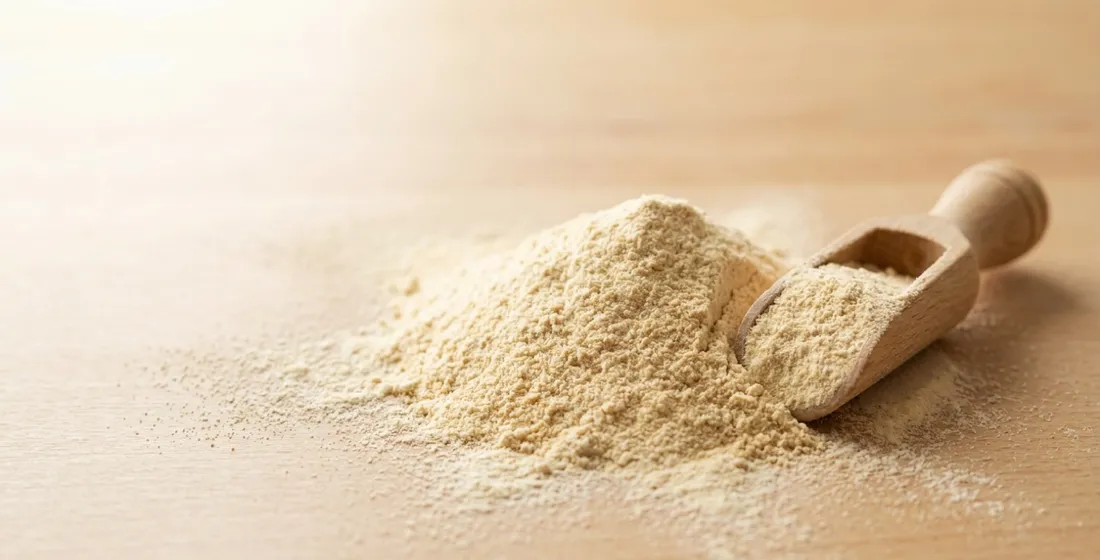
Banana powder is dehydrated banana, milled to a free-flowing powder. The fruit is simple. The processing is where the procurement decision lives. Three drying routes dominate, and each one hands you a different functional ingredient.
Banana powder is produced by three main drying routes. Spray-drying atomizes banana puree blended with a maltodextrin carrier into hot air at 130 to 200°C, yielding a very fine, highly soluble powder. Drum-drying spreads puree on heated rotating drums at around 150°C, producing pre-gelatinized flakes. Freeze-drying sublimates frozen puree under vacuum, preserving the most color and nutrients at the highest cost (Journal of Food Processing and Preservation, 2018).
| Drying method | Typical process | Particle / texture | Best fit | Relative cost |
|---|---|---|---|---|
| Spray-dried | Puree + maltodextrin atomized into hot air, 130 to 200°C | Very fine, highly soluble | Beverages, instant drinks, smoothie premix | Mid |
| Drum-dried | Puree dried on heated rollers near 150°C | Pre-gelatinized flakes, coarser | Bars, batters, viscosity building | Low to mid |
| Freeze-dried | Frozen puree sublimated under vacuum | Fine, best color and nutrient retention | Premium retail, infant nutrition | High |
Source: SRV facility data + Journal of Food Processing and Preservation, 2018
Spray-drying is the workhorse for beverage applications. It needs a carrier (usually maltodextrin) because banana puree is sugar-rich and would otherwise stick to the dryer wall, and that carrier does double duty: it lowers the finished powder’s water activity and hygroscopicity, improves flowability, and limits storage browning (Wong et al., Journal of Food Processing and Preservation, 2018). The trade-off is dilution. A higher maltodextrin load means a more stable, more soluble powder with less banana per kilogram, so the carrier percentage belongs in the spec, not in a footnote.
Drum-drying pre-gelatinizes the starch, which is useful when you want a powder that builds viscosity or binds in a bar or batter. Freeze-drying retains the most flavor, the truest color, and the most heat-sensitive nutrients, and a 2023 study on ripe Nendran banana confirmed freeze-drying as the best of the methods tested for nutrient retention (Journal of Food Science and Technology, 2023). It also costs the most, which is why it tends to sit in premium retail and infant-nutrition SKUs rather than commodity bar lines.
Ripe or green? The spec confusion that costs a reformulation
The single most expensive mistake in banana powder sourcing is treating ripe banana powder and green banana flour as interchangeable. They are not. Ripeness at harvest decides the powder’s entire functional profile.
Ripe banana powder leads with natural sugars and banana flavor, light brown in color, and works as a flavoring and natural sweetener. Green (unripe) banana flour is starch-led: it carries roughly 30% resistant starch on a dry basis, with cultivar values ranging from about 31.5% in Cavendish to 49% in Ladyfinger (Munir et al., Food Science & Nutrition, 2024). Green banana flour is a functional, prebiotic, gluten-free ingredient; ripe banana powder is a flavor and sweetness ingredient.
On the trade desk, this is the most common spec gap we see on banana powder inquiries: a brand asks for “banana powder” for a high-fiber bar, then sends a target flavor profile that only ripe powder can hit. The two requests pull in opposite directions. A bar leaning on a resistant-starch fiber claim wants green banana flour; a smoothie or baby-food line leaning on banana sweetness wants ripe powder. Naming the ripeness stage in the first email saves a sample round.
The resistant starch in green banana flour is the reason the ingredient keeps expanding into bread, biscuits, pasta, and beverages: it survives milling, behaves as dietary fiber, and supports a prebiotic gut-health story that a 2024 review tied to glycemic and digestive benefits (Munir et al., Food Science & Nutrition, 2024). If your claim platform needs that fiber, the green grade is not a preference, it is the spec. If your application needs banana taste and color, ripe is the answer and the resistant starch is irrelevant.
What particle size should you specify for bars versus beverages?
Particle size is where banana powder either dissolves cleanly or leaves grit at the bottom of the bottle. It is set by the milling step after drying, and it should be specified by mesh, not adjective.
After dehydration, banana powder is milled to a typical particle size of 50 to 100 microns. For beverage and instant-drink applications, where smooth reconstitution matters, a finer cut of 80 mesh or finer is the working target. Coarser cuts are acceptable in baked and extruded formats where the powder is hydrated into a matrix rather than dissolved in cold liquid.
For a cold beverage, smoothie premix, or instant drink, finer is better: an 80-mesh-or-finer spray-dried powder reconstitutes without a chalky mouthfeel or sediment. For a bar, a baked good, or an extruded product, you have more latitude, because the powder hydrates into the dough or matrix and particle size matters less to the eating experience than it does to dosing accuracy and color uniformity. The practical rule is simple. Specify the finer cut when the consumer drinks it, and the standard cut when the consumer bites it.
Mesh interacts with drying method. Spray-dried powders arrive fine by default, which is part of why they dominate beverages. A hot-air-dried, then milled powder can be cut to a target mesh but will not match spray-dried solubility because the particle structure is denser. Put both the mesh and the drying method in the spec so the supplier quotes the right line, not the cheapest one.
The shelf-life math: water activity, hygroscopicity, and packaging
Shelf life on banana powder is not a marketing number. It is a function of three measurable things: water activity, the powder’s tendency to pull moisture from the air, and the barrier you ship it in.
Spray-dried banana powder typically holds a water activity around 0.25 and a moisture content under 0.5%, well inside the microbiologically stable zone. Its hygroscopicity, measured near 13.6%, means it readily absorbs ambient moisture once a bag is opened. Stored in aluminium-laminated polyethylene, spray-dried ripe banana powder stayed sensory-acceptable after a full year (Storage study, ResearchGate, 2018).
The headline is that water activity under about 0.3 keeps the powder microbiologically stable and slows non-enzymatic browning, the reaction that turns banana powder from cream to brown over time. Maltodextrin helps here too, because it lowers water activity and does not drive browning and HMF formation as aggressively as some other carriers (Wong et al., 2018). That is the chemistry behind a clean 12-month shelf life.
The hygroscopicity number is the operational warning. At nearly 14%, banana powder will draw moisture the moment it sits in a humid warehouse or an opened liner, and once water activity climbs, the shelf-life clock speeds up. A spec that names water activity and a moisture ceiling, paired with an aluminium-laminated or equivalent high-barrier pack and a clear repack-after-opening instruction, is what actually delivers the year on the COA. The powder does not fail in the dryer. It fails in storage.
Spec snapshot: bulk banana powder (typical procurement spec)
- Type: ripe (sweet, flavor) or green (resistant-starch, functional), specify which
- Drying method: spray-dried, drum-dried, or freeze-dried, specify which
- Carrier: maltodextrin %, where spray-dried
- Particle size: 80 mesh or finer for beverages; standard cut for bakery and bars
- Moisture: typically below 5%; water activity target below 0.3
- Packaging: aluminium-laminated or equivalent high-barrier, food-grade liner
- COA: per batch (moisture, water activity, microbial, and pesticide MRL where specified)
How to specify bulk banana powder in your RFQ
Most banana powder disappointments trace back to an RFQ that named the fruit and nothing else. A defensible spec names the five variables that decide performance, and it lets a competent supplier quote precisely instead of quoting the cheapest commodity grade.
Buyer’s checklist: bulk banana powder RFQ
- 1. Ripeness grade stated: ripe (flavor and sweetness) or green (resistant starch)
- 2. Drying method stated: spray-dried, drum-dried, or freeze-dried
- 3. Carrier declared, with percentage, for spray-dried powders
- 4. Particle size in mesh, matched to the application (beverage versus bar)
- 5. Moisture ceiling and water activity target
- 6. Per-batch COA with the parameters your end-claim depends on
- 7. Packaging barrier specified, plus shelf-life statement
- 8. Certification stack requested with versions, and a sample against the spec before any PO
Buyers running this exercise usually fall into two camps: brand owners specifying banana powder as a bulk ingredient against their own co-packer, and distributors building a multi-fruit-powder line for resale. Silk Route Ventures supplies both. The same spec discipline applies whether the order is a single banana SKU or a banana, mango, and pineapple powder set shipped on one set of customs documents.
FAQ
What is the difference between spray-dried and drum-dried banana powder?
Spray-drying atomizes banana puree with a maltodextrin carrier into hot air, producing a very fine, highly soluble powder suited to beverages. Drum-drying cooks puree on heated rollers into pre-gelatinized flakes that build viscosity and bind well in bars and batters. Spray-dried is finer and more soluble; drum-dried is coarser and more functional in a matrix.
Is green banana flour the same as banana powder?
No. Green banana flour is milled from unripe fruit and is starch-led, carrying around 30% resistant starch (Munir et al., 2024), which makes it a functional, prebiotic, gluten-free ingredient. Ripe banana powder is sugar-led and used for natural banana flavor and sweetness. Specify the ripeness stage, because the two are not interchangeable.
What particle size should banana powder be for a beverage?
For cold beverages, smoothie premixes, and instant drinks, target a fine cut of 80 mesh or finer so the powder reconstitutes without grit or sediment. Banana powder is typically milled to 50 to 100 microns; the finer end of that range, usually from spray-dried powder, gives the cleanest beverage mouthfeel.
How long does banana powder last, and what drives shelf life?
Spray-dried banana powder held at a water activity near 0.25 and under 0.5% moisture stays sensory-acceptable for about 12 months in aluminium-laminated packaging (storage study, 2018). Shelf life depends on keeping water activity below roughly 0.3 and protecting the powder from its own hygroscopicity with a high-barrier pack.
Does Silk Route Ventures supply bulk banana powder with BRCGS and FSSC 22000 certification?
Yes. Silk Foods Ceylon spray-dries and mills banana powder at its Matale facility under BRCGS and FSSC 22000 V6, with USDA Organic and EU Organic available per SKU. First-order MOQ is 50 kg per SKU, COA ships with every batch, and samples reach most markets by international courier in 3 to 5 business days.
How Silk Route Ventures can help
Silk Route Ventures (SRV) supplies bulk banana powder and a full fruit-powder range (mango, pineapple, papaya, soursop, lime, and more) to bar, bakery, beverage, and distribution buyers across the US, EU, and Australia. Powder is spray-dried or dried and milled to the buyer’s mesh and ripeness spec at the BRCGS and FSSC 22000 V6 audited Silk Foods Ceylon (SFC) facility in Matale, with COA on every batch and farm-level traceability on the USDA Organic and EU Organic SKUs. First-order MOQ is 50 kg per SKU, with volume tiers at 500 kg, 1,000 kg, and 2,500 kg, and samples ship door-to-door by international courier in 3 to 5 business days. For brands ready to move from bulk ingredient supply to a finished private-label retail SKU, SRV runs that from the same site. Contact us to send an inquiry or request a banana powder sample against your spec.
Sources
- Wong et al., “Effect of enzymatic processing, inlet temperature, and maltodextrin concentration on the rheological and physicochemical properties of spray-dried banana powder,” Journal of Food Processing and Preservation, 2018. link (retrieved 1 June 2026)
- Munir et al., “Green banana resistant starch: A promising potential as functional ingredient against certain maladies,” Food Science & Nutrition, 2024. link (retrieved 1 June 2026)
- “Effect of different drying techniques on the nutrient and physicochemical properties of Musa paradisiaca (ripe Nendran banana) powder,” Journal of Food Science and Technology, 2023. link (retrieved 1 June 2026)
- “Storage Studies on Spray Dried Ripe Banana Powder Produced by Response Surface Methodology,” 2018. link (retrieved 1 June 2026)
- Banana Powder Market intelligence, 360iResearch / Grand View Research, 2024. link (retrieved 1 June 2026)
Further reading
- “Influence of hot-air drying and freeze-drying on functional, rheological, structural and dielectric properties of green banana flour and dispersions,” Food Hydrocolloids, ScienceDirect. link
- “Bioaccessibility of Phenolic Compounds, Resistant Starch, and Dietary Fibers from Australian Green Banana,” Molecules (MDPI), 2024. link
Written by the Silk Route Ventures Trade Team. Silk Route Ventures (E-Silk Route Ventures (Pvt) Ltd, T/A Silk Route Ventures) is a Sri Lankan B2B supply-chain operator for the Food, Beverage, Wellness, and Nutraceuticals sectors. The Silk Foods Ceylon manufacturing arm holds BRCGS and FSSC 22000 V6 certifications. Questions or to request a sample: contact https://www.esilkroute.com.lk/contact or email info@esilkroute.com.lk.