
Papaya Powder and Papaya Seed Powder: Enzyme Claims and Sourcing Spec
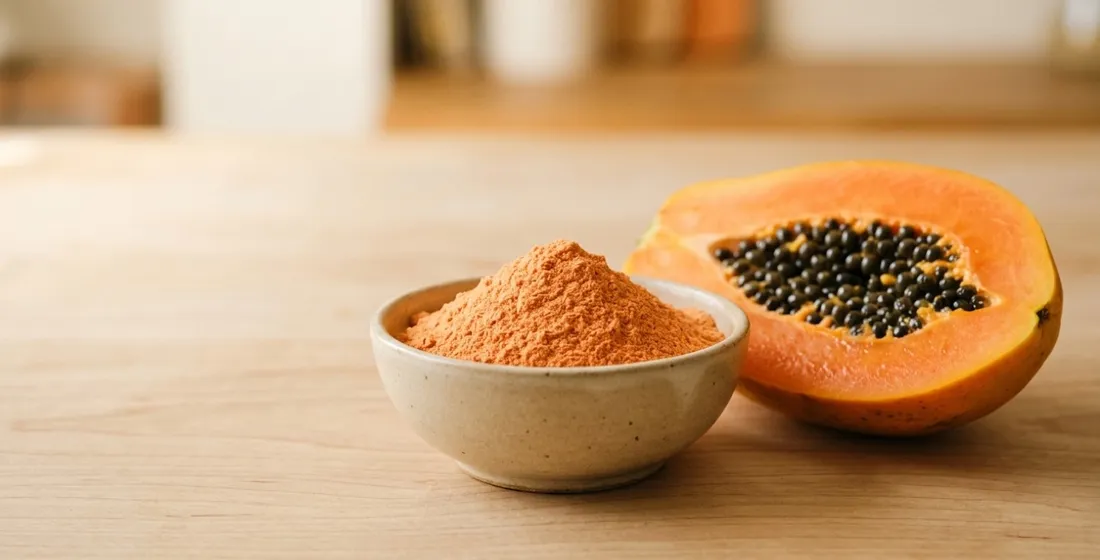
Buyer’s snapshot
- In 2023, global papaya output reached about 14.2 million tonnes, led by India at roughly 5.24 million tonnes (FAOSTAT, 2023). Papaya is abundant. The sourcing problem is spec discipline, not supply.
- “Papaya powder” is not one product. Ripe-fruit powder, green papaya powder, papaya seed powder, and papaya leaf powder differ in composition, claim, and risk.
- Papain, the protease buyers associate with papaya, denatures near 83°C. Standard spray drying runs 120 to 190°C inlet air, so a hot-dried fruit powder rarely carries meaningful enzyme activity.
- Silk Foods Ceylon (SFC), the Matale manufacturing arm of Silk Route Ventures (SRV), processes papaya fruit, seed, and leaf powders under BRCGS and FSSC 22000 V6, with a 100 kg MOQ per SKU and a COA on request.
- For wellness and beverage brands writing an enzyme or digestion claim, this post is the spec. For a flavor or fiber SKU, the simpler fruit-powder route is the more honest one.
Most brands that ask for “papaya powder with papain” are asking for two different things at once. One is a fruit powder for color, fiber, and tropical flavor. The other is an active protease that can stand behind a digestion claim. Those are not the same SKU, and the gap between them is a drying curve. This piece separates papaya fruit powder, green papaya powder, papaya seed powder, and papaya leaf powder at the spec level, and shows where the enzyme claim survives and where it quietly dies in the dryer.
What is the difference between papaya fruit powder and papaya seed powder?
Papaya yields at least four distinct powders. Ripe-fruit powder carries sugars, soluble fiber, beta-carotene, and vitamin C. Green, unripe fruit powder holds more of the latex-stage protease papain. Papaya seed powder concentrates benzyl isothiocyanate and the alkaloid carpaine, flagged by the Cosmetic Ingredient Review (2022) for dose limits. Leaf powder is the traditional platform-claim material. One fruit, four spec sheets.
The mistake buyers make is treating these as interchangeable because they share a label word. They do not share a function. A ripe-fruit powder is a flavor and nutrition carrier. A green-fruit powder is where a brand would look for residual protease activity, because the latex enzymes are most abundant before the fruit ripens. Papaya seed powder is a functional, almost peppery material with antiparasitic interest in the literature, not a flavor base. Papaya leaf powder sits in a separate Ayurvedic-claim lane entirely.
For a procurement team, the first job is to fix which of the four the RFQ actually means. The team at the Silk Foods Ceylon facility fields papaya enquiries that conflate all four, and the intake question is always the same: which plant part, at which ripeness, dried how, and for which claim.
| Papaya powder form | Source part | Key constituents | Typical buyer use | Main claim caution |
|---|---|---|---|---|
| Ripe papaya fruit powder | Ripe flesh | Sugars, fiber, beta-carotene, vitamin C | Flavor, color, smoothie and bar inclusion | Low residual papain; do not imply enzyme activity |
| Green papaya powder | Unripe flesh | Higher latex-stage papain, fiber | Digestive-positioned blends | Activity depends on drying method |
| Papaya seed powder | Seeds | Benzyl isothiocyanate, carpaine alkaloids | Functional, antiparasitic-positioned SKUs | Dose ceiling; intended-use statement needed |
| Papaya leaf powder | Leaves | Carpaine, phenolics | Traditional Ayurvedic-claim platforms | Platform-claim only; verify destination rules |
Source: SRV product catalog and Cosmetic Ingredient Review (2022).
Why drying method decides whether papaya powder carries active papain
Papain’s activity peaks near 60°C, and its apparent thermal denaturation sits around 83°C (Khatun et al., Food Research, 2021). Conventional spray drying uses 120 to 190°C inlet air. A 2018 study in the Journal of Food Science and Technology measured roughly 86.5% vitamin C retention in spray-dried papaya, and heat-labile enzymes fare worse than vitamin C. Drying method, not the word “papaya,” decides enzyme survival.
This is the detail that most “papaya powder with papain” sourcing briefs miss. Spray drying is the default for fruit powders because it is fast, cheap at volume, and pairs with a maltodextrin carrier that produces a free-flowing 12 to 120 micron particle. That same heat profile strips most of the protease activity a brand might want to claim. Freeze drying, run at minus 45 to minus 60°C, protects heat-labile actives far better, and several studies record vitamin C retention at or above 100% for papaya because the matrix opens up. It also costs several times more and yields a coarser, lower-density powder.
SRV finding: a spray-dried papaya fruit powder sold on price will almost never support an enzyme-activity claim. If a brand wants to claim papain on the panel, it needs a low-temperature-dried green-fruit fraction, or it sources purified papain separately and blends it. “Papaya fruit powder” should be positioned on fiber, color, and vitamin content. The protease claim belongs to a different, more expensive input.
| Drying method | Typical process temperature | Heat-labile actives | Particle and carrier | Cost signal |
|---|---|---|---|---|
| Spray-dried with maltodextrin | 120 to 190°C inlet | Largely lost | 12 to 120 micron, free-flowing | Lowest at volume |
| Freeze-dried | minus 45 to minus 60°C | Best retained | Coarse, low density, often carrier-free | Highest |
| Cabinet-dehydrated then milled | 50 to 70°C | Partly retained | Variable mesh, no carrier | Middle |
Source: Journal of Food Science and Technology (2018) and SRV process data.
Does papaya powder qualify for a digestive-enzyme claim?
Papain is recognized in the US food system as a GRAS enzyme preparation (US FDA, 21 CFR 184.1585), and EFSA’s food-enzyme panel found that papain from papaya latex needs no toxicological testing because it derives from an edible plant. The claim risk sits elsewhere. Enzyme inputs are specified in activity units, not milligrams, and the supporting trials test multi-enzyme blends rather than papain alone (CRN, 2013).
A 2023 randomized, double-blind, placebo-controlled trial in Biomedicine and Pharmacotherapy found that a digestive-enzyme blend improved pain and dyspepsia scores in adults with functional dyspepsia over two months. Papain was one component of the blend, not the sole agent. For a brand, that means the honest claim platform is a formulated enzyme complex with a stated activity, not a scoop of fruit powder positioned as a digestive aid.
In Q1 2026, the SRV procurement desk saw the same pattern three times in a month: a wellness brand asking for “papaya enzyme powder” at a fruit-powder price, expecting a protease claim a fruit powder can’t carry. The reframe each time was the same. Pick the claim first, then the input. The claim decides whether the right answer is a fruit powder, a low-temperature green-papaya fraction, or a separately assayed papain.
Specifying bulk papaya powder in an RFQ
A defensible papaya-powder RFQ names the plant part and ripeness stage, the drying method, the carrier and its percentage, mesh size, moisture, microbial limits, heavy metals, and a pesticide panel matched to the destination market. Only where an enzyme claim is intended does it add a papain activity figure in FCC units against a stated assay. Most failed papaya briefs omit the first two lines and argue about the last one.
Color is a fast authenticity check. Ripe papaya powder runs orange to salmon. A pale or brown powder points to oxidation, over-heating, or a green-fruit blend the buyer did not specify. Mesh and moisture drive flowability and shelf life, and a maltodextrin carrier should be declared as a percentage, because it dilutes the fruit solids a brand is paying for.
Spec snapshot: bulk papaya fruit powder
Plant part and stage: ripe fruit (specify if green)
Drying: spray-dried (maltodextrin carrier, declared percentage) or freeze-dried
Color: orange to salmon, uniform
Moisture: typically below 5%
Mesh: 80 to 100 as standard, confirm per application
Microbial and heavy-metals panel: per destination market
SRV MOQ: 100 kg per SKU; COA on request
The fruit powders sourcing reference for nutraceutical and beverage R&D covers the cross-fruit version of this spec discipline, and the per-fruit logic carries across to banana powder drying and particle-size guidance and spray-dried versus freeze-dried pineapple powder.
Is papaya seed powder safe to put on a label?
Papaya seed powder concentrates benzyl isothiocyanate, which falls from about 109 micrograms per gram in green fruit to 10 micrograms per gram in ripe fruit, alongside carpaine-type alkaloids (Cosmetic Ingredient Review, 2022). Those compounds drive the seed’s antiparasitic interest and its dose ceiling. Animal studies report reversible antifertility effects at high intake, so finished-format dosing and a clear intended-use statement matter more here than for fruit powder.
This is a real ingredient with a real audience, mostly wellness brands building cleanse or gut-support SKUs. It’s not a flavor powder, and it should never be positioned as one. A brand that wants papaya seed powder needs a dosing rationale, a destination-market check on novel-food and botanical rules, and a label that states intended use rather than implying open-ended consumption.
Where the brief is a mass-market beverage looking for a cheap “papaya enzyme” hook on the front of pack, seed powder is the wrong input and a fruit powder positioned on flavor is the more honest one. Naming that early saves a formulation cycle. For brands that want the functional material done properly, the seed-powder spec sits next to the bulk moringa leaf powder spec in the same nutraceutical-grade lane.
Sourcing papaya powder from Sri Lanka: MOQ, certifications, and lead time
Sri Lanka is a small papaya grower next to India’s 5.24-million-tonne crop, so the case for sourcing here is processing discipline, not field volume. The global fruit-powder market, about USD 28 billion in 2025 by one Fortune Business Insights estimate, increasingly rewards suppliers who can document spec rather than just ship tonnage. Silk Foods Ceylon runs papaya fruit, seed, and leaf powders under BRCGS and FSSC 22000 V6, with USDA Organic and EU Organic on selected SKUs, confirmed per SKU.
The Matale facility mills powders on a 100 to 200 kg per hour grinding line and runs spray drying at 50 kg per day, with a 100 kg per SKU MOQ and volume breaks at 500 kg, 1,000 kg, and 2,500 kg. Samples are free for evaluation (you cover the courier). Production lead is 2 to 3 weeks from purchase order to dispatch for standard SKUs (4 to 6 weeks for private label, custom specifications and organic orders), with sea freight at 4 to 5 weeks to the US and 3 to 4 weeks to the EU.
Most papaya enquiries that reach SRV are ingredient-supply briefs: bulk powder against the buyer’s spec, shipped with a full documentation pack. The same facility also runs private label for brands that want a finished retail powder under their own label, and the SRV R&D team scopes custom blends where a papaya fraction sits inside a larger enzyme or fruit-powder formulation. The FSSC 22000 V6 scope covers all three routes from the same audit.
Frequently asked questions
Does spray-dried papaya powder contain active papain?
Usually very little. Papain’s apparent thermal denaturation sits near 83°C (Khatun et al., 2021), and standard spray drying runs 120 to 190°C inlet air. A spray-dried ripe-fruit powder should be positioned on fiber, color, and vitamin content. For a protease claim, a low-temperature-dried green-papaya fraction or a separately assayed papain is the correct input.
What is the MOQ and lead time for bulk papaya powder from Silk Route Ventures?
The MOQ is 100 kg per SKU, with volume breaks at 500 kg, 1,000 kg, and 2,500 kg. Samples are free for evaluation (you cover the courier), and production lead is 2 to 3 weeks from purchase order to dispatch for standard SKUs (4 to 6 weeks for private label, custom specifications and organic orders). Sea freight runs 4 to 5 weeks to the US and 3 to 4 weeks to the EU.
Can Silk Route Ventures supply organic papaya powder for the US and EU?
Yes. Papaya powders are processed at the Silk Foods Ceylon facility in Matale under BRCGS and FSSC 22000 V6, with USDA Organic and EU Organic on selected SKUs, confirmed per SKU. A COA is available on request, and organic SKUs ship with the organic import certificate the destination requires so the buyer’s downstream organic claim stays valid.
Is papaya seed powder different from papaya fruit powder on a COA?
Yes, materially. Seed powder concentrates benzyl isothiocyanate and carpaine alkaloids (Cosmetic Ingredient Review, 2022), so its COA and intended-use statement differ from a fruit powder built for flavor and fiber. The two should never be specified or labeled interchangeably, even though both are sold as “papaya powder.”
How Silk Route Ventures can help
Silk Route Ventures supplies bulk papaya fruit powder, green papaya powder, papaya seed powder, and papaya leaf powder to wellness, beverage, and nutraceutical brands across the US, EU, and Australia. Powders are processed at the BRCGS and FSSC 22000 V6 audited Silk Foods Ceylon facility in Matale, with USDA Organic and EU Organic on selected SKUs, confirmed per SKU. MOQ is 100 kg per SKU, and samples are free for evaluation (you cover the courier). For early-stage brands without a co-packer, the SRV R&D and NPD team also develops custom fruit-powder and enzyme-blend formulations in-house. Contact us to send an inquiry or request a sample. For volume pricing, see our spices from Sri Lanka.