
Coconut Chips Flavor Formats: A Sourcing Spec for Snack Brands
Buyer’s snapshot
- Market-research estimates put the coconut chips category near USD 800 million in 2024, growing at roughly 6% a year on the back of better-for-you snacking. Flavor format, not raw coconut, is where a private-label brand wins or loses shelf.
- A coconut chip is a wide, curved slice of fresh kernel dried to 2 to 3% moisture and a water activity below 0.60. That is what gives the format a 12-month ambient shelf life (peer-reviewed shelf-life modeling, 2022).
- The nine flavor formats collapse into three processing routes: dried only (natural), oil-roasted or dry-toasted (roasted, salted, savory), and coated (sweetened, cinnamon, ginger, cocoa). The route, not the name, sets the spec.
- Silk Foods Ceylon runs coconut chips on a BRCGS and FSSC 22000 V6 audited flavoring and repacking line in Matale, with finished private-label packs and a coconut bulk MOQ of 1 metric tonne per SKU.
- For US-bound brands, a 2025 FDA guidance change matters: coconut is no longer treated as a major food allergen for the “Contains” statement. This post is the format spec; for a lowest-cost tender with no origin or certification ask, this is not the right supplier.
Most buyers shopping “coconut chips” on a sourcing platform compare a single price against a single photo. The photo hides the decision that actually drives cost, shelf life, and label: which of three processing routes the chip went through, and which flavor system rides on top. A natural dried chip, a salt-roasted chip, and a sugar-coated cinnamon chip share one raw material and almost nothing else on the spec sheet. This piece walks a private-label or co-pack buyer through the nine formats Silk Foods Ceylon (SFC) runs, what each one does to the spec, and where the label risk sits.
What is a coconut chip, at the spec level?
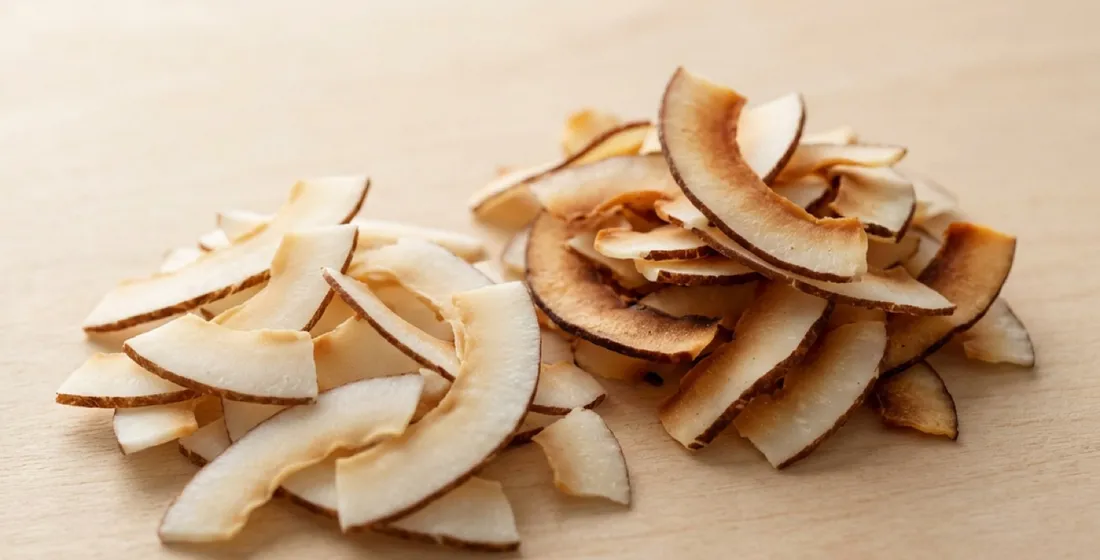
A coconut chip is a wide, curved slice of mature coconut kernel, typically 2 to 4 cm across with a thin brown testa edge left on, dried to 2 to 3% moisture and a water activity below 0.60. At that water activity, microbial growth stalls and the format holds a 12-month ambient shelf life. Peer-reviewed kinetic modeling published in Processes in 2022 put usable shelf life near 144 days at 35 degrees C, with fat oxidation, not microbes, as the rate-limiting failure.
The chip sits between two coconut formats buyers already know. Desiccated coconut is shredded and milled small; the chip is a slice, with surface area low enough to roast and high enough to carry flavor (desiccated coconut grade selection covers the shredded grades). Coconut flour is the defatted kernel; the chip keeps its fat, roughly 60 to 65% on a dry basis, which is why oxidation and not moisture ends its life (see the residual-fat logic in the coconut flour spec). That fat number is also why roasting and coating behave the way they do.
Spec snapshot: natural coconut chip
- Form: curved kernel slice, 2 to 4 cm, testa-on or testa-off
- Moisture: 2 to 3% (target below 3%)
- Water activity: below 0.60
- Fat: roughly 60 to 65% (dry basis)
- Shelf life: 12 months ambient in sealed barrier packaging
- SFC MOQ: 1 metric tonne per SKU (bulk); finished private-label packs available
The three processing routes behind nine flavors
The nine SFC flavor formats (natural, roasted, salted, sweetened, cocoa, pineapple, cinnamon, ginger, savory, and a garlic and curry-leaf savory) collapse into three processing routes. Dried only keeps the chip closest to raw kernel. Oil-roasting or dry-toasting drives the Maillard browning behind roasted, salted, and savory. Coating adds a sugar, cocoa, or spice layer for sweetened, cinnamon, and ginger. The route a chip takes, not the flavor name on the pack, is what sets its spec and its label.
| Flavor format | Processing route | What it adds to the spec | Primary label flag |
|---|---|---|---|
| Natural | Dried only | Nothing beyond kernel; cleanest label | None beyond coconut |
| Roasted | Oil-roast or dry-toast | Maillard color, lower moisture, acrylamide watch | Acrylamide monitoring |
| Salted | Roast plus salt | Sodium load | Sodium per serving |
| Savory, garlic and curry leaf | Roast plus seasoning | Spice and salt system; seasoning allergen check | Seasoning allergens |
| Sweetened | Sugar coating | Added sugar, higher calorie | Added-sugar declaration |
| Cinnamon, ginger | Spice coat, often with sugar | Spice plus sugar; spice microbial spec | Added sugar and spice microbial |
| Cocoa, pineapple | Cocoa or fruit coat with sugar | Added sugar; coating solids | Added sugar; origin claim on cocoa |
Source: Silk Foods Ceylon line data and flavor-route classification.
Natural and roasted: where the clean label lives
Natural and lightly toasted coconut chips carry the shortest ingredient list, one line, which is the format permissible-indulgence buyers want. FoodNavigator reported in 2026 that better-for-you snacking is led by products with short, recognizable ingredient lists and whole-food associations. A natural coconut chip is structurally that product: one ingredient, no added sugar, naturally high in fat and fiber.
In practice, the most common first sample request the SFC team fields for chips is the natural and the lightly salted, not the sweet ones. The reason is the back-of-pack. A US or EU snack brand building a permissible-indulgence line wants the one-ingredient story up front, then a salted line extension for savory occasions. The sugar variants tend to come later, once the brand has a shelf position to extend.
Roasting is where a spec quietly gets technical. Oil-roasting lifts browning and flavor, but it also raises surface fat and the acrylamide question. The EU set acrylamide benchmark levels under Commission Regulation (EU) 2017/2158 in 2017; potato crisps sit at 750 micrograms per kg as a reference value. Coconut chips are not named in that regulation, but a brand roasting for EU retail should hold a roast profile that keeps browning controlled, because the same Maillard chemistry applies. A longer dry-toast at lower temperature is the lever that keeps color and acrylamide both in range without a sugar crutch. The flavored coconut oil used for some roasts comes off the same plant (the trade-offs between oil grades sit in virgin coconut oil vs RBD oil).
Sweetened, cinnamon, and ginger: the added-sugar trade-off
Sweetened, cinnamon, and ginger coconut chips deliver indulgence but carry an added-sugar declaration that can work against a better-for-you positioning. Mintel analysts noted in 2026 that strict diet claims that sacrifice taste no longer resonate, while Innova Market Insights flagged reduced sugar as a top snacking driver for 2026. The format answer is a thin, spice-forward coat that leads with cinnamon or ginger and keeps sugar as a minor carrier.
The sweet formats are not a problem; they are a positioning choice. A cinnamon coconut chip can lead with the spice and use sugar as a carrier, or lead with sugar and use cinnamon as garnish. The first reads as permissible indulgence; the second reads as candy. For the sweetener itself, coconut sugar is the on-brand option, though its retail glycemic-index story should be checked against raw-material reality before it goes on pack (coconut sugar GI claims walks through that gap). A brand can also match a chip to a coconut sugar or coconut cream SKU for a coherent range (see the coconut cream SKU economics).
How Silk Foods Ceylon runs coconut chips under one audit
Silk Foods Ceylon manufactures coconut chips on a flavoring and repacking line covered by both BRCGS and FSSC 22000 V6, the same audit that covers desiccated coconut, coconut flour, and coconut sugar. For a private-label snack brand, that means a multi-format coconut range can ship from one supplier on one certificate stack, with no second supplier audit when the brand adds a line extension.
The chip line is a flavoring and repacking cell, not a separate factory. Cellular manufacturing is the structural reason SFC can run a natural batch, a salted batch, and a cinnamon batch in sequence without a changeover that forces a new audit. The facility sits 1 km from Nalanda Gedige in Matale, the historic coconut and spice belt. Coconut bulk MOQ is 1 metric tonne per SKU, with finished private-label packs in kraft pouches from 50 g to 1 kg. Samples ship door-to-door by courier in 3 to 5 business days; PO to dispatch runs 2 to 3 weeks; sea freight to the US is 4 to 5 weeks and to the EU 3 to 4 weeks. Brands evaluating the wider plant can start with the coconut sourcing and contract manufacturing guide or the broader plant-based and functional food contract manufacturing overview.
Where SRV’s pricing doesn’t fit
- Lowest-shelf-price private label with no origin story and no certification ask.
- A buyer choosing coconut chips purely on landed cents per pouch, with no BRCGS or organic requirement, will find a cheaper repacker.
- SRV’s chips are built for brands competing on a clean label, a Ceylon origin, and a dual-cert audit trail.
Frequently asked questions
Is coconut a tree-nut allergen I have to declare on coconut chips?
For the US, no longer in the “Contains” statement. On 6 January 2025, the FDA published Edition 5 of its food allergen labeling guidance and confirmed coconut is not a major food allergen, removing it from the tree-nut list for “Contains” labeling. Coconut still appears by common name in the ingredient list, and EU rules differ, so check the destination market.
Does Silk Route Ventures offer private label for coconut chips?
Yes. Silk Foods Ceylon runs coconut chips in nine flavor formats on a BRCGS and FSSC 22000 V6 audited line, finished into the brand’s own kraft pouches from 50 g to 1 kg. Coconut bulk MOQ is 1 metric tonne per SKU, and samples ship by international courier in 3 to 5 business days.
What is the shelf life of a coconut chip and what limits it?
About 12 months ambient in sealed barrier packaging. The limiting factor is fat oxidation, not microbial growth, because the chip dries to a water activity below 0.60. Peer-reviewed modeling in Processes (2022) estimated near 144 days of usable life at 35 degrees C, so a cool, sealed supply chain extends life materially.
Which coconut chip format has the cleanest label?
Natural, then lightly salted. A natural chip is a single ingredient with no added sugar, the format better-for-you buyers want. Sweetened, cinnamon, and ginger variants add a sugar declaration, so lead them with the spice and keep sugar as a minor carrier to protect a permissible-indulgence positioning.
Can SRV match coconut chips to other coconut SKUs for a full range?
Yes. The same FSSC 22000 V6 and BRCGS audit covers desiccated coconut, coconut flour, coconut sugar, and flavored coconut oil, so a brand can build a coconut chips, flour, sugar, and oil range from one supplier on one certificate stack without a separate audit per SKU.
How Silk Route Ventures can help
Silk Route Ventures (SRV) contract-manufactures and private-labels coconut chips in nine flavor formats at the Silk Foods Ceylon (SFC) facility in Matale. The chip line is covered by BRCGS and FSSC 22000 V6, the same audit that covers desiccated coconut, coconut flour, coconut sugar, and flavored coconut oil, so a brand can launch a full coconut range without a separate supplier audit per SKU. Coconut bulk MOQ is 1 metric tonne per SKU, with finished private-label packs in kraft pouches from 50 g to 1 kg, and the cellular manufacturing layout means a line extension does not restart the audit clock. Contact us to send an inquiry for a co-manufacturing or private-label briefing tailored to your flavor range and target launch volume. For grades, packaging and lead times, see our coconut products supplier.
Sources
- Sri Lanka Export Development Board, “Coconut and coconut-based products: export performance” (2024). Retrieved 2026-06-30. https://www.srilankabusiness.com/coconut/about/export-performance.html
- European Commission, “Commission Regulation (EU) 2017/2158 establishing mitigation measures and benchmark levels for the reduction of acrylamide in food” (2017). Retrieved 2026-06-30. https://eur-lex.europa.eu/eli/reg/2017/2158/oj
- US Food and Drug Administration, “Questions and Answers Regarding Food Allergens, Including the Food Allergen Labeling Requirements (Edition 5)” (2025). Retrieved 2026-06-30. https://www.fda.gov/regulatory-information/search-fda-guidance-documents
- Processes (MDPI), “Kinetic Modeling of Quality Changes and Shelf Life Prediction of Dried Coconut Chips” (2022). Retrieved 2026-06-30. https://www.mdpi.com/2227-9717/10/7/1392
- FoodNavigator, “Permissible indulgence trend powers better-for-you boom” (2026). Retrieved 2026-06-30. https://www.foodnavigator.com/Article/2026/02/11/permissible-indulgence-trend-powers-betterforyou-boom/
- Innova Market Insights, “Healthy snacks trends: global market overview” (2026). Retrieved 2026-06-30. https://www.innovamarketinsights.com/trends/healthy-snacks-trends-global-market-overview/
Further reading
- Sri Lanka Export Development Board, “Coconut and coconut-based products overview” -> https://www.srilankabusiness.com/coconut/sri-lankan-coconut-and-coconut-based-products.html
- FoodNavigator-USA, “4 trends shaping sweets and snacks in 2026” -> https://www.foodnavigator-usa.com/Article/2026/05/27/4-trends-shaping-sweets-and-snacks-in-2026/
Written by the Silk Route Ventures Trade Team. Silk Route Ventures (E-Silk Route Ventures (Pvt) Ltd) is a Sri Lankan B2B supply-chain operator for the Food, Beverage, Wellness, and Nutraceuticals sectors. The Silk Foods Ceylon manufacturing arm holds BRCGS and FSSC 22000 V6 certifications. Questions or to request a sample: Contact us or email info@esilkroute.com.lk.