
Desiccated Coconut Grade Selection for Bakery and Confectionery
Buyer's snapshot • Codex Alimentarius (CXS 177-1991) defines three desiccated coconut grades by sieve size: extra-fine, fine, and medium. The grade you specify changes mouthfeel, dispersion, and fat behaviour in the finished product. • Most "premium" claims in the category resolve down to four numbers: particle size, moisture, fat content, and total plate count. The rest is marketing. • Sri Lanka shipped 41,854 metric tonnes of desiccated coconut in Q1 2024 alone, up 20.8% year on year (Coconut Development Authority, 2024). It remains a primary origin for fine-grade bakery and confectionery volume. • Silk Route Ventures supplies fine-cut and medium-cut desiccated coconut from a Matale facility under BRCGS and FSSC 22000 V6, with a Certificate of Analysis on every batch and a 1 metric tonne first-order MOQ. • This post is the spec for procurement teams writing a desiccated coconut RFQ. For lowest-shelf-price commodity buying, the grade discipline below is overkill. |
Most desiccated coconut sold as “bakery grade” is specified on one line: “fine, white, dry.” That line passes a tasting panel and fails a procurement audit. The grade that actually performs in a macaroon, a coated confection, or a cereal inclusion is defined by a sieve fraction, a moisture ceiling, a fat range, and a microbial limit, and those four parameters move independently. This piece is for the procurement managers who want a defensible desiccated coconut spec to put in their next sourcing brief, instead of inheriting whatever their broker last shipped.
What are the desiccated coconut grades, and which fits which application?
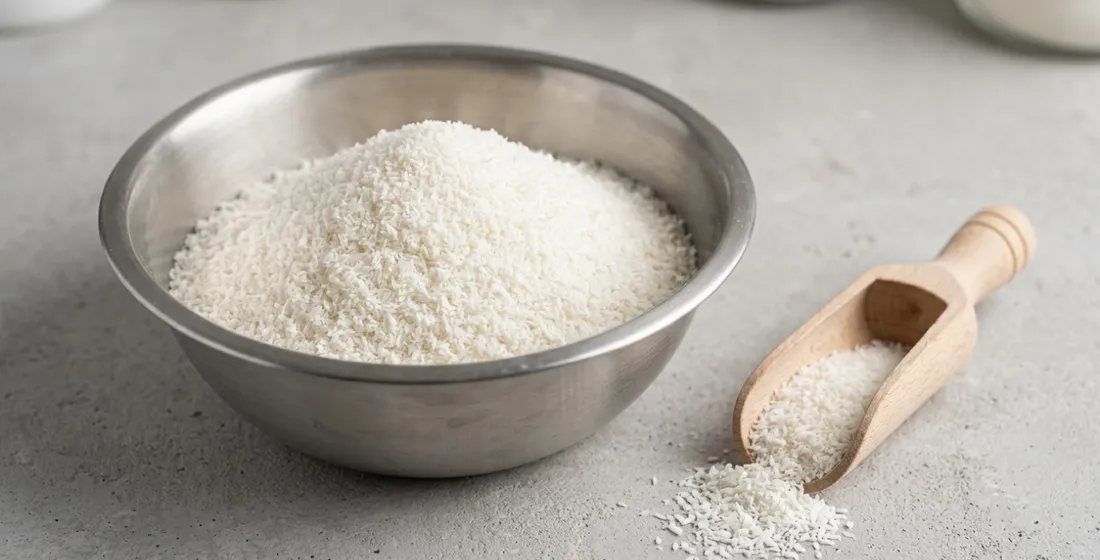
Desiccated coconut is grated, dried coconut kernel, milled and sieved into grades by particle size. The international reference is Codex Alimentarius standard CXS 177-1991, which classifies three cuts by sieve aperture. Extra-fine passes a 0.85 mm sieve. Fine passes a 1.40 mm sieve with a controlled fines fraction. Medium passes a 2.80 mm sieve. Coarse and chip cuts sit above medium and are governed by supplier spec rather than the Codex grades.
Grade is not a quality ranking. It is an application match. A finer cut disappears into a batter and a coarser cut stays visible and audible in the bite. Choosing the wrong cut is the most common and most expensive desiccated coconut sourcing error, because it usually surfaces only after a full production run.
| Grade | Codex sieve basis | Texture in finished product | Best-fit applications |
| Extra-fine | Passes 0.85 mm | Smooth, no visible pieces | Coconut flour blends, fillings, dairy-alternative bases, smooth confections |
| Fine | Passes 1.40 mm | Light bite, even dispersion | Macaroons, biscuits, cakes, cereal premixes, chocolate confectionery |
| Medium | Passes 2.80 mm | Visible flakes, clear bite | Toppings, granola, snack inclusions, coated confections |
| Coarse / chip | Above medium (supplier spec) | Pronounced flake or chip | Decorative toppings, trail mixes, premium snack lines |
Specifying particle size in your RFQ
Naming the grade is not the same as specifying it. “Fine” from one processor and “fine” from another can differ by a full sieve fraction if neither party writes down the percentage retained. The Codex grades are defined by what passes a sieve, so a complete spec names the aperture and the pass-through percentage, not just the word.
For fine grade, Codex requires not less than 80% by weight to pass a 1.40 mm square-aperture sieve, with a maximum 20% passing a 0.71 mm sieve. That second number is the one buyers forget. It caps the fines fraction, which controls how much fat smear and dust the cut carries into your mix. Specify both bounds and the supplier cannot quietly ship a dustier, cheaper cut against a clean-cut PO.
Bakery and confectionery R&D teams should also state the end-use in the RFQ, not just the grade. A macaroon and a chocolate inclusion can both call for fine grade, but the chocolate line will care about fat migration and the macaroon line will care about bind and bake colour. The supplier’s technical team can match the cut to the application only if the application is on the brief.
The four numbers buyers actually compete on
Once the cut is fixed, the rest of a desiccated coconut spec is four parameters: moisture, fat, free fatty acid, and microbial load. They are the procurement-decision inputs, and they move independently of each other and of grade.
Spec snapshot: fine-cut desiccated coconut (bakery and confectionery) Particle size: passes 1.40 mm sieve, fines fraction capped per Codex CXS 177 Moisture: 3.0% maximum (commercial bakery target; Codex ceiling is 4.0%) Fat content: 60 to 65% (full-fat); defatted and reduced-fat cuts run lower by design Free fatty acid: 0.30% maximum as lauric acid Microbial: total plate count under 5,000 cfu/g; E. coli absent; Salmonella absent in 25 g Colour: natural white to light creamy white (Codex CXS 177) |
Moisture is the shelf-life lever. Codex sets the ceiling at 4.0% by weight, but most bakery and confectionery buyers tighten it to 3.0% maximum, because every tenth of a percent above that shortens shelf life and raises microbial risk. Higher moisture is also the cheapest way for a processor to add saleable weight, so a tight moisture spec is also a price-honesty spec.
Fat is where the “fat-loss” question lives. Full-fat desiccated coconut runs 60 to 65% oil, and that oil is the flavour and the mouthfeel. The finer the cut and the harder the mill works, the more free oil leaches to the particle surface, which shows up as caking, fat smear on the bag, and a higher free fatty acid reading over time. That is fat-loss in practice: not the fat disappearing, but migrating out of the particle and going rancid faster. A free fatty acid ceiling of 0.30% as lauric acid is the parameter that keeps it in check. Reduced-fat and defatted cuts exist for buyers who want lower oil for a specific texture or cost target, but they are a deliberate spec choice, not a default.
Why microbial spec is the real risk in desiccated coconut
Particle size gets the attention. Microbial load is the parameter that pulls product off shelves. Desiccated coconut is a low-moisture product, which slows microbial growth, but the kernel is handled wet before it is dried, and that handling window is where contamination enters. The two pathogens that matter for procurement are Salmonella and Listeria.
This is not hypothetical. The US FDA maintains a standing import alert for coconut products, allowing detention of shipments from flagged firms for microbiological contamination, and the agency has logged Salmonella and Listeria findings in imported coconut over multiple years. In one published case, an organic coconut snack was recalled after FDA lab analysis confirmed Salmonella, with six reported illnesses (US FDA recall notice). For a procurement team, that history is not a footnote. It is the reason the microbial panel belongs on the COA for every batch, not just the first sample.
The supplier-side control is the part of the spec a buyer cannot see on a sample. A facility audited under BRCGS and FSSC 22000 V6 runs the environmental monitoring, the validated drying step, and the batch testing that keep total plate count under target and pathogens absent. The certification is the proxy for the controls the buyer will never witness in person. That is why the cert stack and the per-batch COA, not the tasting panel, are the real microbial spec.
Writing the desiccated coconut RFQ: a procurement template
A complete desiccated coconut RFQ names the cut, the four numbers, the destination market, and the documentation. The grade word alone invites the supplier to interpret. The full spec removes the interpretation.
Buyer's checklist: desiccated coconut RFQ 1. Grade with sieve basis (e.g. fine, passes 1.40 mm, fines fraction capped per Codex CXS 177) 2. Moisture ceiling (3.0% for bakery and confectionery; state it, do not assume) 3. Fat target (full-fat 60 to 65%, or a named reduced-fat spec) 4. Free fatty acid maximum (0.30% as lauric acid) 5. Microbial panel: total plate count, E. coli, Salmonella in 25 g, yeast and mould 6. Per-batch COA covering the above, not a one-time certificate of conformance 7. Heavy metals and pesticide panel aligned to the destination market 8. Supplier cert stack with versions, and the organic transaction certificate for organic SKUs 9. Sample dispatched and approved against the written spec before any PO |
One of the most common patterns the Silk Route Ventures procurement desk sees is a bakery brand that has run desiccated coconut for years on a one-line spec, then hits a microbial deviation on a single batch and has no contractual recourse because the RFQ never named the limit. The fix is not a better supplier relationship. It is a spec that names the number, so the number is testable on every batch and enforceable when a batch misses.
Frequently asked questions
What is the difference between fine and medium desiccated coconut?
Fine desiccated coconut passes a 1.40 mm sieve and gives a light, even bite that disperses into batters and confectionery, while medium passes a 2.80 mm sieve and stays visible as flakes (Codex CXS 177-1991). Fine suits macaroons, biscuits, and cereal premixes; medium suits toppings, granola, and coated snacks.
What moisture and fat content should bakery-grade desiccated coconut have?
Codex caps moisture at 4.0%, but bakery and confectionery buyers typically specify 3.0% maximum for shelf life, with full-fat oil content of 60 to 65% and free fatty acid under 0.30% as lauric acid. Tightening moisture below the Codex ceiling is the simplest way to reduce caking and microbial risk.
Why is microbial testing important for desiccated coconut?
Coconut kernel is handled wet before drying, and that window is where Salmonella and Listeria can enter, which is why the US FDA keeps a standing import alert for coconut products. A per-batch COA covering total plate count, E. coli, and Salmonella in 25 g, backed by a BRCGS and FSSC 22000 V6 facility, is the buyer’s real safeguard.
Does Silk Route Ventures supply private-label or bulk desiccated coconut to bakery brands?
Yes. Silk Foods Ceylon supplies fine-cut and medium-cut desiccated coconut as bulk ingredient supply and as private-label retail SKUs from its Matale facility under BRCGS and FSSC 22000 V6. First-order MOQ is 1 metric tonne, with a Certificate of Analysis on every batch and farm-level traceability for USDA Organic and EU Organic cuts.
How Silk Route Ventures can help
Silk Route Ventures (SRV) supplies fine-cut and medium-cut desiccated coconut to bakery and confectionery brands across the US, EU, and Australia, shipped against the buyer’s written spec from the BRCGS and FSSC 22000 V6 audited Silk Foods Ceylon (SFC) facility in Matale. First-order MOQ is 1 metric tonne, with a Certificate of Analysis on every batch, USDA Organic and EU Organic on the relevant cuts, and farm-level traceability for organic SKUs. Samples ship door-to-door by international courier at 3 to 5 business days, and production lead time runs 2 to 3 weeks from PO to dispatch. For CPG scale-ups that want a finished coconut SKU rather than bulk ingredient, SRV runs private label and contract manufacturing from the same site and audit. Contact us to send an inquiry or request a sample against your spec.
Sources
- Codex Alimentarius, Standard for Desiccated Coconut (CXS 177-1991), FAO/WHO. https://www.fao.org/input/download/standards/261/CXS_177e.pdf (retrieved 2 June 2026)
- Coconut Development Authority of Sri Lanka, Q1 2024 export data, via Export Lanka 2024 coconut industry report. https://export-lanka.com/2024-coconut-industry-report/ (retrieved 2 June 2026)
- US Food and Drug Administration, recall notice, Coconut Smiles Organic (Salmonella). https://www.fda.gov/safety/recalls-market-withdrawals-safety-alerts/natural-grocers-issues-recall-coconut-smiles-organic-due-salmonella (retrieved 2 June 2026)
Further reading:
- Asian and Pacific Coconut Community, Desiccated Coconut product standards. https://coconutcommunity.org/products-detail/desiccated-coconut
- Xinhua, Sri Lanka targets 1.7 billion USD from coconut exports in 2025 (20 April 2025). https://english.news.cn/20250420/0dc9e4209ada4204aeb6982169414ed1/c.html
Written by the Silk Route Ventures Trade Team. Silk Route Ventures (E-Silk Route Ventures (Pvt) Ltd) is a Sri Lankan B2B supply-chain operator for the Food, Beverage, Wellness, and Nutraceuticals sectors. The Silk Foods Ceylon manufacturing arm holds BRCGS and FSSC 22000 V6 certifications. Questions or to request a sample: Contact us or email info@esilkroute.com.lk.