
Coconut Cream 22% vs 24% Fat: The Glass-Jar SKU Economics
Buyer’s snapshot
- Codex sets the floor: a product sold as coconut cream must carry at least 20 percent fat (CODEX STAN 240-2003). Both 22 percent and 24 percent clear it, so the choice is economics and shelf behaviour, not compliance.
- Two fat points is real money. Moving from 22 to 24 percent is roughly 9 percent more coconut fat per jar, which pulls more kernel into every unit. Across a multi-thousand-jar run that is a measurable cost-of-goods line, not a rounding error.
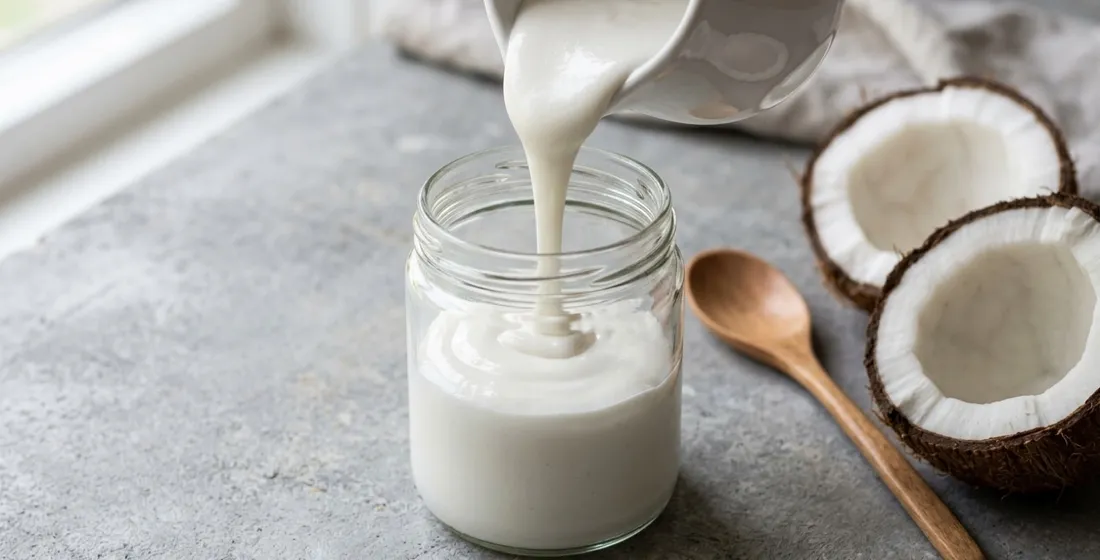
- Glass shows everything a can hides. A clear jar makes the natural cream-and-serum layering visible on the shelf, and the higher-fat 24 percent tends to throw a thicker cream plug, so it needs either a shake-well cue or tighter homogenization and stabilizer discipline.
- Retort is the real gate. Coconut cream is a low-acid food at roughly pH 6.0 to 6.2 and has to be commercially sterilized, near F0 5 at 115 to 121 degrees Celsius, to ship shelf-stable under United States low-acid canned food rules.
- Silk Foods Ceylon (SFC) co-packs retort coconut cream in glass and can from a Matale facility under BRCGS and FSSC 22000 V6, at a 1,500-jar first-order MOQ with a per-batch COA.
- For lowest-cost commodity coconut milk in steel cans, a high-volume can line is the more honest answer. This post is the fat-tier and format spec for ready-to-cook brands that have chosen glass.
Most ready-to-cook coconut cream briefs name a fat percentage and stop there. The number gets copied from a competitor jar, written into the spec, and treated as settled. Then the first retort run comes back, the clear glass shows a thick cream plug the marketing team never expected, and the question reopens at the worst possible time. The 22 versus 24 percent decision is not really about richness on the palate. It is about what two points of fat cost to buy, how that fat behaves inside a clear jar after sterilization, and whether the shopper actually pays for the difference. This piece works the decision the way a procurement and product team should work it before the artwork is locked.
Does a ready-to-cook coconut cream need 22% or 24% fat?
For most ready-to-cook applications, 22 percent fat is the more defensible default and 24 percent is a deliberate premium choice, not a quality requirement. Codex Alimentarius requires only 20 percent fat for a product to be called coconut cream (CODEX STAN 240-2003, 2003), so both tiers are compliant. The application, not the headline number, should set the tier.
Codex Alimentarius classifies aqueous coconut products into four grades by total fat and solids: light coconut milk, coconut milk at a 10 percent fat minimum, coconut cream at a 20 percent fat minimum, and coconut cream concentrate above that (CODEX STAN 240-2003, 2003). A 22 percent and a 24 percent cream sit close together inside the same legal grade. Neither is more authentic than the other; they are two points on a continuum the standard treats as one category.
In a ready-to-cook context the cream rarely reaches the plate undiluted. It is simmered into a curry base, loosened with stock, or balanced against acid and aromatics. That dilution narrows the sensory gap between 22 and 24 percent considerably. A consumer panel can often tell a 20 percent product from a 30 percent concentrate, but the step from 22 to 24 is much harder to detect once the cream is cooked into a finished dish.
So the honest starting question is not which number tastes richer. It is whether the application and the shelf story justify buying and shipping the extra fat. For a pourable cooking cream that competes on price and convenience, 22 percent usually wins. For a brand selling indulgence and willing to pay for it, 24 percent can earn its place, provided the format can carry it.
Coconut cream sits inside a wider sourcing set; the Coconut Products sourcing pillar covers how the format and grade decisions run across the category.
What two points of coconut fat actually cost per jar
Going from 22 to 24 percent fat is about 9 percent more coconut fat in every jar, and that fat is the most expensive part of the product. The increment is small per unit and large per run, which is exactly the kind of cost that hides in a spec until the first big order.
The arithmetic is simple and worth doing out loud. Raising fat from 22 to 24 percent of the jar is a relative increase of roughly 9 percent in the fat fraction (24 divided by 22). Coconut fat comes from the kernel, and kernel is the dominant raw-material cost in any aqueous coconut product, so a 9 percent lift in the fat fraction pulls noticeably more kernel into each unit than the two-point label change suggests.
Per jar the difference looks trivial. Across a production run it compounds. On a 50,000-jar order, the extra kernel, the extra extraction yield demand, and the tighter cream-fraction selection all land on the cost-of-goods line at once. The brand that specified 24 percent because a competitor did, without checking whether shoppers reward it, has quietly raised its own floor cost on every future reorder.
This is the lean-route argument that runs through coconut sourcing. The right move is to price both tiers against the same finished-product brief, then decide whether the premium tier returns its cost in shelf price or repeat purchase. Specifying fat by habit is how margin leaks. Specifying it against a costed brief is how a ready-to-cook line protects its economics. Exact per-jar figures depend on kernel price at the time of the run and should be quoted live, not assumed.
The same cost-versus-claim discipline shapes other coconut SKUs; see coconut sugar GI claims and sourcing for how a retail story can outrun the raw-material reality.
Why does coconut cream separate in a glass jar?
Coconut cream separates because its natural proteins are weak emulsifiers, so the fat rises into a cream layer over a thinner serum within hours unless processing intervenes. A clear glass jar makes that separation visible, which a steel can never has to answer for.
Coconut milk and cream are physically unstable emulsions. The coconut protein at the fat-droplet surface has low emulsifying capacity, so the large fat globules drift upward and the system splits into an opaque cream layer over a more transparent serum, often within five to ten hours of manufacture (Tangsuphoom and Coupland, Food Hydrocolloids via ScienceDirect, 2008). This is normal physics, not spoilage, but in clear glass it is also a merchandising event.
Higher fat makes the effect more pronounced. A 24 percent cream carries more fat to rise, so it tends to throw a thicker, firmer cream plug at the top of the jar than a 22 percent product. In an opaque can the shopper sees nothing and shakes before use. In a clear jar the plug is on display at the point of sale, and an unprepared customer reads it as curdled or spoiled even though the product is perfectly safe.
Processors manage this in two ways. The first is mechanical: fine homogenization, and in some lines microfluidization, drives down droplet size and slows the rise. The second is formulation: food-grade stabilizers such as sodium caseinate or sodium stearoyl lactylate hold the emulsion together (coconut milk emulsion-stability research, ScienceDirect, 2008). A clean-label brand that wants no added stabilizer has to accept some visible layering and tell the shopper to shake, which is a legitimate choice as long as the label and the jar agree.
Glass versus can: the retort and merchandising trade-off
Glass buys a premium, BPA-free, clean-label shelf story and full product visibility, at the cost of heavier freight, breakage risk, and a cream layer the shopper can see. The can hides separation and ships cheaper but reads as commodity. The format choice frames the fat-tier choice.
Glass packaging now works as a visible signal of purity and premium intent across food and wellness categories, and brands have moved to glass specifically to sidestep the BPA-lined epoxy used in many metal cans and closures (Packaging Digest, BPA in packaging). For a ready-to-cook coconut cream aimed at a clean-label shopper, the jar itself is part of the pitch.
The trade-offs are real and they all point back at the fat decision. Glass is heavier, which raises sea-freight cost per unit on a product already shipped halfway around the world. Glass breaks, which adds handling and reject cost on a retort line that heats and cools under pressure. And glass is transparent, so every choice about fat tier, homogenization, and stabilizer is now visible to the end consumer rather than hidden behind tinplate.
| Factor | Glass jar | Steel can |
|---|---|---|
| Shelf positioning | Premium, clean-label, BPA-free story | Commodity to mid-tier |
| Product visibility | Full; cream layer is visible | Hidden; separation never seen |
| BPA exposure | Avoidable with BPA-free closure | Common in epoxy can lining |
| Freight cost per unit | Higher; heavier pack | Lower; lighter pack |
| Breakage and line reject | Higher; fragile under retort | Low; durable |
| Best-fit fat tier | Stabilized 22%, or 24% with a shake cue | Either; separation is invisible |
Glass-versus-can trade-offs for a retort coconut cream SKU. Compiled from packaging-industry and retort-processing sources, 2011 to 2026.
Glass and retort go together on more than coconut cream; the vegan cheese spread retort contract manufacturing post works the same shelf-stable-in-glass economics for a plant-based SKU.
What does retort processing require for low-acid coconut cream?
Coconut cream is a low-acid food at about pH 6.0 to 6.2, so it must be commercially sterilized in its sealed jar to roughly F0 5 at 115 to 121 degrees Celsius to destroy Clostridium botulinum spores and ship shelf-stable. In the United States this falls under the FDA low-acid canned food rules.
Because coconut cream sits well above pH 4.6, it cannot rely on acidity to control Clostridium botulinum and must be processed as a low-acid canned food. Retort sterilizes the product inside its sealed container in a pressurized vessel using steam or hot water at 115 to 121 degrees Celsius, and coconut milk lines are typically run to an F0 of around 5 to give the safety margin a low-acid liquid demands (retort processing for ready-to-serve coconut milk, Food Research Lab; FDA 21 CFR 113, thermally processed low-acid foods in hermetically sealed containers).
The reward for that heat is shelf life. Canned and retorted coconut products hold for roughly 24 months at ambient temperature, which is what makes a ready-to-cook SKU shippable to distant markets without a cold chain (Tetra Pak Coconut Handbook). The cost is that the same heat stresses the emulsion, which is one more reason the fat tier and the stabilizer or homogenization plan have to be set together, not in sequence.
For a buyer, the practical consequence is documentation. A credible retort coconut cream supplier runs a validated scheduled process, files it where the destination market requires, and can show the F0 record behind the batch. A jar that is shelf-stable on a claim but cannot produce its thermal-process validation is a recall waiting to happen, and that paperwork belongs in the supplier-qualification questions, not after the first container ships.
Spec snapshot: retort coconut cream in glass
- Product: coconut cream, single-ingredient or stabilized, retort-sterilized in glass
- Fat tier: 22 percent (economical default) or 24 percent (premium), both above the 20 percent Codex floor
- pH: low-acid, approximately 6.0 to 6.2; processed as a low-acid canned food
- Thermal process: validated scheduled process, target near F0 5 at 115 to 121 degrees Celsius
- Stability plan: homogenization and optional food-grade stabilizer, or a shake-well cue for clean-label
- Shelf life: about 24 months ambient when correctly sterilized and sealed
- Documentation: per-batch COA, thermal-process record; produced under BRCGS and FSSC 22000 V6
The certification scope behind a retort claim matters; the what FSSC 22000 V6 means for a buyer explainer covers what a buyer should actually ask for.
Matching fat tier to the ready-to-cook application
A 22 percent cream is the workhorse for pourable cooking creams and sauces where it gets diluted anyway; 24 percent suits a premium indulgence position; concentrate above 25 percent is for reduction-style dishes and dessert bases. The application picks the tier, and the format keeps it honest.
The table below maps the fat decision the way a product team should read it, against the dish, the shelf story, and the behaviour the jar will show. It is the comparison most coconut cream briefs skip when they copy a number off a competitor.
| Fat tier | Best-fit application | Shelf-layer behaviour in glass | Best-fit buyer |
|---|---|---|---|
| 22% coconut cream | Pourable cooking creams, curry bases, RTC sauces | Moderate cream layer; manageable with light stabilization | Value-to-mid ready-to-cook brand |
| 24% coconut cream | Premium indulgent cooking cream, richer curries | Thicker cream plug; needs shake cue or tighter processing | Premium clean-label brand |
| Concentrate (>25% fat) | Reductions, dessert bases, dairy-cream replacement | Heavy separation; usually stabilized | Dessert and foodservice formulator |
Coconut cream fat tier mapped to ready-to-cook application and glass-jar behaviour. Tier thresholds per CODEX STAN 240-2003.
For powder-format coconut alongside the wet cream, see coconut milk powder for global distribution and desiccated coconut grade selection.
Specifying a retort coconut cream SKU: the RFQ lines that matter
A retort coconut cream RFQ should name the fat tier against a costed brief, the pack format, the stability plan, the thermal-process target, and the certification scope. Leaving any one of these to the supplier’s default is how the first run surprises the brand.
The strongest briefs treat fat tier as a costed decision, not a copied number. They state 22 or 24 percent with a reason, name glass or can, and say explicitly whether the product is single-ingredient with a shake-well cue or stabilized for a uniform look. They specify the thermal-process expectation and ask the supplier to confirm a validated scheduled process. And they pin certification: a supplier running BRCGS and FSSC 22000 V6 clears most United States and European Union retail listing requirements without a separate audit cycle.
In the first quarter of 2026 the Silk Route Ventures (SRV) trade desk worked the same problem twice in six weeks. A brand had launched a 24 percent coconut cream in clear glass, then logged a spike in customer messages calling the product split or curdled, because the rich cream plug was sitting in plain view on the shelf. The product was safe and on-spec. The fix was not a new supplier. It was a packaging-and-process decision the brief had skipped: add a visible shake-well cue and tighten homogenization, or step down to a stabilized 22 percent that held a more uniform appearance in glass. Either path works, but it has to be chosen before the artwork, not after the complaints.
Buyer’s checklist: retort coconut cream RFQ
- State the fat tier (22% or 24%) and the reason, priced against a costed finished-product brief
- Name the format (glass or can) and the closure spec, including BPA-free if claimed
- Declare the stability plan: clean-label with shake cue, or homogenized and stabilized
- Specify the thermal process and request the validated scheduled-process and F0 record
- Require per-batch COA and confirm BRCGS and FSSC 22000 V6 scope before sampling
- Confirm MOQ, lead time, and sea-freight Incoterms for the destination market
A first-time buyer can start by reading how to evaluate a food supplier before sending a spec.
Frequently asked questions
Is 22% or 24% coconut cream better for cooking?
For most ready-to-cook dishes, 22 percent is the more economical choice and performs well because the cream is diluted into a sauce or curry base anyway. A 24 percent cream is a deliberate premium step, not a quality requirement, since both sit above the 20 percent Codex minimum for coconut cream (CODEX STAN 240-2003, 2003).
What is the minimum fat for a product labelled coconut cream?
Codex Alimentarius requires at least 20 percent fat for an aqueous product to be called coconut cream, versus a 10 percent minimum for coconut milk (CODEX STAN 240-2003, 2003). A 22 percent and a 24 percent product both qualify as coconut cream, so the fat-tier choice is about economics and shelf behaviour rather than label compliance.
Why does coconut cream separate in the jar, and is it safe?
Coconut protein is a weak emulsifier, so the fat rises into a visible cream layer over a thinner serum within hours, often inside five to ten hours of manufacture (ScienceDirect emulsion-stability research, 2008). It is normal physics, not spoilage. The product is safe; shoppers simply shake the jar. Glass makes the layer visible, which a can hides.
Who contract-manufactures retort coconut cream in glass jars with BRCGS and FSSC?
Silk Foods Ceylon co-packs retort coconut cream in glass and can from a Matale, Sri Lanka facility under BRCGS and FSSC 22000 V6, with a validated thermal process, per-batch COA, and a 1,500-jar first-order MOQ. Silk Route Ventures runs the fat-tier formulation, sampling, and export documentation for private-label and contract buyers.
How Silk Route Ventures can help
Silk Route Ventures (SRV) and its manufacturing arm Silk Foods Ceylon (SFC) co-pack retort coconut cream in glass and can for ready-to-cook, private-label, and contract buyers. The team formulates to a chosen fat tier, 22 percent, 24 percent, or a stabilized concentrate, and sets the homogenization and stabilizer plan against the pack format so the product looks right in clear glass as well as on the palate.
Production runs under BRCGS and FSSC 22000 V6 from a Matale facility, with a validated retort scheduled process, per-batch COA, and organic certification available for qualifying lines. First-order MOQ on retort glass jars starts at 1,500 units, with sea-freight Incoterms quoted to the destination market. For brands still choosing between glass and can, or between fat tiers, the SRV trade desk will cost both against the finished-product brief before any tooling or artwork is committed.