
Virgin Coconut Oil vs RBD Oil for Ingredient Applications
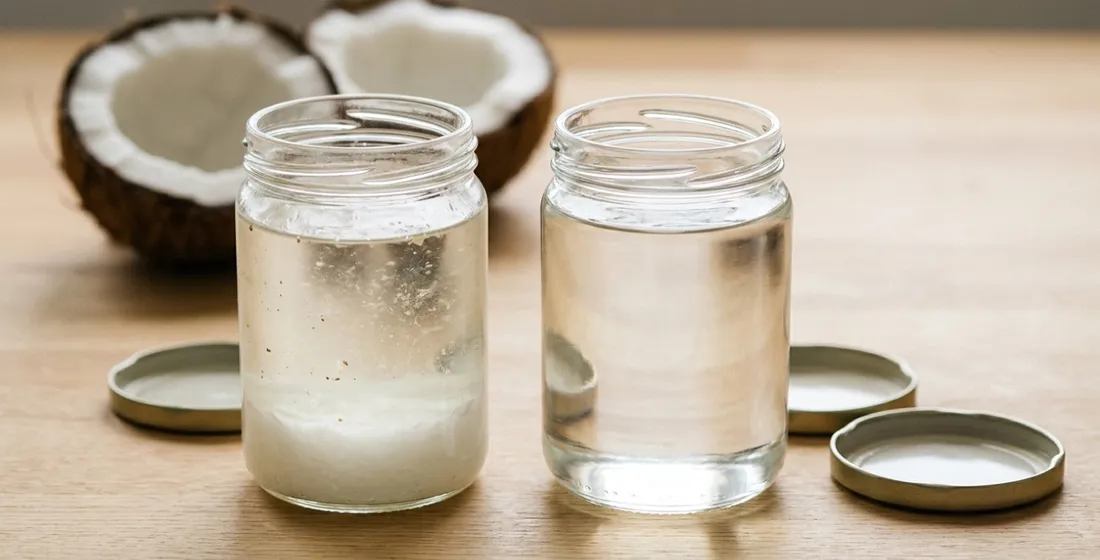
Virgin coconut oil (left) and RBD coconut oil (right) on a Sri Lankan processing-floor side-by-side comparison.
Buyer's snapshot • Sri Lanka's coconut-based exports reached USD 1.03 billion through October 2025, growing 43.83% year-on-year, with kernel products (desiccated coconut, coconut milk, virgin coconut oil) generating 53% of total category revenue in 2024 (Sri Lanka Export Development Board, October 2025). • Virgin coconut oil and RBD coconut oil are not interchangeable. Lauric acid content overlaps (≈45 to 53% C12 in both), but the spec sheets diverge sharply on free fatty acid, moisture, peroxide value, smoke point, color, and flavor. • RBD costs roughly 40 to 60% less per kg than virgin coconut oil and serves frying, confectionery, plant-based-fat-base, and OEM bakery applications where neutral flavor and a 204 to 232°C smoke point are the binding constraints. • The Silk Foods Ceylon (SFC) facility in Matale ships both grades against the buyer's spec under BRCGS and FSSC 22000 V6. First-order MOQ is 1 metric tonne for bulk; samples ship door-to-door in 3 to 5 business days. • For US and EU CPG scale-up brands evaluating coconut fat for a new SKU launch, this post is the spec. For wellness brands building a virgin-coconut-oil claim platform, see the linked guidance below. |
Coconut oil sits in two different procurement conversations in 2026, and most sourcing decks confuse them. One is a high-claim, single-press, premium-grade conversation about virgin coconut oil. The other is a working-fat, neutral-flavor, frying-base conversation about RBD coconut oil. The trade press writes about coconut oil as a single category. The procurement reality is two distinct SKUs with two distinct cost structures, two distinct spec sheets, and two very different end-product fits.
The global coconut oil market was valued at USD 6.93 billion in 2025 (Fortune Business Insights, 2025). The virgin coconut oil sub-category sits somewhere between USD 0.75 and USD 3.3 billion of that, depending on which market-research firm’s methodology you accept (Business Research Insights, 2025; SkyQuest, 2025). The size gap matters because it tells a procurement buyer which conversation they’re in.
This piece walks through the spec-level differences, where each oil belongs in a CPG formulation, the 2026 cost and supply landscape from Sri Lanka, and what to put on the next RFQ.
What virgin coconut oil and RBD coconut oil actually are
Virgin coconut oil (VCO) is pressed from fresh coconut kernel within hours of dehusking, using either a wet process (coconut milk emulsion separated mechanically or by gentle heat) or a dry process (cold-pressed from dried kernel). No chemical solvent, no high-temperature refining, no bleaching, no deodorizing. The Asia-Pacific Coconut Community (APCC) Standard for Virgin Coconut Oil caps moisture at 0.15%, free fatty acid (as lauric) at 0.2%, and peroxide value at 3.0 meq/kg (APCC VCO Standard, 2009 onwards). The oil retains the coconut aroma, a fraction of polyphenols and tocopherols from the fresh kernel, and a smoke point near 170°C.
RBD coconut oil is refined, bleached, and deodorized from copra (sun-dried coconut kernel). The starting material is cheaper, the yield per kg of kernel is higher, and the refining stack (degumming, neutralization, bleaching with activated earth, deodorization at 240 to 260°C under vacuum) strips out flavor, free fatty acids, and color. The Codex Alimentarius Standard for Named Vegetable Oils (CXS 210-1999) sets the chemistry of edible coconut oil overall, with Reichert values of 6 to 8.5 and Polenske values of 13 to 18 distinguishing coconut from adjacent vegetable oils (Codex Alimentarius, CXS 210-1999). What RBD loses in flavor and antioxidants it gains in shelf life, neutral organoleptic profile, and a smoke point in the 204 to 232°C range.
Lauric acid content (C12), the medium-chain fatty acid most often cited as coconut oil’s functional signature, is roughly equivalent in both: around 45 to 53% of the fatty acid profile (Dayrit, 2014, Lauric acid is a medium-chain fatty acid). The MCT story doesn’t change between VCO and RBD. What changes is everything around it.
How the spec sheets differ
Procurement teams making the VCO-vs-RBD call should screen on these six parameters first. The numbers below reflect APCC-aligned VCO specs and standard commercial RBD specs from Sri Lankan processors.
| Parameter | Virgin coconut oil (VCO) | RBD coconut oil | Why it matters |
| Free fatty acid (% as lauric) | ≤ 0.2 | ≤ 0.1 | Drives oxidative shelf life and end-product flavor stability |
| Moisture (%) | ≤ 0.15 | ≤ 0.1 | Above 0.2% accelerates hydrolytic rancidity in finished SKU |
| Peroxide value (meq/kg) | ≤ 3.0 | ≤ 2.0 | Indicator of oxidation; tighter limits for long-shelf-life CPG |
| Smoke point | ~170°C | 204 to 232°C | Determines suitability for frying and high-heat baking |
| Color (Lovibond) | Water-white to faint yellow | Water-clear | RBD’s neutrality keeps finished-product color on-spec |
| Flavor / aroma | Pronounced coconut | Neutral / odorless | Single biggest application driver |
Source: APCC Standards for Virgin Coconut Oil; Codex Alimentarius CXS 210-1999; Silk Foods Ceylon batch COA range, 2024 to 2026.
The other spec the procurement team usually wants on the RFQ is heavy metals and pesticide residue. Both oils are tested on every batch at the SFC site against destination-market panels: FDA action levels for US-bound product, EU MRL register for EU-bound, FSANZ for AU-bound. The COA template doesn’t change between VCO and RBD. The acceptable ranges do.
Which application calls for which
The application question is where most procurement calls end. The answer falls into three buckets, and the boundary between them is usually flavor.
VCO belongs in formulations where coconut flavor is the claim, or where “virgin coconut oil” on the ingredient deck is part of the brand story. Premium wellness retail SKUs (coconut-oil supplements in glass bottles, MCT-positioned products, raw-food-aligned spreads), beauty and personal care formulations (hair oils, lip balms, cleansers), the upper tier of plant-based dairy alternatives (yogurts, ice creams, cream cheeses where the coconut note is a feature), and any SKU running a “cold-pressed” or “raw” claim platform. The retail consumer is paying for the unrefined origin and the lauric acid story.
RBD belongs in formulations where coconut fat is a working ingredient, not a flavor. Confectionery (chocolate coatings, compound chocolates, candy fillings), plant-based meat alternatives (the fat phase in patty, nugget, sausage formulations where coconut flavor would clash with savory profiles), OEM bakery (croissants, viennoiserie, biscuit doughs), frying-oil bases for restaurant or industrial use, non-dairy creamers, infant formula fat blends, and most of the cosmetics and personal care fat-base applications where carrier neutrality is required. The retail consumer rarely reads “RBD coconut oil” on a deck. They read “coconut oil.” The procurement team’s job is to keep the cost-per-kg and the flavor profile in spec.
The third bucket: blends. Some CPG R&D teams run VCO and RBD blends at 20:80 or 30:70 to keep a subtle coconut signature in a finished SKU without paying the full VCO price. The blend has to be specified on the COA and the ingredient deck per destination-market labeling rules. In the EU, this gets handled under Regulation (EU) 1169/2011 on food information to consumers; “virgin coconut oil” cannot appear on the ingredient list unless the SKU contains it as a standalone fraction.
Where this lands in practice In Q3 2025, the Silk Route Ventures (SRV) trade desk fielded the same conversation three times in a month with US-based plant-based spreads brands. Each one had specified VCO at launch on a clean-label claim, hit retail at a price point that needed a 35% margin, and asked whether moving 60% of the fat phase to RBD would survive the consumer panel. In two cases it did. In the third the brand kept VCO and shifted shelf positioning instead. The math is harder than the marketing makes it sound. |
The cost and supply economics
RBD coconut oil costs roughly 40 to 60% less per kg than virgin coconut oil (Heaven Coconut Global, 2024). The gap reflects three things: copra is cheaper and more abundant than fresh kernel; refining yields are higher than virgin-press yields; and the global virgin-coconut-oil category is sized at roughly one-tenth of the total coconut oil category, with a corresponding pricing premium (Fortune Business Insights, 2025).
For a CPG scale-up moving from a 5,000 kg launch run to a 50,000 kg run, the choice between VCO and RBD reshapes the bill of materials more than almost any other spec decision short of switching coconut for sunflower or palm. A patty formulation at 12% coconut fat moving from VCO to RBD across a 30,000-unit-per-day production schedule saves on the fat phase alone. That’s the line that the SRV finance review of co-manufactured patty cost models keeps hitting.
Sri Lanka shipped roughly 12,163 metric tonnes of virgin coconut oil in the first nine months of 2025, down 4% from 2024 before the sector closed the gap in Q4 (Nutiooils, Sri Lanka VCO Export Sector White Paper, 2025). Total coconut-based exports tracked toward a USD 1.7 billion target for 2025, with the Coconut Development Authority guiding to that figure publicly in April (Xinhua / Sri Lanka EDB, April 2025). For procurement teams building a 2026 supply plan, this matters: the Sri Lankan VCO and RBD pipeline is growing into a category that is itself growing at 6.71% CAGR through 2034 (Fortune Business Insights, 2025). Lead times remain stable. Pricing remains under copra-cycle pressure.
What changed in 2025 for buyers sourcing from Sri Lanka
The cleaner answer to “where do I buy” shifted in 2025. Sri Lanka’s coconut-based export revenue crossed USD 1.03 billion through October, up 43.83% year-on-year (Sri Lanka EDB, October 2025). Kernel products (desiccated coconut, coconut milk, VCO) carried 53% of the 2024 category total at USD 458.25 million. The supply story for buyers diversifying away from Philippine and Indonesian-only origins is more credible in 2026 than it was 24 months ago.
What that means for procurement: dual-sourcing across Sri Lanka and one of the Philippines or Indonesia for VCO is feasible at commercial volumes for the first time in roughly a decade. For RBD, Sri Lanka already runs at the price tier US and EU buyers are screening for. Three certifications usually decide the call: BRCGS (UK and EU retail gating), FSSC 22000 V6 (GFSI-recognized; satisfies most multinational retailers’ supplier audit requirements), and USDA Organic plus EU Organic on the relevant SKUs. The Silk Foods Ceylon scope statement covers coconut processing across spreads, oils, powders, and milk under all four.
How to specify VCO or RBD on your next RFQ
Buyer's checklist: coconut oil RFQ 1. Botanical origin and grade: "Virgin coconut oil per APCC standard" or "RBD coconut oil per Codex CXS 210-1999, deodorized at no less than 240°C." 2. Process: state wet-process or dry-process expectation for VCO; specify RBD-grade refining stack explicitly. 3. Per-batch COA including FFA, moisture, peroxide value, iodine value, saponification value. 4. Heavy metals panel aligned to destination market (FDA action levels for US, EU MRL register for EU/UK, FSANZ for AU). 5. Pesticide residue panel for destination market. 6. Smoke point report when end-application is frying or high-heat baking. 7. Allergen and GMO-free declaration; cross-contamination protocol if facility shares lines with allergen SKUs. 8. Organic transaction certificate if SKU carries USDA Organic or EU Organic; cert version on the supplier's dossier. 9. Sample dispatched against the full spec before any production PO. |
The documentation pack that ships with every order should include the commercial invoice, packing list, BL or AWB, certificate of origin, phytosanitary certificate, batch COA, and (where applicable) the organic transaction certificate. SRV ships that pack as the default with every container. Skip the deck that promises “all documentation provided” without naming the documents; the line items above are the ones a US or EU customs broker will ask for at clearing.
How Silk Foods Ceylon handles VCO and RBD production
The Matale facility processes both VCO and RBD on dedicated lines within the BRCGS and FSSC 22000 V6 scope. Virgin coconut oil is produced from fresh kernel within the same site, COA tested per batch against the APCC standard, and packed into 200 kg HDPE drums, 25 kg jerry cans, or smaller retail-ready glass bottles for private-label SKUs. RBD is produced from copra refined on-site, tested per batch against Codex CXS 210-1999 and the buyer’s spec, and packed into the same drum and jerry-can formats for ingredient supply.
Cellular manufacturing layout means a CPG scale-up running both grades (RBD as the working fat in a plant-based patty line plus VCO in a paired retail spread SKU under the same brand) doesn’t need a separate audit cycle for each. One BRCGS audit, one FSSC 22000 V6 scope statement, one COA cadence, one container if the volumes line up.
FAQ
What’s the difference between virgin coconut oil and RBD coconut oil in fatty acid composition?
Lauric acid (C12) content is roughly equivalent in both: 45 to 53% of the fatty acid profile (Dayrit, 2014). What differs is the trace fraction: virgin coconut oil retains a small amount of naturally occurring polyphenols, tocopherols, and the coconut aroma volatiles that the RBD refining stack strips out. Medium-chain triglycerides (C8, C10, C12) survive refining intact because MCTs are thermally stable.
Which coconut oil should I use in a vegan butter or plant-based spread formulation?
Most plant-based spreads use RBD as the primary fat phase because coconut flavor competes with the buttery profile the SKU is targeting. Some premium organic spreads use a 20% VCO blend to register a subtle coconut signature; the deck then labels “virgin coconut oil” alongside “refined coconut oil.” For dairy-alternative cream cheeses and yogurts where coconut aroma is on-brand, full VCO works. The decision lives in the consumer-panel data, not the spec sheet.
What’s the MOQ and lead time for VCO or RBD bulk supply from Silk Foods Ceylon?
First-order MOQ for bulk coconut oil is 1 metric tonne per grade. Production lead time from PO to dispatch is 2 to 3 weeks. Sea freight from Colombo runs 4 to 5 weeks to the US, 3 to 4 weeks to the EU and UK, and 3 to 4 weeks to Australia. Samples ship door-to-door by international courier (DHL, FedEx, UPS) at 3 to 5 business days. Volume-tier pricing breaks at 5 MT, 10 MT, and 20 MT per PO.
Does virgin coconut oil need different certifications than RBD?
The food-safety certifications (BRCGS, FSSC 22000 V6) cover both grades under the same scope statement when produced at one facility, as they are at Silk Foods Ceylon. USDA Organic and EU Organic are SKU-specific: a buyer ordering organic VCO needs the organic transaction certificate per shipment, and the supplier’s organic certification must cover the specific process (wet-press or dry-press for VCO; refining stack for RBD). The fastest way to verify is to ask for the cert dossier with the SKU number and target market named.
Is Sri Lankan virgin coconut oil cheaper than Philippine VCO?
Pricing varies quarter to quarter with the copra cycle, but Sri Lankan VCO and Philippine VCO have historically run within 5 to 10% of each other on FOB terms. The decision rarely comes down to per-kg price alone. Differentiators include BRCGS and FSSC 22000 V6 audit transparency, USDA Organic and EU Organic dual certification on the same SKU, dual-sourcing risk reduction for buyers already locked into a single Philippine supplier, and the documentation pack that ships with every container. The honest comparison is landed cost plus the audit-and-documentation overhead, not invoice cost alone.
How Silk Route Ventures can help
Silk Route Ventures (SRV) contract-manufactures finished CPG SKUs (spreads, sauces, semi-liquids in glass jars; vegan patties at 15,000 units/day; vegan nuggets at 30,000 units/day; spray-dried plant milks; jackfruit-in-brine for plant-based meat formats; functional beverages) and supplies bulk virgin coconut oil and RBD coconut oil under one roof at the Silk Foods Ceylon (SFC) facility in Matale. The site holds BRCGS and FSSC 22000 V6 covering the full coconut processing scope, plus USDA Organic and EU Organic on relevant SKUs. The cellular manufacturing layout means new SKU introductions don’t require a separate audit cycle, and the SRV R&D and NPD team scopes the formulation in parallel with the production plan. Contact us at https://www.esilkroute.com.lk/contact to send an inquiry for a co-manufacturing capability briefing or a bulk-supply quote tailored to your SKU and target launch volume.
Written by the Silk Route Ventures Trade Team. Silk Route Ventures (E-Silk Route Ventures (Pvt) Ltd) is a Sri Lankan B2B supply-chain operator for the Food, Beverage, Wellness, and Nutraceuticals sectors. The Silk Foods Ceylon manufacturing arm holds BRCGS and FSSC 22000 V6 certifications. Questions or to request a sample: Contact us at https://www.esilkroute.com.lk/contact or email info@esilkroute.com.lk.
Sources
1. Sri Lanka Export Development Board, “Coconut and Coconut-Based Products Export Performance, January to October 2025.” Retrieved 2026-05-27. https://www.srilankabusiness.com/
2. Coconut Development Authority of Sri Lanka, “Export Data and Sector Performance, 2024 to 2025.” Retrieved 2026-05-27. https://www.cda.gov.lk/web/index.php?option=com_content&view=article&id=15&Itemid=239&lang=en
3. Xinhua / Sri Lanka EDB, “Sri Lanka targets 1.7 bln USD from coconut exports in 2025,” (April 2025). Retrieved 2026-05-27. https://english.news.cn/20250420/0dc9e4209ada4204aeb6982169414ed1/c.html
4. Codex Alimentarius, Standard for Named Vegetable Oils, CXS 210-1999 (revised 2015). Retrieved 2026-05-27. https://www.fao.org/fao-who-codexalimentarius/sh-proxy/en/?lnk=1&url=https%3A%2F%2Fworkspace.fao.org%2Fsites%2Fcodex%2FStandards%2FCXS+210-1999%2FCXS_210e.pdf
5. Asian and Pacific Coconut Community (APCC), Standards for Virgin Coconut Oil (2009 onwards). Retrieved 2026-05-27. https://www.apccsec.org/products-detail/virgin-coconut-oil
6. Fortune Business Insights, “Coconut Oil Market Size, Share, Growth Forecast to 2034,” (2025). Retrieved 2026-05-27. https://www.fortunebusinessinsights.com/coconut-oil-market-112181
7. Business Research Insights, “Virgin Coconut Oil Market Size and Growth Report, 2034,” (2025). Retrieved 2026-05-27. https://www.businessresearchinsights.com/market-reports/virgin-coconut-oil-market-122735
8. Dayrit, F. M., “Lauric Acid is a Medium-Chain Fatty Acid; Coconut Oil is a Medium-Chain Triglyceride,” (2014). Retrieved 2026-05-27. https://www.semanticscholar.org/paper/Lauric-Acid-is-a-Medium-Chain-Fatty-Acid-,-Coconut-Dayrit/34bcdb43c84b418b4b309c1c6babe1c873dc900a
9. Nutiooils, “Sri Lanka Virgin Coconut Oil Export Sector White Paper, 2025.” Retrieved 2026-05-27. https://nutioils.com/documents/white-paper-vco-export-sector-2025.pdf
Further reading
• Silk Route Ventures, “Coconut ingredient and contract manufacturing in Sri Lanka: a CPG sourcing guide” → https://www.esilkroute.com.lk/blog/coconut-sourcing-contract-manufacturing-sri-lanka-cpg
• Silk Route Ventures, “Plant-based and functional food contract manufacturing in Sri Lanka” → https://www.esilkroute.com.lk/blog/plant-based-functional-food-contract-manufacturing-sri-lanka
• Silk Route Ventures, “Food and Beverage Contract Manufacturing Buyer’s Guide” → https://www.esilkroute.com.lk/blog/food-beverage-contract-manufacturing-buyers-guide