
Coconut Flour for Gluten-Free Bakery Formulators: Spec, Fat-Loss, and Substitution Ratios
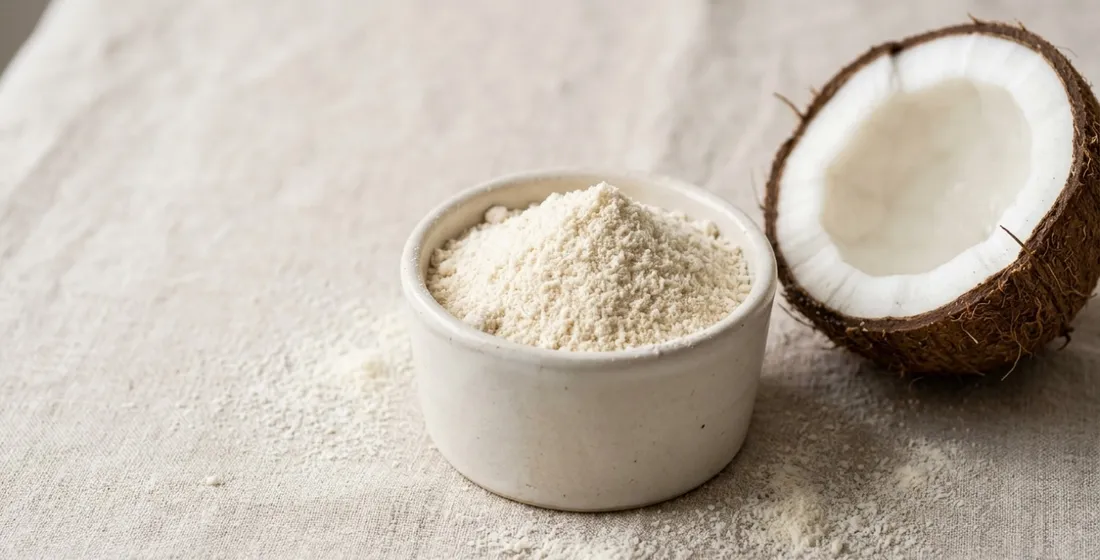
Buyer's snapshot • Coconut flour is the dried, defatted coconut kernel left after virgin coconut oil and coconut milk extraction, milled to a fine powder. It runs roughly 46 to 60% dietary fibre and 14 to 21% protein, an order of magnitude more fibre than wheat flour (Trinidad et al., 2006; Adsare and Annapure, 2023). • It absorbs about 7g of water per gram, far above wheat, so it cannot be swapped one-for-one. Formulators replace a fraction of the wheat and add liquid and egg to compensate (Shakeela et al., 2024). • Residual fat is the spec that separates suppliers: defatted coconut flour holds 10 to 15% fat, high-fat grades run far more. The number drives shelf life, dispersion, and rancidity risk. • Coconut flour is naturally gluten-free, but the label claim still requires validated testing below 20 ppm gluten under Codex CXS 118-1979 and US FDA 21 CFR 101.91. • Silk Route Ventures (SRV) supplies bulk and private-label coconut flour from a Matale facility under BRCGS and FSSC 22000 V6, with a Certificate of Analysis on every batch and a 1 metric tonne first-order MOQ. |
Most coconut flour sold into bakery R&D is specified on a single line: gluten-free, fine, white. That line clears a tasting panel and fails a formulation audit. Coconut flour behaves nothing like wheat flour, and not much like other gluten-free flours either. It carries five to twenty times the fibre, soaks up several times its weight in water, and rewrites the egg and liquid math of every recipe it enters. Its residual fat, the number most data sheets leave off, decides shelf life and price. This piece is the spec for formulators and procurement teams writing a coconut flour brief, instead of inheriting whatever a broker last shipped.
What is coconut flour, and why doesn’t it behave like wheat flour?
Coconut flour is dried, defatted coconut kernel, milled to a fine powder after virgin coconut oil or coconut milk has been pressed out. It carries roughly 46 to 60% dietary fibre and 14 to 21% protein, against wheat flour’s 3% fibre and 10% protein (Trinidad et al., 2006). That fibre load is the reason it drinks liquid and binds differently in a batter.
Two facts follow from how it is made. First, coconut flour is a co-product, not a primary mill run. It comes off the same kernel stream that yields virgin coconut oil and coconut milk, which means its fat content depends entirely on how much oil was extracted upstream. Second, the high insoluble-fibre fraction makes the powder hygroscopic and dense. A cup of coconut flour weighs more and absorbs more than a cup of wheat flour, so volume-for-volume substitution fails before the oven door closes.
For a bakery formulator, that changes the brief. Coconut flour is not a like-for-like wheat replacement. It is a fibre-and-protein-dense functional flour that earns its place on a label claim (grain-free, high-fibre, gluten-free) and has to be formulated around, not dropped in. The grade you buy decides how far you can push it.
The composition spec, line by line
Coconut flour’s value to a formulator sits in four numbers: dietary fibre, protein, residual fat, and moisture. Peer-reviewed analyses of partially defatted coconut flour from virgin-coconut-oil cake report about 14% fat, 21% protein, 46% dietary fibre, and 5% moisture (Adsare and Annapure, Journal of Food Science and Technology, 2023). Total dietary fibre is commonly cited near 60g per 100g, of which roughly 56% is insoluble (Trinidad et al., 2006).
Spec snapshot: coconut flour (partially defatted) Dietary fibre: 46 to 60g per 100g (about 56% insoluble) Protein: 16 to 21g per 100g Residual fat: 14 to 15g per 100g (defatted grades 10 to 15%) Moisture: typically 5 to 7g per 100g Water-holding capacity: about 7g water per gram of flour Naturally gluten-free; label claim requires testing below 20 ppm |
Set against wheat flour, the contrast is the whole sourcing argument. Coconut flour is not a cheaper or whiter wheat substitute. It is a different ingredient class that a formulator chooses for fibre, protein, and a clean grain-free claim.
| Parameter (per 100g) | Coconut flour | Wheat flour (refined) |
|---|---|---|
| Dietary fibre | 46 to 60g | about 3g |
| Protein | 16 to 21g | about 10g |
| Fat | 14 to 15g (defatted) | about 1g |
| Total carbohydrate | 55 to 60g | about 76g |
| Moisture | 5 to 7g | about 12g |
Source: Adsare and Annapure (2023); Trinidad et al. (2006); Shakeela et al. (2024). Figures are typical ranges, not a fixed standard; confirm against a batch COA.
Why does coconut flour absorb so much liquid, and what’s the substitution ratio?
Coconut flour’s defining handling property is its water-holding capacity: about 7g of water per gram of flour, with a swelling capacity near 20 mL per gram (Shakeela et al., Sustainable Food Technology, 2024). Wheat flour holds a fraction of that. Drop coconut flour into a wheat recipe unchanged and the batter seizes; the flour pulls the free water out of the system and the crumb bakes dry and crumbly.
The practical fix is to replace only part of the wheat and add liquid and egg to compensate. As practitioner guidance, formulators typically swap 20 to 25% of the wheat in a standard recipe, or in a pure gluten-free formula use about one quarter to one third the volume of the wheat being replaced, then raise the egg and liquid sharply. The defensible, sourced upper bound comes from a controlled muffin study, where partially defatted coconut flour replaced wheat at up to 50% in a high-moisture batter while holding the top sensory score (Adsare and Annapure, 2023). High-moisture, egg-rich formats tolerate more coconut flour than lean doughs.
| Format | Coconut flour replacement | Compensation |
|---|---|---|
| High-moisture batter (muffin, cake) | up to 50% of the wheat (validated in a muffin study) | add liquid and egg; expect a denser, moister crumb |
| Standard wheat recipe | 20 to 25% of the wheat | add roughly equal-weight liquid per part flour, plus an extra egg |
| Pure gluten-free formula | one quarter to one third the wheat volume it replaces | raise egg and liquid substantially; bind with psyllium or xanthan |
Practitioner guidance except the 50% muffin figure (Adsare and Annapure, 2023). Always pilot at production scale before committing a SKU.
Defatted, partially defatted, or full-fat: the residual-fat decision
Residual fat is the single most important spec a coconut flour buyer can pin down, and the one most broker data sheets omit. Because coconut flour is the cake left after oil extraction, how hard the kernel was pressed sets the fat level, and the fat level sets shelf life, dispersion, mouthfeel, and rancidity risk. A flour that runs 30% fat behaves and ages nothing like one that runs 12%.
| Class | Residual fat | Behaviour and use |
|---|---|---|
| Defatted / low-fat | 10 to 15% | longest shelf life, finest dispersion, driest crumb; the cleanest spec for high-fibre claims |
| Partially defatted / medium-fat | 16 to 25% | balanced mouthfeel; the common bakery grade; about 14% measured in virgin-coconut-oil cake flour |
| High-fat | 25 to 48% | richer mouthfeel, shorter shelf life, higher rancidity risk; needs tighter peroxide-value control |
| Full-fat desiccated (reference) | 60 to 68% | not a flour; included for contrast with milled defatted grades |
Source: composition figures from Adsare and Annapure (2023) and Shakeela et al. (2024).
The procurement consequence is simple. Specify the residual-fat ceiling on the RFQ and require it on every batch COA, alongside a free-fatty-acid or peroxide-value limit. A coconut flour that meets a fibre floor but carries unstated fat will pass the first sample and fail the printed shelf life on the third production run.
Can you label a coconut flour product gluten-free, and what’s the glycemic angle?
Coconut flour is naturally gluten-free, but the label claim is a regulatory test, not a botanical fact. Both Codex Alimentarius (CXS 118-1979) and the US FDA (21 CFR 101.91) set the gluten-free threshold at below 20 ppm. A coconut flour milled or repacked on a line that also handles wheat needs validated testing and a batch certificate to carry the claim safely; the risk is cross-contact, not the ingredient itself.
The functional pull is the fibre. In a controlled study, coconut flour products showed glycaemic indices in the low range, 45.7 for macaroons and 51.8 for carrot cake, with a strong negative correlation between glycaemic index and dietary fibre content (r = minus 0.85; Trinidad et al., British Journal of Nutrition, 2003). For a clean-label bakery brand, that pairs a grain-free, gluten-free claim with a defensible high-fibre, lower-glycaemic story, which is why coconut flour rides the wider gluten-free category. That category is growing at roughly 9 to 10% a year (Fortune Business Insights, 2025).
SRV finding: The SRV trade desk sees a recurring pattern from US and EU bakery formulators. A clean-label brand reformulates a muffin or cookie around coconut flour for the fibre and the gluten-free claim, then discovers in scale-up that the broker's flour ran high-fat and turned rancid inside the printed shelf life. The reformulation cost was not the flour. It was the missing residual-fat line on the first COA. |
Specifying coconut flour in a sourcing RFQ
A defensible coconut flour brief locks the four composition numbers, the fat ceiling, and the gluten-free test, then names the market-specific safety panel. The checklist below is the spec to send a supplier before the first sample request.
Buyer's checklist: coconut flour RFQ 1. Botanical and origin: Cocos nucifera, single origin stated (Sri Lanka, Matale belt) 2. Residual fat: state the ceiling (for example, 12% maximum for a defatted grade) 3. Dietary fibre: state the floor (for example, 40% minimum) 4. Moisture: ceiling, typically 6 to 7% maximum 5. Particle size or mesh: defatted coconut flour is coarser than wheat; confirm the grind 6. Gluten: below 20 ppm, with the test method named (R5 ELISA) 7. Rancidity control: free-fatty-acid or peroxide-value limit 8. Microbial panel: total plate count, yeast and mould, Salmonella, E. coli 9. Heavy metals and pesticide MRL panel aligned to the destination market 10. Organic transaction certificate if the SKU carries USDA Organic or EU Organic; COA on every batch |
Buyers running this brief usually fall into two camps: bakery brands specifying bulk ingredient supply against an existing co-packer, and CPG scale-ups exploring a private-label retail pack. SRV serves both from the same spec. The fat-and-fibre discipline above applies identically whether the order is a bulk raw-material pallet or a finished private-label retail bag.
Frequently asked questions
What is the difference between coconut flour and desiccated coconut?
Desiccated coconut is grated, dried coconut kernel sold by particle cut for texture. Coconut flour is milled, defatted kernel, finer and far higher in fibre, used to replace part of the wheat in a formula. Desiccated coconut runs 60 to 68% fat; defatted coconut flour runs 10 to 15% (Adsare and Annapure, 2023).
How much coconut flour replaces wheat flour in a recipe?
As practitioner guidance, swap 20 to 25% of the wheat in a standard recipe, or one quarter to one third the volume in a pure gluten-free formula, and add liquid and egg to offset the absorption. A controlled muffin study validated up to 50% replacement in a high-moisture batter (Adsare and Annapure, 2023).
Is coconut flour gluten-free, and can I label it that way?
Coconut flour is naturally gluten-free, but the label claim requires validated testing below 20 ppm under Codex CXS 118-1979 and US FDA 21 CFR 101.91. A flour handled on a wheat-sharing line needs a batch certificate confirming the threshold before the claim is safe to print.
Does Silk Route Ventures supply bulk or private-label coconut flour for US and EU bakery brands?
Yes. Silk Route Ventures supplies bulk coconut flour and private-label retail packs from the Silk Foods Ceylon facility in Matale under BRCGS and FSSC 22000 V6. First-order MOQ is 1 metric tonne per SKU; samples ship door-to-door by international courier in 3 to 5 business days, with a COA on every batch.
What residual fat percentage should I specify?
For the longest shelf life and cleanest high-fibre claim, specify a defatted grade at 10 to 15% fat. A medium-fat grade (16 to 25%) suits richer formats but needs tighter rancidity control. Always state the fat ceiling on the RFQ and require it on the batch COA (Shakeela et al., 2024).
How Silk Route Ventures can help
Silk Route Ventures (SRV) supplies certified coconut flour and the wider Ceylon coconut range (desiccated coconut, coconut milk powder, virgin coconut oil, coconut sugar) to bakery and CPG brands across the US, EU, and Australia. Bulk raw material ships against the buyer’s spec from the BRCGS and FSSC 22000 V6 audited Silk Foods Ceylon (SFC) facility in Matale, with a Certificate of Analysis on every batch and farm-level traceability for the organic SKUs. First-order MOQ is 1 metric tonne per SKU; samples ship door-to-door by international courier in 3 to 5 business days. For brands ready to launch a grain-free or gluten-free retail line under their own label, SRV runs private-label packing from the same site. Contact us to send an inquiry or request a coconut flour sample. The full range sits on our coconut products supplier.
Sources
-
Trinidad, T.P., et al., Glycaemic index of different coconut (Cocos nucifera) flour products in normal and diabetic subjects, British Journal of Nutrition, 2003. Retrieved 2026-06-25. https://www.cambridge.org/core/journals/british-journal-of-nutrition/article/glycaemic-index-of-different-coconut-cocos-nuciferaflour-products-in-normal-and-diabetic-subjects/C6710ACF603F7D0B2E4A42572782BAD7
-
Adsare, S., and Annapure, U.S., Development of muffins using partially defatted coconut flour, Journal of Food Science and Technology, 2023. Retrieved 2026-06-25. https://pmc.ncbi.nlm.nih.gov/articles/PMC10844170/
-
Trinidad, T.P., et al., Dietary fibre from coconut flour: a functional food, Innovative Food Science and Emerging Technologies, 2006. Retrieved 2026-06-25. https://www.sciencedirect.com/science/article/abs/pii/S1466856406000452
-
Shakeela, M., Mohan, A., and Nisha, P., Valorization of coconut flour, Sustainable Food Technology (Royal Society of Chemistry), 2024. Retrieved 2026-06-25. https://pubs.rsc.org/en/content/articlehtml/2024/fb/d3fb00247k
-
FAO/WHO Codex Alimentarius, Standard for Foods for Special Dietary Use for Persons Intolerant to Gluten (CXS 118-1979). Retrieved 2026-06-25. https://www.fao.org/fao-who-codexalimentarius/
-
US Food and Drug Administration, Gluten-Free Labeling of Foods (21 CFR 101.91). Retrieved 2026-06-25. https://www.ecfr.gov/current/title-21/chapter-I/subchapter-B/part-101/subpart-F/section-101.91
-
Sri Lanka Export Development Board, Export Performance: Coconut and Coconut-based Products, 2024. Retrieved 2026-06-25. https://www.srilankabusiness.com/coconut/about/export-performance.html
Further reading:
-
Future Market Insights, Coconut Flour Market. https://www.futuremarketinsights.com/reports/coconut-flour-market
-
Fortune Business Insights, Gluten-Free Food Market. https://www.fortunebusinessinsights.com/industry-reports/gluten-free-food-market
-
Sri Lanka Coconut Development Authority, export statistics. https://www.cda.gov.lk/
Written by the Silk Route Ventures Trade Team. Silk Route Ventures (E-Silk Route Ventures (Pvt) Ltd) is a Sri Lankan B2B supply-chain operator for the Food, Beverage, Wellness, and Nutraceuticals sectors. The Silk Foods Ceylon manufacturing arm holds BRCGS and FSSC 22000 V6 certifications. Questions or to request a sample: Contact us or email info@esilkroute.com.lk.