
Coconut Sugar GI Claims and Sourcing - Retail Story vs RM Reality
Buyer’s snapshot
- Coconut sugar’s headline “low glycemic index of 35” traces to a single Philippine study of about 10 subjects. The University of Sydney’s Glycemic Index Research Service measured 54, near the top of the medium band.
- In 2025 the global coconut sugar market sat at roughly USD 420 million and is forecast to reach about USD 618 million by 2030 (Mordor Intelligence), with the organic segment holding more than half of volume.
- Glycemic index is a property measured on a finished food in human subjects, not a value a buyer can lift from a raw-material COA. A bulk coconut sugar spec cannot, on its own, license a “low GI” label claim.
- Coconut sugar is a documented adulteration target. Cane sugar cut into coconut sugar is detectable by stable carbon isotope analysis, because coconut palm is a C3 plant and cane is a C4 plant.
- Silk Route Ventures (SRV) supplies bulk and private-label coconut sugar from a BRCGS and FSSC 22000 V6 audited facility in Matale, with organic transaction certificates on USDA Organic and EU Organic SKUs and a 1 metric tonne first-order MOQ.
Most brands buying “low GI coconut sugar” are buying a number that has never been independently confirmed at the value they print on the pack. The famous figure of 35 comes from one small study. The most-cited international laboratory puts the real number around 54. For a procurement manager, that gap is not academic. It decides whether a sweetener swap can carry a label claim, what the supplier should actually be asked to certify, and where the price premium is real versus where it is story. This piece is the sourcing spec behind the retail claim.
What is coconut sugar, and how is it actually made?
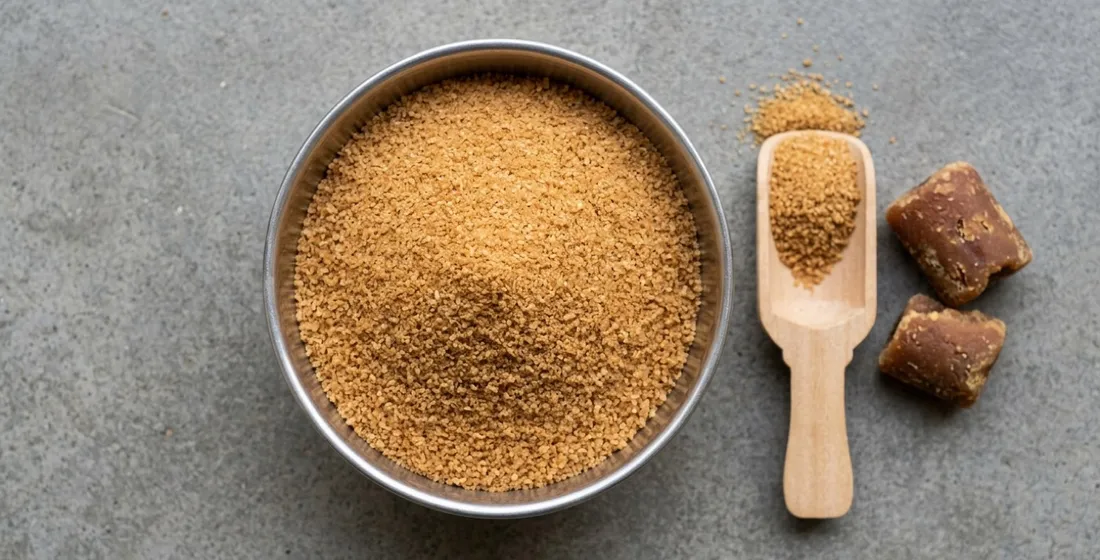
Coconut sugar is the granulated sap of the coconut palm flower, tapped as a liquid, then boiled down and crystallised into a dry, sandy, golden-brown sugar. Its composition is dominated by sucrose, typically 70 to 80 percent, with smaller amounts of glucose and fructose, trace minerals such as potassium and zinc, and small quantities of inulin, a soluble fibre (Cocos nucifera sap review, PMC, 2020). At about 3.9 kcal per gram, it carries the same energy density as table sugar.
The processing matters for the buyer because it drives both colour and consistency. Sap collection, evaporation temperature, and crystallisation each vary by producer, which is why two “coconut sugar” lots can differ in colour, moisture, and grain. The inulin and trace-mineral content that underpin the wellness story are real but minor, and they are exactly the components most sensitive to how hard the sap was boiled.
Is coconut sugar’s glycemic index really 35?
The widely repeated claim that coconut sugar has a glycemic index of 35 rests on a single study conducted in the Philippines using roughly 10 subjects, reported through the Philippine Coconut Authority. No corresponding figure appears in the major peer-reviewed GI databases at that value. When the University of Sydney’s Glycemic Index Research Service tested coconut sugar, it measured a GI of 54, and Sydney classifies any score above 55 as high. More recent work concludes coconut sugar behaves much like other sugars in the bloodstream.
The two numbers describe the same product. One is a marketing-friendly outlier; the other is the figure most often used by independent reviewers. A buyer who specifies coconut sugar on the strength of “GI 35” is building a product claim on the weaker of two contradictory results.
| GI source | Reported value | Sample basis | How buyers should read it |
|---|---|---|---|
| Philippine Coconut Authority / FNRI | 35 (low) | One study, ~10 subjects | Single-origin claim, not independently replicated |
| University of Sydney GI Research Service | 54 (high end of medium) | Standardised GI testing service | The defensible reference number |
| Recent comparative studies | Behaves like other sugars | Multiple subjects | GI advantage over table sugar is small |
Why the GI number is a sourcing story, not a spec
Glycemic index is measured in human subjects eating a finished food, against a glucose or white-bread reference. It is not a chemical assay a laboratory runs on a sack of raw material, and it is not a parameter that travels on a bulk COA. A coconut sugar certificate of analysis reports moisture, particle size, colour, microbial counts, and heavy metals. It does not, and cannot, certify the glycemic response of whatever the buyer eventually formulates.
That distinction is where most “low GI” product claims get exposed. Regulators treat coconut sugar as an added sugar like any other. The US FDA requires coconut sugar to be declared under Added Sugars on the Nutrition Facts label (FDA, Added Sugars on the Nutrition Facts Label), and the agency’s 2024 final rule on the “healthy” nutrient content claim added an explicit limit on added sugars (Federal Register, 2024). A sweetener that counts against the added-sugar limit is a thin foundation for a health-positioning claim, regardless of its GI story.
Buyer’s checklist: pressure-testing a coconut sugar claim
- Ask which GI figure the supplier is citing and from which study, then check it against the University of Sydney value of 54.
- Confirm the GI claim, if any, is supported by testing on the finished product, not the raw material.
- Treat the bulk COA as the spec: moisture, particle size, colour, microbial, heavy metals.
- Check the destination market’s rules on added-sugar declaration before any front-of-pack claim.
- Require species and origin documentation so the lot is genuinely coconut palm sap, not a blend.
The adulteration problem: when “coconut sugar” is cut with cane
Coconut sugar sells at a premium to cane sugar, which creates a direct incentive to dilute it. The most common adulteration is exactly that: cane or corn sugar blended into coconut sugar and sold at the coconut price. The reliable way to catch it is stable carbon isotope analysis. Coconut palm fixes carbon by the C3 photosynthetic pathway, while sugarcane and corn are C4 plants, so excess C4 sugar shifts the sample’s carbon isotope ratio toward more positive values (Authentication of Indonesian Coconut Sugar Using Stable Carbon Isotopes, Food Analytical Methods, Springer, 2021).
For a buyer paying the coconut premium, this is the test that protects the spend. A standard COA will not flag a cane-cut lot, because the adulterant is chemically a sugar too. Isotope authentication is worth requesting on premium and organic SKUs, where the price gap and the certification both raise the stakes.
Sourcing coconut sugar from Sri Lanka: spec and RFQ
Sri Lanka is a smaller coconut sugar origin than Indonesia or the Philippines, and for a sourcing buyer that is a feature rather than a limitation. A shorter, more concentrated supply base in the coconut-growing belt of the North Western and Western provinces is easier to trace to source than a sprawling commodity flow. Silk Foods Ceylon (SFC) handles coconut sugar on its repacking line under BRCGS and FSSC 22000 V6, with bulk and retail formats, organic transaction certificates on the certified SKUs, and a COA on every batch.
In Q1 2026, the Silk Route Ventures procurement desk fielded a recurring request from two specialty brands rebuilding their coconut sugar spec after a buyer-side audit questioned the GI claim on their existing pack. The fix in both cases was not a new supplier; it was a tighter spec. They dropped the GI language, set particle size and moisture ranges, and added isotope authentication to the qualification. The product did not change. The defensibility did.
Spec snapshot: bulk coconut sugar
- Botanical source: coconut palm sap (Cocos nucifera), confirmed in writing
- Composition: ~70 to 80 percent sucrose; trace minerals; small inulin fraction
- Screening: moisture, particle size, colour, microbial (TPC, yeast and mould, Salmonella, E. coli), heavy metals
- Authenticity: stable carbon isotope analysis on premium and organic lots
- Certification: BRCGS and FSSC 22000 V6; USDA Organic and EU Organic per SKU
- SRV MOQ: 1 metric tonne first order; sample dispatch 3 to 5 business days by international courier
Where the premium is real, and where it is not
In 2025 coconut sugar was roughly a USD 420 million global market, growing toward an estimated USD 618 million by 2030 at about 7.7 percent annually, with the organic segment commanding more than half of volume (Mordor Intelligence, Coconut Sugar Market). The premium over cane sugar is anchored by genuine attributes: a single-origin agricultural story, organic certification, and a minimally refined process. The premium is not anchored by a settled clinical advantage, because the GI evidence is contested and the product is still an added sugar.
That honesty is the sourcing position. Coconut sugar is a credible premium ingredient for brands competing on provenance, clean label, and organic certification. It is a poor fit for a brand whose entire pitch is a low-glycemic health claim it cannot substantiate on the finished product.
Where SRV’s coconut sugar fit ends
Brands whose sole selling point is an unsubstantiated “low GI” or blood-sugar claim. If the product story collapses without GI 35, coconut sugar is the wrong sweetener to build on. For a provenance-led, organic, clean-label position, it is a strong one, and that is the brief SRV supplies against.
FAQ
Is coconut sugar’s glycemic index 35 or 54?
The widely cited figure of 35 comes from one Philippine study of about 10 subjects. The University of Sydney’s Glycemic Index Research Service measured 54, near the top of the medium range. The 54 value is the more defensible reference, and recent research suggests coconut sugar behaves much like other sugars.
Can a brand put “low GI” on a coconut sugar product?
Glycemic index is measured on a finished food in human subjects, not on raw material, so a bulk coconut sugar COA cannot license a low GI claim. Regulators also treat coconut sugar as an added sugar; the US FDA requires it under Added Sugars on the Nutrition Facts label.
How is coconut sugar adulteration with cane sugar detected?
Through stable carbon isotope analysis. Coconut palm is a C3 plant and cane sugar is a C4 plant, so cane cut into coconut sugar shifts the carbon isotope ratio toward more positive values (Food Analytical Methods, Springer, 2021). A standard COA will not catch it, which is why isotope testing is advised on premium and organic lots.
Does Silk Route Ventures supply organic coconut sugar in bulk?
Yes. Silk Route Ventures supplies bulk and private-label coconut sugar from the BRCGS and FSSC 22000 V6 audited Silk Foods Ceylon facility in Matale, with USDA Organic and EU Organic transaction certificates on the certified SKUs. First-order MOQ is 1 metric tonne, and samples ship by international courier in 3 to 5 business days.
How Silk Route Ventures can help
Silk Route Ventures supplies certified-organic, single-origin coconut sugar and the wider Ceylon coconut range to specialty brands and CPG manufacturers across the US, EU, and Australia. Bulk raw material is shipped against the buyer’s spec from the BRCGS and FSSC 22000 V6 audited Silk Foods Ceylon facility in Matale, with a COA on every batch, organic transaction certificates on the certified SKUs, and stable carbon isotope authentication available on premium lots. First-order MOQ is 1 metric tonne; samples ship door-to-door by international courier in 3 to 5 business days. For brands ready to launch a private-label coconut sugar SKU under their own label, SRV runs end-to-end private label manufacturing from the same site. Contact us to send an inquiry or request a sample.
Sources
- Philippine Coconut Authority / FNRI, glycemic index of coconut sap sugar, via Coconut sugar overview, Wikipedia, retrieved 2026-06-09 https://en.wikipedia.org/wiki/Coconut_sugar
- University of Sydney, Glycemic Index Research Service, coconut sugar GI 54, via Foodwatch, retrieved 2026-06-09 https://www.foodwatch.com.au/coconut-sugar/
- Coconut (Cocos nucifera L.) sap as a potential source of sugar: antioxidant and nutritional properties, PMC, 2020, retrieved 2026-06-09 https://pmc.ncbi.nlm.nih.gov/articles/PMC7174220/
- US Food and Drug Administration, Added Sugars on the Nutrition Facts Label, retrieved 2026-06-09 https://www.fda.gov/food/nutrition-facts-label/added-sugars-nutrition-facts-label
- Federal Register, Food Labeling: Nutrient Content Claims; Definition of Term “Healthy” (final rule), 2024-12-27, retrieved 2026-06-09 https://www.federalregister.gov/documents/2024/12/27/2024-29957/food-labeling-nutrient-content-claims-definition-of-term-healthy
- Authentication of Indonesian Coconut Sugar Using Stable Carbon Isotopes, Food Analytical Methods, Springer, 2021, retrieved 2026-06-09 https://link.springer.com/article/10.1007/s12161-021-01967-9
- Mordor Intelligence, Coconut Sugar Market Size, Share and 2030 Growth Trends Report, retrieved 2026-06-09 https://www.mordorintelligence.com/industry-reports/coconut-sugar-market
Further reading:
- Future Market Insights, Coconut Sugar Market Size, Trends and Growth 2025 to 2035 https://www.futuremarketinsights.com/reports/coconut-sugar-market
- Sugar-specific carbon isotope ratio analysis for authentication, PubMed, 2018 https://pubmed.ncbi.nlm.nih.gov/30065408/
Written by the Silk Route Ventures Trade Team. Silk Route Ventures (E-Silk Route Ventures (Pvt) Ltd) is a Sri Lankan B2B supply-chain operator for the Food, Beverage, Wellness, and Nutraceuticals sectors. The Silk Foods Ceylon manufacturing arm holds BRCGS and FSSC 22000 V6 certifications. Questions or to request a sample: Contact us or email info@esilkroute.com.lk.