
Sulphite-Free Dried Fruit: Colour, Moisture and Labelling Without SO2
By the Silk Route Ventures Trade Team | 11 November 2026
Buyer’s snapshot
- Both the EU and the US set the same sulphite trigger: a declaration is required once the finished food reaches 10 mg/kg (EU) or 10 ppm (US) of sulphur dioxide (FSAI; 21 CFR 101.100). A sulphite-free claim is a label outcome you can specify and test, not a feeling.
- Without sulphur dioxide, three jobs have to be done by other means: holding colour, holding the microbial line, and holding shelf life. Each has a lever, and each lever costs something.
- Plan for a darker fruit that keeps darkening. In one apricot study, unsulphured fruit browned more than sulphured fruit, through Maillard and oxidative routes that an acid dip does not touch.
- Silk Route Ventures (SRV) fixes sulphite status in the written spec for each dehydrated fruit SKU, from a 100 kg first-order MOQ. It is confirmed per SKU, never assumed across the range.
- For brands writing “no added sulphites” on a retail pack, this post is the spec. For buyers who want bright, pale fruit with no sulphur and no darkening, no supplier can honestly promise it.
Most RFQs for sulphite-free dried fruit contain one line: “no sulphites”. That line leaves four decisions to the supplier: what colour range is acceptable, what moisture and water activity protect the lot, what replaces the preservative, and what number on the certificate of analysis counts as “free”. Sulphur dioxide did several jobs at once, and removing it moves all of them onto the spec sheet. This piece is for procurement and product teams in the EU, UK, US and Australia who want a defensible sulphite-free spec before the first sample arrives.
What does sulphur dioxide actually do in dried fruit?
Sulphur dioxide does three jobs in dried fruit: it blocks enzymatic browning, it slows non-enzymatic browning, and it suppresses yeast, mould and bacteria during storage. A sulphite-free route has to cover all three with other controls. That is why “just leave it out” is a spec failure rather than a spec.
Enzymatic browning is the fast reaction. Once fruit is cut, polyphenol oxidase (PPO) oxidises phenolic compounds into quinones that polymerise into brown pigment. An open-access review in PubMed Central on controlling this reaction notes that PPO has little activity below about pH 4, and that ascorbic acid works by reducing the quinones back to their phenol precursors, a process that consumes the ascorbic acid as it goes (PMC7355983). So acidulants and ascorbate buy time, and the time is finite.
Non-enzymatic browning is the slow reaction. A study of sun-dried Alkaya apricots found browning was higher in the unsulphured fruit than in the sulphured fruit, and the authors attributed the difference to Maillard and other thermal and oxidative pathways (Turkish Journal of Agriculture and Forestry). Nothing in an ascorbic or citric dip stops sugars and amino compounds reacting over months on a shelf.
The third job is easy to forget because it is invisible at sample stage. In a storage study of non-sulphited dried apricots, yeast and mould counts passed 5.0 log cfu/g after two months at 20 C in fruit held at 27 percent moisture (Journal of Agricultural Sciences). Sulphur dioxide was quietly carrying part of that microbial load, and the moisture spec now has to carry it.
How is colour held without sulphur?
Colour is held without sulphur by controlling the enzyme before drying, controlling heat during drying, and controlling oxygen, light and temperature afterwards. Four levers do most of the work, and the table below sets them beside the sulphured route so the trade-offs are visible.
| Route | What controls colour | Colour at pack | Colour drift in storage | Microbial protection | Label outcome |
|---|---|---|---|---|---|
| Sulphured (SO2 dip or gassing) | Enzyme blocked, Maillard slowed | Bright, light | Low | SO2 contributes | Declaration above 10 mg/kg (EU) or 10 ppm (US) |
| Sulphite-free, hot-air drying only | Nothing beyond drying conditions | Darker, uneven | High | Moisture and water activity only | No sulphite declaration |
| Sulphite-free with acid or ascorbate pretreatment | Surface pH lowered, quinones reduced | Lighter than untreated | Medium to high | Moisture and water activity only | No sulphite declaration; ascorbic and citric acid appear in the ingredients |
| Sulphite-free with blanch plus acid pretreatment | PPO inactivated by heat, then pH controlled | Lighter, more even | Medium | Moisture and water activity only | As above |
Sulphite-free routes trade colour stability for a clean declaration; blanching helps colour but can soften texture.
Blanching is the strongest physical lever against PPO, but heat can change colour and flavour and soften texture. These are process choices with trade-offs, and each one belongs on the spec.
The guides to dehydrated fruit slices, dices and strips and dried mango formats cover cut and sugar decisions. This post covers what sits underneath them.
Spec snapshot: what to write for colour
- A reference sample approved by both sides, kept sealed and dated, not a colour adjective.
- A measured colour range (L*, a*, b* or a delta-E limit against the reference) at pack and at an agreed month of shelf life.
- The pretreatment named: none, acid dip, ascorbate dip, blanch, or a combination.
- The storage condition the shelf-life claim assumes.
Which moisture and water activity targets replace the preservative?
Without sulphur dioxide, moisture and water activity become the primary microbial control, so the targets need to be tighter and written down. A common bakery-inclusion target is water activity at or below 0.60 with moisture under 15 percent, reached by drying or by sugar infusion. Water activity, not moisture percentage alone, governs mould risk and shelf life.
The apricot trial is the cautionary number: the lots that failed were at 27 percent moisture, far above any inclusion-grade target. A loose moisture range is how a mould complaint arrives in month three. Set a maximum, not a typical value, and put water activity on the certificate of analysis per lot.
Temperature does the rest. Browning runs faster warm, so if your warehouse or container leg runs hot, the sulphite-free pack will show it first. Oxygen and light barrier packaging (foil laminate or equivalent) belongs in the spec for the same reason.
What does “sulphite-free” have to mean on the label and the COA?
On a label, sulphite-free should mean the finished food stays below the 10 mg/kg declaration line in every market you sell into, and the certificate of analysis should prove it by a named method. The EU requires sulphur dioxide and sulphites to be declared by full name above 10 mg/kg, and an E number alone is not enough (FSAI). The US requires declaration at 10 ppm or more (21 CFR 101.100). Both thresholds apply to the finished product, so every ingredient counts.
Here is the point that catches blends. A dried fruit lot at 4 mg/kg is below the line on its own, and a granola or trail mix with three sulphited inclusions can still cross it. Carry-over from other ingredients adds to the total. A sulphite-free fruit spec only protects the pack if the whole recipe is specified the same way.
Wording matters too. “No added sulphites” describes the process; “below 10 mg/kg total SO2 by a named method” describes the result. The American Spice Trade Association’s April 2026 sulphite FAQ notes that some foods carry naturally occurring sulphites, so a clause should separate additive from result. A sensible clause therefore reads: no sulphur dioxide or sulphite additive used, and total SO2 below 10 mg/kg by the agreed method on the COA.
Pretreatment agents also reach the label. Ascorbic acid and citric acid used as dips are additives or processing aids that the destination market may require in the ingredient list, so a “single-ingredient” claim needs the pretreatment stated before it is made.
What an RFQ for sulphite-free dehydrated fruit should say
A defensible RFQ names the fruit and format, the pretreatment, the colour reference and range, the moisture and water activity maximums, the SO2 limit and method, the destination market labelling position, and the packaging barrier. Written that way, sulphite-free becomes a set of testable parameters.
Buyer’s checklist: sulphite-free dehydrated fruit
- Fruit, variety and format (ring, tidbit, strip, tea-bag-cut) with piece dimensions
- Pretreatment: none, acid dip, ascorbate dip, blanch, or a named combination
- Colour: sealed reference sample, measured range at pack, and agreed range at month six
- Moisture maximum and water activity maximum, per lot
- Total SO2 below 10 mg/kg, with the test method named, on the COA
- Destination-market labelling position (EU, UK, US, Australia) and the ingredient-list wording
- Added sugar status: unsweetened, sweetened or sugar-infused
- Packaging barrier (oxygen and light) and the storage temperature the shelf life assumes
- Microbial panel with yeast and mould included, and a pesticide panel to the destination market
Pricing basis is FOB Colombo, with CFR and CIF on request. Microbiology and residue panels run through an external laboratory on request.
One procurement pattern worth planning for
Procurement desks reviewing sulphite-free quotes see the same sequence repeat. A bright sample from a sulphured lot is approved for appearance, the order is then raised as “sulphite-free”, and the first delivered pallet is visibly darker than the sample. Nothing was mis-shipped. The sample and the order described different products, and the spec never named a colour range. The fix costs nothing: approve the sample from the sulphite-free route itself, and write its measured colour into the contract.
Where SRV fits, and where it does not
SRV is a fit when the specification is written, tested and repeatable. Silk Foods Ceylon (SFC) dehydrates fruit at its Matale facility under BRCGS and FSSC 22000 V6, and whether a given fruit SKU is sulphite-free is fixed in that SKU’s product specification and confirmed on the quote. It is not a blanket claim across the fruit range, and it is not something to infer from a product page.
SRV is not the right supplier for a buyer who needs pale, bright tropical fruit with no sulphur, no pretreatment and no darkening over twelve months. That combination does not exist in the trade, and a supplier who promises it is either sulphuring or not telling you. Brands that pair fruit with spices, such as ginger or cinnamon in granola clusters, can also source those from the same audited site through the Ceylon spices range, which keeps one certificate of analysis cadence across both lines.
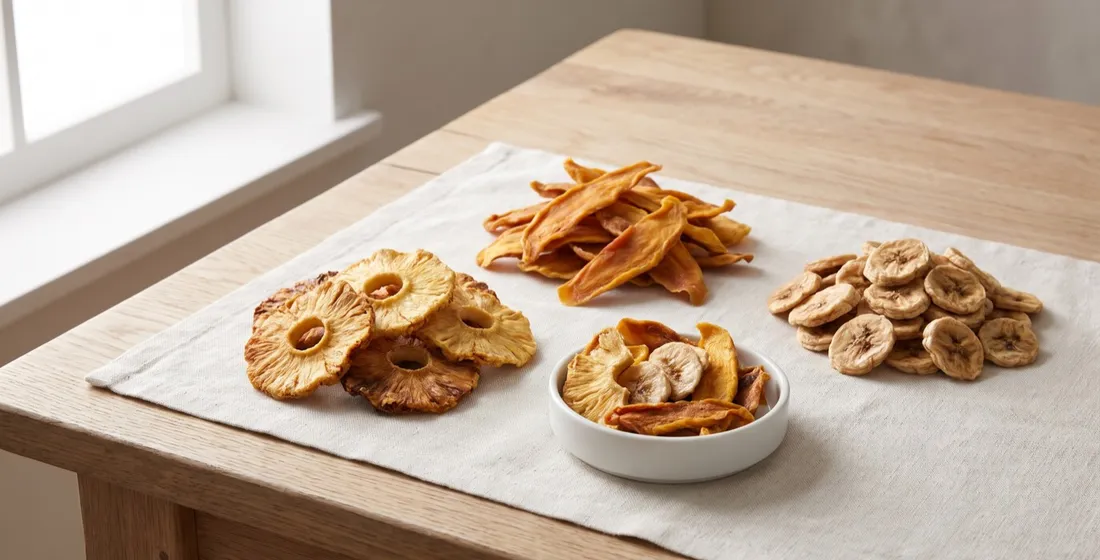
For colour, the practical entry point is the dehydrated pineapple rings, where a darker unsulphured piece and a brighter treated one are easy to compare against a sealed reference.
FAQ
What does sulphite-free mean on dried fruit? It should mean no sulphur dioxide or sulphite additive was used and the finished food tests below the 10 mg/kg declaration threshold that applies in the EU and, as 10 ppm, in the US. Specify the threshold and the test method in the contract, because “no sulphites” alone is not measurable and does not cover carry-over from other ingredients.
Why is sulphite-free dried fruit darker? Sulphur dioxide blocks the enzyme that browns cut fruit and slows later Maillard browning. Without it, the fruit darkens during drying and continues to darken in storage. In one apricot study, unsulphured fruit browned more than sulphured fruit, which is why a colour range and a shelf-life point belong in the spec.
Can acid or ascorbate dips replace sulphur dioxide? They replace part of the job. Citric acid lowers surface pH, and PPO has little activity below about pH 4, while ascorbic acid reduces the quinones that form pigment but is consumed doing so. Neither suppresses mould or stops Maillard browning, so moisture, water activity and packaging must carry the rest.
Does SRV offer sulphite-free dehydrated fruit under private label? SRV runs private label and contract manufacturing for dehydrated fruit from the BRCGS and FSSC 22000 V6 audited Silk Foods Ceylon facility in Matale. Sulphite status is set in the written product specification for each SKU and confirmed on the quote, with a COA available on request.
How Silk Route Ventures can help
Silk Route Ventures (SRV) supplies dehydrated pineapple, mango, papaya and banana to snack, bakery and distribution buyers across the US, EU, UK and Australia, shipped against the buyer’s written specification from the BRCGS and FSSC 22000 V6 audited Silk Foods Ceylon (SFC) facility in Matale. Sulphite status, pretreatment, colour range and water activity are written into the spec and confirmed per SKU on the quote. First-order MOQ is 100 kg per SKU, with trial quantities from 10 kg, and samples are free for evaluation (you cover the courier). Standard SKUs dispatch 2 to 3 weeks from purchase order, and private label or custom specifications take 4 to 6 weeks. Contact us with your target colour reference and destination market.
Written by the Silk Route Ventures Trade Team. Silk Route Ventures (E-Silk Route Ventures (Pvt) Ltd) is a Sri Lankan B2B supply-chain operator for the Food, Beverage, Wellness, and Nutraceuticals sectors. The Silk Foods Ceylon manufacturing arm holds BRCGS and FSSC 22000 V6 certifications. Questions or to request a sample: Contact us or email info@esilkroute.com.lk.
Sources
- Food Safety Authority of Ireland, “Sulphur Dioxide and Sulphites,” labelling threshold of 10 mg/kg expressed as SO2. https://www.fsai.ie/business-advice/running-a-food-business/food-safety-and-hygiene/additives/sulphur-dioxide-and-sulphites (retrieved 11 November 2026).
- US eCFR, 21 CFR 101.100, sulfiting agent declaration at 10 ppm or more. https://www.ecfr.gov/current/title-21/chapter-I/subchapter-B/part-101/subpart-D/section-101.100 (retrieved 11 November 2026).
- National Library of Medicine (PMC), enzymatic browning control by acidulants and ascorbic acid, PMC7355983. https://pmc.ncbi.nlm.nih.gov/articles/PMC7355983 (retrieved 11 November 2026).
- “Effect of sulphuring on physicochemical characteristics and aroma of dried Alkaya apricot: a new Turkish variety,” Turkish Journal of Agriculture and Forestry. https://www.iris.unict.it/retrieve/dfe4d22b-22d8-bb0a-e053-d805fe0a78d9/tar-41-1-7-1607-60.pdf (retrieved 11 November 2026).
- “Effects of moisture contents and storage temperatures on the physical, chemical and microbiological qualities of non-sulfitted dried apricots,” Journal of Agricultural Sciences. https://www.acarindex.com/journal-of-agricultural-sciences/effects-of-moisture-contents-and-storage-temperatures-on-the-physical-chemical-and-microbiological-qualities-of-non-sulfitted-dried-apricots-1270780 (retrieved 11 November 2026).
- American Spice Trade Association, “FAQ: Sulfites,” April 2026. https://astaspice.org/downloads/ASTA-FAQ-Sulfites-April-2026.pdf (retrieved 11 November 2026).