
Dehydrated Fruit Slices, Dices and Strips: A Buyer's Spec Primer
Buyer’s snapshot
- Global dried fruit production ran at 3.24 million metric tonnes in 2024/25 and has sat near 3 million tonnes for a decade (International Nut and Dried Fruit Council, 2025). Supply is not the constraint. The spec is.
- Water activity governs shelf life, not moisture percentage. Two lots at the same 15 percent moisture can behave differently in the same cereal box.
- Sulphite declaration triggers at 10 mg/kg in the EU and 10 ppm in the US, both expressed as SO2.
- Tropical dried fruit going into the EU sits under a 2.0 µg/kg ochratoxin A ceiling, four times tighter than the 8.0 µg/kg allowed on raisins and dried figs.
- Silk Foods Ceylon dehydrates pineapple, mango, papaya and banana in Matale under BRCGS and FSSC 22000 V6, from 50 kg per SKU on a first order.
Dried fruit is one of the few food categories where global supply has barely moved. Production ran at 3.24 million metric tonnes in 2024/25 and has hovered near 3 million tonnes across the past decade, according to the International Nut and Dried Fruit Council’s Nuts and Dried Fruit Global Statistical Review 2025. What has moved is what buyers do with it. Cereal, granola, bar and snack lines now pull dehydrated fruit in cut formats rather than whole, and the cut is where most sourcing disputes start. This piece is the cross-fruit spec primer: the parameters that belong on the RFQ line before anyone argues about price.
What is the difference between dehydrated fruit slices, dices and strips?
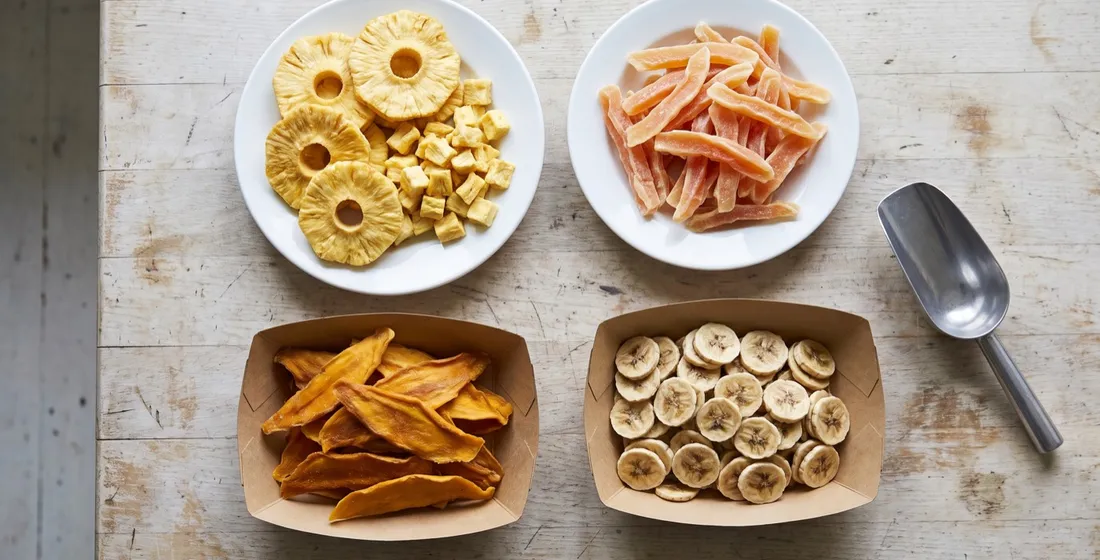
Slice, dice and strip describe cut geometry, not quality. A slice is a cross-cut through the whole fruit, a dice is a cube cut on three axes, and a strip is a longitudinal cut. The Codex Alimentarius General Standard for Dried Fruits (CXS 360-2020) sets no geometry rules at all, which means the buyer’s own spec is the only control on what arrives in the sack.
Geometry matters because it sets the ratio of surface area to mass, and that ratio drives almost everything downstream. A high-surface-area cut dries faster, rehydrates faster, browns faster, and generates more fines in transit. A low-surface-area cut holds colour and structure but resists dosing equipment. The same fruit, dried on the same line to the same moisture, will behave like two different ingredients in cut and in ring form.
| Format | Typical cut dimension | Surface area to mass | Where it works | Where it fails |
|---|---|---|---|---|
| Ring or slice | 40 to 70 mm outer diameter, 6 to 10 mm thick | Low | Retail snack packs, cereal toppers, visual merchandising | Volumetric dosing; rings bridge in hoppers and shatter under an auger |
| Tidbit or dice | 6 to 12 mm cube | Moderate | Cereal and granola inclusions dosed by volume | Fines at the base of the box if over-dried |
| Strip | 40 to 80 mm long, 5 to 12 mm wide | Moderate | Bars, trail mix, chewy inclusion texture | Tangling and mat formation in ribbon blenders |
| Tea-bag cut | 2 to 4 mm | High | Infusions, tea blends, seasoning inclusions | Rehydrates too fast in wet dough; colour bleed |
| Chip or coin | 20 to 35 mm round, 2 to 4 mm thick | High | Crisp snack formats, cereal toppers | Breakage in transit, high fines percentage |
Per-fruit format selection is its own decision, and it differs by species because the flesh structure differs. The detail sits in the dried mango format guide covering tidbit, tea-bag-cut and strip, the dehydrated banana strip, chip and coin comparison, the papaya strip and tea-bag-cut selection guide, and the pineapple rings, tidbits and strip format guide. What follows applies across all of them.
Setting the moisture and water activity ceiling
Moisture percentage is a composition number. Water activity is a behaviour number. Codex CXS 360-2020 requires dried fruit to be sufficiently dried to ensure food safety and to meet a maximum moisture level appropriate to the variety, deliberately declining to fix one figure across fruits. Below a water activity of 0.60, no microorganism grows at all.
The thresholds are worth committing to memory because they are the whole basis of a shelf-life argument. Most moulds stop below 0.70. Xerophilic moulds push down to roughly 0.65. Osmophilic yeasts reach about 0.60. Below that, nothing grows, and remaining shelf life is governed by chemistry (browning, oxidation, colour loss) rather than by microbiology. Most conventionally dried fruit lands somewhere between 0.55 and 0.70, which is why a moisture figure alone tells a quality manager very little.
There is a second reason water activity beats moisture on a cereal spec, and it catches formulators out regularly. In a mixed pack, moisture migrates between components until their water activities equalise. An inclusion at a higher water activity than the flake or extrudate base will soften that base over shelf life, and the complaint arrives as “stale cereal” rather than “wrong fruit spec.” The practical rule is to specify the inclusion at or below the water activity of the base, then hold the supplier to a ceiling rather than a range.
Spec snapshot: dehydrated tropical fruit, Matale line Fruits: pineapple, mango, papaya, banana, lime Formats: ring, slice, tidbit or dice, strip, tea-bag cut, chip or coin Moisture: specified per fruit and per format against the buyer’s spec Water activity: specified as a ceiling, not a range, for inclusion applications Sulphite status: sulphite-free or declared SO2, fixed at order stage First-order MOQ: 50 kg per SKU, 2 to 3 weeks from purchase order to dispatch
Sulphite-free or sugar-infused: which spec fits your line?
Sulphites preserve colour and suppress enzymatic browning, and they are the oldest answer to the problem of pale fruit going brown. They also trigger mandatory declaration once total SO2 exceeds 10 mg/kg under Regulation (EU) No 1169/2011 Annex II in the EU, and at 10 ppm or more under 21 CFR 101.100(a)(4) in the US. Both jurisdictions landed on the same number.
Sugar infusion is the other route, and it does more than sweeten. Steeping fruit in a sugar or fruit-juice syrup before or during drying raises soluble solids, and dissolved solutes bind water. That lowers water activity at any given moisture content, which is why an infused piece can carry 18 to 22 percent moisture, stay pliable, and still sit below the mould threshold. The trade is on the label: added sugar is declared, and the ingredient list grows.
| Spec route | How it works | Colour outcome | Label consequence | Best fit |
|---|---|---|---|---|
| Sulphite-free | Hot-air or solar drying only, no additive | Darkens through drying and continues over shelf | No sulphite declaration | Clean-label cereal, organic SKUs, private-label ranges avoiding allergen listing |
| Sulphured | SO2 dip or gassing before drying | Bright and stable | Declaration above 10 mg/kg (EU) or 10 ppm (US); EU allergen listing | Retail formats where colour drives purchase |
| Sugar-infused | Osmotic steeping in sugar or juice syrup, then drying | Bright, slightly translucent | Added sugar declared; longer ingredient list | Bars, chewy inclusions, applications needing pliability at low water activity |
EU maximum use levels for SO2 are set category by category in Annex II to Regulation (EC) No 1333/2008, and the categories are narrower than most buyers assume. Dried apricots and peaches sit at 2,000 mg/kg. Dried bananas sit at 1,000 mg/kg. Dried coconut sits at 50 mg/kg. Tropical fruits like pineapple, mango and papaya are not each named the way apricots and bananas are, so confirm which category applies with your own regulatory affairs function rather than assuming the headline 2,000 mg/kg figure travels. It usually does not.
One point of honesty about the clean-label route. Sulphite-free tropical fruit is darker, and it keeps getting darker. A brand that specifies sulphite-free and then rejects lots on colour six months into a contract is specifying two things that cannot both be true.
Piece-size tolerance and the cost of fines
Piece-size tolerance is the parameter buyers most often leave off the RFQ, and the one that generates the most claims. A nominal 8 mm dice is meaningless without a stated band and a stated fines ceiling. Written properly, the line reads as a target dimension, a tolerance either side, a minimum percentage of pieces within band, and a maximum percentage passing a named sieve.
Fines are not free. They settle to the bottom of the box, so the first bowl poured looks nothing like the last. They change the dosing weight per scoop on volumetric equipment. They carry more surface area per gram, so they brown and oxidise ahead of the rest of the lot and set the effective shelf life for the whole pack. On a dosing line, a rising fines fraction shows up as drift in fill weight before anyone thinks to look at the fruit.
The Silk Route Ventures (SRV) procurement desk sees the same sequence often enough to name it. A buyer specifies the fruit, the cut and the moisture, accepts the first two lots without complaint, then raises a quality claim in month four on a lot that meets every written parameter. The disagreement is real, but it is not about the lot. Nobody wrote down the tolerance band, so both sides had been reading the first shipment as the standard. Sampling the first delivery and writing its measured distribution into the contract costs nothing and settles the argument before it starts.
Screening tightens a distribution but it does not create yield. Every screening pass removes mass, and the removed mass has to be paid for by somebody. A very tight band on a naturally variable fruit is a legitimate ask, and it prices accordingly. That is a straight commercial conversation and it belongs at the RFQ stage, not at the claim stage.
How long does dehydrated fruit hold, and what sets the limit?
Shelf life on dehydrated fruit is set by four things in roughly this order: water activity, packaging barrier, storage temperature, and sulphite status. Get the first one right and the rest are manageable. Get it wrong and no amount of foil laminate rescues the lot.
Packaging is where good fruit is routinely lost. A bulk sack with a plain polyethylene liner is a moisture-permeable container, and fruit shipped at a controlled 0.60 water activity into a humid warehouse will climb. For anything held beyond a few months, or destined for a tropical or coastal store, the barrier specification belongs on the purchase order alongside the fruit specification.
Contaminants are the other ceiling, and they are market-specific. Commission Regulation (EU) 2023/915, which applied from 1 January 2023, sets ochratoxin A at 8.0 µg/kg for dried vine fruit and dried figs, and at 2.0 µg/kg for other dried fruits. Tropical dehydrated fruit falls into that second group, so the ceiling on a pineapple or mango lot bound for the EU is four times tighter than the one applied to raisins. Buyers who have only ever handled vine fruit tend to carry the wrong number across.
| Parameter | EU | US | Where it bites |
|---|---|---|---|
| Sulphite declaration | Above 10 mg/kg total SO2, listed as an allergen (Reg (EU) No 1169/2011 Annex II) | 10 ppm or more total SO2 (21 CFR 101.100(a)(4)) | Any sulphured lot, and any lot with carry-over from an ingredient |
| SO2 maximum use level | Set per fruit category in Annex II to Reg (EC) No 1333/2008 | Declaration-driven rather than a single fixed dried-fruit ceiling | Sulphured lots; confirm the applicable category per fruit |
| Ochratoxin A | 2.0 µg/kg other dried fruits; 8.0 µg/kg dried vine fruit and figs (Reg (EU) 2023/915) | No federal limit specific to dried fruit | Tropical dehydrated fruit into the EU |
Per-batch certificates of analysis are how any of this becomes verifiable rather than asserted. Reading one properly is a skill in itself, covered in the guide to per-lot heavy metal and pesticide testing and how to read a COA.
Specifying dehydrated fruit on an RFQ
The gap between a good RFQ and a poor one is not length. It is whether each line can be measured and failed.
Buyer’s checklist: the dehydrated fruit RFQ line
- Fruit species and variety, plus the country of origin
- Cut format, with a target dimension in millimetres
- Piece-size tolerance band, and minimum percentage of pieces within band
- Maximum fines percentage, against a named sieve aperture
- Moisture percentage, stated as a ceiling
- Water activity, stated as a ceiling, not a range
- Sulphite status: sulphite-free, or a declared maximum total SO2 in mg/kg
- Added sugar status, and the infusion medium if infused
- Colour reference, agreed against a retained physical sample rather than a word
- Microbiological limits: total plate count, yeast and mould, and pathogen absence criteria
- Contaminant panel matched to the destination market, including ochratoxin A for EU-bound lots
- Packaging barrier specification and declared shelf life from date of production
Item 9 does the most work per word. Colour disputes are the most common quality claim in this category and the least resolvable in writing, because “golden” is not a measurement. A retained, dated, sealed physical reference sample held by both parties settles in an afternoon what an email thread will not settle in a month.
Buyers moving from cut fruit into powdered formats will find the same discipline applied to particle size and drying method in the mango powder sourcing spec, and the wider category view in the overview of dehydrated fruits from Sri Lanka.
Where Silk Route Ventures is not the right supplier Lowest-shelf-price retail and discount-channel private label. Buyers who need infused fruit at commodity pricing are better served by high-volume single-fruit processors in Thailand or Vietnam running one format continuously. The Matale line is built for certified, multi-fruit, multi-format supply at low first-order volumes, and it prices that way.
Frequently asked questions
What moisture content should dehydrated fruit have for cereal inclusions?
There is no single figure, which is why Codex CXS 360-2020 sets moisture per variety rather than across the category. Specify water activity instead, as a ceiling at or below the water activity of the cereal base, and let the supplier hit the moisture that delivers it for that fruit and cut.
Is sulphite-free dried fruit better than sulphured fruit?
Neither is better; they solve different problems. Sulphite-free avoids the 10 mg/kg EU and 10 ppm US declaration thresholds and suits clean-label and organic SKUs, but the fruit is darker and darkens further over shelf. Sulphured fruit holds colour for retail formats where appearance drives purchase.
Does sugar-infused dried fruit need a sugar declaration?
Yes. Osmotic infusion adds sugar to the product, so it appears in the ingredient list and in the nutrition declaration. The compensation is functional: raised soluble solids lower water activity at a given moisture, so infused pieces stay pliable at 18 to 22 percent moisture while remaining below the mould growth threshold.
What is the ochratoxin A limit for dried tropical fruit in the EU?
Commission Regulation (EU) 2023/915, applicable from 1 January 2023, sets 2.0 µg/kg for other dried fruits, the category covering pineapple, mango, papaya and banana. Dried vine fruit and dried figs are allowed 8.0 µg/kg. Buyers carrying the raisin figure across to tropical fruit are working to a limit four times too loose.
Does Silk Route Ventures supply dehydrated fruit in custom cut sizes, and what is the MOQ?
Yes. Silk Foods Ceylon dehydrates pineapple, mango, papaya, banana and lime in Matale in ring, slice, dice, strip, tea-bag-cut and chip formats, cut to the buyer’s stated dimension and tolerance. First-order MOQ is 50 kg per SKU, samples ship door to door by international courier in 3 to 5 business days, and production runs 2 to 3 weeks from purchase order to dispatch.
How Silk Route Ventures can help
Silk Route Ventures supplies dehydrated pineapple, mango, papaya, banana and lime to cereal, granola, bar and snack manufacturers across the US, EU and Australia. Fruit is cut, dried and packed against the buyer’s written spec at the Silk Foods Ceylon facility in Matale, which holds BRCGS and FSSC 22000 V6, with USDA Organic and EU Organic on the relevant SKUs. First-order MOQ is 50 kg per SKU, every batch ships with a certificate of analysis, and the documentation pack covers the destination-market file rather than just the invoice. For buyers still fixing a tolerance band or deciding between a sulphite-free and an infused route, the SRV trade desk will quote both against the same brief. Contact us to send an inquiry or request a sample pack.
Sources
- International Nut and Dried Fruit Council. Nuts and Dried Fruit Global Statistical Review 2025 Edition, 2025. https://inc.nutfruit.org/resources/global-statistical-review-2025/ (retrieved 25 August 2026)
- Codex Alimentarius Commission. General Standard for Dried Fruits, CXS 360-2020, adopted 2020. FAO and WHO. https://www.fao.org/fao-who-codexalimentarius/codex-texts/list-standards/en/ (retrieved 25 August 2026)
- Regulation (EU) No 1169/2011 of the European Parliament and of the Council on the provision of food information to consumers, Annex II (substances causing allergies or intolerances), item 12. European Union, 2011. https://eur-lex.europa.eu/legal-content/EN/TXT/?uri=CELEX%3A32011R1169 (retrieved 25 August 2026)
- Regulation (EC) No 1333/2008 of the European Parliament and of the Council on food additives, Annex II (Union list of food additives approved for use in foods). European Union, 2008. https://eur-lex.europa.eu/legal-content/EN/TXT/?uri=CELEX%3A02008R1333-20200702 (retrieved 25 August 2026)
- Food; exemptions from labeling, 21 CFR 101.100(a)(4), sulfiting agents at 10 parts per million or more. US Food and Drug Administration. https://www.ecfr.gov/current/title-21/chapter-I/subchapter-B/part-101/subpart-G/section-101.100 (retrieved 25 August 2026)
- Commission Regulation (EU) 2023/915 of 25 April 2023 on maximum levels for certain contaminants in food, ochratoxin A in dried fruits. European Union, applicable 1 January 2023. https://eur-lex.europa.eu/eli/reg/2023/915/oj/eng (retrieved 25 August 2026)
- Food Safety Authority of Ireland. Sulphur dioxide and sulphites: labelling threshold of 10 mg/kg or 10 mg/l expressed as SO2. https://www.fsai.ie/business-advice/running-a-food-business/food-safety-and-hygiene/additives/sulphur-dioxide-and-sulphites (retrieved 25 August 2026)