
Papaya Strip and Dehydrated Papaya Tea-Bag Cut: Format Selection for Blends and Snacks
By the Silk Route Ventures Trade Team | 28 July 2026
Buyer’s snapshot
- Air-dried papaya typically finishes at a water activity between 0.5 and 0.6 (Systems Microbiology and Biomanufacturing, 2022; Food Science and Biotechnology, 2024). Above roughly 0.6, mold risk rises fast enough that most snack-bar specs will not accept the product without a moisture-barrier pouch.
- The cut changes the number. Tea-bag cut’s small dice dries faster and more evenly than the thicker strip, which is why most tea and functional-blend formulators specify the cut even when the label just says “papaya.”
- Silk Foods Ceylon (SFC) runs papaya strip, tea-bag cut, and tidbit off the same FSSC 22000 V6 audited dehydration line, at a 50 kg first-order MOQ per format.
- The spec matrix and the buyer’s checklist further down carry the RFQ-ready detail.
- This post is for blend, tea, and snack-bar formulators specifying a cut and a moisture target. It is not the spec for an ambient, barrier-free snack pouch: that RFQ needs osmotic pretreatment or vacuum drying, a different process altogether.
Dried papaya coming off a straightforward convective drying line lands at a water activity between 0.5 and 0.6 in most published trials, with moisture content in the 13 to 23 percent range depending on the method (Food Science and Biotechnology, 2024; SciRP, “Stability and Sensory Quality of Dried Papaya”). Pushing below roughly 0.4 water activity takes osmotic pretreatment or vacuum-assisted drying before the fruit ever reaches the dehydrator. That gap, between dried and shelf-stable dried, is the first fork in the road for anyone specifying papaya for a blend, a tea infusion, or a snack bar. The second fork is the cut itself: strip or tea-bag cut. They solve different problems, and buyers who pick on appearance alone usually end up re-cutting the RFQ six months later.
What’s the difference between papaya strip and tea-bag cut for a blend formulator?
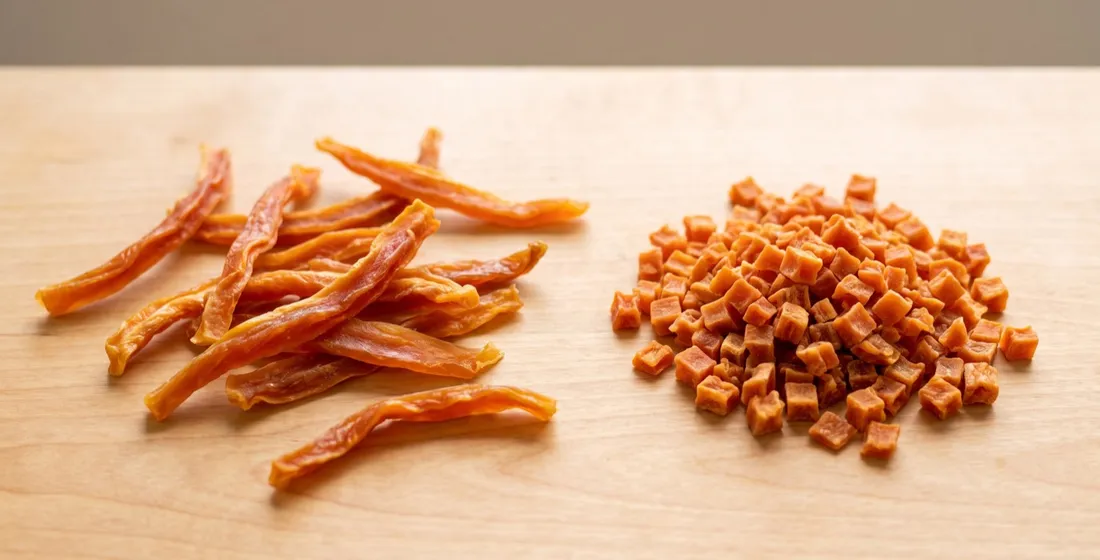
Papaya strip is a long ribbon-cut piece, typically 6 to 10 cm, built for visual presence in a snack mix or bar. Tea-bag cut is a small dice, typically 3 to 5 mm, built to pass a tea bag’s mesh and to dry fast and even. The two formats solve different formulation problems, not the same problem at two sizes.
| Format | Typical dimension | Drying uniformity | Best application | Packaging fit |
|---|---|---|---|---|
| Strip | 6 to 10 cm ribbon, several mm thick | Slower; thicker cross-section carries case-hardening risk if under-dried | Snack bars, trail mix, visual fruit-and-nut blends | Kraft pouch, bulk sack |
| Tea-bag cut | 3 to 5 mm dice | Fast and even; low case-hardening risk | Fruit tea infusions, functional blends, small-format inclusions | Kraft pouch, tea bag filling |
| Tidbit | 10 to 15 mm irregular chunk | Moderate | Mid-size snack inclusions, granola, bakery topping | Kraft pouch, bulk sack |
Source: Silk Foods Ceylon product specification, cross-checked against published drying-method studies, 2024.
Case hardening is the practical risk buyers should ask about directly. It happens when the outer surface of a thicker piece dries and seals before the interior has released enough moisture, trapping a moist core inside a dry shell. Strip format, with more thickness to move moisture through, carries more of this risk than tea-bag cut. A COA that reports average moisture without a spread, or without a water-activity number specifically, will not catch a case-hardened batch. Ask for both.
The same dimension-driven logic runs through Silk Route Ventures’ dried mango format guide and the pineapple rings, tidbits, and tea-bag-cut comparison: tea-bag cut solves an infusion or fast-dry problem the same way across fruits, even though the fruit itself changes the color and browning chemistry. For a fine-powder format instead of a piece, the relevant comparison is Silk Route Ventures’ banana powder format guide.
Moisture, water activity, and the shelf-life math behind each cut
In 2022, a Systems Microbiology and Biomanufacturing study on osmotically pretreated papaya reported moisture below 12 percent and water activity below 0.41 after ultrasound-assisted pretreatment and convective drying, against the 0.5 to 0.6 range typical of straight air-drying. For a buyer, that difference decides whether the finished product needs a moisture-barrier pouch or can ship in a simpler kraft format.
Silk Foods Ceylon’s dehydration line tests moisture and water activity on every batch’s COA, not moisture alone. That distinction matters more for strip than for tea-bag cut: the smaller dice equalizes faster during drying, so an average moisture reading is a reasonably honest picture of the whole batch. A strip batch can show an acceptable average while individual pieces sit well above the target, the case-hardening problem again, and a buyer relying on average moisture alone would not see it on paper.
The practical takeaway for an RFQ: specify a maximum water activity, not just a moisture percentage, and ask whether the supplier tests both on every batch or on a sampling basis. The two-parameter spec costs nothing extra and closes the gap that average-only reporting leaves open.
Browning control: what keeps the color, and what it costs the label
Papaya’s cut surface browns fast once exposed to oxygen, and the two standard fixes, sulfite treatment or an ascorbic acid dip, sit on opposite sides of a label line. The US FDA requires any sulfiting agent detectable at 10 parts per million or more to be declared by name on the finished product’s ingredient panel (FDA, Compliance Policy Guide Chapter 19: Undeclared Major Food Allergens and Food Intolerance Substances, retrieved 2026-07-28).
A 2021 study on Ethiopian papaya reported that ascorbic acid pretreatment retained more than 90 percent of total carotenoids and beta-carotene through refractance window drying, without a sulfite declaration on the finished label (PMC8194739, 2021). For brands positioning on a clean label, that is the more defensible route even though the color outcome runs slightly duller than a sulfited batch. For brands with no clean-label constraint and a bright-orange color target, sulfiting is still the more predictable fix: the tradeoff is the declaration line, not the food-safety question, since sulfites are permitted at declared levels.
Buyers should treat the browning-agent decision as a spec line, not a default. Ask the supplier which method is standard for the SKU, and ask for the sulfite ppm result on the COA if sulfiting is used, whether or not the level clears the 10 ppm declaration threshold.
What Central Province growing conditions bring to the spec
Papaya intended for strip and tea-bag cut comes off fully ripe fruit sourced from Sri Lanka’s Central Province growing belt, distinct from the unripe, latex-tapped fruit used for papain enzyme extraction and papaya seed powder, covered separately in Silk Route Ventures’ papaya powder and papaya seed powder post. Ripeness grading at intake is the quality gate: under-ripe fruit dehydrates pale and starchy, while over-ripe fruit breaks down during cutting and produces excess fines that fail a tea-bag-cut dimension spec. Papain itself was first isolated and named in 1879 from papaya latex (Biocatalysts, “Papain: Nature’s Proteolytic Powerhouse”), a separate processing stream with a much longer written history than fruit dehydration, which is a comparatively modern format built for export logistics rather than traditional use.
Specifying the right cut in an RFQ: blends, tea infusions, and snack bars
An RFQ for dehydrated papaya should specify, in order: the cut (strip, tea-bag cut, or tidbit) and its dimension tolerance, a maximum water activity alongside the moisture percentage, the browning-agent method and its COA parameter, the packaging barrier level, sample lead time, and first-order MOQ. Buyers who specify only “dried papaya” without a cut and a moisture ceiling routinely receive a sample that fits their taste test and fails their shelf-life test six weeks later.
In Q2 2026, the SRV trade desk fielded a small pattern worth naming: two European wellness-tea brands revised their papaya RFQ from strip to tea-bag cut after their co-packer’s infusion line jammed on oversized ribbon pieces sized for a snack bar, not a tea bag. The fix was not a different fruit. It was a different cut, specified before the first production run instead of after it.
Buyers running this spec usually fall into one of two camps: brand owners specifying bulk ingredient supply against an existing co-packer, and brands wanting a finished, private-label tea or snack SKU built end to end. Silk Route Ventures (SRV) serves both from the same Matale facility, and the same low-MOQ economics that apply to spice contract manufacturing apply here: a small first order does not have to mean a compromised spec.
Buyer’s checklist: specifying dehydrated papaya
- Cut format confirmed (strip, tea-bag cut, or tidbit) with a stated dimension tolerance
- Maximum water activity specified, not moisture percentage alone
- Browning-agent method disclosed (sulfite or ascorbic acid) with the relevant COA parameter
- Sulfite ppm result requested on the COA whenever sulfiting is used, regardless of declared status
- Packaging barrier level matched to the water activity result (kraft pouch versus barrier laminate)
- Sample lead time and first-order MOQ confirmed per SKU before the RFQ is finalized
- Bulk ingredient supply versus private-label finished SKU decided up front, since packaging and MOQ differ between the two
Does SRV manufacture private-label papaya blends and snacks under contract?
Silk Foods Ceylon’s dehydration line supplies papaya strip, tea-bag cut, and tidbit under FSSC 22000 V6, which covers the drying, cutting, and packing scope at the Matale facility. The cellular manufacturing layout means a papaya SKU can sit alongside an existing spice or coconut order on the same audit, without a separate supplier qualification cycle. Not every Sri Lankan exporter runs fruit dehydration and a broader spice, coconut, and capsule scope on one FSSC-audited site: that flexibility is the practical reason a distributor or blend brand can add a papaya line without opening a second supplier relationship. Buyers weighing an organic claim on the finished SKU should start with Silk Route Ventures’ buyer’s guide to organic certifications before finalizing the RFQ.
Certification snapshot: dehydrated papaya, Silk Foods Ceylon
- BRCGS and FSSC 22000 V6 (covers the dehydration line: drying, cutting, and packing)
- USDA Organic and EU Organic scoped per SKU on request; confirm current scope for a specific papaya SKU before finalizing an organic or UK/EU retail-bound RFQ
Frequently asked questions
What’s the difference between papaya strip and tea-bag cut for a blend or snack formulator?
Strip is a 6 to 10 cm ribbon built for visual presence in bars and trail mix. Tea-bag cut is a 3 to 5 mm dice built to pass a tea bag’s mesh and to dry faster and more evenly, lowering case-hardening risk. The choice depends on the application, not on which format looks more “premium.”
Does dried papaya need sulfites to hold its color, and does that trigger a US label declaration?
Not always. Ascorbic acid pretreatment retained over 90 percent of carotenoids in a 2021 Ethiopian papaya drying study without a sulfite declaration. Sulfiting gives a brighter, more predictable color but must be declared on the label whenever the finished product carries 10 ppm or more (FDA Compliance Policy Guide Chapter 19).
What moisture and water activity should bulk dehydrated papaya meet before it ships?
Straight air-drying typically lands at 0.5 to 0.6 water activity and 13 to 23 percent moisture. Osmotic pretreatment or vacuum-assisted drying can bring water activity below 0.4, which changes the packaging and shelf-life math. Specify both moisture and water activity on the COA, not moisture alone.
Can Silk Route Ventures manufacture a private-label papaya tea-bag-cut blend or snack SKU?
Yes. Silk Foods Ceylon runs papaya strip, tea-bag cut, and tidbit under FSSC 22000 V6 at its Matale facility, with a 50 kg first-order MOQ per SKU and a 1 to 2 week sample lead time. Private-label packaging and finished-SKU formats are available alongside bulk ingredient supply.
What’s the MOQ and lead time for bulk dehydrated papaya from Sri Lanka?
Silk Foods Ceylon’s first-order MOQ for dehydrated papaya is 50 kg per format or SKU, consistent with SRV’s other bulk raw-material categories. Sample dispatch runs 1 to 2 weeks by international courier, and production lead time from PO to dispatch runs 2 to 3 weeks.
How Silk Route Ventures can help
Silk Route Ventures (SRV) supplies dehydrated papaya in strip, tea-bag cut, and tidbit formats from the FSSC 22000 V6 audited Silk Foods Ceylon (SFC) dehydration line in Matale, with COA reporting both moisture and water activity per batch. First-order MOQ is 50 kg per format; samples ship by international courier at 1 to 2 weeks, with production lead time of 2 to 3 weeks from PO to dispatch. For brand teams that have already settled on bulk ingredient supply against an existing co-packer, and for distributors or blend brands ready to launch a finished, private-label tea or snack SKU, SRV runs both from the same audited site. Contact us to send an inquiry or request a sample of either cut.
Sources
- US FDA, “Compliance Policy Guide, Chapter 19: Undeclared Major Food Allergens and Food Intolerance Substances.” Retrieved 2026-07-28. https://www.fda.gov/media/80337/download
- Sri Lanka Export Development Board, “Fruit and vegetable exports record 21% growth” (sector blog, 2024/2025). Retrieved 2026-07-28. https://www.srilankabusiness.com/blog/fruit-and-vegetable-exports-record-21-growth.html
- Innova Market Insights, “Global snacks market trends, consumer insights and preferences” (2025/2026). Retrieved 2026-07-28. https://www.innovamarketinsights.com/trends/global-snacks-market/
- Food Science and Biotechnology (Springer Nature), “Conductive hydro drying of ripened papaya: optimization and product characterization” (2024). Retrieved 2026-07-28. https://link.springer.com/article/10.1007/s10068-024-01526-y
- Systems Microbiology and Biomanufacturing (Springer Nature), “Ultrasound-assisted osmotic dehydration, followed by convective drying of papaya: effect on physicochemical and functional quality parameters” (2022). Retrieved 2026-07-28. https://link.springer.com/article/10.1007/s43393-022-00151-2
- PMC/NCBI, “Effects of different drying methods and ascorbic acid pretreatment on carotenoids and polyphenols of papaya fruit in Ethiopia,” PMC8194739 (2021). Retrieved 2026-07-28. https://pmc.ncbi.nlm.nih.gov/articles/PMC8194739/
- PMC/NCBI, “Influence of particle size and extraction solvent on antioxidant properties of extracts of tea, ginger, and tea-ginger blend,” PMC5694873 (2017). Retrieved 2026-07-28. https://www.ncbi.nlm.nih.gov/pmc/articles/PMC5694873/
- Biocatalysts, “Papain: Nature’s Proteolytic Powerhouse.” Retrieved 2026-07-28. https://www.biocatalysts.com/media-resources/papain-natural-powerhouse
Further reading
- Food Allergy Research & Resource Program, University of Nebraska, “Sulfites - USA”, https://farrp.unl.edu/farrp-resources/regulatory/sulfites-usa/
- Sri Lanka Export Development Board, Trade Statistics, https://www.srilankabusiness.com/edb/trade-statistics.html
- ScienceDirect Topics, “Enzymatic Browning”, https://www.sciencedirect.com/topics/food-science/enzymatic-browning
Written by the Silk Route Ventures Trade Team. Silk Route Ventures (E-Silk Route Ventures (Pvt) Ltd) is a Sri Lankan B2B supply-chain operator for the Food, Beverage, Wellness, and Nutraceuticals sectors. The Silk Foods Ceylon manufacturing arm holds BRCGS and FSSC 22000 V6 certifications. Questions or to request a sample: info@esilkroute.com.lk.