
Dehydrated Banana Formats: Strip, Chip and Coin
Buyer’s snapshot
- USDA FoodData Central puts fried banana chips at 33.6 g total fat per 100 g, of which 29.0 g is saturated, against 1.81 g total fat per 100 g for air-dehydrated banana. The word chip on a purchase order does not separate the two.
- Commission Regulation (EU) No 1129/2011 permits sulphur dioxide on dried bananas up to 1,000 mg/kg. Both the EU and the United States force a label declaration above 10 mg/kg, so sulphite-free is a threshold question, not a legality question.
- Codex covers dried banana under CXC 5-1971, the dehydrated fruit and vegetable hygiene code. It is not covered by CXC 3-1969, the dried fruit code, whose scope list does not include banana. Specifications citing the wrong code are common.
- Banana enters the dryer at 73 to 77 percent moisture on a wet basis. Published drying trials reach a 10 percent endpoint in about 4.5 hours at 70 degrees C against 6 hours at 60 degrees C, a 33 percent time reduction that shows up in tonnage per shift.
- Silk Route Ventures (SRV) runs banana strip, tea bag cut and chip or coin formats on the dehydration line at the Silk Foods Ceylon (SFC) site in Matale, at a 50 kg first-order minimum per SKU with a certificate of analysis per batch. The full specification parameter block sits at the close.
Three purchase orders can read banana, dried, and land three products that behave nothing alike in a cereal box. One is a leathery longitudinal strip that survives a coating drum. One is a thin cross-cut chip that shatters in a mixer. One is a thick coin fried in coconut oil that carries eighteen times the fat of the other two. All three are sold as dried banana, all three clear customs, and only one of them matches what the specification writer had in mind. Banana is the fruit where the trade name does the least work of any dehydrated fruit a snack or cereal buyer sources, which puts the burden back on the parameter block.
Strip, chip and coin are three different inclusions, not three cuts
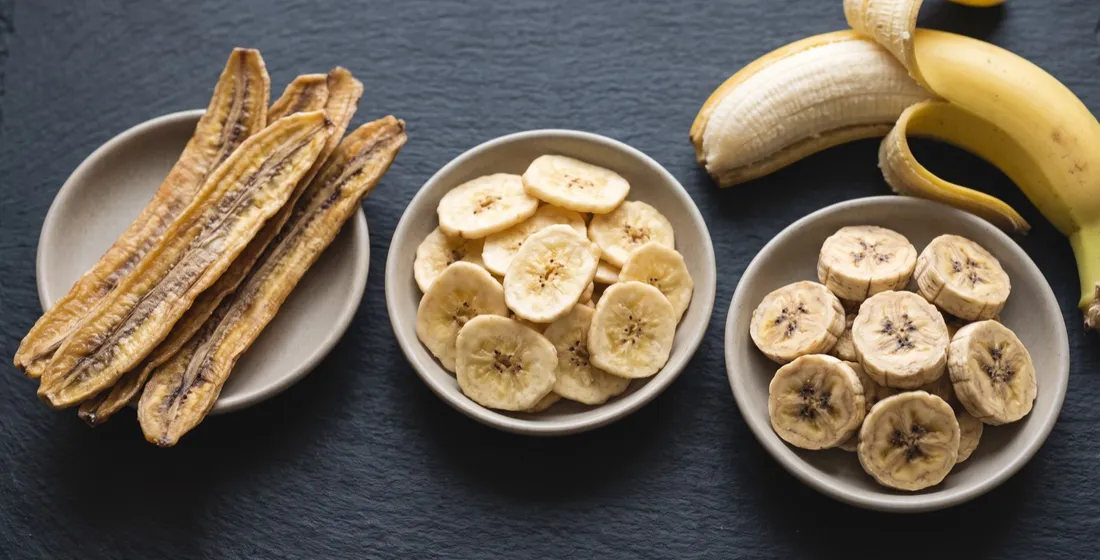
The three formats are distinguished by cut axis before they are distinguished by thickness. A coin is a cross-cut disc taken through the whole finger, so it keeps the central seed line visible and presents two flat faces to the dryer. A chip is the same cross-cut taken thinner, which is why it dries faster, browns harder and fractures more readily. A strip is a longitudinal cut, a half or a quarter of the finger along its length, which gives the lowest surface area per gram of the three and the most pliable finished texture. Tea bag cut is a diced format sized for infusion rather than for visible inclusion.
Cut axis decides mechanical survival, and mechanical survival is what a cereal or bar brand is actually buying. A strip flexes through a coating drum and a ribbon blender. A thin chip does not, and a lot that arrives whole can reach the retail pack as fines. In an extruded cluster or a cold-pressed bar the failure mode is different again: water migrates from the wetter matrix into the drier inclusion, the inclusion softens, and the bar goes from crunchy to uniform inside its stated shelf life. That is a water activity problem, and it belongs on the specification rather than in a complaint email.
| Format | Cut axis | Typical finished texture | Where it holds up | Common failure mode |
|---|---|---|---|---|
| Strip | Longitudinal, half or quarter finger | Pliable, leathery | Coating drums, ribbon blenders, trail mix, bar inclusion | Sticking and clumping if moisture runs high |
| Coin | Cross-cut disc, full finger diameter | Firm to crisp, seed line visible | Muesli, topping, visible-inclusion cereal | Chipping at the rim during pneumatic conveying |
| Chip | Cross-cut, thinner than a coin | Crisp, brittle | Dry snack mixes, direct eating | Fracture to fines in mixing and transit |
| Tea bag cut | Diced | Firm, small particle | Infusion blends, cereal fines fraction | Dust generation and screening loss |
Format selection is a mechanical decision first and a sensory decision second.
SRV finding: The most frequent correction the SRV trade desk makes on an inbound banana enquiry is not the cut, it is the process route. Buyers write chip and mean a fried product on one line and an air-dried product on the next. Naming the process route on the specification removes more ambiguity than tightening the thickness tolerance ever does.
Thickness tolerance is still a buyer-set parameter and belongs in writing, because it drives both dryer residence time and the fines fraction the buyer will accept. It is not set by any published banana standard, so silence on the point means the supplier picks it. The same logic runs through the other dehydrated fruit formats, and the reasoning is laid out for the adjacent fruits in the dried mango format guide and the papaya strip and tea bag cut comparison.
The fried chip is a fat decision, not a texture decision
This is the number that changes procurement conversations. USDA FoodData Central lists Snacks, banana chips at 33.6 g total fat per 100 g, of which 29.0 g is saturated, at 519 kcal per 100 g. The same database lists Bananas, dehydrated, or banana powder at 1.81 g total fat per 100 g and 346 kcal. That is roughly eighteen times the fat and a gap of 173 kcal per 100 g between two ingredients that a category buyer will find sitting under the same three-word description on a supplier list.
The saturated fraction is the part that bites. Commercial banana chips are typically fried in coconut oil, which is why 29.0 of the 33.6 g is saturated. For a granola or bar brand managing a front-of-pack nutrition score or a saturated fat claim, the choice between a fried chip and an air-dried coin is a reformulation lever with a measurable effect on the finished pack, before anyone discusses flavour. A cluster carrying 8 percent fried banana chip inclusion is carrying about 2.7 g of fat per 100 g of finished product from the inclusion alone; the same inclusion rate of air-dried banana contributes about 0.14 g. Those two figures are calculated from the USDA composition values, not quoted from them.
There is a customs consequence too. Simple dried banana is classifiable in the EU nomenclature under heading 0803, bananas including plantains, fresh or dried, at the dried subheading. A banana chip fried in oil is generally treated as otherwise prepared or preserved and falls to heading 2008. Different heading, different duty treatment, different paperwork. A buyer who switches process route without re-checking the classification has changed the landed cost model as well as the nutrition panel.
What a fried-versus-dried swap actually moves
- Total fat per 100 g: 33.6 g fried against 1.81 g air-dried (USDA FoodData Central).
- Saturated fat per 100 g: 29.0 g fried, mostly from coconut oil.
- Energy per 100 g: 519 kcal fried against 346 kcal air-dried.
- Tariff heading: 2008 for the fried chip against 0803 for the dried fruit.
- Shelf-life driver: oxidative rancidity for the fried chip, water activity for the air-dried format.
Moisture, water activity and what the low-moisture code actually says
Drying banana is not a kill step, and the Codex text on this is unusually blunt. The Code of Hygienic Practice for Low-Moisture Foods, CXC 75-2015, states that the water activity of low-moisture foods is often well below 0.85 and that foodborne pathogens such as Salmonella cannot multiply under these conditions, but that the cells can remain viable for extended periods of time. Prevention of growth is not the same as reduction of load. A dehydrated banana specification that carries a microbial limit without either a validated lethality step or a stated incoming-material control is relying on the dryer to do something the dryer does not do.
On the moisture side there are two credible anchors. The FAO processing guideline for dried banana sets a final moisture content of around 12 percent. A 2021 hot-air and osmo-air drying study in the Journal of Food Science and Technology reports banana entering the process at 73 to 77 percent moisture on a wet basis and targets a 10 percent endpoint, reaching it in about 4.5 hours at 70 degrees C against 6 hours at 60 degrees C. The osmo-air dried slices equilibrated at 8.35 percent. Those two endpoints, 12 percent and 10 percent, bracket the pliable formats. Crisp chip formats sit lower, and the USDA entry for dehydrated banana shows 3.00 g water per 100 g at the dry extreme.
| Route | Indicative finished moisture | Water activity behaviour | Sourced from |
|---|---|---|---|
| Air-dried, pliable strip or coin | 10 to 12 percent | Sits above the crisp formats, needs a barrier liner | FAO processing guideline; 2021 drying study endpoint |
| Osmo-air dried slice | 8.35 percent at equilibrium | Lower than plain hot-air at the same endpoint | 2021 Journal of Food Science and Technology trial |
| Dehydrated, dry extreme | 3.00 g water per 100 g | Low, brittle, hygroscopic | USDA FoodData Central, bananas dehydrated |
| Freeze-dried | Lowest of the four | About 0.30 water activity or below, range 0.08 to 0.33 | Utah State University Extension, January 2026 |
Freeze-drying reaches the lowest water activity of the four routes and is still not a kill step.
The practical instruction is to put both numbers on the certificate of analysis. Moisture percent tells the buyer what was removed. Water activity tells the buyer what the inclusion will do inside a finished matrix over shelf life, and it is the parameter that predicts whether a bar goes soft. Specifying one without the other is the single most common gap in dehydrated fruit specifications, and it applies equally to the pineapple ring and tidbit formats and to dehydrated fruit sourcing from Sri Lanka generally.
Sulphites are legal at 1,000 mg/kg and declarable above 10
Banana browns hard during drying because polyphenol oxidase acts on the fruit’s phenolic compounds once the tissue is cut and exposed to air. The oldest industrial answer is sulphur dioxide, and the regulatory position is more permissive than most buyers assume. Commission Regulation (EU) No 1129/2011, which sets Annex II of the food additives regulation, carries a specific row for dried bananas at 1,000 mg/kg of sulphur dioxide, expressed as total SO2 from all sources.
| Dried fruit category (EU Annex II wording) | Maximum SO2, mg/kg |
|---|---|
| Only dried apricots, peaches, grapes, prunes, and figs | 2,000 |
| Only dried bananas | 1,000 |
| Only dried apples and pears | 600 |
| Only dried fruit and nuts in shell, excluding the named fruits above | 500 |
| Only dried tomatoes | 200 |
| Only dried coconut | 50 |
Dried banana carries the second-highest permitted SO2 level of any named dried fruit in the EU list.
The ceiling is not the operative number for most brand owners. Regulation (EU) No 1169/2011 requires sulphur dioxide and sulphites to be declared as an allergen at concentrations above 10 mg/kg expressed as total SO2. The United States sets the same figure by a different route: 21 CFR 101.100(a)(4) defines a detectable amount of sulfiting agent as 10 parts per million in the finished food, which is the trigger for declaration. The EU additive note attached to the sulphite entries uses the same language, treating an SO2 content of not more than 10 mg/kg as not present.
SRV finding: When a buyer writes no sulphites into an enquiry, the requirement is almost always a label outcome rather than an absolute absence. Restating it as a numeric ceiling below 10 mg/kg with a named test method turns an unverifiable claim into a contractual parameter the certificate of analysis can carry.
How easily a lot crosses that line is worth seeing. The FAO processing guideline for dried banana describes dipping the prepared material for one minute in a solution containing 2,000 ppm sulphur dioxide. A dip at that strength is an anti-browning step designed for colour, not a residue-managed step designed for a 10 mg/kg finished-product declaration threshold. If the buyer needs to stay under declaration, the anti-browning route has to be specified upstream, typically as an ascorbic or citric acid dip, a blanch, or a controlled combination, with the trade-off accepted on finished colour.
There is also a moving part worth tracking. FRUCOM, the European federation for the dried fruit and edible nut trade, reports that the sulphite maximum levels are under re-evaluation by EFSA, with one scenario cutting dried bananas from 1,000 mg/kg to 600 mg/kg. That is an industry federation account of a proposal, not enacted law, and it should be treated as a watch item on multi-year supply agreements rather than a current limit.
Contaminant limits arrive through the drying ratio
Commission Regulation (EU) 2023/915 sets ochratoxin A at 2.0 micrograms per kilogram for other dried fruits, the category dried banana falls into, against 8.0 for dried vine fruits and dried figs. For aflatoxins the regulation distinguishes dried fruits that will be sorted or physically treated, at 5.0 micrograms per kilogram for B1 and 10.0 for the sum of B1, B2, G1 and G2, from dried fruits used as the only ingredient or as processed products, at 2.0 for B1 and 4.0 for the sum. A dried banana inclusion going straight into a cereal box is in the tighter tier.
Heavy metals work differently and this is where specifications tend to go quiet. The regulation carries no dried-fruit-specific lead or cadmium entry for banana. Instead, Article 3(1) directs that where no specific maximum level exists for dried, diluted or processed food, the limit is applied taking account of the change in contaminant concentration caused by drying, the change caused by processing, the proportions of the ingredients, and the analytical limit of quantification. The lead limit for other fruits is 0.10 mg/kg on the fresh product.
Run that through the drying ratio and the practical ceiling becomes visible. Using the USDA figure of 74.9 g water per 100 g of raw banana, peeled banana flesh carries about 25.1 g of dry solids per 100 g, so drying to a 12 percent finished moisture concentrates the fruit by roughly 3.5 times on a peeled-flesh basis. At that factor, fresh flesh carrying about 0.03 mg/kg of lead already produces a dried product sitting at the effective ceiling. Those ratios are calculated from the USDA composition value and the target moisture, not quoted from a regulation, and the peel loss on a whole-fruit purchase basis pushes the input requirement higher still.
| Target finished moisture | Output per 100 g peeled flesh | Approximate fresh to dried ratio |
|---|---|---|
| 15 percent, pliable strip or coin | 29.5 g | About 3.4 to 1 |
| 12 percent, FAO guideline endpoint | 28.5 g | About 3.5 to 1 |
| 5 percent, crisp chip | 26.4 g | About 3.8 to 1 |
| 3 percent, dehydrated extreme | 25.9 g | About 3.9 to 1 |
Calculated from USDA raw banana composition at 74.9 g water per 100 g, peeled-flesh basis.
Cultivar is a specification line, not a footnote
FAO puts world banana trade at around 20 million tonnes per year in recent years, with Cavendish the most traded variety at just under half of global production and an estimated 50 million tonnes of annual output. Cavendish dominates the fresh export trade because it ships well, which is a different optimisation from drying well. A dehydration buyer is selecting for solids, sugar and phenolic load, none of which are what the fresh trade selected Cavendish for.
Sri Lanka’s cultivar range makes the point concrete. A 2025 study in Food Agricultural Sciences and Technology compared eight commercially grown cultivars from the Southern Province, including Seeni, Ambul, Kolikuttu, Puwalu, Rath kesel, Anamalu, Cavendish and Ambon. Rath kesel recorded the highest total soluble solids at 18.4, Ambul the highest sugar content at 36.4 g per 100 g, and Kolikuttu the highest phenolic content at 55.13 mg per 100 g. Sugar drives finished sweetness and the rate of non-enzymatic browning during drying. Phenolic load drives how hard the fruit browns enzymatically before any dip is applied.
The buyer conclusion is short: name the cultivar. A specification that says Musa spp. and stops has left the two variables that decide finished colour and sweetness to whatever the packhouse could buy that week. That is how a brand ends up with a sensory drift complaint in month nine of a twelve-month contract with no parameter breached, because the parameter was never written.
The data gap a banana specification has to cover itself
Dried banana is a commercially real product with almost no institutional data behind it. The International Nut and Dried Fruit Council Statistical Yearbook 2024 puts world dried fruit production at 3,355,486 metric tonnes in 2023/24, split across dates at 42 percent, dried grapes at 36 percent, prunes at 7 percent, dried cranberries at 6 percent, dried apricots at 5 percent and dried figs at 4 percent. The yearbook tracks those six categories. Banana is absent from the dataset entirely.
Trade statistics are no cleaner. On the World Bank WITS view of UN Comtrade data for HS 0813.40, the residual other dried fruit line, Thailand led 2023 exports at about 264.7 million US dollars, ahead of China at 228.1 million and Spain at 158.6 million, with Sri Lanka at 0.78 million. That line is a floor rather than a total for banana, because simple dried banana is arguably classifiable under heading 0803 and fried banana chips generally fall to heading 2008. No single customs line measures the product, so no reliable public series exists to benchmark a price against.
Demand-side signal is easier to find. Innova Market Insights reported in April 2025 that breakfast cereal launches in Canada grew at a 12 percent compound annual rate over the preceding two years, with 27 percent of consumers saying they increased cereal consumption because of greater variety and novelty. Fruit inclusions are one of the levers brands pull to deliver that novelty, which is why format questions on banana are arriving more often than the trade data would suggest.
SRV finding: With no dried-banana commodity standard identified, no clean customs series and no category dataset, the contract has to carry what the standards do not. On this product the specification is the standard, and a thin specification is not a neutral choice.
What belongs on a dehydrated banana purchase specification
The following parameter block is what the SRV trade desk works from on a banana enquiry. It is written so a buyer can lift it into an enquiry document and hold any supplier to it, not only this one.
- Botanical name and cultivar. Musa spp. with the cultivar named, because sugar and phenolic load differ materially between cultivars.
- Format and cut axis. Strip, coin, chip or tea bag cut, with the thickness tolerance and the acceptable fines percentage stated, since no published banana standard sets them.
- Process route. Air-dried, osmo-air dried, freeze-dried or fried. If fried, the oil type and the residual fat percentage on the finished product.
- Moisture percent and water activity, each with the test method. Moisture describes the process, water activity predicts behaviour inside the finished matrix.
- Sulphur dioxide in mg/kg with the method, AOAC Official Method 990.28 or an LC-MS/MS method, plus the declaration position required for the destination market.
- Anti-browning treatment declared as sulphite dip, ascorbic or citric acid dip, blanch or none, with the accepted finished colour range.
- Aflatoxin B1 and total aflatoxins, ochratoxin A, lead and cadmium, with the drying concentration factor stated so both sides agree how the fresh-basis limit is being applied.
- Microbiological limits and a statement of whether a validated lethality step is applied, since drying alone is not one.
- Added sugar, honey or syrup coating: present or absent, and the percentage if present.
- Packaging, liner specification, oxygen and moisture barrier, net weight, and shelf life at a stated storage temperature and relative humidity.
- Certificate of analysis cadence and traceability depth, naming the parameters tested per batch and how far back the lot can be traced.
Frequently asked questions
Are banana chips and dehydrated banana the same ingredient?
No. USDA FoodData Central lists fried banana chips at 33.6 g total fat per 100 g, of which 29.0 g is saturated, against 1.81 g total fat for dehydrated banana. That is roughly eighteen times the fat and 173 kcal more per 100 g. The two also sit under different customs headings.
How much sulphur dioxide is allowed on dried banana in the EU?
Commission Regulation (EU) No 1129/2011 permits up to 1,000 mg/kg of sulphur dioxide on dried bananas, expressed as total SO2 from all sources. Separately, Regulation (EU) No 1169/2011 requires an allergen declaration above 10 mg/kg, which is the threshold most brand owners are actually managing to.
Does drying kill Salmonella on banana?
No. Codex CXC 75-2015 states that pathogens such as Salmonella cannot multiply at the water activity of low-moisture foods, often well below 0.85, but that the cells can remain viable for extended periods. Freeze-drying reaches about 0.30 water activity or below and is likewise not a lethality step.
Can Silk Route Ventures supply dehydrated banana to a buyer’s own specification?
Yes. SRV supplies banana strip, tea bag cut and chip or coin formats against a written buyer specification, dehydrated at the SFC site in Matale, at a 50 kg first-order minimum per SKU with volume breaks above that, a certificate of analysis per batch, and a production lead time of two to three weeks from purchase order to dispatch.
How Silk Route Ventures can help
Silk Route Ventures supplies dehydrated banana in strip, tea bag cut and chip or coin format against the buyer’s written specification, processed at the BRCGS and FSSC 22000 V6 audited Silk Foods Ceylon site at Nalanda in Matale, one kilometre from the Nalanda Gedige. Cultivar can be named on the contract, the anti-browning route can be specified as sulphite or as an acid dip below the declaration threshold, and moisture and water activity are both reported on the batch certificate of analysis. The first-order minimum is 50 kg per SKU with breaks at 500, 1,000 and 2,500 kg, production lead time runs two to three weeks from purchase order to dispatch, and traceability runs back to the collection point. USDA Organic and EU Organic scopes are available on the terms set out in the buyer’s guide to organic certifications, and the same site can co-manufacture a finished retail snack or cereal SKU under the buyer’s own label rather than shipping inclusion material alone, as described in the bulk ingredient supply playbook. Buyers working the powder route rather than the piece route will find the parallel parameters in the banana powder sourcing spec. Contact us to send a specification or request a sample.
Sources
- Codex Alimentarius, CXC 5-1971, Code of Hygienic Practice for Dehydrated Fruits and Vegetables Including Edible Fungi. https://www.fao.org/input/download/standards/265/CXP_005e.pdf (retrieved 4 August 2026)
- Codex Alimentarius, CXC 3-1969, Code of Hygienic Practice for Dried Fruits. https://www.fao.org/input/download/standards/263/CXP_003e.pdf (retrieved 4 August 2026)
- Codex Alimentarius, CXC 75-2015, Code of Hygienic Practice for Low-Moisture Foods. https://www.fao.org/input/download/standards/13921/CXP_075e_2015.pdf (retrieved 4 August 2026)
- Commission Regulation (EU) No 1129/2011 amending Annex II to Regulation (EC) No 1333/2008 on food additives. https://eur-lex.europa.eu/legal-content/EN/TXT/HTML/?uri=CELEX:32011R1129 (retrieved 4 August 2026)
- Regulation (EU) No 1169/2011 on the provision of food information to consumers, Annex II. https://www.legislation.gov.uk/eur/2011/1169/annex/II (retrieved 4 August 2026)
- US Food and Drug Administration, 21 CFR 101.100, Food; exemptions from labeling. https://www.law.cornell.edu/cfr/text/21/101.100 (retrieved 4 August 2026)
- US Food and Drug Administration, New Method for the Analysis of Sulfites in Foods, Federal Register, 18 January 2022. https://www.federalregister.gov/documents/2022/01/18/2022-00816/new-method-for-the-analysis-of-sulfites-in-foods (retrieved 4 August 2026)
- Commission Regulation (EU) 2023/915 on maximum levels for certain contaminants in food. https://eur-lex.europa.eu/eli/reg/2023/915/oj/eng (retrieved 4 August 2026)
- US Department of Agriculture, FoodData Central, Snacks banana chips (FDC 168849), Bananas dehydrated or banana powder (FDC 173945), Bananas raw (FDC 173944). https://fdc.nal.usda.gov/ (retrieved 4 August 2026)
- Food and Agriculture Organization, Fruit and Vegetable Processing, recipe guidelines for dried fruit and vegetables. https://www.fao.org/4/v5030e/V5030E10.HTM (retrieved 4 August 2026)
- Rai R., Rani P., Tripathy P.P., Osmo-air drying of banana slices: multivariate analysis, process optimization and product quality characterization, Journal of Food Science and Technology, 2021, DOI 10.1007/s13197-021-05261-8. https://pmc.ncbi.nlm.nih.gov/articles/PMC9114283/ (retrieved 4 August 2026)
- Utah State University Extension, Can I Freeze-Dry That? A Practical Guide to Safe and Effective Freeze-Drying, January 2026. https://extension.usu.edu/foodsafety/research/can-i-freeze-dry-that-a-practical-guide-to-safe-and-effective-freeze-drying (retrieved 4 August 2026)
- International Nut and Dried Fruit Council, Nuts and Dried Fruits Statistical Yearbook 2024. https://inc.nutfruit.org/wp-content/uploads/2025/01/Statistical-Yearbook-2024.pdf (retrieved 4 August 2026)
- World Bank WITS / UN Comtrade, exports of HS 081340 other dried fruit by country, 2023. https://wits.worldbank.org/trade/comtrade/en/country/ALL/year/2023/tradeflow/Exports/partner/WLD/product/081340 (retrieved 4 August 2026)
- Innova Market Insights, Breakfast cereals in the US and Canada, 28 April 2025. https://www.innovamarketinsights.com/trends/breakfast-cereals-in-the-us-and-canada/ (retrieved 4 August 2026)
- Oshani Dhanushka K.L., Kodikara M., Buddhika Niroshie P.A. et al., A study on the morphological, physicochemical, nutritional and functional properties of commercially grown banana cultivars in the Southern Province of Sri Lanka, Food Agricultural Sciences and Technology, 2025, 11(2). https://ph02.tci-thaijo.org/index.php/stej/article/view/255182 (retrieved 4 August 2026)
- Food and Agriculture Organization, Markets and Trade, Bananas. https://www.fao.org/markets-and-trade/commodities-overview/bananas-tropical-fruits/bananas/en (retrieved 4 August 2026)
- FRUCOM, Additives: sulphur dioxide (SO2) maximum levels to be analysed by EFSA. https://frucom.eu/news/8-news/230-additives-sulphur-dioxide-so2-maximum-levels-to-be-analysed-by-efsa.html (retrieved 4 August 2026)