
Herbal Tea-Bag Cut Specification: Particle Size, Dust and Fill Weight for Tisane Blends
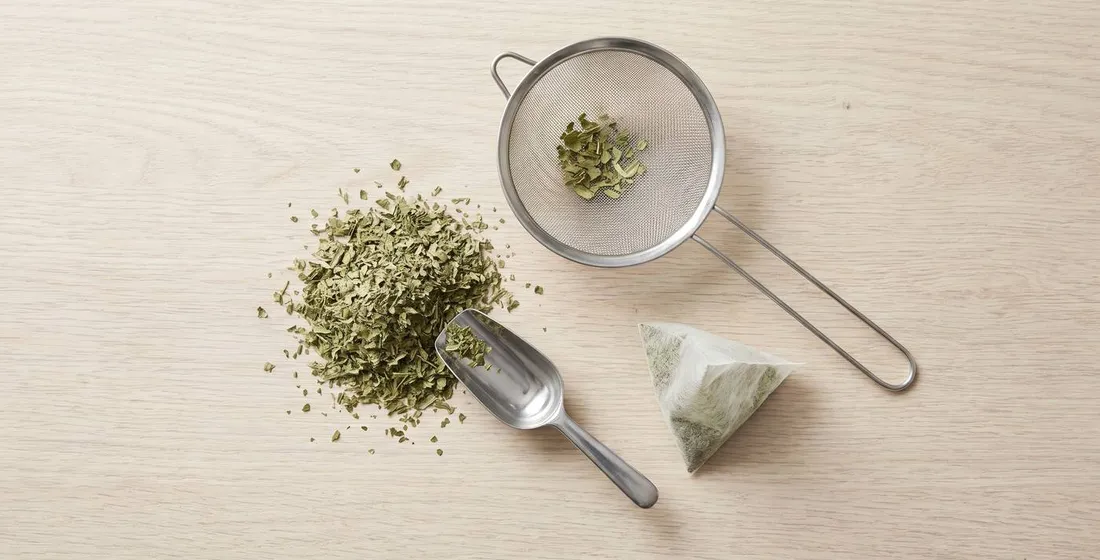
RFQ snapshot
- “Tea-bag cut” has no published standard. Herbs for bagged tea are commonly cut between about US mesh #10 (2 mm) and #60 (0.25 mm), and fine cuts sit at roughly 0.315 to 2.00 mm (Frontiers in Pharmacology, 2022).
- The same bag filled to the same volume can hold 1.0 g or 1.75 g of herb, depending only on the bulk density of the cut. Fill weight is a particle-size outcome, so it belongs in the specification.
- Silk Foods Ceylon (SFC) agrees the cut range, fines ceiling and moisture limit per botanical in writing before the first order, from a 25 kg first-order MOQ per SKU.
- This primer is for tisane brands and distributors writing a tea-bag-cut RFQ. It is not for buyers who want a single “fine cut” label with no numbers behind it.
A tisane RFQ usually names the herb and the pack size, then asks for “tea-bag cut” as though the phrase meant one thing. It does not. Two lots can both arrive labelled tea-bag cut, one dusty and dense, the other open and fluffy, and the bagging line will treat them as different products. This post is the clause-by-clause version: which numbers to write, which ones Silk Route Ventures (SRV) publishes, and which are questions to put to any supplier. For the category-level view of eight Ceylon botanicals and their contaminant checks, start with the tisane buyer’s guide. This one goes narrower, into the cut itself.
What does a tea-bag cut actually specify?
A tea-bag cut specifies a particle-size distribution: the share of material that stays on, or passes through, a defined set of sieves. A single millimetre range is only the headline. The distribution behind it decides extraction speed, how the herb meters into the bag and how much dust reaches the cup.
Published SRV figures are few and consistent. Silk Foods Ceylon cuts Ceylon cinnamon for infusion at a tea cut of 1 to 2 mm and a pyramid cut of 3 to 5 mm, and the herb range is offered in tea-bag cut, fine cut, coarse cut and powder. For every other botanical, the range is agreed per botanical against the buyer’s written specification. A leaf, a root and a flower break differently, so one number cannot serve all three.
| Parameter | Published by SRV | Where it sits in the RFQ |
|---|---|---|
| Cut range (tea cut) | 1 to 2 mm for cinnamon; agreed per botanical for herbs | Write the millimetre range and name the sieve method |
| Cut range (pyramid cut) | 3 to 5 mm for cinnamon | Match to the bag, see the bag formats guide |
| Fines ceiling | Agreed per botanical, not a fixed catalogue value | RFQ question: maximum percentage passing the finest sieve |
| Moisture | Typical range confirmed per SKU on request | RFQ question: ceiling and test method |
| Foreign matter | Stated on the specification | RFQ question: ceiling and largest permitted particle |
| First-order MOQ | 25 kg per SKU for dried herbs | Fixed commercial fact |
Where a cell says “RFQ question”, the value is not a catalogue number. It is something the buyer should ask for and the supplier should confirm in writing against the lot.
How do you specify sieve limits and the dust fraction?
Specify a retained range and a fines ceiling together. Name the upper and lower sieve apertures, state the minimum share that must sit between them, and set a maximum for what passes the finest sieve. Without the ceiling, a lot can meet the millimetre range and still carry a dust load that shows up as sediment in the cup.
The reason is mechanical. Cutting a dried leaf always produces some fines, and leaf botanicals shed more than roots or flower calyces. Fines pass through filter paper, collect at the bottom of a pyramid bag and settle in the cup, and they dominate the first minute of extraction because their surface area is so large. A buyer who cares about clarity in the cup, or colour that develops evenly, should ask for the fines figure by name.
Write the clause in four parts:
- The aperture pair, for example “retained between 2.0 mm and 0.5 mm”, with the sieve method named.
- The minimum retained share inside that pair, agreed per botanical.
- The fines ceiling, as a maximum percentage passing the finest sieve.
- How the result is reported: per lot, on the certificate of analysis (COA), which is available on request.
SRV does not publish a single catalogue fines percentage, and a buyer who sees one quoted across every herb should ask how it was measured.
How does cut size change bag fill weight?
Cut size changes fill weight because bags fill by volume and herbs are sold by weight. The link between the two is bulk density, and bulk density moves with particle size, particle shape and fines content. A finer, dustier cut packs tighter. An open cut with long thin fragments packs looser.
Here is the arithmetic, using illustrative figures rather than SRV data. Take a pyramid bag that fills to 5 mL on the bagging line. At a bulk density of 0.20 g/mL, typical of an open leaf cut, the bag holds 1.0 g of herb. At 0.35 g/mL, typical of a denser, finer lot, the same 5 mL holds 1.75 g. Same bag, same herb, same machine setting: a 75% swing in dose.
If the label claims 1.5 g per bag, a lot that fills at 1.0 g is underweight, and a lot that fills at 1.75 g gives the brand a stronger first infusion than the one it approved at the sample stage. Both are customer complaints, and neither was caused by a faulty bagging line.
Three controls keep the swing small:
- Ask the supplier for the bulk density of the sample lot, measured by a stated method, and approve the sample on that number as well as on appearance.
- Re-check fill weight when the lot changes. A new lot of the same herb will rarely have the same density.
- Weigh a defined sample of finished bags. The pharmacopoeial uniformity-of-mass test weighs 20 units individually and compares each to the average (European Pharmacopoeia, general chapter 2.9.5). The permitted deviation for a tea bag is a figure for the buyer and supplier to agree, since the chapter’s percentages are set for pharmaceutical dosage forms.
The fill is also where cut and bag meet. A finer cut meters faster but sifts through coarser filter paper, and a coarser cut sits well in a pyramid but extracts slowly in a three-to-five-minute steep. Choose the bag first, then ask for the cut range it needs.
Which moisture, foreign matter and contaminant lines go in the RFQ?
Moisture, foreign matter and the contaminant panel complete the specification, and each has a method as well as a limit. Moisture governs shelf life and how the herb behaves in a bag. Foreign matter protects the bagging line and the cup. The contaminant panel is what keeps a lot saleable.
The European Spice Association’s Quality Minima Document (Rev. 5, 2018) is the usual reference point for dried herbs bought for processing in Europe, and the tisane buyer’s guide sets out the moisture, water activity and extraneous matter figures it carries for the herbs it covers. The document gives reference values for only some herbs, so for most Ceylon botanicals the numbers are agreed between buyer and supplier.
Spec snapshot: tea-bag-cut herb RFQ lines Species and plant part: Latin binomial and part, stated on every COA Cut range: millimetre range with the sieve method named, agreed per botanical Fines ceiling: maximum percentage passing the finest sieve, agreed per botanical Bulk density: reported on the sample lot, method stated Moisture: ceiling and test method agreed per botanical Microbiology and contaminants: tested through an external laboratory on request First-order MOQ: 25 kg per SKU; lead time 2 to 3 weeks from PO to dispatch for standard SKUs
On the contaminant side, dried herbal infusions are limited to 200 µg/kg of pyrrolizidine alkaloids, and 400 µg/kg for chamomile, peppermint, lemon balm and a short list of others (Commission Regulation (EU) 2020/2040, now carried in Regulation (EU) 2023/915). Microbiology, heavy metals and pesticide residues are tested through an external laboratory on request, and results are judged against the destination market. Cut size matters here too, because a very fine cut exposes more surface and makes it harder to sort out weed material by eye before drying.
Which herb, which cut? Matching botanicals to a tea-bag cut
The right cut depends on the plant part. Leaf botanicals shed fines and need a firmer fines ceiling. Roots and bark cut cleanly and rarely generate dust. Flowers break into fragments that vary in density, so bulk density is the figure to watch.
| Plant part | Example (Ceylon) | Behaviour when cut | What to specify first |
|---|---|---|---|
| Leaf | Gotukola (Centella asiatica) | Sheds fines, light bulk density | Fines ceiling and soil-contact contaminants |
| Root | Iramusu (Hemidesmus indicus) | Cuts cleanly, dense | Cut range and ash |
| Flower | Blue pea (Clitoria ternatea) | Fragments unevenly | Bulk density and colour target |
| Bark | Ceylon cinnamon (Cinnamomum verum) | Hard, uniform fragments | Species verification and cut range |
Gotukola is the practical test case. The SKU is offered as Gotukola TBC: leaf cut and sifted to a tea-bag grade for even infusion in single-serve sachets, for bulk and private-label tea-bag packers. Because it is a leaf, it is where the fines ceiling and bulk density clauses earn their place. See the gotukola spec and evidence post for the botanical, and the blue pea tea-bag-cut spec for a flower worked through the same way.
Buyer’s checklist: writing a tea-bag-cut RFQ
- Latin binomial and plant part for every herb
- Cut range in millimetres, sieve method named
- Minimum retained share inside the range
- Fines ceiling as a maximum percentage passing the finest sieve
- Bulk density of the sample lot, method stated
- Target fill weight per bag and the permitted deviation, with a 20-bag weighing as the check
- Moisture ceiling and test method
- Foreign matter ceiling and largest permitted particle
- Pyrrolizidine alkaloid, heavy metal, pesticide and microbial results per lot, for the destination market
- A sample dispatched against the written specification before any PO
Where Silk Route Ventures walks away
Briefs that ask for “fine tea-bag cut” with no millimetre range, no fines ceiling and no fill-weight check, and then judge the lot on price per kilo. A cut that is not defined cannot be held to account, and a supplier who agrees to it is guessing. For that brief, a reseller with no sieve data will quote lower.
Frequently asked questions
What is the particle size of a herbal tea-bag cut?
A tea-bag cut is a particle-size range, commonly between about 0.25 mm and 2 mm, and fine cuts sit at roughly 0.315 to 2.00 mm (Frontiers in Pharmacology, 2022). No published standard defines the term, so the buyer should write the millimetre range, the sieve method and a fines ceiling into the contract.
How does cut size affect tea bag fill weight?
Bags fill by volume, so fill weight follows bulk density, and bulk density follows cut size and fines content. In a worked example, a 5 mL pyramid bag holds 1.0 g at 0.20 g/mL and 1.75 g at 0.35 g/mL. Approve the sample on bulk density and re-check fill weight whenever the lot changes.
How much dust is acceptable in a tea-bag-cut herb?
There is no universal figure. Dust is controlled with a fines ceiling, a maximum percentage passing the finest sieve, agreed per botanical because leaf herbs shed more than roots or bark. Ask the supplier to report the fines result per lot and confirm it on the sample before the first order.
Does Silk Route Ventures supply tea-bag-cut herbs for private label?
Yes. Silk Route Ventures supplies tea-bag-cut herbs in bulk and for private-label tisane programmes, made at the Silk Foods Ceylon facility in Matale, from a 25 kg first-order MOQ per SKU. Private-label and custom-specification orders run 4 to 6 weeks from PO to dispatch, and a custom blend moves from signed brief to approved formulation in 3 to 4 weeks at most.
How Silk Route Ventures can help
Silk Route Ventures (SRV) supplies Ceylon herbs in tea-bag cut, fine cut, coarse cut and powder to tisane brands and multi-category distributors in the US, EU and Australia, and the Sri Lankan herbs supplier range is the place to start. The BRCGS and FSSC 22000 V6 audited Silk Foods Ceylon facility in Matale cuts each botanical to the buyer’s written cut, fines and moisture specification, with a COA available on request and USDA Organic and EU Organic on selected SKUs, confirmed per SKU. First orders start at 25 kg per SKU, lead time is 2 to 3 weeks from PO to dispatch for standard SKUs, and samples are free for evaluation (you cover the courier). Sea freight runs 3 to 4 weeks to the EU and Australia and 4 to 5 weeks to the US. To check a cut against your bag, request a sample of Gotukola TBC and contact us with your target fill weight.