
Blue Pea (Butterfly Pea) Flower: Natural Blue and Tea-Bag-Cut Spec
Buyer’s snapshot
- In a 2021 stability study, butterfly pea anthocyanin at pH 7 lost 4.7% of its colour absorbance over 27 days at 4 °C and 63.6% at 50 °C (PMC8622631). Warehouse temperature is a colour specification.
- The US lists butterfly pea flower extract as a colour additive exempt from certification (21 CFR 73.69), with uses widened by an FDA order in 2025. The EU has no equivalent route for the dried flower: the Commission closed the novel food procedure on 12 February 2026 without adding it to the Union list.
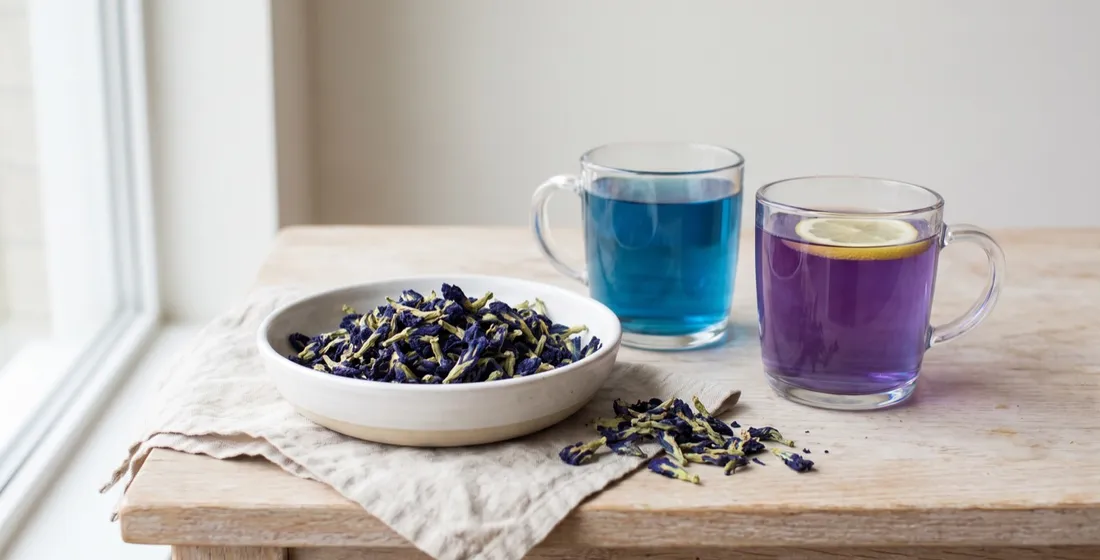
- “Blue” is a pH result, not a fixed property. The same flower gives blue, purple or magenta depending on the liquid it meets, so the buyer’s pH target belongs in the brief.
- Silk Foods Ceylon supplies blue pea in tea-bag cut, whole flower and powder from a BRCGS and FSSC 22000 V6 audited facility in Matale, with a 50 kg first-order MOQ per SKU.
- This guide is for beverage, tisane and colour-led food brands selling into the US, Australia and other non-EU markets. For EU-bound infusions, read the regulatory section first.
A brand developing a colour-change drink usually writes one line in the ingredient brief: “butterfly pea flower, blue.” Then the pilot goes wrong in a familiar way: the infusion fades in a warm warehouse, the tea-bag lot sheds petal dust that stains the filter paper, or a market assumed open treats the flower as an unauthorised food. All three are specification problems, cheaper to fix on paper than in a container. This guide sets out what to write into the brief for Clitoria ternatea flower in tea-bag cut, whole and powder form.
What is blue pea flower, and what do buyers actually order?
Blue pea is the dried flower of Clitoria ternatea, a climbing legume. The colour comes from polyacylated delphinidin anthocyanins known as ternatins, whose long acyl side chains protect the blue form of the molecule and make it more stable than most plant blues (Spectral Characteristic, Storage Stability and Antioxidant Properties of Anthocyanin Extracts from Flowers of Butterfly Pea, 2021).
Buyers order it in three forms, and each one solves a different problem.
| Format | Typical use | What to specify | Main risk |
|---|---|---|---|
| Whole dried flower | Cocktails, café serves, premium loose tisane | Flower count per 100 g, colour of the dry flower, stalk and calyx ceiling | Breakage in transit, visible foreign matter |
| Tea-bag cut | Single-serve sachets, pyramid bags, blends | Millimetre cut range, fines ceiling, moisture | Dust staining filter paper, uneven extraction |
| Fine powder | Lattes, rice, noodles, bakery, confectionery colouring | Particle size, dispersibility, colour value in a stated medium | Speckling in clear liquids, batch colour drift |
Silk Foods Ceylon (SFC) lists all three on its herb range, and the tea-bag cut is the format most beverage brands start with because it steeps to a clear blue liquor in a few minutes and meters cleanly on a bagging line.
Why does the colour change, and what should the brief say about pH?
The flower is a pH indicator that happens to taste mild. Across published work the pattern is consistent, though the exact pH boundaries differ by extract and method: red to magenta in strongly acidic conditions (about pH 1 to 3), purple as the liquid moves toward pH 4 to 5, blue around neutral, and green then yellow above about pH 10 as the anthocyanin degrades (PMC8622631; PMC10255602, 2023).
That gives a brand three working colours from one flower. A lemon-tea serve sitting at pH 3 will not be blue however good the flower is, and a flat blue drink needs a liquid near pH 6 to 7, which rules out most citrus-acid formulations. A “stays blue for 12 months” claim is a storage promise, and it depends on temperature and light.
On storage, the 2021 study found the pigment most stable at low temperature and neutral pH. At pH 7 it lost 4.7%, 32.8%, 51.7% and 63.6% of its absorbance over 27 days at 4, 25, 37 and 50 °C, and it showed weaker photostability (PMC8622631, retrieved 16 October 2026). A separate pH 6 to 8 study reported wide batch-to-batch variation in stability.
Spec snapshot: blue pea tea-bag cut Species and part: Clitoria ternatea, dried flower, stated on every COA Cut: millimetre range and fines ceiling agreed before the first order Colour: a stated target in a defined infusion (water volume, temperature, steep time, pH) Moisture: ceiling agreed in writing, tested by ISO 939 Storage: cool, dark, sealed; colour is checked again at the buyer’s receiving date SFC MOQ: 50 kg per SKU, volume tiers at 500, 1,000 and 2,500 kg
How should a tea-bag cut be specified for blue pea?
No published standard defines “tea-bag cut”. Herbs for bagged tea are commonly cut between about 0.25 mm and 2 mm, and the range is a contract term, not a grade (Frontiers in Pharmacology, 2022). Petals are thin and brittle: too fine and they shatter into dust, too coarse and they extract slowly.
For the RFQ, four lines carry most of the risk.
- Cut range and fines. Write the millimetre range, name the sieve method, and set a ceiling for the percentage passing the finest sieve. Dust is the main reason blue pea stains filter paper.
- Colour test. Define one test infusion, for example a stated mass of cut flower in a stated volume of water at a stated temperature for a stated time, and set the target colour or absorbance. “Deep blue” is not a spec.
- Non-flower material. Set a ceiling for stalk, calyx and extraneous matter by weight. The European Spice Association’s Quality Minima Document (Rev. 5, 2018) uses a 2% extraneous matter ceiling for herbs, which is a sensible starting point, though it sets no blue pea figures.
- Moisture and water activity. A moisture ceiling and a water activity target of 0.65 or below protect shelf life and colour.
Take a brand that pilots in a cool laboratory and ships in a hot container. Weeks later at 37 °C, the colour has lost around half its absorbance on the evidence above. Nothing about the flower changed; the spec never named a storage temperature or a re-test date. Writing both into the contract is free.
Which regulations apply to blue pea in the US and EU?
This is the section that decides where a product can be sold, so read it before the sample request.
United States. FDA lists butterfly pea flower extract at 21 CFR 73.69 as a colour additive exempt from certification. The listing describes a dark blue liquid made by aqueous extraction of dried flowers, ultrafiltered and pasteurised, with anthocyanins as the principal colouring component and a pH specification of 3.0 to 4.5. Lead, arsenic, mercury and cadmium are each limited to 1 mg/kg. Listed uses include teas, sport and energy drinks, flavoured and carbonated waters, juices, nutritional beverages and confectionery, and an FDA order of 12 May 2025 added cereals, crackers, snack mixes and some chips (Federal Register, 2025; 21 CFR 73.69, retrieved 16 October 2026).
Two points matter for a buyer. The listing is for an extract made to that identity, so a brand colouring a food must check that its colour supplier’s material meets § 73.69, and foods with a standard of identity are excluded unless the standard allows added colour. A whole-flower tisane is a different question, and a brand should confirm its labelling position with its own regulatory adviser.
European Union. The position is stricter. EFSA reviewed a 2020 traditional-food notification for dried Clitoria ternatea flowers and in 2022 raised safety objections, noting concerns about cyclotides and that traditional use for herbal infusions had not been established (EFSA Supporting Publications, 2022, EN-7084). The Commission then closed the authorisation procedure NF/2023/20953 by Implementing Decision C(2026) 776 final of 12 February 2026, without updating the Union list of novel foods (European Commission novel food decisions page, retrieved 16 October 2026).
The practical reading: do not assume dried blue pea flower is a freely marketable tisane ingredient in the EU. Check the EU Novel Food Catalogue on the day of any shipment decision and take advice on national rules. SFC does not recommend an EU-first launch on blue pea tea.
Buyer’s checklist: before ordering blue pea
- Destination market confirmed, with regulatory status checked in writing for that market
- Species (Clitoria ternatea) and plant part confirmed on the COA
- Cut range, fines ceiling and sieve method written into the contract
- A defined test infusion with a colour target and pH stated
- Moisture by ISO 939 and a water activity target of 0.65 or below
- Heavy metals panel (lead, cadmium, arsenic, mercury) per batch
- Pesticide and microbial panels for the destination market
- Storage and shelf-life colour check agreed between buyer and supplier
- A sample dispatched against the written spec before any PO
How does Ceylon blue pea compare with the common alternatives?
Buyers choosing a natural blue weigh the dried flower against a flower-derived extract from a colour house. For plant colour in general, the beetroot powder pH and heat guide is the useful comparison.
| Route | Best for | Strength | Limit |
|---|---|---|---|
| Dried flower, tea-bag cut | Infusions, colour-change serves, blends | Visible, simple label, low MOQ | Colour set by steep and pH, light sensitive |
| Dried flower, fine powder | Lattes, rice, bakery, confectionery | Disperses without extraction, no solvent step | Speckling in clear liquids, batch drift |
| Extract from a colour house | Clear drinks, large uniform volumes | Standardised colour value | Must meet the listing in the destination market, higher cost per kg of colour |
The herbal infusion and tea-bag cut guide covers the contaminant tests that apply to the other seven botanicals in a typical tisane range, and hibiscus cut grades is the usual companion when a blue-to-magenta serve is the goal. For bag styles, see the pyramid, round paper and string-and-tag formats post.
What does a Sri Lankan blue pea supply programme look like?
Silk Route Ventures (SRV) works as the trade desk and Silk Foods Ceylon as the manufacturer, so the buyer deals with one party for quotation, sampling and shipping. The SFC herb and spice line runs at 100 to 200 kg per hour, with a 50 kg first order per SKU and volume tiers from 500 kg.
Lead times follow the standard SFC stack: samples by international courier in 3 to 5 business days, production 2 to 3 weeks from PO to dispatch, and sea freight of 3 to 4 weeks to Australia and 4 to 5 weeks to the US. A custom blend that includes blue pea moves from a signed brief to an approved formulation in 3 to 4 weeks at most. For the money page on the wider herb range, see the Sri Lankan herbs supplier overview.
Where Silk Route Ventures walks away Briefs that want a guaranteed permanent blue in a clear acidic drink from dried flower alone, briefs aimed first at the EU infusion market, and buyers shopping blue pea purely on price per kilo with no colour test. For those, a standardised extract from a colour house, or a different product, is the more honest answer.
Frequently asked questions
What is the difference between blue pea flower and butterfly pea flower?
They are the same plant, Clitoria ternatea. “Blue pea” is the usual trade name. Write the Latin binomial and plant part (dried flower) into the contract, because common names vary by market.
Why does blue pea tea turn purple with lemon?
The anthocyanins in the flower change structure with pH. The infusion is blue near neutral pH and shifts toward purple, then magenta, as acid is added, with the red form dominating at about pH 1 to 3 (PMC8622631, 2021). Brands using the effect should state the target pH of the finished drink in the brief.
Is dried butterfly pea flower allowed in the EU?
Not as an established food ingredient. The Commission closed the novel food procedure NF/2023/20953 on 12 February 2026 without adding dried Clitoria ternatea flowers to the Union list, after EFSA raised safety objections in 2022 (European Commission; EFSA EN-7084). Buyers should check the EU Novel Food Catalogue and national rules before committing to an EU launch.
Does Silk Route Ventures offer private-label blue pea tea bags?
Yes. SRV runs private-label herbal tea programmes from the Silk Foods Ceylon facility in Matale, including single-herb blue pea sachets and blends, in pyramid, round paper and string-and-tag formats. The MOQ is 50 kg of material per SKU, and a custom blend takes 3 to 4 weeks at most from signed brief to approved formulation.
How Silk Route Ventures can help
Silk Route Ventures (SRV) supplies blue pea flower in tea-bag cut, whole and powder form to beverage, tisane and food brands in the US, Australia and other non-EU markets, with a 50 kg first-order MOQ per SKU and a per-batch certificate of analysis. The BRCGS and FSSC 22000 V6 audited Silk Foods Ceylon facility in Matale mills each lot to the buyer’s written cut, colour test and moisture spec. Send an inquiry through the contact form with the target market, format and test infusion, and the Trade Team will quote against your spec.
Sources
- U.S. Code of Federal Regulations, 21 CFR 73.69, Butterfly pea flower extract. Retrieved 16 October 2026. law.cornell.edu/cfr/text/21/73.69
- U.S. Food and Drug Administration, Listing of Color Additives Exempt From Certification; Butterfly Pea Flower Extract, Federal Register, 12 May 2025. federalregister.gov/documents/2025/05/12/2025-08248
- European Commission, Novel food: decisions terminating the procedure, entry for dried flowers of Clitoria ternatea L. (NF/2023/20953), C(2026) 776 final, 12 February 2026. Retrieved 16 October 2026. food.ec.europa.eu/food-safety/novel-food/decisions-terminating-procedure_en
- EFSA, Notification of dried flowers of Clitoria ternatea L. as a traditional food from a third country pursuant to Article 14 of Regulation (EU) 2015/2283, EFSA Supporting Publications, 2022, EN-7084. doi.org/10.2903/sp.efsa.2022.EN-7084
- Spectral Characteristic, Storage Stability and Antioxidant Properties of Anthocyanin Extracts from Flowers of Butterfly Pea (Clitoria ternatea L.), 2021. PMC8622631. Retrieved 16 October 2026.
- A Systematic Review of Butterfly Pea Flower (Clitoria ternatea L.): Extraction and Application as a Food Freshness pH-Indicator, 2023. PMC10255602. Retrieved 16 October 2026.
- European Spice Association, Quality Minima Document, Rev. 5, 2018.
- Frontiers in Pharmacology, 2022, on herbal tea cut size ranges.
Written by the Silk Route Ventures Trade Team.