
Young Jackfruit in Brine: Capability One-Pager for Plant-Based SKUs
Buyer’s snapshot
- Plant-based meat sold about EUR 1.24 billion across Europe’s six largest retail markets in 2025, inside a EUR 4.75 billion plant-based category that grew 3.4% (GFI Europe, Circana data, 2026). Price, not novelty, drove the volume.
- Any EU label for jackfruit in brine must declare drained net weight as well as net weight (Regulation (EU) No 1169/2011, Annex IX), so drained weight is a legal number, not just a QA number.
- Silk Foods Ceylon (SFC) runs young jackfruit in brine on a retort glass-jar line at up to 3,000 jars a day, 1,500 jars per SKU for a first order, under BRCGS and FSSC 22000 V6.
- The capability matrix below is the page to forward to procurement.
Most jackfruit supplier pages list what a factory can do. Fewer say what it runs every week, what it can scope for a brief, and what it does not do. For a plant-based brand writing a co-manufacturing shortlist, those are three different answers, and mixing them up is how a sample round stalls in week three. This one-pager sets out the Silk Route Ventures (SRV) and SFC position on young jackfruit in brine in that order: cut formats, drained-weight control, pack formats, daily capacity, and the certified scope behind all of it.
The capability matrix: what runs, what is scoped, what is not offered
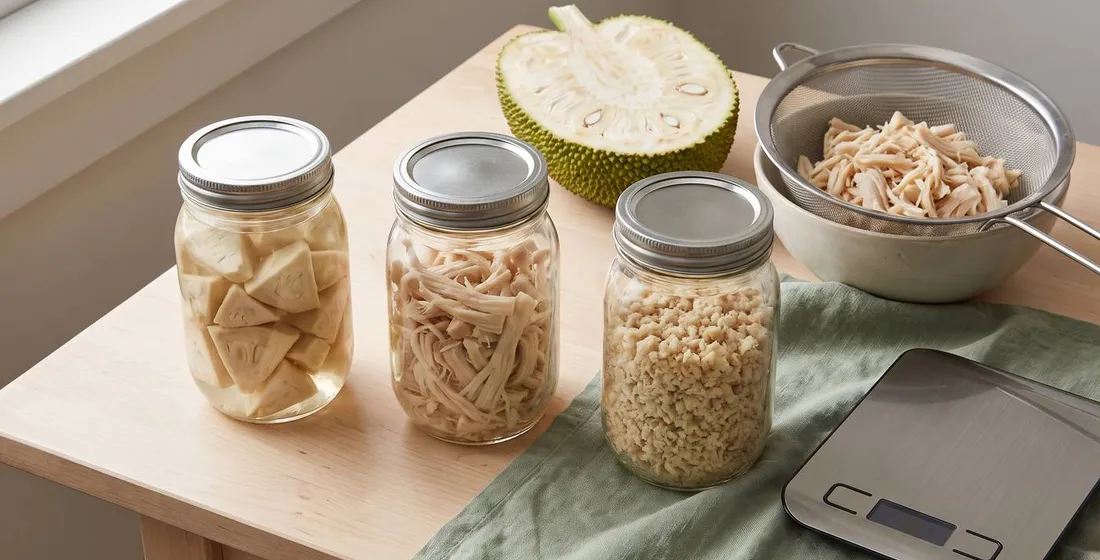
SFC runs young jackfruit in brine in chunk, pulled, and minced cuts, packed in retort-processed glass jars or bulk buckets, on a line with up to 3,000 jars of daily capacity. Retort pouches and metal cans sit inside the certified packaging scope but are not a standing jackfruit format, so both are scoped per brief.
| Capability | Status | What the buyer gets |
|---|---|---|
| Chunk, pulled, minced cuts | Running | Cut matched to end product, one cut per SKU |
| Retort glass jar, 220 ml to 1 L | Running | Ambient shelf-stable retail SKU |
| Bulk bucket | Running | Foodservice or re-packer volume |
| Seasoned retort SKUs (curry, BBQ, teriyaki, tomato basil) | Running | Ready-to-heat range on the same line |
| Drained-weight target and tolerance | Agreed at spec, checked per batch | Stated on the spec sheet and the batch COA |
| Retort pouch | Scoped per brief | Line slot, MOQ, and scheduled process confirmed at brief stage |
| Metal can | Scoped per brief | Same as pouch |
| Frozen jackfruit | Not offered as a jackfruit format | Frozen capacity serves the patty and nugget lines |
Source: Silk Foods Ceylon facility data, 2026.
The “scoped per brief” rows are deliberate. Publishing a pouch MOQ that the line has not yet run for jackfruit would be a number the buyer cannot hold SFC to. The honest version is shorter: glass and bucket are the running formats, and anything else gets a written answer on line time, MOQ, and process before a price is quoted.
Which cut format fits which plant-based SKU?
The cut decides the texture, the jar size, and the drained-weight ratio, so it is the first line of any jackfruit spec. Chunks hold shape through a retort cycle for curries and skewers. Pulled strands carry sauces for tacos and sandwiches. Minced gives a loose crumb for fillings, bakes, and meatball formats.
A brand launching one hero SKU usually starts with pulled, because it photographs as meat and asks the least of the home cook. A brand building a range tends to pair pulled with minced, since the two cuts cover most of the savory recipe space between them. Cut-to-product detail is covered in the retort glass-jar formats guide for plant-meat SKUs, and seasoned variants in the tender jackfruit retort SKU capability brief. This page does not repeat them.
How does SFC hold drained weight consistent from batch to batch?
Drained weight is the mass of jackfruit left after the brine is poured off, and in the EU it must appear on the label next to net weight whenever a solid food is packed in brine (Regulation (EU) No 1169/2011, Annex IX). SFC agrees the target and tolerance with the buyer at spec stage and reports it per batch.
Three things move drained weight, and all three are controlled on the line rather than corrected after the fact. Cut size sets how tightly the fruit packs. Fill practice sets the fruit-to-brine ratio going into the jar. Retort schedule sets how much water the fibers take up or give back during heating. Change one without the others and the drained figure drifts, even when the net weight stays on target.
The check itself is not exotic. The US FDA method for vegetables packed in liquid pours the contents onto a weighed sieve, drains for two minutes, then reweighs (US FDA, Macroanalytical Procedures Manual, MPM V-11). European legal metrology authorities publish a harmonized drained-weight guide for the same purpose (WELMEC Guide 6.8, 2020). Naming the method in the spec means SFC’s COA and the buyer’s incoming QA are measuring the same thing.
Spec snapshot: young jackfruit in brine, Silk Foods Ceylon
- Raw material: young (unripe) jackfruit, Sri Lankan origin
- Cuts: chunk, pulled, minced (one cut per SKU)
- Packing medium: brine, salt level set per SKU
- Process: retort to commercial sterility for ambient shelf life
- Drained weight: target and tolerance agreed at spec, reported on every batch COA
- First-order MOQ: 1,500 jars per SKU; bulk buckets by quote
Glass jar, retort pouch, or can: choosing the pack
The pack format changes the thermal process, the freight weight, and the shelf presence, so it belongs in the first brief, not the final one. Flexible pouches heat faster than rigid containers because the product layer is thinner, which usually means a shorter process and less time for the fibers to soften (Jimenez et al., Food Science and Nutrition, 2023).
| Factor | Glass jar | Retort pouch | Metal can |
|---|---|---|---|
| Heat penetration | Slowest, needs controlled cool-down | Fastest, thin product layer | Moderate |
| Texture risk for pulled strands | Higher on long schedules | Lowest | Moderate |
| Shelf presence | Product visible, premium read | Flat, printed front | Familiar canned-goods read |
| Freight weight | Heaviest per unit | Lightest per unit | Middle |
| Overpressure in retort | Needed for lids | Needed for seal integrity | Not usually needed |
| SFC status for jackfruit | Running | Scoped per brief | Scoped per brief |
Sources: Jimenez et al., 2023; Silk Foods Ceylon facility data, 2026.
Glass wins where the shopper needs to see the strands before buying, which is most first-time jackfruit buyers. The pouch wins on freight and texture but asks the brand to carry the shelf story on print alone. Cans win on retailer familiarity in canned-goods aisles. That trade-off is the brand’s call. SFC’s job is to say plainly which format is ready now.
A recurring pattern on the SRV trade desk: a brand opens with a pouch request because of freight cost, then moves to glass after its own shelf test shows shoppers passing over a flat pack with no visible product. The reverse also happens, usually with foodservice brands, where nobody sees the pack at all and the bucket beats both.
What daily capacity does the line give a scale-up brand?
The retort glass-jar line runs up to 3,000 jars a day, so a 1,500-jar first order is about half a day of line time. The line is shared with retorted spreads and sauces, which means weekly jackfruit allocation is booked at PO rather than promised as a standing slot.
| Run size | Line time at full rate | Typical buyer |
|---|---|---|
| 1,500 jars | About half a day | Single-SKU pilot |
| 3,000 jars | About one day | Two-cut launch or first reorder |
| 6,000 jars | About two days | Four-SKU range |
| Larger volumes | Booked across weeks | Distributor or national listing |
Source: Silk Foods Ceylon capacity data, 2026.
The same 10,000 sq ft cellular site in Matale runs the plant-based patty line at 15,000 units a day and the vegan nugget line at 30,000 units a day. For a brand planning jackfruit alongside a formed product, that is one audit and one documentation pack instead of two. PO to dispatch runs 2 to 3 weeks, with sea freight of 4 to 5 weeks to the US and 3 to 4 weeks to the EU.
What does the BRCGS and FSSC 22000 V6 scope cover for jackfruit?
The Matale facility is certified to BRCGS and FSSC 22000 V6, and the FSSC scope names young jackfruit in brine and in spicy gravy directly. Glass jars, retort pouches, and metal cans all appear in the certified packaging scope, so a pouch or can project extends an audited system rather than starting a new one.
Certification snapshot: Silk Foods Ceylon, Matale
- BRCGS: covers the retorted and plant-based product lines
- FSSC 22000 V6: scope names young jackfruit in brine and spicy gravy
- Packaging in scope: glass jars, retort pouches, metal cans
- US FDA-registered facility; Sri Lanka EDB-registered
The certificate is one gate. For a US launch, a shelf-stable low-acid food also needs the processor registered with the FDA and a scheduled process filed for each product, container type, and size (21 CFR 108.35). That filing is why a pouch or can jackfruit SKU cannot simply borrow the glass-jar process. Each container is its own filing. What BRCGS signals to a retail listing buyer and the FSSC 22000 V6 scope explainer cover the certificate side in more depth.
Where SRV walks away
Frozen-only jackfruit programs, and briefs that need a pouch price before the format has been trialled. For a frozen foodservice line, a processor with a dedicated jackfruit freezing tunnel is the better fit. For pouch or can, SRV will scope the work, but will not quote a number the line has not yet earned.
Frequently asked questions
Does jackfruit in brine need a drained weight on the label?
In the EU, yes. Regulation (EU) No 1169/2011, Annex IX requires the drained net weight to be declared alongside net weight whenever a solid food is packed in a liquid medium such as brine. Silk Foods Ceylon agrees the drained-weight target and tolerance at spec stage and reports it on every batch COA.
Can young jackfruit in brine be packed in retort pouches?
Yes, technically, and pouches heat faster than rigid containers, which helps hold texture (Jimenez et al., 2023). For a US launch, each container type needs its own scheduled process filed with the FDA under 21 CFR 108.35. At SFC, pouches sit in the certified packaging scope and are scoped per brief.
What is the daily capacity for jackfruit in brine at Silk Foods Ceylon?
The retort glass-jar line at the Matale facility runs up to 3,000 jars a day under BRCGS and FSSC 22000 V6. A 1,500-jar first order per SKU takes about half a day of line time. Because the line is shared with retorted spreads, weekly jackfruit allocation is booked at PO.
Can Silk Route Ventures co-manufacture a private-label jackfruit SKU for a US or EU plant-based brand?
Yes. Silk Route Ventures contract-manufactures chunk, pulled, and minced young jackfruit in brine in retort glass jars and bulk buckets at the BRCGS and FSSC 22000 V6 audited Silk Foods Ceylon facility. First orders start at 1,500 jars per SKU, with PO to dispatch in 2 to 3 weeks.
How Silk Route Ventures can help
Silk Route Ventures contract-manufactures young jackfruit in brine for plant-based brands in the US, EU, UK, and Australia, at the Silk Foods Ceylon facility in Matale. Chunk, pulled, and minced cuts run in retort glass jars from 220 ml to 1 L and in bulk buckets, on a line producing up to 3,000 jars a day, under BRCGS and FSSC 22000 V6. First orders start at 1,500 jars per SKU. Drained weight is set at spec and reported on every batch COA. Retort pouch and metal can projects are scoped per brief, with line time, MOQ, and process confirmed in writing before pricing. Request a sample or send a brief, or email info@esilkroute.com.lk.
Further reading
- Jackfruit in brine and patty fat: an RFQ primer for CPG buyers
- Five questions before you sign a plant-based co-manufacturing deal
- Plant-based and functional food contract manufacturing in Sri Lanka
- Traceability depth and COA cadence: a compliance primer for buyers
Sources
- GFI Europe, “European plant-based sales data” (Circana retail data, 2025). https://gfieurope.org/european-plant-based-sales-data/ (retrieved 28 September 2026)
- European Union, Regulation (EU) No 1169/2011 on the provision of food information to consumers, Annex IX. https://eur-lex.europa.eu/LexUriServ/LexUriServ.do?uri=OJ:L:2011:304:0018:0063:en:PDF (retrieved 28 September 2026)
- WELMEC, Guide 6.8, “Drained weight”, 2020. https://www.welmec.org/welmec/documents/guides/6.8/2020/WELMEC_Guide_6.8_v2020.pdf (retrieved 28 September 2026)
- US Food and Drug Administration, Macroanalytical Procedures Manual, MPM V-11 Vegetables and Vegetable Products. https://www.fda.gov/food/laboratory-methods-food/mpm-v-11-vegetables-and-vegetable-products (retrieved 28 September 2026)
- US Code of Federal Regulations, 21 CFR 108.35, Thermal processing of low-acid foods packaged in hermetically sealed containers. https://www.ecfr.gov/current/title-21/chapter-I/subchapter-B/part-108/subpart-B/section-108.35 (retrieved 28 September 2026)
- Jimenez, P. S., Bangar, S. P., Suffern, M., and Whiteside, W. S., “Understanding retort processing: A review”, Food Science and Nutrition, 2023. https://pmc.ncbi.nlm.nih.gov/articles/PMC10916645/ (retrieved 28 September 2026)
Written by the Silk Route Ventures Trade Team. Silk Route Ventures (E-Silk Route Ventures Ltd) is a Sri Lankan B2B supply-chain operator for the Food, Beverage, Wellness and Nutraceuticals sectors. The Silk Foods Ceylon manufacturing arm holds BRCGS and FSSC 22000 V6 certifications. Questions or to request a sample: Contact us or email info@esilkroute.com.lk.