
Tender Jackfruit Curry, Smokey BBQ, Teriyaki, and Tomato-Basil Retort SKUs: Capability and MOQ
Buyer's snapshot • Ready-to-eat tender jackfruit SKUs are shelf-stable retort meals. The four house flavours (curry, smokey BBQ, teriyaki, and tomato and basil) ship ambient, with no cold chain, on a validated low-acid retort process. • Young jackfruit is a texture play, not a protein source. It carries about 1.5 to 1.7 g of protein per 100 g (USDA FoodData Central); the flavour system, not the fruit, carries the shelf appeal. • Global retail sales of plant-based meat and seafood reached about USD 6.6 billion in 2025 (Good Food Institute, 2025), and the growth is shifting toward minimally processed, whole-food formats, exactly where jackfruit sits. • Silk Foods Ceylon (SFC) runs these on a glass-jar line at up to 3,000 jars a day, shared with vegan patties at 15,000 a day and nuggets at 30,000 a day. First-order unit minimums are set per flavour and confirmed on your quote. • For a distributor or CPG scale-up launching a flavour ladder under one label, this is the capability and the MOQ math. It is not built for single-jar hobby runs. |
Most contract manufacturers in South Asia will quote plain young jackfruit in brine by the tonne. A smaller number will retort a finished, flavoured ready-meal SKU. Fewer still will run both on one line, under one certification, and hand a buyer a four-flavour range without a separate audit for each recipe. That gap is the subject of this piece: what it takes to manufacture tender jackfruit curry, smokey BBQ, teriyaki, and tomato and basil as shelf-stable retort SKUs, and the MOQ math a brand faces when it launches the range rather than a single jar.
What are tender jackfruit retort SKUs, and how do the four flavours map to markets?
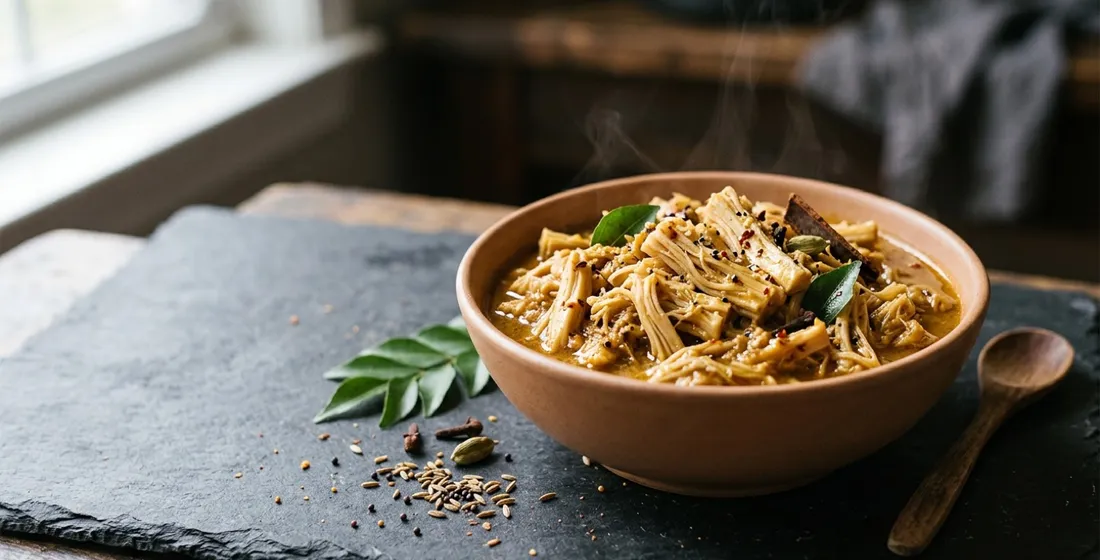
Tender jackfruit retort SKUs are ready-to-eat meal components. Young, unripe jackfruit is cooked in a flavour system, filled into glass jars or retort pouches, then thermally processed to commercial sterility for ambient shelf life. Silk Foods Ceylon runs four house flavours, curry, smokey BBQ, teriyaki, and tomato and basil, each finished at origin in Matale.
These are a different product from the plain in-brine formats. Young jackfruit in brine is a blank base: a brand drains it, rinses it, and builds its own recipe downstream. The retort flavour SKUs arrive already seasoned and cooked, so the buyer sells a finished shelf item rather than an ingredient. The full spec on the plain base, including the low-acid canned food rules that govern how it is canned, sits alongside this range on the same retort line.
The timing favours a whole-food format. Global retail sales of plant-based meat and seafood reached about USD 6.6 billion in 2025 (Good Food Institute, 2025), but the growth is splitting. In the US, first-generation ultra-processed analogues saw dollar sales fall 7% in 2024, while minimally processed whole-food proteins such as tofu, tempeh, and seitan grew about 7% (Good Food Institute, 2024). Jackfruit sits on the growing side of that split: one recognisable ingredient, a short label, the opposite of a lab-built analogue.
The four flavours are not arbitrary. Each one is a recognisable meat-analogue cue aimed at a specific shelf. Curry reads as a pulled mutton or chicken curry for UK and South Asian diaspora grocery. Smokey BBQ stands in for pulled pork in a US or UK sandwich. Teriyaki carries a pan-Asian stir-fry or bowl. Tomato and basil gives European clean-label buyers a ragu-style filling with a short, readable label.
| Flavour SKU | Meat-analogue role | Primary market / channel | Flavour base |
|---|---|---|---|
| Tender jackfruit curry | Pulled chicken or mutton curry | UK, EU, South Asian diaspora retail; HORECA | Ceylon spice, coconut |
| Smokey BBQ | Pulled-”pork” sandwich filling | US and UK grocery, foodservice | Tomato, smoke, molasses notes |
| Teriyaki | Shredded stir-fry or bowl protein | Pan-Asian, Australia, US bowl concepts | Soy, ginger, glaze |
| Tomato and basil | Ragu-style Mediterranean filling | European clean-label, ambient alternative | Tomato, herb |
Source: Silk Foods Ceylon product catalogue, 2026.
The retort process behind a shelf-stable flavoured jackfruit SKU
A flavoured jackfruit meal is shelf-stable because of the thermal process, not the recipe. After the jar or pouch is sealed, it goes into a retort, a pressurised steam vessel that holds the product at temperature long enough to reach commercial sterility. Get the process right and the SKU sits on an ambient shelf for 18 to 24 months with no refrigeration. Get it wrong and it is a food-safety recall waiting to happen.
Jackfruit in a savoury sauce has a finished equilibrium pH above 4.6 and a water activity above 0.85, which makes it a low-acid canned food under US FDA 21 CFR 113, not an acidified food under 21 CFR 114 (US FDA, current). The safety of a low-acid canned food rests on a validated heat process, not on acidity. The accepted floor is a botulinum cook of at least F0 3 minutes, a 12-log reduction of Clostridium botulinum spores, with the actual scheduled process set higher by a competent process authority to control spoilage organisms.
The compliance layer is where a lot of first-time programs stall. A foreign processor shipping low-acid canned food into the US must register the facility, obtain a Food Canning Establishment number, and file each scheduled process with the FDA before the product can clear customs. Unregistered LACF is refused at the port. A buyer evaluating a jackfruit supplier should treat retort validation and LACF filing as gating questions, not afterthoughts. The retort glass-jar format detail for plant-meat SKUs covers the pack side of that decision.
Spec snapshot: tender jackfruit retort SKUs • Product: young (unripe) jackfruit, cooked in a flavour system, ready to eat • Classification: low-acid canned food, finished pH above 4.6, water activity above 0.85 (US FDA 21 CFR 113) • Process: validated retort thermal process, F0 at or above the 3-minute botulinum-cook floor • Pack: glass jar (220 ml to 500 ml) or retort pouch • Shelf life: typically 18 to 24 months ambient, no cold chain • Cert coverage: BRCGS and FSSC 22000 V6 across the retort lines |
Line capacity: what the Matale facility can run
The tender jackfruit range runs on the same glass-jar and semi-liquid line as the wider retorted spreads and sauces. That line produces up to 3,000 jars a day. It shares a cellular manufacturing footprint with the plant-based patty line at 15,000 units a day and the vegan nugget line at 30,000 units a day, so a buyer evaluating jackfruit is really evaluating a multi-format plant-based site, not a single-product workshop.
| Line | Daily capacity |
|---|---|
| Vegan nuggets | 30,000 units |
| Vegan patties | 15,000 units |
| Glass-jar retort (jackfruit, spreads, sauces) | 3,000 jars |
| Functional beverages | 2,500 bottles |
| Spray-dried powders | 50 kg |
Source: Silk Foods Ceylon facility data, 2026.
The cellular layout is the point for a scale-up. A new jackfruit flavour drops onto a line that is already audited, so it does not trigger a separate certification cycle. The Matale facility holds BRCGS and FSSC 22000 V6 across the relevant lines. For US and EU CPG buyers, that pairing clears a GFSI-recognised food-safety bar and the BRCGS standard most UK and EU grocers gate supplier listings on, without commissioning a fresh audit for each recipe added. The same retort capability sits behind the vegan cheese spread retort program.
What is the MOQ for a four-flavour tender jackfruit launch?
First-order unit minimums for a glass-jar tender jackfruit SKU are confirmed on your quote. The number that matters for a range launch is that the MOQ is per flavour, not per order. A two-flavour launch carries two per-flavour minimums, and the full four-flavour range carries four. Glass tooling adds about one week of lead time on a first run.
| Launch scenario | First-order commitment | Notes |
|---|---|---|
| Single-flavour pilot | One per-flavour minimum | One recipe |
| Two-flavour launch | Two per-flavour minimums | For example curry plus smokey BBQ |
| Full four-flavour range | Four per-flavour minimums | Unit minimums confirmed on your quote |
| Volume reorder tier | By quote | Better unit economics at scale |
Source: Silk Foods Ceylon MOQ ladder, 2026.
In practice, the SRV procurement desk rarely fields a single-flavour jackfruit inquiry any more. The pattern over the past year has been the flavour ladder: a distributor wants two or three variants at launch so the shelf reads as a range, not a one-off. The retort line lets them do that without a separate audit or a separate supplier per recipe. Because the MOQ is per flavour, the range decision is really a working-capital decision, and framing it that way upfront saves a round of surprise later.
Formulating a custom flavour: the R&D and NPD route
The four house flavours are a starting menu, not the ceiling. A brand that wants a signature profile, a regional masala, a Korean gochujang glaze, a Caribbean jerk, briefs the flavour and the SRV R&D and NPD team scopes it against the retort process. Formulation adds roughly 2 to 4 weeks upfront before the production clock starts, because a new sauce has to be validated to hold through the heat process and the target shelf life without splitting or browning.
The discipline that protects the buyer is that the recipe stays the buyer’s. Custom formulation work is scoped as the brand’s IP, and the sample run happens against the agreed spec before any volume PO. The wider R&D and NPD workflow at Silk Foods Ceylon runs the formulation in parallel with the production plan, so a custom flavour does not sit in a separate queue from the line booking.
How do lead times, freight, and payment work for a retort jackfruit program?
Lead times are practical to plan against. Samples are free for evaluation (you cover the courier) and ship door-to-door by international courier (DHL, FedEx, UPS). A production run is 2 to 3 weeks from PO to dispatch for standard SKUs (4 to 6 weeks for private label, custom specifications and organic orders), with an extra 2 to 4 weeks upfront when a new flavour needs formulation. Sea freight runs 3 to 4 weeks to the EU and Australia and 4 to 5 weeks to the US.
Orders ship with the standard documentation pack: commercial invoice, packing list, bill of lading or air waybill, a certificate of origin, and a phytosanitary certificate where the destination requires it, with a Certificate of Analysis available on request. Payment terms are consistent across the customer book. Orders under USD 10,000 are 100% advance by bank transfer. Orders of USD 10,000 or above run 50% advance with the balance against scanned shipping documents. The broader plant-based and functional food contract manufacturing program frames where the jackfruit range sits in the full line-up.
Frequently asked questions
What is the MOQ for tender jackfruit curry and the other retort flavours?
First-order unit minimums for glass-jar tender jackfruit SKUs are set per flavour and confirmed on your quote, with glass tooling adding about one week of lead time. A full four-flavour launch (curry, smokey BBQ, teriyaki, tomato and basil) carries four per-flavour minimums. Production runs 2 to 3 weeks from PO to dispatch for standard SKUs (4 to 6 weeks for private label, custom specifications and organic orders).
Can Silk Route Ventures develop a custom jackfruit flavour under contract?
Yes. Beyond the four house flavours, the Silk Foods Ceylon R&D and NPD team develops custom retort recipes to a brand’s brief, validated against the heat process and target shelf life. Formulation adds 2 to 4 weeks upfront, and a sample run ships against the agreed spec before any volume PO. The recipe stays the brand’s IP.
Are the tender jackfruit retort SKUs shelf-stable without refrigeration?
Yes. The SKUs are low-acid canned foods (finished pH above 4.6) processed on a validated retort schedule to commercial sterility, so they hold on an ambient shelf for typically 18 to 24 months with no cold chain (US FDA 21 CFR 113). That ambient stability is the main logistics advantage over chilled meat alternatives.
Does SRV manufacture these under BRCGS and FSSC 22000 V6 for US and EU retail?
Yes. The Matale facility holds BRCGS and FSSC 22000 V6 across the retort lines, covering a GFSI-recognised food-safety bar and the BRCGS standard most UK and EU grocers require for listing. Sea freight runs 3 to 4 weeks to the EU and 4 to 5 weeks to the US, with the full export documentation pack on every order.
How Silk Route Ventures can help
Silk Route Ventures (SRV) contract-manufactures ready-to-eat tender jackfruit retort SKUs, curry, smokey BBQ, teriyaki, and tomato and basil, under one roof at the Silk Foods Ceylon (SFC) facility in Matale, alongside vegan patties at 15,000 units a day, vegan nuggets at 30,000 units a day, and retorted spreads and beverages. The site holds BRCGS and FSSC 22000 V6 across the relevant lines, and the cellular manufacturing layout means a new flavour does not trigger a separate audit cycle. The SRV R&D and NPD team scopes any custom recipe in parallel with the production plan. First-order unit minimums per flavour are confirmed on your quote. Contact us to send an inquiry for a co-manufacturing capability briefing tailored to your jackfruit range and target launch volume. Bulk buyers can review specs on our spices from Sri Lanka.
Sources
1. Good Food Institute, “Plant-based meat, eggs, and dairy: State of the Industry,” (2025). Retrieved 2026-07-03. https://gfi.org/resource/plant-based-meat-eggs-and-dairy-state-of-the-industry/
2. Good Food Institute, “Analyzing plant-based meat and seafood sales (US retail, 2024),” (2024). Retrieved 2026-07-03. https://gfi.org/resource/analyzing-plant-based-meat-and-seafood-sales/
3. US Food and Drug Administration, “21 CFR Part 113: Thermally Processed Low-Acid Foods Packaged in Hermetically Sealed Containers,” (current). Retrieved 2026-07-03. https://www.ecfr.gov/current/title-21/chapter-I/subchapter-B/part-113
4. US Food and Drug Administration, “21 CFR Part 114: Acidified Foods,” (current). Retrieved 2026-07-03. https://www.ecfr.gov/current/title-21/chapter-I/subchapter-B/part-114
5. US Food and Drug Administration, “Establishment Registration and Process Filing for Acidified and Low-Acid Canned Foods (LACF),” (current). Retrieved 2026-07-03. https://www.fda.gov/food/registration-food-facilities-and-other-submissions/establishment-registration-process-filing-acidified-and-low-acid-canned-foods-lacf
6. US Department of Agriculture, FoodData Central, “Jackfruit, raw,” (current). Retrieved 2026-07-03. https://fdc.nal.usda.gov/
Further reading
Agriculture Dive, “How jackfruit became a plant-based meat contender” -> https://www.agriculturedive.com/news/jackfruit-plant-based-meat-vegan-food-trends/735778/
EconomyNext, “Sri Lanka sees export potential for jackfruit amid planting drive” (2023) -> https://economynext.com/sri-lanka-sees-export-potential-for-jackfruit-amid-planting-drive-117627/
TERRA Food-Tech, “The importance of the F0 value in sterilization” -> https://www.terrafoodtech.com/en/importance-of-f0-value-in-sterilization/
Written by the Silk Route Ventures Trade Team. Silk Route Ventures (E-Silk Route Ventures (Pvt) Ltd) is a Sri Lankan B2B supply-chain operator for the Food, Beverage, Wellness, and Nutraceuticals sectors. The Silk Foods Ceylon manufacturing arm holds BRCGS and FSSC 22000 V6 certifications. Questions or to request a sample: contact us at https://www.esilkroute.com.lk/contact or email info@esilkroute.com.lk.