
Vegan Nugget Contract Manufacturing: 30,000 Units a Day, Dual-Cert Co-Pack
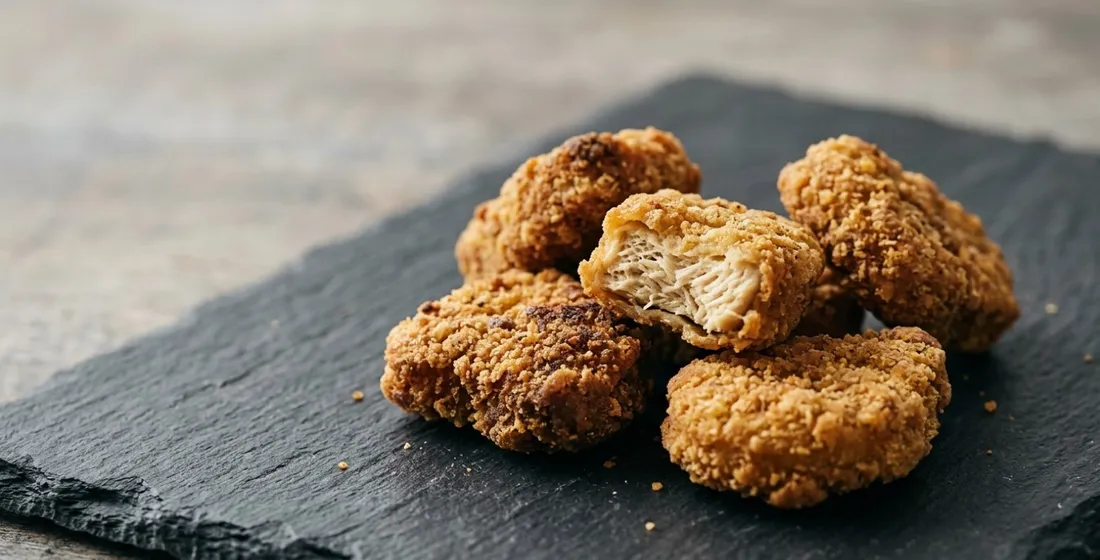
Buyer’s snapshot
- In 2024, plant-based chicken tenders and nuggets were a rare growth pocket inside a declining US foodservice category that fell 5% to $289 million in broadline distributor sales (The Good Food Institute, 2024). Nuggets are where the demand still moves.
- For a CPG scale-up, the format is harder to make well than it looks: a nugget has to survive freezing, a deep fryer or oven, and a coating that stays attached. Co-packer capability, not unit price, is the gating question.
- Silk Foods Ceylon co-manufactures vegan nuggets at 30,000 units per day from a Matale facility audited under BRCGS and FSSC 22000 V6, on the same cellular line that runs vegan patties.
- First-run contract manufacturing MOQ is typically 5,000 to 10,000 units per SKU, with a sample run available before a volume commitment. See the capacity and MOQ tables below.
- This guide is for brands and distributors scaling a plant-based nugget into national retail or foodservice. For a domestic chilled-only line with no export plan, a local co-packer is the more honest answer.
Most contract manufacturers in South Asia quote spice and herb tonnage. A smaller number quote frozen plant-based formats. A handful quote a vegan nugget, at scale, on the same food-safety audit that covers their spreads and capsules. The plant-based nugget is a deceptively technical SKU, and the gap between “we can make it” and “we can make it ship, fry, and hold coating” is where most co-manufacturing conversations actually live. This is the capability picture for a CPG scale-up evaluating Sri Lanka for a vegan nugget co-pack.
Why the nugget format is still worth manufacturing in a down market
In 2025, US retail sales of plant-based meat and seafood fell 10% to roughly $1 billion, with unit sales down 11% (The Good Food Institute, 2025). Read alone, that number talks a brand out of the category. Read with the format detail, it does the opposite. Within the decline, chicken formats held up better than the average, and tenders and nuggets were named as bright spots in foodservice while patties softened. The category is not collapsing uniformly. It is concentrating into the formats consumers still reach for, and the breaded chicken-analogue nugget is near the front of that list.
The forward read supports the same conclusion. The global plant-based nuggets market was valued at about $502 million in 2025 and is projected to reach $833.4 million by 2035, a 5.2% compound annual growth rate (Future Market Insights, 2025). That is not a hockey stick. It is a steady, defensible category for a brand that can make a good nugget and land it in the right channel. The buyers winning here are picking the durable format and a co-manufacturer who can produce it to a retail-ready spec, rather than chasing the whole plant-based shelf at once.
SRV finding: in Q1 2026, the Silk Route Ventures (SRV) trade desk fielded three separate inquiries from US and EU brands that had paused a plant-based burger line but wanted to keep a nugget or tender SKU alive. The pattern is consistent. When a brand trims its plant-based range, the nugget is more often the SKU that survives the cut than the one that gets dropped.
What makes a vegan nugget hard to co-manufacture
A nugget is an assembly, not a single mass. The core has to bind without egg, hold moisture through a freeze-thaw cycle, and keep a fibrous, chicken-like bite after a second cook at the foodservice or home end. The coating is a separate problem: a batter and crumb layer that adheres through freezing, bagging, transport abuse, and frying, without sloughing off in the bag. Get the protein-to-fat-to-binder ratio wrong and the nugget either crumbles or turns rubbery. Get the coating pickup wrong and the brand fields texture complaints from the first retail run.
This is why format capability matters more than the per-unit quote. A co-manufacturer that runs vegan nuggets, vegan patties, and other frozen plant-based formats on the same line has already solved the binding, the forming, the coating adhesion, and the freeze logistics. Silk Foods Ceylon (SFC) runs its nugget line on the same cellular footprint as the 15,000 units per day plant-based patty line, which means the forming, coating, and blast-freezing capability is shared infrastructure rather than a one-off build. The SRV research and development team scopes the formulation in parallel with the production plan, so a brand bringing a target texture and a clean-label constraint gets a development path rather than only a price.
Spec snapshot: vegan nugget co-pack at Silk Foods Ceylon
- Format: breaded plant-based nugget, core plus batter and crumb coating
- Line capacity: 30,000 units per day (shares cellular footprint with the 15,000 units/day patty line)
- First-run MOQ: 5,000 to 10,000 units per SKU
- Certification scope: BRCGS and FSSC 22000 V6, covering plant-based meat alternatives; USDA Organic and EU Organic on qualifying SKUs
- Cold chain: blast-frozen, shipped in reefer containers
- Lead time: 2 to 3 weeks PO to dispatch after formulation lock
What is the production capacity for plant-based nuggets at a Sri Lankan contract manufacturer?
Silk Foods Ceylon’s vegan nugget line in Matale runs at 30,000 units per day, alongside a 15,000 units per day vegan patty line, in a 10,000 sq ft facility audited under BRCGS and FSSC 22000 V6 (Silk Route Ventures operations data). The cellular manufacturing layout means a new nugget SKU does not trigger a separate audit cycle, so a brand can add a flavor or a coating variant without re-qualifying the supplier. For a CPG scale-up, that single-audit flexibility is the difference between a 12-week relaunch and a 2-week one.
The capacity table below sets the nugget line in the context of the rest of the plant-based and frozen formats on the same site, so a buyer evaluating a multi-SKU launch can see the whole footprint at once.
| Format | Capacity | Cold chain |
|---|---|---|
| Vegan nuggets | 30,000 units/day | Blast-frozen, reefer |
| Vegan patties | 15,000 units/day | Blast-frozen, reefer |
| Spreads and sauces (300 g glass jar) | 3,000 jars/day | Ambient (retort) |
| Functional beverages (200 ml) | 2,500 bottles/day | Ambient or chilled |
| Spray-dried plant milk powder | 50 kg/day | Ambient |
One line item carries a quiet message for a scale-up. The nugget and patty lines together can absorb a brand’s full frozen plant-based range, and the spreads, beverages, and powders sit under the same certification stack. A distributor or a multi-format brand can consolidate a frozen co-pack and an ambient co-pack with one supplier, one audit, and one set of export documents.
What is the contract manufacturing MOQ for a vegan nugget co-pack?
The first-run contract manufacturing MOQ for vegan nuggets at Silk Foods Ceylon is typically 5,000 to 10,000 units per SKU, with a sample run available before a brand commits to volume (Silk Route Ventures operations data). Lead time from purchase order to dispatch is 2 to 3 weeks once the formulation is locked, and samples ship door-to-door by international courier in 3 to 5 business days. For an early-stage brand, the low first-run floor means a nugget can be validated in market before a container-scale commitment.
The MOQ ladder below shows how the per-unit economics move as a SKU scales. The figures are illustrative of the tier structure, not a published price list; an actual quote depends on formulation, coating, and pack format.
| Order tier | Indicative position | Use case |
|---|---|---|
| 5,000 to 10,000 units | First-run / sample-to-shelf | Market validation, single SKU |
| Single full SKU run | Second tier | Confirmed retail or foodservice listing |
| Multi-SKU / container | Volume tier | National rollout, multiple flavors |
A frequent objection at this stage is that the volume is too small to be worth a quote. It rarely is. A brand running a single nugget SKU at a confirmed retail listing is already past the entry floor, and the path to better per-unit pricing is visible from the first order rather than gated behind a tenure threshold.
How does dual certification clear a US or EU retail listing?
For a plant-based nugget headed to national retail, the certification stack is the gating filter, not a nice-to-have. The Global Food Safety Initiative recognizes 13 benchmarked certification programs, and major retailers including Walmart, Costco, Target, and Kroger require suppliers to hold a GFSI-recognized certification as a condition of doing business (NSF, 2025). BRCGS and FSSC 22000 V6 are both GFSI-benchmarked, which means a Silk Foods Ceylon nugget arrives with the food-safety credential a US or EU buyer’s procurement team screens for before a sample is even tasted.
There is an honest nuance worth stating. North American retailers often specify SQF, while UK and EU customers more commonly require BRCGS (NSF, 2025). Holding both BRCGS and FSSC 22000 V6 covers the GFSI requirement broadly, and where a specific US retailer mandates SQF, that becomes a defined scope conversation rather than a disqualification. Listing BRCGS first is deliberate: it is the tighter, UK-retail-driven standard, and for EU listings it is frequently the cert that opens the door.
A note on the direction of travel for US-bound importers. Under the FDA’s FSMA Rule 204 food traceability rule, recordkeeping requirements were extended to a July 20, 2028 compliance date (Federal Register, 2025). A finished plant-based nugget is not itself on the Food Traceability List, but the rule signals where US procurement diligence is heading, and a co-manufacturer that already tracks batch-level inputs to farm is positioned for it rather than scrambling later.
Frozen logistics: the part that ends co-manufacturing conversations
A vegan nugget is a frozen export, and the cold chain is where a co-manufacturing deal either works or quietly dies. Silk Foods Ceylon blast-freezes nuggets and ships them in reefer containers, with sea freight running 4 to 5 weeks to the US and 3 to 4 weeks to the EU and Australia. The reefer cost and the transit time are real line items in the landed-cost math, and a buyer comparing a Sri Lankan FOB Colombo quote against a domestic co-packer’s price has to compare landed cost to landed cost, not invoice to invoice.
This is also where SRV is candid about fit. A brand selling only a chilled, short-shelf-life nugget into a single domestic market gains little from a manufacturer 4 to 5 weeks of sea freight away. The case for a Matale co-pack is strongest for a brand exporting a frozen SKU at scale, where the dual certification, the 30,000 units per day capacity, and the cellular SKU flexibility outweigh the freight leg. For a chilled domestic-only line, a local co-packer is the more honest answer.
Frequently asked questions
Does Silk Route Ventures manufacture vegan nuggets under contract for US and EU brands?
Yes. Silk Foods Ceylon contract-manufactures vegan nuggets at 30,000 units per day from its Matale facility, audited under BRCGS and FSSC 22000 V6 covering plant-based meat alternatives, with USDA Organic and EU Organic available on qualifying SKUs. First-run MOQ is typically 5,000 to 10,000 units per SKU. Samples ship by international courier in 3 to 5 business days.
What is the contract manufacturing MOQ for plant-based nuggets?
The first-run MOQ at Silk Foods Ceylon is typically 5,000 to 10,000 units per SKU, with a sample run available before a volume commitment (Silk Route Ventures operations data). Lead time from purchase order to dispatch is 2 to 3 weeks after the formulation is locked. The low first-run floor lets an early-stage brand validate a nugget in market before committing to container volume.
Can the SRV team develop a custom vegan nugget formulation?
Yes. The Silk Route Ventures research and development team develops nugget core and coating formulations in-house, scoping the spec in parallel with the production plan. A brand brings a target texture, a clean-label constraint, and a flavor brief, and the team develops the binder, coating adhesion, and freeze-stability before scale-up. Formulation work adds roughly 2 to 4 weeks upfront.
Does the same facility handle freight and export documentation?
Yes. Silk Foods Ceylon ships blast-frozen nuggets in reefer containers, with sea freight at 4 to 5 weeks to the US and 3 to 4 weeks to the EU and Australia. Every order includes the standard documentation pack: commercial invoice, packing list, bill of lading, certificate of origin, phytosanitary certificate, batch COA, and an organic transaction certificate for organic SKUs.
How is plant-based nugget capacity split with the patty line?
The vegan nugget line at 30,000 units per day and the vegan patty line at 15,000 units per day share a single cellular manufacturing footprint at the Matale facility (Silk Route Ventures operations data). That shared infrastructure is why a brand can run a nugget co-pack alongside a patty co-pack, or add a coating variant, without triggering a separate supplier audit.
How Silk Route Ventures can help
Silk Route Ventures (SRV) contract-manufactures finished plant-based CPG SKUs, including vegan nuggets at 30,000 units per day and vegan patties at 15,000 units per day, under one roof at the Silk Foods Ceylon (SFC) facility in Matale. The site holds BRCGS and FSSC 22000 V6 covering plant-based meat alternatives, with USDA Organic and EU Organic on qualifying SKUs. The cellular manufacturing layout means a new nugget SKU does not require a separate audit cycle, and the SRV research and development team scopes the formulation in parallel with the production plan. First-run MOQ is typically 5,000 to 10,000 units per SKU. Contact us to send an inquiry for a co-manufacturing capability briefing tailored to your SKU and target launch volume.