
Plant-Based Patty Contract Manufacturer
By Silk Route Ventures Trade Team, 31 May 2026
Procurement snapshot
- US retail sales of plant-based meat and seafood fell about 7% to $1.2 billion in 2024 (Good Food Institute, SPINS data), while global retail rose 4% to $6.1 billion. The category is consolidating around brands that can hit a clean spec at a defensible cost.
- For a CPG buyer, that shifts the decision. Manufacturing base and certification now matter more than category hype, because retail buyers screen on a GFSI-recognized food-safety audit before they read the brand deck.
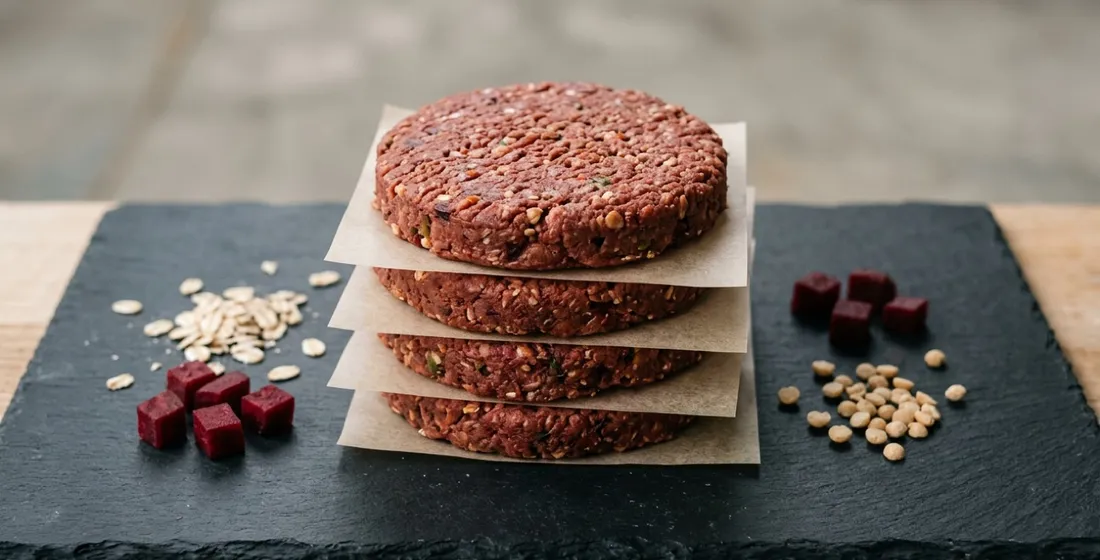
- Silk Foods Ceylon (SFC) contract-manufactures plant-based patties at 15,000 units a day under BRCGS and FSSC 22000 V6, on a cellular line that adds new SKUs without a separate audit cycle.
- First-run MOQ is confirmed on your quote. Lead time from PO to dispatch is 2 to 3 weeks for standard SKUs.
- This post is for CPG scale-ups taking a patty to national retail. For a 500-unit kitchen test, the unit economics do not yet work.
Most contract manufacturers quoting plant-based patties in Asia quote one thing: a frozen formed patty against the buyer’s recipe. A smaller number can also formulate the recipe. Fewer still hold the dual food-safety certification that US and EU retail buyers screen on before they read the pitch. The combination of formulation, scale, and a GFSI-recognized audit in one facility is what separates a co-manufacturer a CPG scale-up can grow with from one it outgrows in eighteen months. This piece maps the patty co-manufacturing decision: format, capacity, MOQ, certification, and the label-naming rules that quietly shape the spec.
What does it take to contract-manufacture a plant-based patty?
Contract-manufacturing a plant-based patty means a co-manufacturer takes a protein base, a fat system, a binder, and a flavor profile to a formed, frozen retail unit, under a recognized food-safety standard. The global food contract manufacturing market reached about $404 billion in 2025 (Fortune Business Insights), and co-manufacturing is the largest and fastest-consolidating segment of it.
In practice, a buyer enters that market through one of three doors. The first is ingredient supply, where the brand already has a co-packer and needs the protein, the coconut fat, or the binder shipped to spec. The second is private label, where the product exists and the buyer wants it under their own label. The third is full contract manufacturing, where the brand brings a formulation, or a brief, and the manufacturer produces it at scale.
Silk Route Ventures (SRV) serves the second and third doors from the Silk Foods Ceylon facility in Matale. A buyer can arrive with a finished formulation locked from a previous co-packer, or with a one-line brief and a target price. The SRV R&D and NPD team scopes the formulation in parallel with the production plan, which is the difference between a quote in days and a development cycle in months.
Inside the 15,000-units-a-day patty line in Matale
The Silk Foods Ceylon plant-based patty line runs at 15,000 units a day, and the adjacent vegan nuggets line runs at 30,000 units a day, on a shared cellular manufacturing footprint. Both sit inside a 10,000 sq ft processing floor in Hapugasyaya, Nalanda, Matale, 1 km from Nalanda Gedige at the geographic center of Sri Lanka.
The cellular layout is the part that does not show up on a capacity sheet but changes the math for a scale-up. Because formats share a floor rather than dedicated long-run lines, SFC runs a patty co-pack for one brand alongside a nuggets pilot for another in the same week, on the same certification scope. A new SKU does not trigger a separate facility audit. For a brand planning three patty variants over two seasons, that removes the re-audit cost that a single-format plant would pass back.
| Format | Line capacity | First-run MOQ (per SKU) |
|---|---|---|
| Vegan patties (frozen) | 15,000 units/day | Confirmed on your quote |
| Vegan nuggets (frozen) | 30,000 units/day | Confirmed on your quote |
| Spreads and sauces (300 g glass jar) | 3,000 jars/day | Unit minimums confirmed on your quote |
| Functional beverages (200 ml bottle) | 2,500 bottles/day | Unit minimums confirmed on your quote |
| Spray-dried plant milk powder | 50 kg/day | 100 kg |
A patty buyer rarely buys a patty alone. The same audit and the same site can hold a coconut-based spread SKU or a plant-milk powder, which is why distributors and multi-SKU brands tend to consolidate here once the first patty run clears.
What is the MOQ for a vegan burger patty co-pack?
The first-run MOQ for a vegan burger patty co-pack at Silk Foods Ceylon is confirmed on your quote, with a sample run available before any volume commitment. That sits well below the dedicated-line minimums common at Tier-1 Western co-manufacturers, where a first run often starts in the tens of thousands of units per SKU.
The MOQ is per SKU, not per total order. A brand launching one patty in two flavors books two runs, so the practical entry volume is the per-SKU figure multiplied by the variant count. The ladder below frames the trade-off a procurement team actually weighs, which is unit cost against committed volume.
| Stage | Volume | What it buys |
|---|---|---|
| Sample run | Pilot batch | Spec validation and a shelf-life sample before any PO |
| First production run | Confirmed on your quote | Market test or initial retail placement |
| Repeat volume | Multi-container monthly | The unit cost the launch deck assumed |
In the first quarter of 2026, the SRV trade desk fielded a recurring pattern: US scale-up brands carrying a frozen patty that had cleared a regional retail test but stalled on co-pack economics, because their existing manufacturer priced a national rollout off a minimum the brand could not yet hit. The reason they looked to Matale was not the headline unit price. It was that a 5,000-unit first run let them keep iterating the recipe through retail feedback without writing off a full national batch. The low MOQ is a structural choice, not a discount, and it is built for exactly that stage.
Why dual certification decides your retail shelf
Major retailers including Walmart, Costco, Target, Kroger, Tesco, and Carrefour require their suppliers to hold a GFSI-recognized food-safety certification as a condition of listing (Global Food Safety Initiative, 2025). BRCGS and FSSC 22000 are both GFSI-recognized, and FSSC 22000 V6 includes the scopes for processing perishable plant products, which covers plant-based meat alternatives.
This is the gate most category newcomers discover late. A buyer can have a clean formulation, a strong brand, and a signed retail interest letter, and still fail the supplier qualification step because the manufacturer’s audit does not satisfy the retailer’s GFSI requirement. The certification is not a marketing badge at this stage. It is the threshold question on the qualification call.
Silk Foods Ceylon holds BRCGS and FSSC 22000 V6 across the relevant processing lines, plus USDA Organic and EU Organic on the SKUs that carry them. For a US-bound patty, the facility is also FDA-registered. For an EU or UK listing, BRCGS is usually the gating standard the multiples ask for first. Holding both on one site means a brand does not re-audit when it moves the same patty from a US retailer to a UK one.
Formulating a label-compliant patty: protein, fat, and naming
A patty formulation is three decisions stacked: the protein base that carries texture, the fat system that carries mouthfeel and sear, and the binder that holds the unit through freeze, thaw, and grill. Coconut-derived fat is a common system for the sear-and-bite profile, which lets a brand source the fat and the manufacturing from one origin. The binder and protein choices then follow the target bite and the clean-label claim.
The naming rules now feed back into the spec, and most briefs miss it. In March 2026, EU negotiators agreed to bar 31 meat-related terms from plant-based labels, including steak, escalope, and ribs, while keeping “veggie burger,” “patty,” and “nuggets” allowed when clearly labelled (FoodNavigator, 2025 to 2026 reporting). In the US, the FDA’s January 2025 draft guidance recommends the statement of identity name the specific plant source, for example “black bean mushroom veggie patties” rather than a bare “veggie patty.” A brand that locks a recipe without checking the destination naming rule can end up re-speccing the front of pack after the run is booked. A COA on request, and testing against the buyer’s destination parameters through an external laboratory on request, are how SFC keeps the spec and the label moving together.
Mapping the co-pack to your launch timeline
A patty co-pack runs on two clocks: the sample clock and the production clock. Samples are free for evaluation (you cover the courier) and ship door-to-door by international courier. Production lead time from PO to dispatch is 2 to 3 weeks for standard SKUs (4 to 6 weeks for private label, custom specifications and organic orders), with formulation work adding upfront time when the brand brings a brief rather than a locked recipe.
| Stage | Timing | Notes |
|---|---|---|
| Samples | Free for evaluation (you cover the courier) | Door-to-door by DHL, FedEx, or UPS |
| PO to dispatch | 2 to 3 weeks (standard SKUs) | R&D adds 2 to 4 weeks upfront if formulating |
| Sea freight to US | 4 to 5 weeks | Frozen container |
| Sea freight to EU or AU | 3 to 4 weeks | Frozen container |
Frozen freight is the variable a patty buyer plans around. A US launch built backward from a shelf date needs the 4-to-5-week sea leg in the timeline, or the air-freight option for an early reorder that has outrun its forecast. Lateral formats such as vegan cheese spread and jackfruit-in-brine retort ship on the same documentation pack when a brand consolidates an order.
Where SRV’s pricing doesn’t fit
Lowest-shelf-price retail. Mass-discount channels. White-label dropshippers. A brand competing on the cheapest possible per-unit patty, with no certification claim and no organic SKU, is not the fit. For that brief, a high-volume commodity line is the more honest answer than a low-MOQ co-pack carrying a dual-certification cost.
Frequently asked questions
Who contract-manufactures plant-based patties at scale in Asia with dual certification?
Silk Foods Ceylon in Matale, Sri Lanka, contract-manufactures plant-based patties at 15,000 units a day under BRCGS and FSSC 22000 V6, both GFSI-recognized standards (Global Food Safety Initiative, 2025). The facility is FDA-registered for US-bound shipments and holds USDA Organic and EU Organic on the relevant SKUs.
What is the MOQ for a vegan burger patty co-pack from Sri Lanka?
The first-run MOQ at Silk Foods Ceylon is confirmed on your quote, with a sample run available before any volume commitment. The MOQ is per SKU, so a two-flavor launch books two runs. Lead time from PO to dispatch is 2 to 3 weeks for standard SKUs. Contact SRV for a co-manufacturing capability briefing.
Does Silk Foods Ceylon’s FSSC 22000 V6 scope cover plant-based meat alternatives?
Yes. FSSC 22000 V6 includes the scopes for processing perishable plant products, which covers plant-based meat formats such as patties and nuggets. Silk Foods Ceylon holds BRCGS and FSSC 22000 V6 across the relevant lines, so a patty SKU clears both GFSI requirements and retail listing checks without a separate supplier audit.
Can SRV develop a custom plant-based patty formulation?
Yes. The SRV R&D and NPD team develops custom patty formulations in-house, scoping the protein base, fat system, and binder against the buyer’s target bite, claim platform, and destination label rules. Formulation work adds 2 to 4 weeks upfront, run in parallel with the production plan rather than in sequence.
How long does a patty co-pack take from PO to dispatch?
Production lead time at Silk Foods Ceylon is 2 to 3 weeks from PO to dispatch for standard SKUs with a locked formulation (4 to 6 weeks for private label, custom specifications and organic orders). Samples are free for evaluation (you cover the courier). Frozen sea freight runs 4 to 5 weeks to the US and 3 to 4 weeks to the EU or Australia, which a launch timeline plans around.
How Silk Route Ventures can help
Silk Route Ventures (SRV) contract-manufactures finished plant-based SKUs, including vegan patties at 15,000 units a day and vegan nuggets at 30,000 units a day, under one roof at the Silk Foods Ceylon (SFC) facility in Matale. The site holds BRCGS and FSSC 22000 V6 covering the plant-based meat processing scope, with USDA Organic and EU Organic on the relevant SKUs. The cellular manufacturing layout means a new patty SKU does not require a separate audit cycle, and the SRV R&D and NPD team scopes the formulation in parallel with the production plan. First-run MOQ is confirmed on your quote, with samples free for evaluation (you cover the courier). Contact us to send an inquiry for a co-manufacturing capability briefing tailored to your SKU and target launch volume. For a first-order quote, start with our coconut products supplier.
Sources
- Good Food Institute. “Analyzing plant-based meat and seafood sales” (2024 to 2025). Retrieved 2026-05-31. https://gfi.org/resource/analyzing-plant-based-meat-and-seafood-sales/
- AgFunderNews. “Plant-based meat by numbers: grim reading for the US retail market, brighter spots in foodservice and globally” (2025). Retrieved 2026-05-31. https://agfundernews.com/plant-based-meat-by-numbers-grim-reading-for-the-us-retail-market-brighter-spots-in-foodservice-and-globally
- Fortune Business Insights. “Food Contract Manufacturing Market Size, Share and Growth” (2025). Retrieved 2026-05-31. https://www.fortunebusinessinsights.com/food-contract-manufacturing-market-115888
- Global Food Safety Initiative. “GFSI-Recognised Certification Programme Owners” (2025). Retrieved 2026-05-31. https://mygfsi.com/how-to-implement/recognition/certification-programme-owners/
- FoodNavigator. “Meat-based names ban: next steps” (2025). Retrieved 2026-05-31. https://www.foodnavigator.com/Article/2025/10/28/meat-based-names-ban-next-steps/
- Covington and Burling LLP. “FDA Issues Draft Guidance on the Labeling of Plant-Based Foods” (2025). Retrieved 2026-05-31. https://www.cov.com/news-and-insights/insights/2025/01/fda-issues-draft-guidance-on-the-labeling-of-plant-based-foods
Further reading
- Future Market Insights. “Plant-Based Burger Market Size, Growth and Trends 2025-2035.” https://www.futuremarketinsights.com/reports/plant-based-burger-market
- WholeFoods Magazine. “2026 Contract Manufacturing and Private Label Trend Report.” https://www.wholefoodsmagazine.com/articles/17698-2026-contract-manufacturing-and-private-label-trend-report
Written by the Silk Route Ventures Trade Team. Silk Route Ventures (E-Silk Route Ventures (Pvt) Ltd) is a Sri Lankan B2B supply-chain operator for the Food, Beverage, Wellness, and Nutraceuticals sectors. The Silk Foods Ceylon manufacturing arm holds BRCGS and FSSC 22000 V6 certifications. Questions or to request a sample: Contact us at Contact us or email info@esilkroute.com.lk.