
Jackfruit in Brine: Retort Glass-Jar Formats for Plant-Meat SKUs
Procurement snapshot
- In 2025, the global jackfruit products market was valued at about USD 1.17 billion, and plant-based meat substitutes were the single largest segment at roughly 38% of that value (Future Market Insights, 2025).
- Young (unripe) jackfruit is a low-acid food (pH above 4.6). Packed in brine for ambient retail, it has to be retort-processed to commercial sterility under a scheduled process (US FDA, 21 CFR Part 113).
- Silk Foods Ceylon (SFC), the Matale manufacturing arm of Silk Route Ventures (SRV), runs jackfruit in brine on a retort glass-jar line at up to 3,000 jars per day, under BRCGS and FSSC 22000 V6. First-order MOQ is 1,500 jars per SKU.
- The format table below maps chunk, pulled, and minced cuts to end-product fit, jar size, and MOQ.
- For brands building shelf-stable plant-meat retail SKUs, this is the spec. For frozen-only foodservice pulled jackfruit, the bulk bucket route fits better.
Most plant-based meat alternatives reach a US or EU shelf in one of two states: frozen, or chilled. Young jackfruit is the exception that often sells best a third way, shelf-stable in a jar. The fruit’s fibrous, pull-apart structure already reads as shredded meat, so the manufacturing problem is narrower than it is for an extruded protein analogue. The job is to hold that texture through a retort cycle and a long ambient shelf life. This piece walks a CPG scale-up buyer through the format choices (chunk, pulled, and minced), the retort-in-glass process the brine SKU depends on, and the capacity and MOQ math for a first production run.
Why is young jackfruit packed in brine instead of frozen?
Young jackfruit is packed in brine because the format gives a plant-meat SKU an ambient shelf life, commonly up to 24 months, with no freezer chain. The fruit is low-acid, so the brine pack is heat-processed to commercial sterility in a sealed container, the same route canned vegetables take (US FDA, 21 CFR Part 113). The brine itself is a simple carrier: water with roughly 1.5% to 2.5% salt, sometimes a small amount of citric acid to support the process and protect colour.
The alternative, frozen jackfruit, carries a cold chain the whole way. For a Sri Lanka-to-US shipment that means a reefer container and 4 to 5 weeks at temperature, then freezer slotting at the retailer. The brine jar ships in a standard dry container and sits on an ambient shelf. That difference is why the brine pack, not the frozen pack, is usually the format a brand needs to clear a national listing. US retail plant-based meat sales softened to about USD 1 billion in 2025 (Good Food Institute and SPINS, 2025), and in a tighter category, whole-food jackfruit SKUs that avoid freezer-set costs have an easier path to the shelf than processed analogues.
Chunk, pulled, and minced: matching the cut to the end product
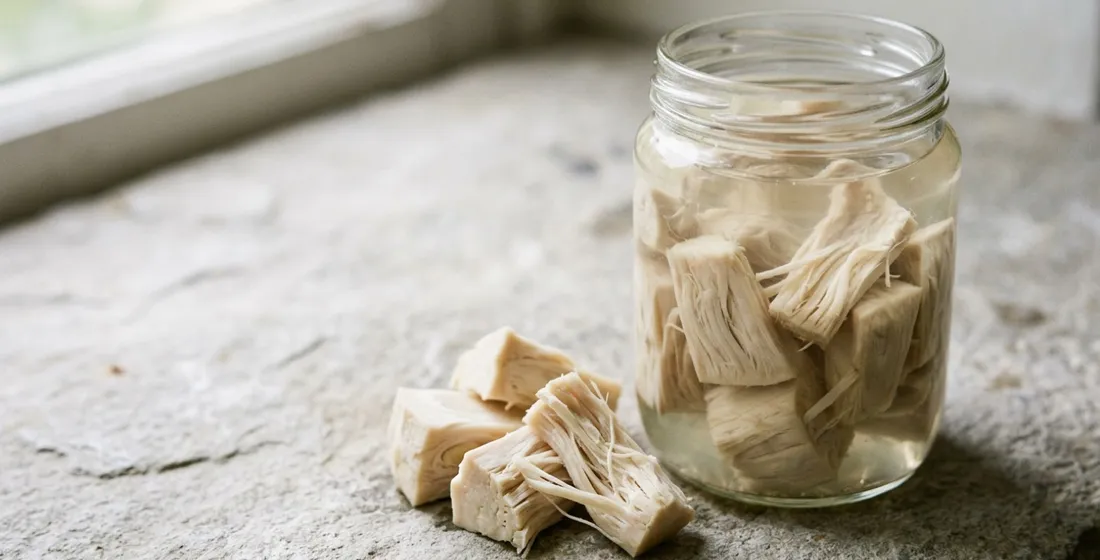
Three young-jackfruit cuts dominate plant-meat SKUs. Chunks hold their shape for curries, stews, and “rib” formats. Pulled jackfruit, separated into strands, suits BBQ sandwiches, tacos, bowls, and pizza topping. Minced jackfruit gives a loose, ground-meat base for bolognese, fillings, and meatballs. The cut a brand picks sets the jar size, the drained-weight ratio, and how much finishing the brand does after opening the jar.
| Format | Texture after retort | Best end-product fit | Typical jar | First-order MOQ |
|---|---|---|---|---|
| Chunks in brine | Firm, holds shape | Curries, stews, “ribs,” skewers | 500 ml, 1 L | 1,500 jars |
| Pulled in brine | Stranded, shreddable | BBQ sandwiches, tacos, bowls, pizza | 330 ml, 500 ml | 1,500 jars |
| Minced in brine | Loose ground crumb | Bolognese, fillings, meatballs, bakes | 220 ml, 330 ml | 1,500 jars |
Source: Silk Foods Ceylon production data, 2026.
Cut and heat schedule are specified together, not separately. A 2025 study in the International Journal of Food Science found that the thermal treatment applied to young jackfruit measurably changes its texture and eating quality in plant-based meatball applications (Samutsri et al., 2025). In practice, a minced SKU bound for a meatball or a bolognese can take a firmer schedule than a pulled SKU, where keeping the strands intact is the whole point.
What does retort processing in a glass jar require?
Retort processing applies heat in a sealed container long enough to reach commercial sterility, which is the destruction of the microorganisms able to grow under ambient storage. For a low-acid food like jackfruit in brine, the US FDA requires a scheduled process set by a competent processing authority, plus establishment registration and a process filing before the product can ship to the US (US FDA, 21 CFR Part 113; LACF registration). This is the same compliance path that governs canned beans and canned vegetables.
The schedule is built around a measured lethality, the come-up time the retort needs to reach temperature, and the heat penetration into the slowest-heating point at the jar centre. Glass behaves differently from a metal can: it has more thermal lag and needs a controlled, slower cool-down to avoid thermal shock and breakage, so a glass schedule usually runs longer than the can equivalent. The hermetic seal is the control point that keeps the jar commercially sterile through distribution. For US-bound SKUs, the manufacturer files the scheduled process with the FDA and the buyer’s importer references that filing, which connects directly to the buyer’s own FSMA Rule 204 traceability obligations on Ceylon imports.
Glass jar versus bulk bucket: the SKU economics
Young jackfruit in brine ships two ways, and the choice follows the buyer’s channel rather than the fruit. Retail-ready glass jars are the consumer-facing SKU: shelf-stable, branded, and sold through grocery. Bulk buckets move volume to a foodservice operator or a re-packer who finishes and re-packs downstream, often into a frozen or chilled format. A brand launching a retail line takes the jar. A distributor or a co-packer feeding a kitchen often takes the bucket.
The jar SKU carries the packaging and the retort time in its unit cost, and it earns that back in retail margin and ambient distribution. The bucket SKU has a lower packaging cost per kilogram but pushes the finishing work, and its cost, onto the buyer. SRV’s first-order MOQ for glass-jar SKUs is 1,500 jars per format, about a half-day on the line, with roughly one extra week of lead time when new jar tooling is involved. The same retort capability also runs vegan cheese spread in retort glass jars, so a brand can consolidate two ambient SKUs on one audit.
How does Silk Foods Ceylon run jackfruit in brine at scale?
Silk Foods Ceylon manufactures jackfruit in brine on a retort glass-jar line at the Matale facility, running up to 3,000 jars per day, under BRCGS and FSSC 22000 V6. The FSSC scope names young jackfruit in brine specifically, so a co-manufactured SKU clears the GFSI gating filter most US and EU retailers require without a separate supplier audit. The facility sits on a 10,000 sq ft cellular manufacturing floor 1 km from Nalanda Gedige in Matale, and the jackfruit line shares that footprint with the plant-based patty line at 15,000 units a day and the nuggets line. That shared layout is the structural reason a new jackfruit SKU can run alongside an existing plant-meat line without a fresh audit cycle, the point the plant-based and functional food contract manufacturing guide makes across the category.
In early 2026, the SRV trade desk fielded the same request three times in a quarter: plant-meat brands that had launched pulled jackfruit as a frozen SKU asking to move it into a shelf-stable jar, because a national grocery buyer would not allocate freezer space to an unproven line. The retort jar was not a quality upgrade for them. It was the only route onto the shelf. Moving from a reefer to a dry container also took roughly USD 2,000 to USD 4,000 of cold-chain cost out of each 40-foot shipment, which is real money on a first production run.
Lead times follow the standard SFC pattern: sample jars by international courier in 3 to 5 business days, PO to dispatch in 2 to 3 weeks, and sea freight of 4 to 5 weeks to the US, 3 to 4 weeks to the EU and Australia. For a seasoned variant rather than plain brine, the same line also runs tender jackfruit curry and sauce SKUs, which the R&D and NPD team can scope in parallel with the production plan.
Specifying jackfruit in brine on your RFQ
A clean RFQ saves a sample round. The parameters a procurement team should put in front of any jackfruit-in-brine supplier are specific and easy to confirm.
Buyer’s checklist: jackfruit in brine
- Maturity confirmed as young, unripe, harvested green (not ripe sweet fruit)
- Cut specified: chunk, pulled, or minced, with a piece-size range
- Drained weight and drained-weight-to-fill ratio per jar
- Brine spec: salt percentage, any acidulant, and target pH
- Jar size and closure type (twist or lug cap), plus headspace
- Commercial sterility confirmed, with the scheduled-process reference (and, for the US, the FDA process filing)
- COA per batch: microbial, drained weight, pH, and salt
- Target shelf life and the ambient storage statement for the label
Frequently asked questions
What is the contract manufacturing MOQ for jackfruit in brine in glass jars?
Silk Foods Ceylon sets a first-order MOQ of 1,500 jars per SKU for jackfruit in brine, about a half-day on the retort glass-jar line, which runs up to 3,000 jars per day. Glass-jar tooling adds roughly one week of lead time, and sample jars ship by international courier in 3 to 5 business days.
Is young jackfruit in brine shelf-stable without refrigeration?
Yes. Packed in brine and retort-processed to commercial sterility in a sealed jar, young jackfruit is ambient shelf-stable, commonly for up to 24 months, with no freezer or chill chain. Low-acid foods like jackfruit require a scheduled thermal process before they can be sold shelf-stable (US FDA, 21 CFR Part 113).
Does Silk Foods Ceylon manufacture jackfruit in brine under BRCGS and FSSC 22000 V6?
Yes. The Matale facility holds BRCGS and FSSC 22000 V6, and the FSSC scope names young jackfruit in brine. For US and EU CPG buyers, that dual coverage clears the GFSI gating filter retailers require, so a co-manufactured jar can be specified into a retail listing without an additional supplier audit.
What jar sizes and cuts are available for jackfruit in brine?
Silk Foods Ceylon packs chunk, pulled, and minced young jackfruit in brine in 220 ml, 330 ml, 500 ml, and 1 L glass jars, plus bulk buckets for foodservice and re-packers. The cut and the jar size are matched to the end-product format, from a shelf-stable curry to a pulled-jackfruit sandwich filling.
How Silk Route Ventures can help
Silk Route Ventures contract-manufactures young jackfruit in brine, in chunk, pulled, and minced cuts, in retail-ready glass jars and bulk buckets at the Silk Foods Ceylon facility in Matale, on a retort line running up to 3,000 jars per day. The site holds BRCGS and FSSC 22000 V6, with the FSSC scope covering young jackfruit in brine, and the cellular manufacturing layout means a new jackfruit SKU runs alongside patties, nuggets, and spreads without a separate audit cycle. First-order MOQ is 1,500 jars per SKU, samples ship by international courier in 3 to 5 business days, and the SRV R&D and NPD team can scope a seasoned or sauce variant in parallel with the production plan. This sits inside the wider food and beverage contract manufacturing offer, all audited under FSSC 22000 V6. Contact us to send an inquiry for a co-manufacturing capability briefing tailored to your SKU and launch volume.