
Five Questions Before You Sign a Plant-Based Co-Manufacturing Deal
Buyer’s snapshot
- Under 18 U.S.C. 1839(3) and EU Directive 2016/943, a formula is a protectable trade secret only while its holder takes reasonable steps to keep it secret. The confidentiality regime is not paperwork around the deal. It is what makes the asset an asset.
- ISO 23662:2021 requires that where a line is shared, thorough cleaning or comparable measures under good manufacturing practice happen before the run. It sets a process obligation and no numerical threshold, so the validated changeover procedure in your quality agreement is the only thing to arbitrate against.
- Under Regulation (EU) 1169/2011 Article 8(1), the operator whose name the food is marketed under is responsible for the food information. A contract can move cost. It cannot move that.
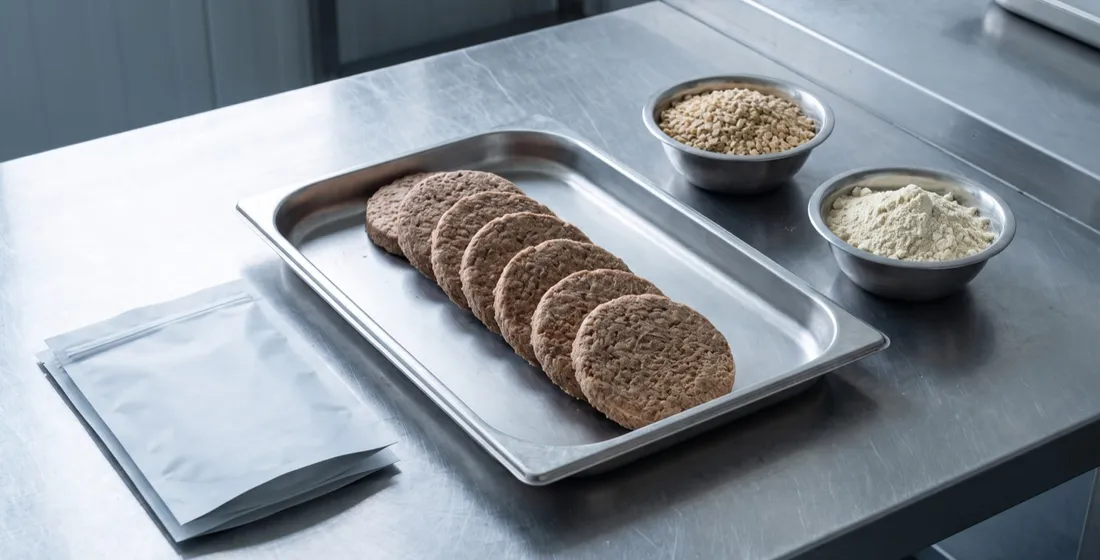
- Silk Foods Ceylon (SFC) runs vegan patties at 15,000 units per day and vegan nuggets at 30,000 units per day, with first-run entry at 5,000 to 10,000 units per SKU.
- The summary table below sets out what each of the five terms defaults to when the agreement stays silent.
Most plant-based sourcing advice stops at the shortlist. Check the certificate on the register, read the scope statement, match the format to the process, agree the MOQ. That work is necessary and it is covered elsewhere, in qualifying a coconut and plant-based contract manufacturer and in how to verify a Sri Lankan contract manufacturer. This post picks up at the point those end. The supplier is qualified, the samples passed, and a supply agreement is sitting in front of you. These are the five terms that decide what you actually bought.
Who owns the formula, and can the plant run it for anyone else?
A plant-based formula is protected as a trade secret, not as a patent, and trade-secret status is conditional on behaviour. The United States Code is explicit that the category covers formulas: 18 U.S.C. 1839(3) protects business, scientific and technical information “including patterns, plans, compilations, program devices, formulas, designs,” but only where “the owner thereof has taken reasonable measures to keep such information secret” and the information derives independent economic value from not being generally known. Directive (EU) 2016/943 Article 2(1) sets three cumulative conditions to the same effect: the information is secret, it has commercial value because it is secret, and it “has been subject to reasonable steps under the circumstances, by the person lawfully in control of the information, to keep it secret.”
Read those two provisions together and the confidentiality clause stops looking like boilerplate. The World Intellectual Property Organization names “the use of confidentiality agreements for business partners and employees” as exactly such a reasonable step, and states that when a trade secret is transferred, a non-disclosure or confidentiality agreement needs to be signed. Handing a formula to a co-manufacturer without a surviving confidentiality regime does not only create commercial exposure. It can undercut the legal status of the thing you are trying to protect.
Two distinctions belong in the drafting. The first is between what each side brought and what the project created. The European Commission’s IP Helpdesk defines background as data, know-how or information, including any rights, that is held by a party before it joined the agreement and is needed to implement the work. A co-manufacturer’s extrusion parameters and process know-how are usually its background. Your protein ratio and sensory target are usually yours. What the two produce together at the bench is the part that needs naming.
The second distinction is harder, and honesty is the right answer here: no statute assigns ownership of a jointly developed recipe by default. There is no rule to fall back on. If the agreement does not say who owns the formulation that came out of joint development work, the question is open, and it is open at the worst possible moment, which is when the relationship ends. Say who owns it, say whether the plant may run it or anything materially like it for another customer, and say what happens to the specification file on termination. Where research and development work at Silk Foods Ceylon feeds a customer formulation, the ownership position is settled in writing before bench work starts, not after. The route from bench sample to first certified run is set out in NPD as a service.
On a shared line, who proves the allergen and vegan changeover?
This is the plant-based question that general contract-manufacturing advice keeps missing. A plant-based SKU is frequently made on equipment that also runs dairy or egg, and the two claims at stake, the allergen declaration and the vegan claim, are governed by completely different instruments.
The allergen side is regulated and specific. Under 21 CFR 117.135(c)(2), food allergen controls must include procedures, practices and processes that address protection of food from allergen cross-contact and the labelling of the finished food, and 117.135(c)(3) puts allergen hazards inside sanitation controls as well. In the European Union, Regulation 1169/2011 Annex II lists the fourteen declarable allergens, including milk and eggs, and Article 21 requires that the allergen be emphasised in the ingredients list by typeset that clearly distinguishes it from the rest of the list. The United States list reached nine in 2023: the FASTER Act identified sesame as the ninth major food allergen, and sesame has had to be labelled on packaged foods since 1 January 2023.
What the contract cannot do is lean on a precautionary statement instead of a control. The FDA position is that advisory statements such as “may contain” are voluntary, are used to address unavoidable cross-contact, and “should not be used as a substitute for adhering to current good manufacturing practices.” An advisory label is an outcome of a hazard you failed to control, not a permission to leave it uncontrolled.
The vegan side has no equivalent backstop, and that is the point. There is no regulatory definition of vegan in United States food law; the FDA treats claims such as vegan as requiring no premarket or postmarket submission, subject to being truthful and not misleading. In the European Union, suitability for vegetarians or vegans is not one of the mandatory particulars, and Article 36(3)(b) of Regulation 1169/2011 contemplates implementing acts on voluntary information of that kind; the operative discipline in the meantime is Article 7(1), which requires that food information not mislead as to the nature, composition or method of manufacture of the food.
Into that gap steps ISO 23662:2021, which sets definitions and technical criteria for foods suitable for vegetarians or vegans, for business-to-business communication as well as labelling. Its shared-line requirement is a process obligation. For ovo-lacto-vegetarian foods, clause 4.2 requires that all stages of production, processing and distribution be designed to take appropriate precautions in conformity with good manufacturing practices, and that where the same production line is shared with non-conforming products, “thorough cleaning or comparable measures in conformity with GMPs shall be carried out before starting the production,” extending to all associated machinery, equipment, utensils and surfaces. The same construction repeats for ovo-vegetarian and lacto-vegetarian foods at clauses 4.3 and 4.4. The standard also bars animal testing on the final product carrying the claim.
Notice what is absent. There is no parts-per-million limit, no analytical detection criterion and no tolerance figure attached to “thorough cleaning.” The standard pushes the entire question onto the validated changeover procedure, which means that if your quality agreement does not define that procedure and the evidence it generates, there is nothing to hold anyone to. Ask for the changeover sequence, the verification method, and the batch-level record that the sequence was executed. The discipline of running segregated production alongside conventional production is the same discipline described in running a certified organic line beside conventional production.
Who owns the shelf-life data when the protein input changes?
Shelf life is treated in most supply agreements as a number on the specification sheet. In the European Union it is a study, and the study has a named owner. Regulation (EC) 2073/2005 Article 3(2) requires food business operators to conduct studies in accordance with Annex II to investigate compliance with the microbiological criteria throughout shelf life. Annex II sets out what those studies involve: specifications for physico-chemical characteristics including pH, water activity, salt content, preservative concentration and the packaging system, a review of literature and research data, and where necessary predictive mathematical modelling and inoculated growth or survival tests under different reasonably foreseeable storage conditions.
The guidance is blunt about who carries this. The European Union Reference Laboratory for Listeria monocytogenes states in its technical guidance document that it is the operator’s responsibility to conduct shelf-life studies, that the operator is responsible for setting the shelf life under defined conditions, that the laboratory’s task is to design and conduct the challenge test or durability study based on information the operator provides, and that interpreting the laboratory’s results and conclusions is the operator’s responsibility again. The operator must also make the study report available to competent authorities on request. A brand owner who assumed the co-manufacturer quietly held all of this is holding a regulatory obligation it cannot evidence.
That matters most at the moment an input changes. The same guidance requires that products analysed during a challenge test be representative of production, and lists product characteristics including the variability between and within batches among the prerequisites the operator must supply. Plant proteins are not interchangeable commodities at that level of precision. A 2025 review of pea protein isolates in Molecules reports that protein content tracks the extraction route, running from roughly 50 percent for dry-fractionated material to 83.33 to 84.67 percent on a dry weight basis for alkaline-extraction isoelectric-precipitation isolates, with wet fractionation near 80 percent. Functionality moves with it: dry-fractionated pea protein showed gel strength nearly twofold higher at pH 7 than wet-extracted isolates, and gelation required at least 20 percent weight-for-weight protein alongside conditions away from the isoelectric point.
| Pea protein route | Typical protein content | Functional note from the 2025 review |
|---|---|---|
| Dry fractionation | around 50 percent | Gel strength nearly twofold higher at pH 7 than wet-extracted isolates |
| Wet fractionation | around 80 percent | Intermediate purity route |
| Alkaline extraction with isoelectric precipitation | 83.33 to 84.67 percent dry weight | Highest purity of the three routes reviewed |
A supplier swap that looks like a purchasing decision can therefore move the water binding, the gel strength and the texture of the finished patty, and it can invalidate the study the operator is legally required to hold. The clause to write is a specification-change and re-validation term: no change of protein supplier, extraction route or grade without written notice, and a named party paying for the re-validation when it happens. Shelf life in a retorted or chilled format carries the same logic, which is worked through for a different format in vegan cheese spread contract manufacturing.
Who pays for an out-of-spec batch, and who carries the recall?
Here the contract runs into a hard limit, and buyers routinely misread it. An agreement can allocate cost between two commercial parties. It cannot reassign regulatory responsibility, because neither regime lets the parties choose who the regulator talks to.
In the European Union, Regulation (EC) 178/2002 Article 17(1) requires that food business operators at all stages of production, processing and distribution within the businesses under their control ensure that foods satisfy the requirements of food law relevant to their activities, and verify that those requirements are met. Article 19 then obliges an operator that considers or has reason to believe a food it has produced or distributed is not in compliance to initiate withdrawal immediately where the food has left its immediate control, to inform the competent authorities, and to recall product already supplied where other measures are insufficient. Alongside that, Regulation 1169/2011 Article 8(1) fixes the responsible operator for food information as “the operator under whose name or business name the food is marketed,” or the importer where that operator is not established in the Union, and Article 8(2) requires that operator to ensure the presence and accuracy of the information. Your brand name on the pack is a regulatory position, not a marketing asset.
The United States arrives at a similar place by a different route. Under 21 CFR 7.40(b) a request by the FDA that a firm recall a product is “reserved for urgent situations and is to be directed to the firm that has primary responsibility for the manufacture and marketing of the product.” Under 21 U.S.C. 350l the agency must first give the responsible party an opportunity to cease distribution and recall voluntarily, and may order the cessation only if that party refuses or fails. And 21 CFR 117.405(a)(1) places the supply-chain programme on the receiving facility for raw materials where it has identified a hazard requiring a supply-chain-applied control, with 117.415 requiring the receiving facility to approve suppliers and to determine and conduct appropriate verification activities. The obligation to verify your supplier is yours whether or not you paid someone else to do the verifying.
None of that stops a contract doing useful work. It means the useful work is specific: define what out of specification means against named parameters, say who decides between rejection, rework and concession, set who pays for the failed batch, the raw material in it and the line time, and require notification within a stated number of hours rather than at month end. Insurance and the recall-cost allocation sit in the same place.
The traceability clause deserves a separate look, because its ground is still moving. The original compliance date for the FSMA 204 food traceability recordkeeping requirements was 20 January 2026. That date passed without taking effect: the FDA has proposed extending it by 30 months to 20 July 2028, and Congress directed the agency not to enforce the rule before that same date. A brand signing a three-year co-manufacturing agreement in 2026 is therefore signing across a compliance date that has already moved once and is not yet settled by a final rule. Write the traceability obligation to the requirement rather than to the calendar, and make the record format an obligation that survives a date change.
What capacity are you actually buying?
A capacity number in a capability deck and the capacity reserved for your SKU are different quantities, and the gap is larger than most buyers assume. In its assessment of plant-based meat manufacturing capacity, the Good Food Institute with Bright Green Partners notes that even at an assumed 100 percent facility utilisation, total effective equipment performance is typically around 40 to 70 percent because of equipment losses, varying by facility and product portfolio. A line quoted at nominal throughput is not a line that will deliver nominal throughput against your forecast.
The same 2023 assessment, using 2022 data, put global plant-based meat production capacity at roughly 2.2 million metric tons across about 143 facilities, concentrated in Europe at 41 percent and North America at 34 percent. It also priced the two expansion routes very differently: retrofitting existing assets at 0.1 to 0.6 million dollars per thousand metric tons of capacity against 0.9 to 2.9 million dollars for greenfield, with greenfield lead times of 18 months to three years while a retrofit can run from days to several months. Treat those capacity figures as the historical picture they are, since they describe the market before the recent contraction in the United States rather than conditions today.
That contraction is the reason to be careful with forecast commitments. Good Food Institute figures drawn from SPINS and Circana data for the 52 weeks ending 30 November 2025 put United States plant-based food dollar sales at 7.9 billion dollars, down 2 percent in value and 3 percent in units, with plant-based meat and seafood at 1.0 billion dollars and down 10 percent in dollars and 11 percent in units. Europe moved the other way over the same year: GFI Europe, working from Circana data, recorded 4.748 billion euros across six markets, with France up 11.0 percent in value, Spain up 7.7 percent, Italy up 4.5 percent and Germany up 3.1 percent, while the United Kingdom fell 1.2 percent and the Netherlands fell 4.1 percent. The two datasets use different baskets and should not be added together. The honest reading for a buyer is that this category is diverging by geography and by sub-segment at the same time, which is precisely the condition under which a fixed multi-year volume commitment is a bad trade.
So buy line time on terms that match that risk. Ask what allocation is reserved and over what window, what notice either side gives to change it, what happens to your slot when a forecast is missed, and whether any minimum-volume obligation carries a payment consequence. Ask where your SKU sits when the plant is oversubscribed. At SFC the relevant entry points are published rather than negotiated case by case: patties at 15,000 units per day, nuggets at 30,000 units per day, first runs from 5,000 to 10,000 units per SKU, and two to three weeks from purchase order to dispatch. The cellular manufacturing layout is what allows a new SKU to enter without a separate audit cycle. How a run size drives the quoted unit price is worked through in low-MOQ versus high-volume contract manufacturing.
Certification snapshot: Silk Foods Ceylon, Matale
- BRCGS and FSSC 22000 V6 across the relevant processing scope, including plant-based meat formats
- USDA Organic and EU Organic, certified per SKU
- Cellular manufacturing layout, so a new SKU enters without a separate audit cycle
- Registered with the Sri Lanka Export Development Board; FDA-registered facility
- Batch-level certificate of analysis on every dispatched batch
| Term | What happens if the agreement is silent | What to write instead |
|---|---|---|
| Formula ownership | No statute assigns joint development output, so ownership is contested exactly when the relationship ends | Name the owner, the exclusivity position, and what happens to the specification file on termination |
| Confidentiality | Trade-secret status under 18 U.S.C. 1839 and Directive 2016/943 depends on reasonable steps to keep it secret | A surviving confidentiality regime, in force before bench work starts |
| Shared-line changeover | ISO 23662 requires thorough cleaning under GMP but sets no threshold to arbitrate against | The validated changeover sequence, its verification method, and the per-batch record |
| Shelf-life study | The operator carries the study obligation under 2073/2005 whether or not it holds the data | Named owner of the study, the report, and the re-validation trigger |
| Protein input change | A route change can move protein content from around 50 to 84 percent and roughly double gel strength | Written notice before any supplier, route or grade change, with re-validation cost assigned |
| Out-of-spec batch | Disputed after the fact, on invoice terms | Defined parameters, decision rights on rework, cost allocation, notification window in hours |
| Recall | Regulatory responsibility sits with the brand whose name is on the pack regardless of contract | Cost allocation, insurance, and the cooperation obligation, with no pretence of transferring the duty |
| Capacity | A deck number, not a reserved quantity, against 40 to 70 percent effective equipment performance | Reserved allocation, forecast window, notice period, and the oversubscription rule |
Buyer’s checklist: the five terms to settle before signature
- Formula ownership, exclusivity, and the fate of the specification file on termination
- A confidentiality regime that is executed before bench work and survives the agreement
- The validated shared-line changeover procedure, its verification method, and the batch-level evidence you receive
- The shelf-life study owner, the report location, and the specification-change trigger that forces re-validation
- Reserved capacity, the forecast window, the missed-forecast consequence, and the oversubscription rule
Frequently asked questions
Does a contract manufacturer own the recipe it helps develop?
There is no statutory default. Neither United States nor European Union law assigns ownership of a jointly developed formulation, which means it belongs to whoever the agreement says it belongs to. Settle ownership, exclusivity and the post-termination position in writing before development work starts rather than after a dispute makes the question urgent.
Can a vegan product be made on a line that also runs dairy?
Yes, subject to control. ISO 23662:2021 requires that where a line is shared, thorough cleaning or comparable measures in conformity with good manufacturing practices are carried out before the run, covering all associated machinery, equipment, utensils and surfaces. The standard sets no numerical threshold, so the validated changeover procedure and its batch-level evidence are what the claim rests on.
Who is responsible if a co-manufactured product is recalled?
The brand under whose name the product is marketed. Regulation (EU) 1169/2011 Article 8(1) makes that operator responsible for the food information, and 21 CFR 7.40(b) directs an FDA recall request to the firm with primary responsibility for the manufacture and marketing of the product. A contract can allocate the cost between the parties. It cannot move the regulatory duty.
What is the contract manufacturing MOQ for plant-based patties and nuggets at Silk Foods Ceylon?
First runs start at 5,000 to 10,000 units per SKU. The patty line runs at 15,000 units per day and the nugget line at 30,000 units per day, with two to three weeks from purchase order to dispatch and sample dispatch by international courier in three to five business days.
How Silk Route Ventures can help
Silk Route Ventures (SRV) contract-manufactures finished plant-based CPG SKUs, including vegan patties at 15,000 units per day, vegan nuggets at 30,000 units per day, vegan cheese and spreads in glass, spray-dried plant milks and jackfruit in brine, at the Silk Foods Ceylon facility in Matale. The site holds BRCGS and FSSC 22000 V6 across the relevant processing scope, with USDA Organic and EU Organic for organic SKUs. The cellular manufacturing layout means a new SKU introduction does not require a separate audit cycle, and the research and development team scopes formulation in parallel with the production plan, with formula ownership settled in writing before bench work begins. Contact us for a co-manufacturing capability briefing covering allocation, changeover validation and the specification-change terms for your SKU.
Sources
- U.S. Government Publishing Office, United States Code Title 18 Section 1839 (2023 edition), retrieved 2026-09-19, https://www.govinfo.gov/content/pkg/USCODE-2023-title18/html/USCODE-2023-title18-partI-chap90-sec1839.htm
- EUR-Lex, Directive (EU) 2016/943 of the European Parliament and of the Council of 8 June 2016 on the protection of undisclosed know-how and business information (trade secrets), retrieved 2026-09-19, https://eur-lex.europa.eu/legal-content/EN/TXT/?uri=CELEX%3A32016L0943
- World Intellectual Property Organization, Frequently Asked Questions: Trade Secrets, retrieved 2026-09-19, https://www.wipo.int/en/web/trade-secrets/tradesecrets_faqs
- European Commission, European IP Helpdesk, Background in EU-funded projects, published 29 June 2021, retrieved 2026-09-19, https://intellectual-property-helpdesk.ec.europa.eu/news-events/news/background-eu-funded-projects-2021-06-29_en
- U.S. Government Publishing Office, Code of Federal Regulations Title 21 Section 117.135 (2024 annual edition), retrieved 2026-09-19, https://www.govinfo.gov/content/pkg/CFR-2024-title21-vol2/xml/CFR-2024-title21-vol2-sec117-135.xml
- U.S. Food and Drug Administration, FASTER Act: Sesame as the Ninth Major Food Allergen, retrieved 2026-09-19, https://www.fda.gov/food/food-allergies/faster-act-sesame-ninth-major-food-allergen
- U.S. Food and Drug Administration, Food Allergies, retrieved 2026-09-19, https://www.fda.gov/food/nutrition-food-labeling-and-critical-foods/food-allergies
- EUR-Lex, Regulation (EU) No 1169/2011 on the provision of food information to consumers, consolidated text of 1 January 2018, retrieved 2026-09-19, https://eur-lex.europa.eu/legal-content/EN/TXT/HTML/?uri=CELEX:02011R1169-20180101
- International Organization for Standardization, ISO 23662:2021 Definitions and technical criteria for foods and food ingredients suitable for vegetarians or vegans and for labelling and claims, first edition 2021-03, clauses 4.2 to 4.4, retrieved 2026-09-19, https://www.iso.org/standard/76574.html
- U.S. Food and Drug Administration, Notifications for Structure/Function and Related Claims, retrieved 2026-09-19, https://www.fda.gov/food/information-industry-dietary-supplements/notifications-structurefunction-and-related-claims-dietary-supplement-labeling
- EUR-Lex, Regulation (EC) No 2073/2005 on microbiological criteria for foodstuffs, consolidated text of 8 March 2020, Article 3(2) and Annex II, retrieved 2026-09-19, https://eur-lex.europa.eu/legal-content/EN/TXT/HTML/?uri=CELEX:02005R2073-20200308
- European Union Reference Laboratory for Listeria monocytogenes, Technical Guidance Document on challenge tests and durability studies for assessing shelf-life of ready-to-eat foods, version 4 of 1 July 2021, retrieved 2026-09-19, https://food.ec.europa.eu/system/files/2021-07/biosafety_fh_mc_tech-guide-doc_listeria-in-rte-foods_en_0.pdf
- J. Harasym, A. Paroń and E. Pejcz, Pea Protein Isolates: From Extraction to Functionality, Molecules volume 30 number 23 article 4650 (2025), retrieved 2026-09-19, https://pmc.ncbi.nlm.nih.gov/articles/PMC12693553/
- EUR-Lex, Regulation (EC) No 178/2002 laying down the general principles and requirements of food law, consolidated text of 1 July 2022, Articles 17 and 19, retrieved 2026-09-19, https://eur-lex.europa.eu/legal-content/EN/TXT/HTML/?uri=CELEX:02002R0178-20220701
- U.S. Government Publishing Office, Code of Federal Regulations Title 21 Part 7 Subpart C (2024 annual edition), retrieved 2026-09-19, https://www.govinfo.gov/content/pkg/CFR-2024-title21-vol1/xml/CFR-2024-title21-vol1-part7.xml
- U.S. Government Publishing Office, United States Code Title 21 Section 350l (2023 edition), retrieved 2026-09-19, https://www.govinfo.gov/content/pkg/USCODE-2023-title21/html/USCODE-2023-title21-chap9-subchapIV-sec350l.htm
- U.S. Government Publishing Office, Code of Federal Regulations Title 21 Sections 117.405 and 117.415 (2024 annual edition), retrieved 2026-09-19, https://www.govinfo.gov/content/pkg/CFR-2024-title21-vol2/xml/CFR-2024-title21-vol2-sec117-405.xml
- U.S. Food and Drug Administration, FSMA Final Rule on Requirements for Additional Traceability Records for Certain Foods, retrieved 2026-09-19, https://www.fda.gov/food/food-safety-modernization-act-fsma/fsma-final-rule-requirements-additional-traceability-records-certain-foods
- The Good Food Institute and Bright Green Partners, Plant-based meat manufacturing capacity and pathways for expansion, published 2023 using 2022 data, retrieved 2026-09-19, https://gfi.org/wp-content/uploads/2023/01/Plant-based-meat-manufacturing-capacity-and-pathways-for-expansion-1.pdf
- The Good Food Institute, U.S. retail market insights for the plant-based industry (SPINS and Circana data, 52 weeks ending 30 November 2025), retrieved 2026-09-19, https://gfi.org/marketresearch/
- GFI Europe, European plant-based sales data (Circana data, 2025), retrieved 2026-09-19, https://gfieurope.org/european-plant-based-sales-data/