
Jackfruit in Brine and Patty Fat: An RFQ Primer for CPG Buyers
RFQ snapshot
- In 2025, US retail dollar sales of plant-based meat and seafood fell 10% and unit sales fell 11%, even as the category held near USD 1.0 billion (Good Food Institute, analyzing SPINS retail scan data, 2025 to 2026 report). Relaunch and reformulation work, not new-brand launches, is where the volume is moving.
- A jackfruit-in-brine RFQ and a patty-fat RFQ read like two different sourcing categories, but for a plant-based patty or nugget SKU they are one formulation decision split across two line items.
- Silk Foods Ceylon (SFC) runs jackfruit in brine on a retort glass-jar line at up to 3,000 jars a day and supplies coconut-based fat systems from the same Matale site, both under BRCGS and FSSC 22000 V6.
- The spec matrix and the buyer’s checklist below cover what to put in each line item so a co-development sample round does not stall on a missing parameter.
Most procurement teams treat “sourcing jackfruit” and “sourcing patty fat” as two separate RFQs sent to two separate suppliers on two separate timelines. For a single plant-based patty or nugget SKU, that split adds a full sourcing cycle before the first sample even runs. Silk Route Ventures (SRV) sees the same two ingredients land on one formulation brief often enough that treating them as one combined RFQ, with two clearly specified line items, shortens the gap between brief and first sample. This piece is the spec primer for writing that RFQ.
Why in-brine jackfruit and patty fat end up on the same RFQ
In-brine jackfruit supplies the fibrous, meat-analogue structure a plant-based patty or nugget needs; a coconut-based fat system supplies the mouthfeel, marbling, and cook-through behavior that structure alone cannot. Brands rebuilding a patty SKU after a soft retail year look at both ingredients in the same formulation pass, because the fat line item is what a taste panel notices first and the jackfruit line item is what the bite and shred pattern depend on.
Because both ingredients are frequently sourced from the same manufacturing footprint for a co-manufactured SKU, splitting them into two RFQs to two suppliers adds a second qualification cycle, a second documentation pack, and a second freight consolidation point for no formulation benefit. A combined RFQ with two line items keeps the co-development conversation, and the sample iteration, inside one supplier relationship.
How is drained weight specified for in-brine jackfruit, and why does the RFQ need to say so?
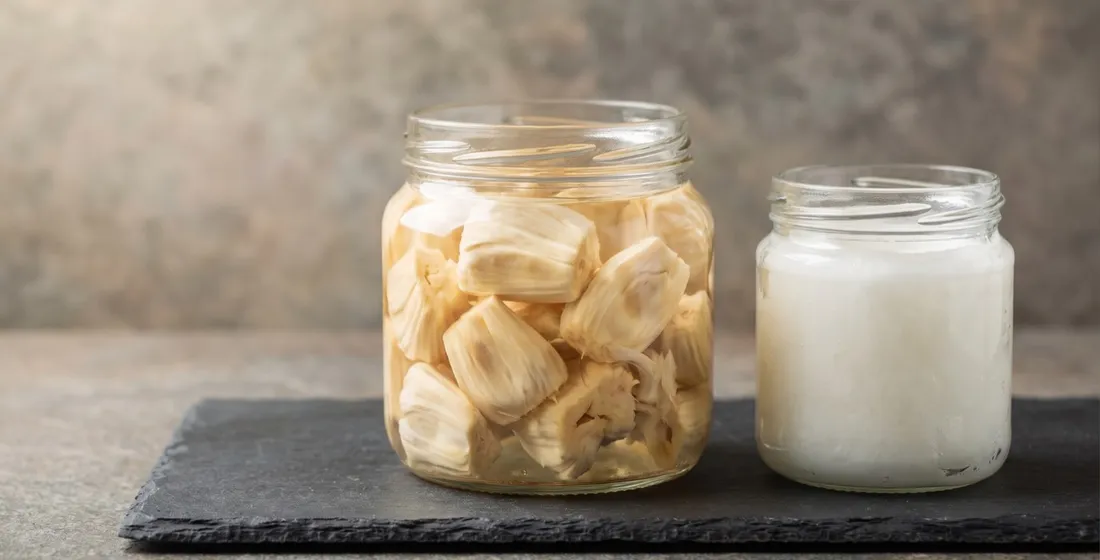
A jackfruit-in-brine spec that lists only net weight is incomplete. The buyer-facing number for a retort glass-jar SKU is drained weight, the mass of jackfruit remaining after the packing liquid is removed, because that is what a formulator actually has to work with once the jar is opened.
The test method most buyers reference traces back to the same fill-of-container logic the US FDA applies to vegetables packed in liquid: pour the contents onto a weighed sieve, drain for two minutes, then reweigh (US Food and Drug Administration, Macroanalytical Procedures Manual, MPM V-11, retrieved 2026-09-23). Codex Alimentarius sets a parallel international standard for canned vegetables under CXS 297-2009. Neither document names jackfruit specifically, but the sieve-and-drain method is the one a buyer’s own QA team will run against an incoming sample, so it is worth naming in the RFQ rather than assuming the supplier already knows which test applies.
One commercially available in-brine jackfruit product lists a net weight of 565 grams against a drained weight of 280 grams (Roland Foods, product specification, retrieved 2026-09-23), a ratio just under 50%. That ratio is not a universal constant. Cut format, brine concentration, and fill practice all move it, which is exactly why the RFQ should state a target drained-weight percentage and a tolerance band rather than a net weight alone.
Spec snapshot: in-brine jackfruit and patty fat RFQ line items
- Jackfruit cut format: chunk, pulled, or minced (state which; each drives a different shred pattern in the finished patty)
- Jackfruit drained weight target: state percentage of net fill weight and tolerance band, tested per the sieve-and-drain method
- Jackfruit pH and process: young jackfruit is low-acid, so retort processing to commercial sterility is required for ambient shelf life
- Fat source: coconut oil (refined or virgin), and any blended-fat or fiber-flake system if marbling or firmness is a target attribute
- Fat functional spec: melting point range, saturated fat grams per 100 grams, oxidative stability under accelerated storage
- Cert coverage required: BRCGS, FSSC 22000 V6, plus USDA Organic or EU Organic if either SKU carries an organic claim
Matching jackfruit cut format to the patty or nugget SKU
Chunk format holds its shape through grinding and suits a coarse-ground patty where visible fiber strands are part of the eating experience. Pulled format is pre-shredded and drops straight into a mince-style blend without an extra grinding pass, which shortens the formulation line’s process steps. Minced format is the finest cut and blends fastest into a smooth nugget-style batter, at the cost of the visible shred a chunk or pulled format gives a patty.
Silk Foods Ceylon runs jackfruit in brine, chunk, pulled, and minced, on the same retort glass-jar line at up to 3,000 jars a day, under BRCGS and FSSC 22000 V6. First-order MOQ is 1,500 jars per cut format; sample dispatch runs 1 to 2 weeks by international courier, and a production PO runs 2 to 3 weeks from confirmation to dispatch. Buyers evaluating the jackfruit-in-brine retort glass-jar formats used in plant-meat SKUs can pair that spec detail directly with the fat-line spec below, since both run through the same Matale facility and the same audit.
What functional specs does the patty fat line item need to carry?
A fat source line item that only says “coconut oil” is under-specified for a formulator. The functional parameters that decide whether a fat system works in a patty are melting point range (whether the fat is solid or liquid at ambient and at griddle temperature), saturated fat content per 100 grams (which decides label claims in both the US and EU), and oxidative stability under accelerated storage (which decides shelf life once the SKU ships).
Refined coconut oil is a common default because it is solid near room temperature and behaves like conventional animal fat during cooking, but it is not the only option a buyer should specify against. Ingredient suppliers have started shipping coconut-oil-and-fiber blends built specifically to improve marbling, firmness, and slice integrity in plant-based meat formats, which means the RFQ should ask whether the supplier can quote a blended system as well as the neat oil. A 2025 label review of 29 plant-based burgers sold in Spain found sunflower oil in roughly 52% of ingredient decks against coconut oil in about 7% (Foods, peer-reviewed food science journal, 2025), a shift the RFQ’s fat line item should account for if the target market’s shelf has moved the same direction. Buyers comparing the underlying spec trade-offs in more depth can read the full coconut versus sunflower versus MCT patty fat matrix; this primer covers only what belongs in the RFQ line item itself.
Pricing the fat line item: what the RFQ should flag about coconut oil movement
Coconut oil is a commodity, and its price moves independently of the formulation decision. In Sri Lanka, crude coconut oil priced at roughly USD 2,637 per tonne in the second quarter of 2026 and eased to about USD 2,168 per tonne by July 2026 (ProcurementResource, Crude Coconut Oil Price Trend, July 2026, retrieved 2026-09-23). A patty-fat RFQ quoted against a single-day price without a stated validity window or an adjustment clause is a quote that goes stale before the first PO lands.
| RFQ line item | Format options | Key spec parameter | First-order MOQ | Cert coverage |
|---|---|---|---|---|
| Jackfruit in brine | Chunk, pulled, minced | Drained weight % (state target and tolerance) | 1,500 jars per cut format | BRCGS, FSSC 22000 V6 |
| Patty fat system | Refined coconut oil, virgin coconut oil, coconut-fiber blend | Melting point range, saturated fat g/100g | 1 metric tonne per SKU (bulk oil) | BRCGS, FSSC 22000 V6, USDA/EU Organic on relevant SKUs |
| Combined SKU (finished patty or nugget) | Patty (15,000 units/day capacity) or nugget (30,000 units/day capacity) | Formulation spec sheet covering both inputs | 5,000 to 10,000 units per SKU, first run | BRCGS, FSSC 22000 V6 |
Source: Silk Foods Ceylon facility data, cross-checked against Roland Foods product specification and ProcurementResource coconut oil pricing, 2026.
What co-development questions shorten the launch timeline?
In the second quarter of 2026, the SRV procurement desk fielded a run of formulation briefs that combined a jackfruit protein-mimic base with a fat-system relaunch, arriving in the same stretch that the Good Food Institute later reported as a soft year for US plant-based meat retail. Brands were not launching new SKUs; they were rebuilding existing ones against a tighter cost and taste bar. That pattern is not a footnote; it is the reason a combined RFQ, not two separate ones, is now the faster path to a first sample.
A buyer can shorten the gap between RFQ and first production run by putting these questions in the brief up front, rather than discovering the answers mid-sample:
- Can the jackfruit cut format and the fat system be trialed together in the same sample round, or does the supplier require two separate formulation passes?
- What is the supplier’s typical number of sample iterations before a formulation locks, and does pricing change between iteration rounds?
- Does the retort process for the jackfruit line interact with the fat system’s melting behavior in a way that needs a joint process trial, not two independent ones?
- What documentation does the supplier provide per batch: certificate of analysis, allergen declaration, and organic transaction certificate if either input carries an organic claim?
- What is the realistic timeline from a locked formulation to a first commercial production run, inclusive of both ingredient lead times?
Building the two-line RFQ: a buyer’s checklist
Buyer’s checklist: writing a combined jackfruit and patty-fat RFQ
- State the jackfruit cut format (chunk, pulled, or minced) per intended SKU, not “jackfruit” alone
- State a target drained-weight percentage and tolerance, and name the test method the supplier should use
- State the fat source options the supplier should quote (neat oil versus a blended system) rather than assuming one
- State the functional fat parameters that matter for the SKU: melting point range, saturated fat content, oxidative stability
- Ask whether both line items can run through one supplier’s audit and one documentation pack
- Ask for a price-validity window on any commodity-linked line item, not a single-day quote
- Ask how many sample rounds are typical before formulation lock, and what changes between rounds
- Confirm cert coverage required for both lines: BRCGS, FSSC 22000 V6, plus USDA Organic or EU Organic if either SKU makes an organic claim
Frequently asked questions
What’s the contract manufacturing MOQ for a plant-based patty combining jackfruit and a coconut-based fat system?
Silk Foods Ceylon’s patty line runs at 15,000 units per day and its nugget line at 30,000 units per day, with a first-run contract manufacturing MOQ typically set at 5,000 to 10,000 units per SKU. The jackfruit and fat inputs carry their own MOQs (1,500 jars per cut format; 1 metric tonne per SKU for bulk fat) ahead of the finished-SKU run. Contact SRV for a co-manufacturing capability briefing.
What’s the difference between drained weight and net weight on a jackfruit-in-brine spec?
Net weight is the total contents of the jar, brine included. Drained weight is what remains after a two-minute sieve drain, the FDA’s standard fill-of-container test logic for vegetables packed in liquid (US FDA, Macroanalytical Procedures Manual V-11, 2026). A formulator needs drained weight, not net weight, to calculate actual jackfruit content per patty.
Can SRV supply both the jackfruit and the fat system on one purchase order?
Yes. Both run through the Silk Foods Ceylon facility in Matale under the same BRCGS and FSSC 22000 V6 audit, which lets a buyer combine the two line items into one documentation pack instead of qualifying two separate suppliers.
Does Silk Foods Ceylon manufacture jackfruit-in-brine and patty-fat formulations under BRCGS and FSSC 22000 V6?
Yes. The Matale facility holds BRCGS and FSSC 22000 V6 covering the retort glass-jar line, the oil line, and the shared patty and nugget production line, with USDA Organic and EU Organic available on the relevant fat SKUs.
How long does co-development take before a first production run?
Sample dispatch runs 1 to 2 weeks; formulation work typically adds 2 to 4 weeks on top of the standard 2 to 3 week production lead time, depending on how many sample rounds the combined formulation needs. A combined RFQ that specifies both line items up front tends to need fewer rounds than one written after the fact around two separately sourced ingredients.
How Silk Route Ventures can help
Silk Route Ventures (SRV) contract-manufactures plant-based patties at 15,000 units a day and nuggets at 30,000 units a day, and supplies both the jackfruit-in-brine input and coconut-based fat systems from the same Silk Foods Ceylon (SFC) facility in Matale, under BRCGS and FSSC 22000 V6. Buyers rebuilding a patty or nugget SKU after a formulation change can qualify both the jackfruit line and the fat line against one audit and one documentation pack instead of two. The SRV R&D and NPD team scopes the combined formulation trial in parallel with the production plan, so a two-ingredient RFQ does not turn into two separate sourcing cycles. Contact us to send an inquiry for a co-manufacturing capability briefing covering both line items.
Sources
- The Good Food Institute, “Analyzing plant-based meat and seafood sales” (SPINS retail scan data), 2025 to 2026 report. Retrieved 2026-09-23. https://gfi.org/resource/analyzing-plant-based-meat-and-seafood-sales/
- US Food and Drug Administration, Macroanalytical Procedures Manual, MPM V-11: Vegetables and Vegetable Products. Retrieved 2026-09-23. https://www.fda.gov/food/laboratory-methods-food/mpm-v-11-vegetables-and-vegetable-products
- ProcurementResource, “Crude Coconut Oil Price Trend,” July 2026. Retrieved 2026-09-23. https://www.procurementresource.com/resource-center/crude-coconut-oil-price-trends
- Roland Foods, Young Green Jackfruit in Brine, product specification. Retrieved 2026-09-23. https://rolandfoods.com/product/45021-jackfruit-in-brine
Further reading
- eCFR, Title 21, Part 155, Canned Vegetables → https://www.ecfr.gov/current/title-21/chapter-I/subchapter-B/part-155
- Codex Alimentarius, Standard for Certain Canned Vegetables, CXS 297-2009 → https://www.fao.org/fao-who-codexalimentarius/sh-proxy/es/?lnk=1&url=https://workspace.fao.org/sites/codex/Standards/CXS+297-2009/CXS_297e.pdf
- Foods (MDPI), plant-based burger ingredient deck survey, 2025 → https://www.mdpi.com/journal/foods
Written by the Silk Route Ventures Trade Team. Silk Route Ventures (E-Silk Route Ventures Ltd) is a Sri Lankan B2B supply-chain operator for the Food, Beverage, Wellness, and Nutraceuticals sectors. The Silk Foods Ceylon manufacturing arm operates under BRCGS and FSSC 22000 V6. Questions or to request a sample: Contact us or email info@esilkroute.com.lk.