
Fenugreek Seed and Powder: Saponin Spec and RFQ Checklist
Buyer’s snapshot
- In 2025-26 India exported 47,069 tonnes of fenugreek worth $40.50 million, and Sri Lanka bought 3,394 tonnes of it (Spices Board India, DGCI&S data). Fenugreek moves into Sri Lanka, not out of it.
- “High saponin” is not a spec. Whole seed runs about 0.14% total steroidal saponins; standardized furostanolic concentrates are sold above 45%, roughly 300 times the seed figure.
- The pooled glycemic effect peaks at 15 g of seed per day across 26 randomized trials. A 500 mg capsule cannot carry that dose, and the format table below shows what can.
- Fenugreek is a legume that cross-reacts with peanut, and on most labels it disappears inside the word “spice.”
- Silk Route Ventures supplies bulk fenugreek seed and powder and encapsulates at a 180-bottle MOQ. The twelve-line RFQ at the close is the procurement-actionable part.
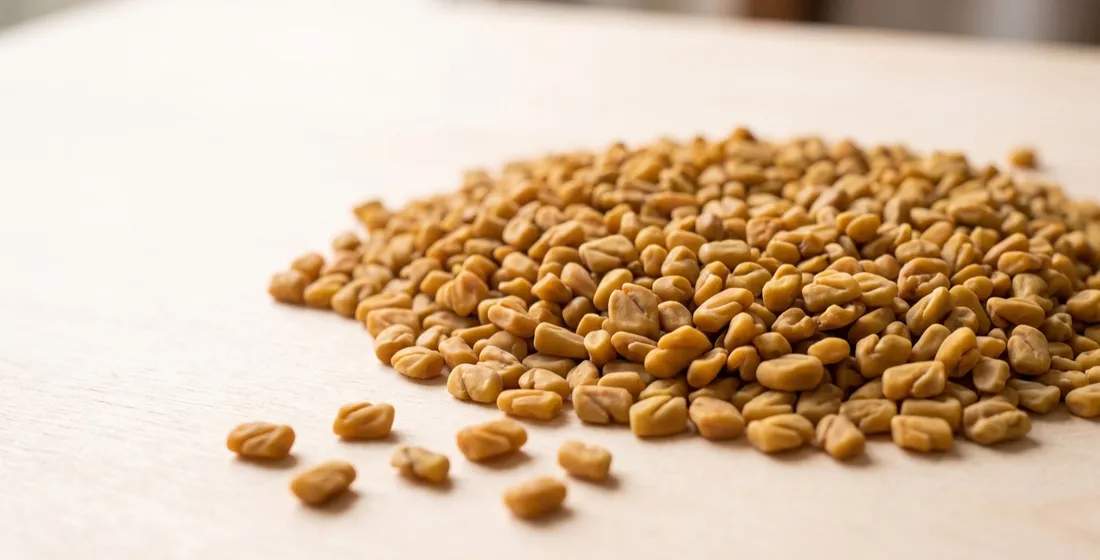
Fenugreek inquiries arrive at the Silk Route Ventures (SRV) trade desk asking for one of two products that are rarely distinguished on the purchase order. Either the buyer wants a culinary spice for a curry blend, where saponins are irrelevant and mesh, moisture, and microbial load decide the deal. Or the buyer wants a functional ingredient for a metabolic or lactation SKU, where the label claim rests on a daily dose the chosen format usually cannot deliver. Different specs, different assays, different price points. This piece separates the two and gives procurement the parameter list to attach to the next inquiry.
What a fenugreek saponin spec actually commits you to
Fenugreek’s steroidal saponin fraction is a family of compounds, not a single number. An HPLC-ELSD-ESI-MS analysis published by Krol-Kogus and colleagues in Acta Pharmaceutica in 2020 measured total steroidal saponins in whole seed at 0.14% and resolved 26 furostanol saponins within that fraction. A buyer who writes “high saponin content” without naming the assay basis has specified nothing a laboratory can test against.
Three bases circulate in fenugreek trade, and they are not interchangeable. Total steroidal saponins is the widest, covering both spirostanol and furostanol forms. Furostanolic saponins is the narrower fraction that standardized extracts are built on, with protodioscin as the usual marker. Diosgenin is the spirostanol aglycone, present in seed at roughly 0.12 to 0.18%, and it is the figure quoted when the buyer is really shopping for a steroid precursor rather than a supplement ingredient.
The gap between those numbers is where most fenugreek RFQs go wrong. A concentrate offered at 45% furostanolic saponins by HPLC sits about 300 times above the whole-seed total. Quoting the two against each other on price per kilogram is meaningless, and quoting them against each other on clinical evidence is worse, because the trial data behind each was generated on a different material.
| Form | Saponin basis | How it is assayed | Where it fits |
|---|---|---|---|
| Whole seed | About 0.14% total steroidal saponins | HPLC-ELSD, or not assayed at all | Curry blends, sprouting, milling inputs |
| Milled powder, culinary grade | Seed basis, unstandardized | Usually not assayed | Curry powder, tea cut, gram-dose sachets |
| Debitterised or defatted powder | Seed basis, saponins retained | HPLC | Food formats, fibre and saponin together |
| Standardized furostanolic extract | 45% and above | HPLC against a named marker | Capsules and tablets at milligram doses |
| Diosgenin-basis material | 0.12 to 0.18% in seed, concentrated in extract | HPLC or HPTLC | Steroid-precursor and speciality uses |
Source: Krol-Kogus et al., Acta Pharmaceutica 2020, plus supplier specification practice observed at the SRV trade desk.
How much fenugreek does a metabolic SKU actually need?
In 2025, Chehregosha and colleagues published an updated meta-analysis in Avicenna Journal of Phytomedicine pooling 26 randomized controlled trials and 1,625 participants. Fenugreek seed lowered fasting blood glucose by 16.75 mg/dl and HbA1c by 0.63 percentage points against control. The non-linear dose-response analysis placed the largest fasting-glucose reduction at 15 g per day, and doses at or below 1 g showed minimal effect.
That is the number most brand teams have never run against their own pack. Fifteen grams a day of seed powder is a food-format dose, not a capsule dose. The math is unkind to the format most brands want to launch.
| Format | Typical unit | Units needed for 15 g of seed per day | Workable |
|---|---|---|---|
| 500 mg capsule | 60-count bottle | 30 capsules | No |
| 1,000 mg tablet | 90-count bottle | 15 tablets | No |
| 5 g stick pack | Single serve | 3 sticks | Yes |
| 10 g scoop, powder tub | 300 g tub | 1.5 scoops | Yes |
| Standardized extract capsule | 500 mg at 45% saponins | Not equivalent by weight | Claim must follow the extract’s own trial data |
Source: dose requirement from Chehregosha et al., Avicenna Journal of Phytomedicine 2025; format units from SRV private-label pack specifications.
The last row is the one that gets missed. An extract capsule is a legitimate product, but it cannot borrow the evidence base built on 10 to 15 g of whole seed. If the pack is going to reference glycemic research, the material in the capsule has to be the material the research used, or the brand needs trial data on its own extract. Buyers running the same question on other botanicals will recognise the pattern from the Gymnema sylvestre blood-sugar spec and from cinnamon capsules for blood-sugar claim SKUs, where the assay basis and the claim basis diverge in exactly the same way.
What does the evidence support for galactagogue positioning?
The US National Library of Medicine’s LactMed database, last revised on 15 July 2026, records mixed findings for fenugreek as a galactagogue. One meta-analysis reported a mild effect with an unknown safety profile; another found no good evidence of a galactagogue effect at all. Doses studied for milk supply ran 1 to 6 g daily, well below the metabolic range.
LactMed also records what a formulator needs for the safety section of a dossier. In one survey, 45% of users reported an adverse reaction, most commonly gastrointestinal. Fenugreek imparts a maple-syrup odour to urine, sweat, and possibly breastmilk. It can interact with warfarin to cause bleeding, and because it lowers blood glucose, it stacks with diabetes medication in a way that belongs in the warning panel rather than the marketing copy.
Where SRV’s spec discipline does not fit
Brands that want a hard “increases milk supply” statement on pack. The evidence does not carry that claim, and a supplier who says it does is selling the brand a regulatory problem rather than an ingredient. Fenugreek is a defensible traditional-use ingredient in a lactation blend. It is not a proven galactagogue, and the difference matters at the point where a competitor files a complaint.
Where fenugreek actually comes from, and what a Ceylon spec can honestly say
In 2025-26 India exported 47,069 tonnes of fenugreek valued at $40.50 million, according to the Spices Board India export tables compiled from DGCI&S data. Sri Lanka was among the buyers, taking 3,394 tonnes that year against 2,491 tonnes the year before. Fenugreek is an Indian crop by volume, and Sri Lanka is a net importer of it.
That has a direct consequence for anyone writing a Ceylon spice RFQ. Fenugreek is used heavily in Sri Lankan cooking, and it appears in almost every Sri Lankan curry blend, which is why it sits in the catalogue of most Sri Lankan spice exporters. It is not a Ceylon-origin crop in the sense that true Ceylon cinnamon is. A Sri Lankan supplier quoting fenugreek is operating as a sourcing agent on that line, and the RFQ should name the growing origin, the import chain, and who holds the certificate of analysis.
The SRV procurement desk sees the same confusion about twice a quarter. A buyer drops a fenugreek line item inside a wider Ceylon spice inquiry, assumes the origin statement travels across the whole basket, and finds out at the certificate-of-origin stage that one line was sourced rather than grown. Nobody is misled on purpose. The specification sheet simply never asked the question.
| Year | Indian export volume (tonnes) | Export value ($ mn) | Implied unit value ($/tonne) | Volume to Sri Lanka (tonnes) |
|---|---|---|---|---|
| 2021-22 | 32,402 | 35.27 | 1,088 | 1,961 |
| 2022-23 | 35,055 | 33.20 | 947 | 2,190 |
| 2023-24 | 30,855 | 32.14 | 1,042 | 1,679 |
| 2024-25 | 44,516 | 43.23 | 971 | 2,491 |
| 2025-26 | 47,069 | 40.50 | 860 | 3,394 |
Source: Spices Board India, Major Item and Country-wise Export of Spices from India, DGCI&S Kolkata. Unit values calculated from the published volume and value columns.
The price column carries the procurement point. Volume rose about 6% between 2024-25 and 2025-26 while value fell about 6%, pulling implied unit value down from roughly $971 to $860 per tonne. Acreage expanded after the strong 2024-25 season and the market softened. Any fenugreek price a buyer is holding from a 2024 contract is stale, and worth re-quoting before the next purchase order goes out.
Contaminant and microbial parameters to write into the spec
The US Food and Drug Administration’s Draft Risk Profile: Pathogens and Filth in Spices found an average Salmonella prevalence of 6.6% across imported spice shipments sampled between fiscal years 2007 and 2009, and filth adulteration in 12% of shipments. Spice is one of the FDA’s higher-scrutiny import categories, and fenugreek carries the same field-crop exposure as any other seed spice.
Sterilisation is the parameter most often left blank. Ethylene oxide is not permitted for treating foodstuffs in the EU, and it has been a recurring theme in Rapid Alert System for Food and Feed notifications on herbs and spices. Saturated steam is the route that keeps a shipment clean on entry. Ask for the treatment method by name, in writing, on the specification rather than the quotation.
Pesticides need the destination panel named. Under Regulation (EC) No 396/2005 a default maximum residue level of 0.01 mg/kg applies wherever no specific limit has been set for the crop and active, which catches a lot of seed spices where crop-specific limits were never established. Buyers who have been through this on other seed spices will recognise the discipline from the coriander, cumin, and fennel MRL work.
Buyer’s checklist: fenugreek contaminant and microbial spec
- Salmonella absent in 25 g, with the method stated
- Total plate count, yeast and mould, and E. coli ceilings
- Sterilisation method named, saturated steam preferred, ethylene oxide excluded in writing
- Pesticide panel matched to the destination market, with the MRL basis referenced
- Heavy metals panel covering lead, cadmium, arsenic, and mercury with action levels
- Moisture ceiling, typically 10% or lower for milled powder
- Foreign matter and extraneous vegetable matter limits
- Certificate of analysis on every batch, not on the first shipment only
Does fenugreek need an allergen declaration?
Fenugreek is a legume, and it cross-reacts with peanut. Takei and colleagues, publishing in the Journal of Allergy and Clinical Immunology: Global in 2024, showed that peanut allergen inhibited IgE binding to a fenugreek protein at a lower concentration than fenugreek itself, indicating peanut as the primary sensitizer. Their paper notes that fenugreek is often hidden on labels inside the generic term “spice.”
Neither the US major food allergen list nor the fourteen allergens in EU food-information rules include fenugreek, so there is no mandatory declaration in either market. That’s the legal position, and it isn’t the whole answer. In a curry blend at 1 to 2% inclusion, “spice” is a defensible declaration. In a supplement or a lactation blend where fenugreek is the functional ingredient at gram doses, naming it explicitly on the ingredient panel is the position a brand can defend if a peanut-allergic consumer reacts.
The regulatory footing for food use is straightforward. Fenugreek appears in the FDA’s list of spices and other natural seasonings and flavourings generally recognized as safe, at 21 CFR 182.10, entered as “Fenugreek, Trigonella foenum-graecum L.” That GRAS listing covers seasoning use in food. It is not a clearance for a gram-dose supplement, which sits under a separate framework.
Physical spec: mesh, mucilage, and the maple note
Fenugreek seed carries roughly 45 to 60% carbohydrate, and about 30% of the seed is soluble galactomannan fibre. Isolated fenugreek gum from the endosperm runs about 73.6% galactomannan, per the review by Dhull and colleagues in Legume Science in 2023. That mucilage is why fenugreek powder behaves badly in a dry free-flowing blend and behaves well in anything where viscosity is the point.
Two milling consequences follow. First, the seed carries fixed oil, so grinding heat and oil release cause caking and screen blinding, which is why fenugreek powder is usually specified at a coarser mesh than a leaf powder. Ask for the particle size distribution, not a single mesh number. Second, the powder is hygroscopic once the galactomannan is exposed, so moisture at intake and packaging barrier both matter more than they do for a dry-leaf material.
Then there is the aroma. Sotolon is the compound that gives fenugreek its maple and curry note, present predominantly as the (5S) enantiomer, and it is the same chemistry behind the maple-syrup odour LactMed records in users. It carries through processing. A fenugreek inclusion that seems modest on the raw-material bench will dominate a finished blend’s aroma, and it is the reason sensory panels should be run at final inclusion rather than on the ingredient.
Spec snapshot: fenugreek seed and powder
Botanical: Trigonella foenum-graecum L., seed Forms available: whole seed, kibbled, milled powder Soluble fibre: about 30% of seed as galactomannan Total steroidal saponins, whole seed: about 0.14% Moisture: 10% maximum for powder Sterilisation: saturated steam, ethylene oxide excluded SRV bulk MOQ: 50 kg per SKU on first order Capsule MOQ: 180 bottles per single shift
The fenugreek RFQ: twelve lines to send with the inquiry
Most fenugreek quotations come back unusable because the inquiry asked for a price before it described a product. These twelve lines close that gap, and they work equally for a culinary line item and a functional one.
- Botanical name and plant part: Trigonella foenum-graecum L., seed
- Form: whole seed, kibbled, or milled powder
- Growing origin named, plus the country of export, stated separately
- Intended application and the target daily dose in the finished SKU
- Saponin basis if any: total steroidal, furostanolic, or diosgenin, with the assay method
- Moisture ceiling and fixed-oil range
- Particle size distribution rather than a single mesh figure
- Microbial panel with methods, Salmonella absent in 25 g
- Sterilisation treatment named, ethylene oxide excluded
- Pesticide panel matched to the destination market, with the MRL basis
- Heavy metals panel with action levels
- Documentation set: batch certificate of analysis, certificate of origin, phytosanitary certificate, organic transaction certificate where applicable, and allergen and GMO statements
A supplier who can answer all twelve without a follow-up call is quoting the same product the buyer is buying. A supplier who answers four of them is quoting something else.
Frequently asked questions
What saponin content should I specify for fenugreek seed powder?
For unstandardized seed powder, specify total steroidal saponins and expect around 0.14%, the figure Krol-Kogus and colleagues measured by HPLC-ELSD in Acta Pharmaceutica in 2020. If the SKU needs a higher number, you are buying a standardized furostanolic extract at 45% and above, which is a different material at a different price.
How much fenugreek seed does a blood-sugar SKU need per day?
The 2025 meta-analysis in Avicenna Journal of Phytomedicine, pooling 26 randomized trials and 1,625 participants, found the largest fasting-glucose reduction at 15 g of seed per day, with minimal effect at or below 1 g. That points to sachets, stick packs, or powder tubs rather than a 500 mg capsule format.
Is fenugreek an allergen that has to be declared?
Fenugreek is not on the US major allergen list or in the EU’s fourteen, so declaration is not mandatory. It does cross-react with peanut, shown in vitro by Takei and colleagues in 2024, and it usually hides under “spice” on labels. Naming it explicitly is the defensible choice for gram-dose supplement SKUs.
Does Silk Route Ventures manufacture fenugreek capsules under contract?
Yes. The Silk Foods Ceylon encapsulation line runs 100,000 capsules per single shift and 200,000 per day, with a private-label MOQ of 180 bottles. Bulk fenugreek seed and powder ships against the buyer’s spec at 50 kg per SKU. Samples move door to door by international courier in 3 to 5 business days.
How Silk Route Ventures can help
Silk Route Ventures (SRV) supplies bulk fenugreek seed and powder against the buyer’s specification and manufactures herbal supplement capsules at the Silk Foods Ceylon (SFC) facility in Matale, which holds BRCGS and FSSC 22000 V6 across the relevant processing scope. Bulk MOQ is 50 kg per SKU on a first order; the capsule line runs a 180-bottle private-label MOQ and 200,000 capsules a day. On fenugreek specifically the team quotes as a sourcing agent against a named growing origin rather than as a Ceylon-origin claim, and says so on the specification sheet. For brands building a wider botanical range, the same site covers the functional herb and Ayurvedic botanical portfolio under one certification stack. Contact us to send an inquiry or request a sample. The full range sits on our Ceylon spices supplier.
Sources
- Krol-Kogus B, Glod D, Krauze-Baranowska M. Qualitative and quantitative HPLC-ELSD-ESI-MS analysis of steroidal saponins in fenugreek seed. Acta Pharmaceutica, 2020, 70(1):89-99. Total steroidal saponin content and furostanol saponin profile. https://pubmed.ncbi.nlm.nih.gov/31677375/ (retrieved 11 August 2026)
- Chehregosha F, Fakhr L, Tarighat-Esfanjani A, Maghsoumi-Norouzabad L. The effects of fenugreek (Trigonella foenum-graecum) seed on glycemic parameters: an updated systematic review and meta-analysis of randomized controlled trials. Avicenna Journal of Phytomedicine, 2025, 15(6):1677-1699. Pooled effects and dose-response. https://pmc.ncbi.nlm.nih.gov/articles/PMC12777671/ (retrieved 11 August 2026)
- US National Library of Medicine, Drugs and Lactation Database (LactMed), Fenugreek monograph, last revised 15 July 2026. Galactagogue evidence, dose range, adverse effects, and warfarin interaction. https://www.ncbi.nlm.nih.gov/books/NBK501779/ (retrieved 11 August 2026)
- Spices Board India, Major Item and Country-wise Export of Spices from India, compiled from DGCI&S Kolkata and Ministry of Commerce data. Fenugreek volume and value, 2021-22 to 2025-26. https://www.indianspices.com/export/major-itemwise-export.html (retrieved 11 August 2026)
- US Food and Drug Administration, Draft Risk Profile: Pathogens and Filth in Spices, 2013. Salmonella prevalence of 6.6% and filth adulteration of 12% in imported spice shipments, FY2007 to FY2009. https://www.fda.gov/food/risk-and-safety-assessments-food/risk-profile-pathogen-and-filth-spices (retrieved 11 August 2026)
- Takei M, Homma Y, Saito A, Yanagida N, Sato S, Ebisawa M. Fenugreek allergy caused by cross-reactivity with peanut: an in vitro analysis. Journal of Allergy and Clinical Immunology: Global, 2024, 3(3):100292. https://pmc.ncbi.nlm.nih.gov/articles/PMC11260561/ (retrieved 11 August 2026)
- US Food and Drug Administration, 21 CFR 182.10, Spices and other natural seasonings and flavorings generally recognized as safe. Fenugreek, Trigonella foenum-graecum L. https://www.law.cornell.edu/cfr/text/21/182.10 (retrieved 11 August 2026)
- Dhull SB, et al. Fenugreek (Trigonella foenum-graecum) gum: a functional ingredient with promising properties and applications in food and pharmaceuticals. Legume Science, 2023, 5:e176. Galactomannan content of seed and isolated gum. https://onlinelibrary.wiley.com/doi/full/10.1002/leg3.176 (retrieved 11 August 2026)
- European Union, Regulation (EC) No 396/2005 on maximum residue levels of pesticides in or on food and feed of plant and animal origin. Default MRL of 0.01 mg/kg where no specific limit is set. https://eur-lex.europa.eu/eli/reg/2005/396/oj/eng (retrieved 11 August 2026)