
Coriander, Cumin, and Fennel: Blend Formulation and MRL Discipline for Export Curry Blends
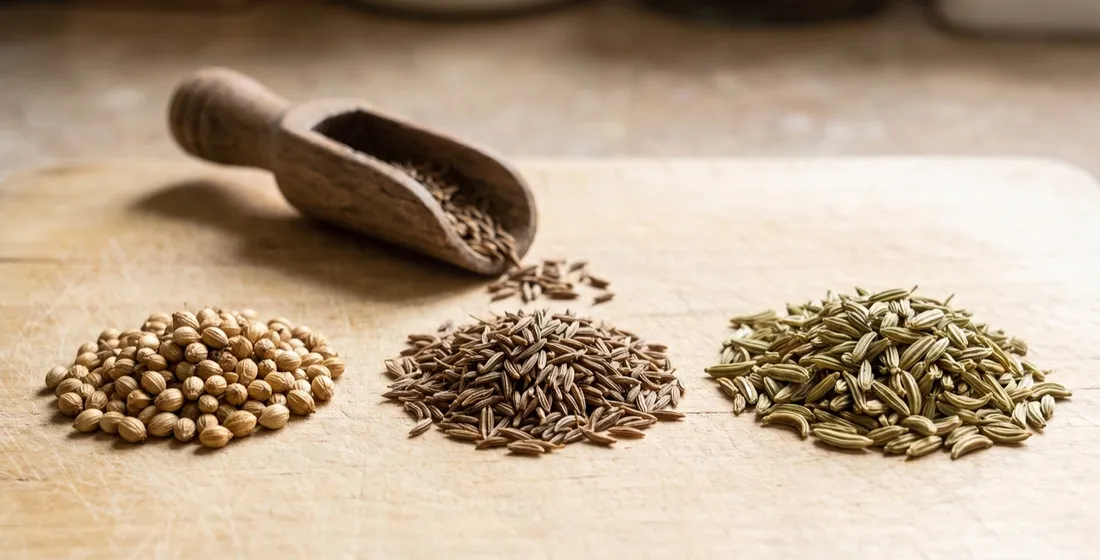
Buyer’s snapshot
- In 2026, the European Commission proposed cutting MRLs for profenofos and fenpropathrin on coriander, cumin, and fennel to the limit of determination, 0.01 to 0.02 mg/kg (AGRINFO Platform, 2026).
- For a blended curry powder, that ceiling applies to each spice before it reaches the mixer, not to the finished blend as an average.
- Silk Route Ventures (SRV) manufactures coriander, cumin, and fennel through its Silk Foods Ceylon (SFC) facility, on a dedicated spice line at 100 to 200 kg per hour under BRCGS and FSSC 22000 V6, with a 50 kg first-order MOQ per SKU.
- The spec matrix further down is the reference sheet procurement teams need before sending a curry blend RFQ.
- Written for specialty spice brands and CPG formulators re-specifying a curry blend for US, EU, or UK retail, not for home cooks.
India supplies roughly 85 to 87% of the world’s cumin and is the largest exporter of coriander seed by value, per 2024 trade data (Observatory of Economic Complexity, 2024). Most curry blends sold into the US, EU, and UK trace their coriander, cumin, and fennel to that same handful of growing regions, whatever brand sits on the label. That concentration isn’t the part of the sourcing brief buyers usually stress-test. What gets missed: what happens to compliance once three single-origin spices, each with its own pesticide residue and microbial history, get roasted, ground, and blended into one SKU. A curry blend isn’t one ingredient with one MRL profile. It’s three, and this piece is a companion to SRV’s curry powder formulation for private label retail piece, focused here on the three-spice base.
What changed in the EU’s pesticide residue limits for coriander, cumin, and fennel
In 2026, the European Commission proposed lowering the MRLs for profenofos and fenpropathrin on a group of spices that includes coriander, cumin, fennel, and cardamom to the limit of determination, 0.01 to 0.02 mg/kg (AGRINFO Platform, Maximum residue levels for profenofos, 2026). The European Food Safety Authority couldn’t complete a full risk assessment on the existing limits because the underlying residue data was incomplete, so the default under EU pesticide law is to push the ceiling down to what current testing can actually detect. For buyers, the practical effect is the same either way: a supplier who hasn’t already tightened intake screening on these three spices will fail the new ceiling on the next shipment, not the one after.
Cumin carries an added wrinkle: an elevated EU import-testing frequency, 30% of consignments as of January 2025, reflecting a higher historical rate of MRL breaches on the commodity (CBI, What requirements must herbs and spices meet to be allowed on the European market?, 2026). Coriander and fennel don’t carry that same testing rate today, but a supplier sourcing all three from one region should expect scrutiny to travel across the group.
Dried spices carry their own MRL math under Regulation (EC) No 396/2005. The EU converts a fresh-crop residue limit into a dried-product ceiling using a dehydration factor; coriander leaf carries a factor of 13 (CBI, 2026). Coriander, cumin, and fennel seed are tested on the dried product directly rather than converted from a fresh-crop baseline, one more reason intake testing on the dried lot matters more than a supplier’s claim about how the crop was grown.
Does blending three spices dilute a pesticide residue problem?
No. A curry blend’s MRL compliance is assessed against each active substance in each named commodity, not against the finished blend as a single averaged product. Procurement teams sometimes assume mixing three spices “evens out” a residue spike in one of them. It doesn’t work that way at the border or in a retailer’s own testing programme. A shipment gets flagged on whichever single ingredient trips its own ceiling, and the recall traces back to that ingredient’s country and lot, not to the blend as a whole. It’s the same species-and-lot-level discipline behind SRV’s Ceylon cinnamon vs Vietnamese cassia sourcing comparison: know exactly what you’re testing, at the ingredient level, before it goes into anything blended.
The 2021 ethylene oxide crisis is the clearest recent case study. A September 2020 finding in Indian sesame seed expanded into more than 700 RASFF notifications across 2021, including a single quarter with five formal notices for Indian sesame plus 26 more for other Indian foods, among them ground coriander seed, black pepper, and ground ginger (Food Safety News, EU countries hit out at ethylene oxide recall measures, 2021). None of those notices were about finished spice blends on a shelf. Every one traced to a raw-material lot fumigated before it ever reached a blender.
The lesson the SRV procurement desk took from that period is straightforward: intake testing has to happen on each spice before blending, not on the finished SKU. By the time a problem shows up in a blended product, the recall has already reached three customers instead of one supplier.
Formulating a curry blend: ratio discipline, roast profile, and intake testing
Spec snapshot: coriander, cumin, and fennel for curry blend formulation
- Coriander (Coriandrum sativum): volatile oil roughly 0.3 to 1.0% by weight; moisture ceiling 10 to 12%; screened for Salmonella, E. coli, and the destination market’s dried-seed MRL panel.
- Cumin (Cuminum cyminum): volatile oil roughly 2.0 to 4.5% by weight, the highest of the three; moisture ceiling 8 to 10%; elevated EU import-testing frequency.
- Fennel (Foeniculum vulgare): volatile oil roughly 1.5 to 3.0% by weight; moisture ceiling 8 to 10%.
- SRV MOQ: 50 kg first order per spice SKU; 2 to 3 week PO-to-dispatch lead time once the spec is confirmed.
A curry blend formulation brief usually specifies four things: the coriander-cumin-fennel ratio plus turmeric, chili, and the rest of the base; the roast profile (raw, light, or dark); the grind (whole, cracked, or fine powder); and the target flavor and heat index. At the Matale facility, the spice line runs the same three intake tests on every lot before it’s released to blending: a moisture check, a pesticide residue panel matched to the destination market, and a microbial screen for Salmonella and E. coli. A lot that fails any one of the three doesn’t go into the mixer, whatever the shipment schedule says.
Formulation and blending follows five steps in sequence:
- Intake testing on each raw spice against the destination market’s MRL and microbial panel.
- Roasting to the buyer’s spec. Roasting shifts flavor and color; it does not reduce pesticide residue, and only modestly reduces microbial load without a validated kill step.
- Grinding to the target mesh size.
- Blending to the formulation ratio, with a homogeneity check across the batch.
- Batch COA covering moisture, microbial, and the pesticide panel, issued before dispatch.
For buyers running a private-label programme, the ratio itself is the intellectual property. SFC holds a buyer’s specific ratio under a private-label agreement rather than publishing a house blend. Contract manufacturing works the same way when the buyer brings an existing formulation to scale; the difference is who owns the development work, not how the line runs it. The same grade-and-ratio discipline shows up in SRV’s cardamom grading breakdown for B2B buyers.
What certifications matter for an export-ready curry blend programme?
| Parameter | Coriander | Cumin | Fennel |
|---|---|---|---|
| Volatile oil (whole seed) | 0.3 to 1.0% | 2.0 to 4.5% | 1.5 to 3.0% |
| Moisture ceiling | 10 to 12% | 8 to 10% | 8 to 10% |
| Primary buyer screen | Salmonella, E. coli, dried-seed MRL panel | Salmonella, E. coli, elevated-frequency MRL panel | Salmonella, E. coli, dried-seed MRL panel |
| SRV first-order MOQ | 50 kg per SKU | 50 kg per SKU | 50 kg per SKU |
Source: SRV facility data plus a comparative GC/MS seed-spice survey, National Academy Science Letters, 2021.
Certification snapshot: Silk Foods Ceylon, Matale
- BRCGS (covers the spice line, including coriander, cumin, and fennel processing)
- FSSC 22000 V6 (covers the full processing scope, spices through capsules and plant-based lines)
- USDA Organic and EU Organic (per-SKU, where the raw material carries organic status)
- Sri Lanka EDB-registered, US FDA-registered facility
For a curry blend headed into UK or EU retail, BRCGS is usually the gating certification multiples ask for first. FSSC 22000 V6 covers the same processing scope for the broader GFSI-recognition requirement most international buyers screen on. Buyers sourcing for US retail typically look for FSSC 22000 V6 and, where an organic claim is on the label, USDA Organic. EU-bound organic claims need EU Organic specifically, since USDA Organic and EU Organic aren’t mutually recognized for every SKU (see SRV’s buyer’s guide to organic certifications for the dual-cert cost and timeline math); a blend that mixes organic and conventional raw material has to carry the paperwork for each input separately, not a single blend-level organic claim.
Private label curry blend economics: MOQ, lead time, and roast customization
For a first private-label curry blend order, the MOQ is 50 kg per spice SKU going into the mixer. A five-ingredient blend, coriander, cumin, fennel, turmeric, and chili, means at least 250 kg of combined raw material for the first run (SRV MOQ ladder; the per-SKU floor multiplies with SKU count, not a shared 50 kg pool). PO-to-dispatch runs 2 to 3 weeks once the ratio and roast profile are confirmed; samples ship by international courier in 3 to 5 business days. Volume-tier pricing breaks at 500 kg, 1,000 kg, and 2,500 kg per SKU, which matters once a blend moves from a pilot SKU to a repeat retail listing.
Buyers running this RFQ usually fall into one of two camps: brand owners specifying a fixed formulation against an existing co-packer, and newer brands asking the SFC R&D team to help set the ratio and roast profile from scratch. SRV serves both. The intake-testing and MRL discipline above applies identically whether the spec arrives fully formed or gets developed on the line.
Buyer’s checklist: specifying a curry blend RFQ
- Ratio and roast profile confirmed in writing (raw, light-roast, dark-roast).
- Destination-market MRL panel specified per ingredient, not just for the finished blend.
- Moisture and microbial ceilings stated per raw spice.
- Batch COA format agreed before the first PO.
- Organic or conventional status confirmed per SKU going into the blend.
- Sample lead time and first-order MOQ confirmed (50 kg per SKU at SFC).
FAQ
What pesticide residue panel does a curry blend need before export? Coriander, cumin, and fennel are each screened against the destination market’s MRL table before blending, not as a finished blend. In 2026, EU regulators proposed cutting profenofos and fenpropathrin limits on the three to 0.01 to 0.02 mg/kg, the limit of determination (AGRINFO Platform, 2026). Cumin carries a 30% EU import-testing frequency as of January 2025.
Can Silk Route Ventures formulate a private-label curry blend from scratch? Yes. The SFC R&D team sets the ratio, roast profile, and grind against a buyer’s target flavor and heat index, then scales it on the same line used for bulk supply. First-order MOQ is 50 kg per spice SKU, using the same RFQ discipline as SRV’s Cinnamomum verum sourcing RFQ guide.
What’s the difference between coriander, cumin, and fennel on a spec sheet? Cumin runs the highest volatile oil content of the three, typically 2 to 4.5%, against roughly 0.3 to 1% for coriander and 1.5 to 3% for fennel (comparative GC/MS survey, National Academy Science Letters, 2021). Cumin and fennel also carry a tighter moisture ceiling, 8 to 10%, against coriander’s 10 to 12%.
Does roasting reduce pesticide residue in a curry blend? No. Roasting changes flavor, color, and aroma; it does not reliably reduce pesticide residue and only modestly affects microbial load without a validated kill step. Residue compliance has to be built at the intake-testing stage, before roasting, on each raw spice individually.
Are coriander, cumin, and fennel grown in Sri Lanka, or sourced regionally? Sri Lanka grows and exports smaller volumes of coriander, cumin, and fennel alongside its dominant cinnamon trade (Sri Lanka Export Development Board, 2026). Silk Foods Ceylon sources these three regionally to spec, then processes and blends them at Matale under the same BRCGS and FSSC 22000 V6 audit that covers Ceylon cinnamon and black pepper.
How Silk Route Ventures can help
Silk Route Ventures (SRV) supplies coriander, cumin, and fennel, whole or powdered, against a buyer’s spec from the BRCGS and FSSC 22000 V6 audited Silk Foods Ceylon (SFC) facility in Matale. First-order MOQ is 50 kg per SKU, with volume-tier pricing at 500 kg, 1,000 kg, and 2,500 kg; samples ship by courier in 3 to 5 business days. For brands ready to formulate or scale a curry blend under their own label, the SFC R&D team sets the ratio and roast profile, then runs it on the same audited line as the bulk spice supply, whether the brief is private label or contract manufacturing. Contact us to send an inquiry or request a sample pack.