
Curry Powder Formulation for Private-Label Retail: Ceylon Blends and Their MRL Ceiling
Buyer’s snapshot
- The blended-spice market is on track to reach USD 14.93 billion by 2032, growing at an 8.17% CAGR (Fortune Business Insights, 2025), and private-label curry powder is one of its fastest-moving retail lines.
- The formulation that ships is not decided by the recipe. It is decided by the tightest pesticide Maximum Residue Level (MRL) among the component spices, adjusted upward by the EU dehydration factor.
- The EU caps ethylene oxide in herbs and spices at 0.1 mg/kg, treats Salmonella as zero-tolerance, and holds aflatoxin B1 to 5 µg/kg. Blends fail on the weakest ingredient.
- Silk Route Ventures runs custom Ceylon curry-powder blends from a BRCGS and FSSC 22000 V6 audited site, first-order MOQ 100 kg per SKU, with a COA on request.
- The comparison table and RFQ checklist below give procurement a spec sheet that survives a border inspection.
Curry powder is the one blend where a buyer’s biggest compliance risk is invisible on the recipe card. A private-label brief usually starts with flavour, colour, and heat. The line that actually decides whether a container clears customs is a residue number attached to a single ingredient the buyer rarely thinks about. Silk Route Ventures (SRV) supplies Ceylon curry-powder blends to private-label programmes across the US, EU, and UK, and the recurring lesson is the same: the MRL ceiling sets the formulation, not the other way around. This piece walks a product developer through the composition, the regulatory arithmetic, the four residues that trigger border rejections, and the manufacturing spec that keeps a retail SKU on the shelf.
What actually sits inside a Ceylon curry powder blend
A Ceylon curry powder is defined by dark roasting. Where an Indian-style blend is often mixed raw, the Sri Lankan signature is to dry-roast the seed spices before grinding, which pushes the colour toward deep brown and the aroma toward toasted and smoky. That roast character suits meat and lentil curries; a lighter, unroasted build suits fish and seafood.
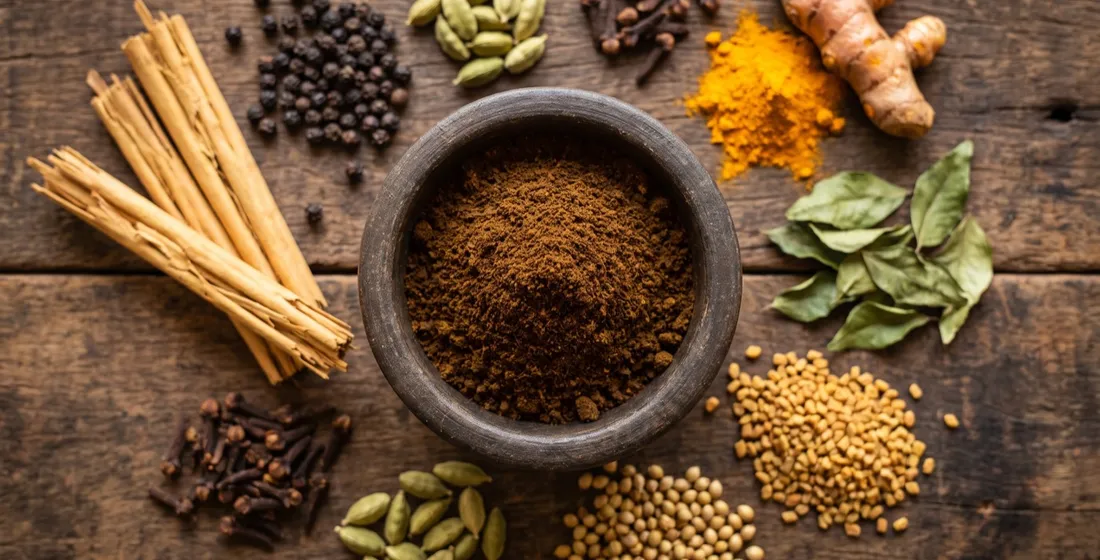
The backbone of the blend is roasted coriander, cumin, and fennel, carried by black pepper, fenugreek, and curry leaves, with true Ceylon cinnamon (Cinnamomum verum), green cardamom, and cloves supplying the sweet-warm top notes. Turmeric provides the colour floor, and chili is dialled in to the target heat. Silk Foods Ceylon (SFC), the manufacturing arm of SRV, holds most of these components as single-origin lines, which means a blend can be specified spice by spice rather than bought as an anonymous pre-mix.
| Component | Role in the blend | Sourcing note |
|---|---|---|
| Coriander, cumin, fennel | Roasted seed backbone | Whole or ground, roasted to spec |
| Black pepper | Pungency and depth | Ceylon-origin, whole or ground |
| Ceylon cinnamon (C. verum) | Sweet-warm top note | Verum, not cassia (see coumarin below) |
| Green cardamom, cloves | Aromatic lift | Whole or powder |
| Fenugreek, curry leaves | The Sri Lankan signature | Dried, ground into the blend |
| Turmeric | Colour and earthiness | Bright orange-yellow, high-curcumin |
| Chili | Heat, dialled to brief | Specified to the buyer’s heat target |
The reason the component list matters is that every one of these spices carries its own residue and contaminant profile, and the finished blend inherits the worst of them.
Why the MRL ceiling, not the recipe, decides your formulation
The EU sets pesticide MRLs on raw commodities under Regulation (EC) No 396/2005, and for a dried or blended spice the raw-commodity limit is not applied directly. Under Article 20 of that regulation, the MRL is multiplied by a dehydration, or concentration, factor because drying removes water and concentrates any residue. The European Spice Association’s published factors run from 3 for dried garlic to 13 for dried coriander leaves (European Commission, DG SANTE guidance SANTE/2021/10704, 2022). The tightest-limited ingredient, concentrated by its own factor, sets the ceiling for the whole blend.
That is the arithmetic most formulation briefs miss. A curry powder is a composite, and its compliant MRL for any given pesticide is derived from the raw spice with the least headroom, not from an average across the recipe. If one component is sourced from a supply chain with heavy chlorpyrifos use, the concentration factor can push a residue that looked safe on the fresh commodity past the limit in the finished powder. In practice this means the formulation is only as compliant as its weakest single ingredient, which is why SRV specifies each spice against the target market’s MRL panel before a blend is locked, rather than testing the blend once at the end and hoping.
For the finished-product side, there is no Codex commodity standard written specifically for curry powder. The citable product specification is ISO 2253:1999, Curry powder, and the contaminant limits sit in the Codex General Standard for Contaminants and Toxins, CXS 193-1995 (FAO/WHO Codex Alimentarius). A blend spec that references both, plus the destination-market MRL panel, gives a private-label buyer a defensible document rather than a taste profile.
The four residues that get curry powder rejected at the EU border
Spices are one of the most-rejected food categories at the EU frontier. A 23-year analysis of RASFF notifications for herbs and spices found that border rejections accounted for 37.9% of notifications and serious-risk decisions for 39.5%, with curry among the top-ten most-notified commodities (Eissa and colleagues, Journal of Food Safety, 2024). Four hazards do most of the damage, and a private-label blend has to be specified against all four.
| Hazard | EU limit for herbs and spices | Basis |
|---|---|---|
| Ethylene oxide (ETO) | 0.1 mg/kg (sum of ETO and 2-chloroethanol, as ETO) | Reg (EC) 396/2005, code 0800000 |
| Aflatoxin B1 / total | 5 µg/kg B1; 10 µg/kg sum B1+B2+G1+G2 | Reg (EU) 2023/915 |
| Salmonella | Absent (zero tolerance) | Reg (EC) 2073/2005 |
| Pesticide residues | Per-commodity MRL times concentration factor | Reg (EC) 396/2005, Art. 20 |
Ethylene oxide is the one that catches formulators out. It has been banned as a food fumigant in the EU since 1991, yet it still appears on spices sterilised or fumigated in some origin markets, and its 0.1 mg/kg limit is set at the level of quantification, which means effectively zero. A single ETO-treated component contaminates the whole blend. The clean alternative is steam sterilisation, which leaves no residue and is the only decontamination route permitted for USDA Organic spices. Specifying steam treatment, in writing, is the single most valuable line a curry-powder RFQ can carry.
The 2020 to 2021 EU ethylene oxide crisis is the cautionary case. What began as an ETO alert on imported sesame seed cascaded across the RASFF system and pulled dozens of spice blends and curries into recall as manufacturers traced contaminated components through their formulas. The lesson for private-label buyers was blunt: a blend is only as traceable as its least-documented ingredient, and a recall does not stop at the spice that failed.
How to specify a compliant Ceylon curry blend in your RFQ
A curry-powder RFQ that protects a retail listing carries more than a flavour brief. It carries the botanical species for each component, the moisture ceiling, the microbial panel, the destination-market pesticide MRL panel, the decontamination method, and the mesh size. Botanical identity matters most where cinnamon is concerned: the EU limits coumarin in cinnamon-based foods to 50 mg/kg, and true Ceylon cinnamon (Cinnamomum verum) carries a fraction of the coumarin found in cassia, which can run roughly one hundred times higher. A blend that claims Ceylon cinnamon but is built on cassia is both a label risk and a coumarin risk.
The practical spec sheet a product developer should hand a manufacturer covers: species and origin per component, moisture typically held under a defined ceiling for shelf stability, a microbial panel covering total plate count, yeast and mould, Salmonella, and E. coli, a pesticide MRL panel matched to the destination market, ETO-free steam sterilisation, mesh and particle size for the finished powder, and a batch COA requirement. SRV screens every blend against this frame before a first production run, and a sample lot ships for the buyer’s own laboratory verification before volume is committed. The point of the exercise is that the residue test is designed into the specification, not bolted on after the container is packed.
What private-label retail needs from the manufacturer
Retail private label adds a layer that bulk ingredient supply does not: the manufacturer’s certifications become the brand’s certifications. For a UK or EU own-label listing, BRCGS is usually the gating standard a retailer requires from an ingredient or finished-blend supplier, with FSSC 22000 V6 serving as the GFSI-recognised filter that most multinational buyers use to qualify a supplier at all. SFC holds both at facility level, and spice blends such as curry powder sit under its FSSC 22000 V6 certification, which lets a co-manufactured curry blend be specified into a retail programme without an additional supplier audit. For US and EU organic listings, USDA Organic and EU Organic sit on top on selected SKUs, confirmed per SKU, removing import-side compliance overhead from the buyer.
Certification and capacity snapshot
- Spice blends produced under FSSC 22000 V6 at the BRCGS and FSSC 22000 V6 certified Matale facility, with USDA Organic and EU Organic on selected SKUs, confirmed per SKU.
- Spice and powder line running at 100 to 200 kg per hour, roughly 1 to 2 metric tonnes per day.
- First-order MOQ 100 kg per SKU, with volume-tier pricing at the 500 kg, 1,000 kg, and 2,500 kg breaks.
- A COA on request, with third-party parameters tested through an external laboratory on request, and lots traceable from raw material intake to shipment through our batch coding.
- Samples free for evaluation (you cover the courier); PO to dispatch in 2 to 3 weeks for standard SKUs (4 to 6 weeks for private label, custom specifications and organic orders).
The structural advantage for a private-label brief is SFC’s cellular manufacturing model, which runs more than 400 product variants from one certified site. A custom curry-powder blend does not need a new supplier or a new audit; it is another specified SKU alongside the component spices already produced there. That is what lets a brand move from a first 100 kg order to a 2,500 kg tier without changing the compliance paperwork underneath it.
FAQ
Does SRV manufacture private-label curry powder for a US or EU brand? Yes. Silk Route Ventures develops and co-manufactures custom Ceylon curry-powder blends for private-label retail from the BRCGS and FSSC 22000 V6 audited Silk Foods Ceylon site in Matale. First-order MOQ is 100 kg per SKU, with a COA on request and steam-sterilised, ETO-free processing specified as standard.
What decides whether a curry powder blend passes EU import checks? The tightest pesticide MRL among the components, concentrated by the EU dehydration factor under Article 20 of Regulation (EC) 396/2005, plus the ethylene oxide ceiling of 0.1 mg/kg, aflatoxin limits, and zero-tolerance Salmonella. A blend fails on its weakest single ingredient, so each component is specified to the destination market before the blend is locked.
Why does Ceylon cinnamon matter in a curry powder formulation? The EU limits coumarin in cinnamon-based foods to 50 mg/kg. True Ceylon cinnamon (Cinnamomum verum) carries a fraction of the coumarin of cassia, which can be roughly one hundred times higher. A blend labelled Ceylon cinnamon but built on cassia is both a labelling and a coumarin-compliance risk.
What is the smallest order for a custom curry blend? The first-order MOQ is 100 kg per SKU. Samples are free for evaluation (you cover the courier) and can go to your laboratory for verification, and volume-tier pricing opens at the 500 kg, 1,000 kg, and 2,500 kg breaks, so a private-label programme can scale from trial to full run without changing suppliers.
How Silk Route Ventures can help
Silk Route Ventures (SRV) develops and supplies custom Ceylon curry-powder blends to specialty and private-label brands across the US, EU, and UK. Each blend is specified spice by spice against the destination market’s MRL panel and shipped from the BRCGS and FSSC 22000 V6 audited Silk Foods Ceylon (SFC) facility in Matale, with USDA Organic and EU Organic on selected SKUs, confirmed per SKU. First-order MOQ is 100 kg per SKU, samples are free for evaluation (you cover the courier), and a COA is available on request, with lots traceable from raw material intake to shipment through our batch coding. For distributors consolidating a multi-category spice programme, the same site supplies the component single-origin lines under one certification stack and one freight schedule. Contact us to request a sample pack and a compliance-ready blend specification. Bulk buyers can review specs on our Sri Lankan spices supplier.