
Black Pepper Origin Comparison - Ceylon Vietnam India Indonesia
Publish target: 29 May 2026 | (Specialty Spice Brand) | Service: Ingredient Supply | Template: origin-vs-origin-comparison | Category: Ceylon Spices / Black Pepper
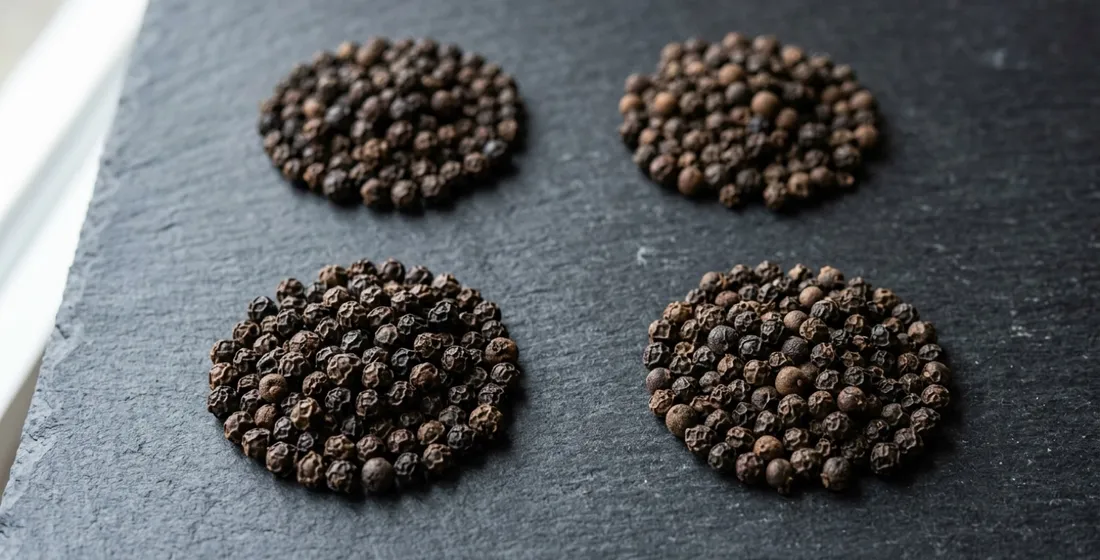
Whole black peppercorns from four major sourcing origins, photographed for spec-level visual comparison. Image: editorial origin-comparison overhead.
Buyer’s snapshot
For a 2026 specialty spice brand sourcing whole or ground black pepper into the EU, US, or AU, the four origins on most procurement shortlists are Vietnam, Indonesia, India, and Sri Lanka. The decision usually hinges on four numbers: piperine percentage, bulk density, FOB price, and the EU MRL reject rate over the last 24 months. Vietnam wins on volume and price discipline. Indonesia wins on bulk density. India wins on grade clarity (Malabar Garbled). Sri Lanka wins on piperine, with Ceylon pepper testing 2 to 6 times the piperine of competing origins (Sri Lanka EDB, 2024). The trade-off is supply: Sri Lanka covers only about 2.5% of global demand, so Ceylon pepper functions as a premium spec layer in a multi-origin sourcing program rather than a single-origin replacement.
Black pepper is the largest spice category in world trade, and most sourcing decks treat it as a commodity question. Global pepper production landed near 520,000 tonnes in 2025, down from prior years on weather and pest pressure across Vietnam and India (International Pepper Community via igrain.in, 2025). The International Pepper Community projects a modest recovery to roughly 533,000 tonnes in 2026.
That tight supply picture is why origin selection now matters more than it did five years ago. Each of the four major origins shipping into the EU, US, and AU comes with a different spec ceiling, a different price floor, and a different compliance risk profile. This guide compares them on the four parameters that show up first in a sourcing RFQ for a 2026 specialty spice brand: piperine and volatile oil, physical spec (bulk density, mesh, moisture), price economics, and EU MRL plus microbial discipline. It closes with the application logic a procurement lead can drop straight into a single-origin or multi-origin specification.
The post is built for: a specialty spice brand owner buying whole, cracked, or ground black pepper for retail private-label or B2B ingredient resale. Silk Route Ventures (SRV) supplies all four origins through its ingredient supply service, and the comparison below reflects what SRV’s procurement team actually sees on incoming COAs and on EU shipment audits.
What the global black pepper map looks like in 2026
Vietnam is the structural anchor of the global pepper trade. It produced roughly 30% of the 855,105 tonne global crop in 2023, with that share holding into 2025 even as total volume contracted (FAOSTAT via Wikipedia, 2024). Some trade analysts put Vietnam’s share above 50% when including re-exports through Ho Chi Minh and the higher-grade processed pepper that re-enters the trade after origin blending (Hanfimex Group, 2025). Either way, Vietnam sets the FOB benchmark that every other origin gets priced against.
India is the second-largest producer and the original source of the global pepper trade. Production has slipped from over 55,000 metric tonnes in 2020 to around 46,000 MT in 2025, the result of erratic monsoons in Karnataka and Kerala plus pest pressure in the Wayanad belt (Didwaniya Group, 2025). India remains the reference origin for graded pepper specifications: Malabar Garbled 1 (MG1) and Tellicherry Garbled Special Extra Bold (TGSEB) are the grade names most procurement teams still use as a quality anchor across other origins.
Indonesia produces roughly 15% of global black pepper, anchored by the Lampung region of southern Sumatra. Lampung is also the origin name that ships into Europe at the highest bulk density, with 550 g/L commercial grade trading at a structural premium to Vietnamese 500 g/L (Tridge, 2025).
Sri Lanka covers around 2.5% of global pepper demand, with cultivation spread across roughly 32,800 acres of hill-country smallholder plots (Sri Lanka EDB, 2024). It is the smallest of the four origins by a wide margin. The Sri Lankan position in the global pepper trade is built on a single piperine claim: Ceylon black pepper tests 2 to 6 times the piperine of other major origins, which is why Ceylon pepper ships to high-spec destinations like Germany, the USA, Australia, and Canada at a premium rather than a discount (Sri Lanka EDB, 2024).
The spec comparison: piperine, volatile oil, bulk density, moisture
The four parameters most procurement teams screen on first are piperine percentage, volatile oil percentage, bulk density, and moisture. Piperine is the alkaloid that delivers pungency and is the active compound for nutraceutical formulations. Volatile oil drives aroma. Bulk density signals berry maturity and is the standard physical screen that distinguishes higher grades from filler. Moisture controls shelf life and microbial risk.
| Spec | Vietnam (550 g/L) | Indonesia (Lampung) | India (Malabar MG1) | Sri Lanka (Ceylon) |
| Piperine (%) | 3.5 min, 4.0 to 5.0 typical | 4.0 to 5.0 typical | 4.5 to 6.5 typical | 7.0 to 12.0 typical |
| Volatile oil (%) | 1.5 min, 1.8 typical | 1.8 to 2.0 typical | 2.0 to 2.5 typical | 2.5 to 4.5 typical |
| Bulk density (g/L) | 500 to 550 | 550 to 600 | 550 min | 500 to 560 |
| Moisture (%) | 12 max | 13 max | 11 max | 12 max |
| Ash (%) | 5 max | 6 max | 6 max | 6 max |
| Mesh (above 28) | 90% min | 90% min | 95% above 3.25 mm | 85% to 95% |
Sources: Vietnamese black pepper spec (Nam Son, 2024); Lampung spec (Tridge, 2025); Malabar MG1 spec (SpiceModo, 2024 and India Spice Board); Ceylon piperine reference (Sri Lanka EDB, 2024) plus Silk Foods Ceylon (SFC) batch COA range, 2024 to 2026.
Two reads from the table. First, the piperine ceiling on Ceylon pepper is the highest by a structural margin: a 9% piperine Ceylon batch tests roughly twice a 4.5% premium Indian Malabar batch, and roughly three times a 3.5% Vietnamese commercial batch. That difference matters whenever the buyer’s downstream application monetizes piperine specifically (nutraceutical capsules, premium tabletop grinders, single-origin retail). Second, Indian Malabar MG1 still owns the cleanest physical spec: 95% of grains above 3.25 mm and a 550 g/L bulk density floor is the legacy grade most European spec sheets still reference, even when the actual shipment originates from Vietnam or Indonesia.
[CITATION CAPSULE] Ceylon black pepper typically tests 7 to 12% piperine, two to six times the level of competing origins (Sri Lanka EDB, 2024). Vietnamese commercial pepper holds at 3.5% piperine minimum and 1.5% volatile oil minimum (Nam Son, 2024). Indian Malabar Garbled 1 (MG1) sets the physical bar at 95% of grains above 3.25 mm with 550 g/L bulk density and 11% maximum moisture (SpiceModo, 2024). Indonesian Lampung typically ships at 550 to 600 g/L, the highest commercial bulk density among the four origins (Tridge, 2025).
Where each origin’s price actually sits in 2026
FOB pricing in 2025 and into the first half of 2026 ran tight across all four origins, the consequence of contracting Vietnamese and Indian volume plus rising compliance and logistics costs (VHB Group, 2025).
| Origin | Grade | FOB price (Q4 2025) | Price per piperine point |
| Vietnam | 500 g/L commercial | USD 6,400 / MT | ~USD 1.83 / kg per piperine % |
| Vietnam | 550 g/L commercial | USD 6,600 / MT | ~USD 1.65 / kg per piperine % |
| Indonesia | Lampung 550 g/L | USD 7,211 / MT | ~USD 1.60 / kg per piperine % |
| India | Malabar MG1 | USD 7,800 to 8,400 / MT typical | ~USD 1.40 to 1.87 / kg per piperine % |
| Sri Lanka | Ceylon premium | USD 8,500 to 9,500 / MT typical | ~USD 1.00 / kg per piperine % |
Sources: Vietnamese and Indonesian FOB pricing (Tridge and Majestic Spice, 2025). Indian Malabar and Ceylon premium ranges reflect Silk Route Ventures (SRV) procurement spread, Q4 2025 to Q1 2026.
The headline FOB number flatters Vietnam: at USD 6.40 per kg for commercial 500 g/L pepper, Vietnamese is roughly 25 to 30% cheaper per kilogram than Ceylon. But when the buyer’s specification monetizes piperine specifically, the price-per-piperine-point comparison flips. Ceylon at USD 9,000 per MT and 9% piperine costs roughly USD 1.00 per kilogram per piperine percentage point. Vietnamese commercial at USD 6,400 per MT and 4% piperine costs about USD 1.83 per kilogram per piperine percentage point. For a nutraceutical capsule SKU formulated around a piperine dose, Ceylon is the cheaper raw material on the active basis even though it ships at the highest absolute FOB.
For a tabletop grinder line or a retail private-label whole pepper, where the buyer is paying for berry size and visual presentation rather than active percentage, Indian Malabar MG1 and Indonesian Lampung 550 g/L typically deliver the better value per dollar.
The compliance map: EU MRL, microbial, RASFF risk
The 2025 RASFF data is unambiguous: pesticide residues are the dominant black pepper rejection cause, and Vietnamese black pepper is the origin most often flagged. In 2025, the EU’s Rapid Alert System for Food and Feed logged 279 spice and herb notifications, of which 35% related to pesticide residues, with cumin from India and black pepper from Vietnam carrying the heaviest concentration (CBI, 2025). Chlorpyrifos remains the recurring flag.
Microbial risk concentrates differently. The European Spice Association (ESA) Quality Minima Document sets Salmonella absent in 25 grams as the absolute floor, with Escherichia coli below 2 log CFU per gram and yeast and moulds below 5 log CFU per gram (ESA Quality Minima, accessed 2026). In the 2022 RASFF data, 45 of 47 black pepper microbial notifications related to Salmonella (CBI, 2025). The control point is water activity: ESA recommends a maximum of 0.65 to prevent microbial growth in storage.
What this means in practice for a 2026 sourcing program:
- Vietnamese black pepper carries the highest pesticide-rejection risk and should ship with a full EU MRL panel COA on every batch. Steam sterilization is now standard from BRCGS-certified and FSSC 22000 V6-scope Vietnamese processors, but the residue risk persists at the farm level before consolidation.
- Indonesian Lampung sits in the middle band on both pesticide and microbial risk. Steam-treated Lampung from a BRCGS-certified packer is the typical EU-ready grade.
- Indian Malabar carries lower pesticide risk than Vietnamese but higher microbial risk if shipped untreated. Steam sterilization or ethylene oxide alternative treatment is the standard mitigation.
- Sri Lanka Ceylon ships at the lowest aggregate compliance risk: the cultivated area is small, mostly smallholder-organic by default, and the consolidation chain is short. Ceylon batches passing through BRCGS-certified processors carry a structurally cleaner residue profile.
[CITATION CAPSULE] In 2025, the EU’s RASFF system logged 279 spice and herb notifications. 35% related to pesticide residues, with Vietnamese black pepper and Indian cumin carrying the highest concentration of rejections; chlorpyrifos remained the recurring flagged pesticide (CBI, 2025). The European Spice Association requires Salmonella absent in 25 grams plus water activity below 0.65 as the microbial floor (ESA Quality Minima, accessed 2026).
Which origin belongs in which buyer’s specification
The procurement decision usually resolves into one of four buyer profiles.
The retail tabletop and grinder buyer typically lands on Indonesian Lampung 550 g/L or Indian Malabar MG1. Both deliver the visual berry weight that consumers associate with quality, the price is workable for retail margins, and both ship to ESA spec from BRCGS-certified Vietnamese, Indonesian, or Indian packers without difficulty.
The ground bulk B2B buyer (food service, large-scale seasoning blender, contract food manufacturer) typically defaults to Vietnamese commercial 500 to 550 g/L. The cost discipline is the controlling variable, and the piperine and volatile oil are acceptable for blended applications where pepper is one ingredient of many.
The premium retail or single-origin storytelling buyer (specialty grocer, gourmet retail, branded gift) typically lands on Ceylon, Malabar Tellicherry, or one of the named single-estate Vietnamese or Indonesian lots. Ceylon is the buyer’s pick when piperine pungency itself is the story.
The nutraceutical or supplement buyer (piperine extract, bioavailability enhancer in turmeric capsules, single-ingredient piperine SKU) almost always lands on Ceylon. The piperine yield per kilogram is high enough that the FOB premium pays back on the active basis.
In the SRV procurement team’s experience supplying all four origins through 2025 and into 2026, the most common error sourcing leads make is comparing FOB price per kilogram instead of price per piperine point or price per cleaned bulk kilogram. The cleaner sourcing decision starts from the downstream application spec and works backward to origin, not the other way around.
The Ceylon premium: piperine discipline as a procurement lever
The Ceylon pepper position in the global trade is small by volume but high in spec advantage. Sri Lanka’s roughly 32,800 acres of pepper produce a crop that historically tests at the high end of the global piperine band: 7 to 12% on most batches, against a global average closer to 3 to 5% (Sri Lanka EDB, 2024). The compound reason for that piperine ceiling is climatic. Pepper grown in the wetter, higher-elevation belts of Sri Lanka’s hill country accumulates piperine at a higher rate than pepper from the lowland Vietnamese and Indonesian plantations, which trade altitude for yield.
For a 2026 specialty spice brand owner, the practical procurement lever this creates is a piperine-anchored RFQ. Instead of specifying “premium Ceylon black pepper,” the cleaner ask is: “Ceylon black pepper, BRCGS-audited steam-treated processor, piperine minimum 8.5%, volatile oil minimum 3.0%, bulk density 520 g/L minimum, moisture maximum 11%, water activity maximum 0.62, full EU MRL panel COA each batch.” That spec locks the origin to Ceylon by piperine and water activity alone, without naming Sri Lanka in the spec sheet, which is the cleanest way for a brand to write a single-origin specification that competing origins cannot back-fill at the same price.
The Silk Foods Ceylon (SFC) procurement team maintains running batch COAs across the 2024 to 2026 Ceylon harvest. The piperine median across the FSSC 22000 V6 certified steam-treated shipment stream sat at 8.7% in 2025 and at 9.1% across the first quarter of 2026, with the 10th-to-90th percentile range running 7.4 to 11.2%.
How Silk Route Ventures supplies Ceylon, Vietnamese, Indian, and Indonesian black pepper
Silk Route Ventures (SRV) operates ingredient supply across all four major black pepper origins. Ceylon black pepper is sourced from the central hill country, consolidated through the Matale processing facility, and shipped under FSSC 22000 V6 scope, with lots traceable from raw material intake to shipment through our batch coding. Vietnamese, Indonesian, and Indian black pepper are sourced from origin-side BRCGS-audited processor partners and shipped under SRV’s consolidated trade documentation: a certificate of analysis on request, a certificate of origin, a phytosanitary certificate where the destination requires it, and an EU MRL pesticide panel tested through an external laboratory on request.
The SRV ingredient supply service covers whole black pepper, cracked black pepper, and ground black pepper in 25 kg multi-wall paper bags with food-grade liner or in 500 kg flexitank-grade super sacks for bulk destinations. A COA is available on request. Commercial orders start from 100 kg per SKU, with private-label retail pouching and branded grinder fill handled through the Silk Foods Ceylon (SFC) contract manufacturing scope.
For a specialty spice brand buying into Europe, North America, or Australasia, the SRV procurement team can ship a single-origin Ceylon SKU, a single-origin Vietnamese or Indonesian commercial SKU, a blended pepper SKU (Ceylon and Vietnamese is the most common 30:70 blend that lifts piperine without trebling FOB), and the matching cracked or ground grades from the same lot.
FAQ
Which origin produces the highest-piperine black pepper?
Ceylon (Sri Lanka) consistently tests at the highest piperine band among major commercial origins, with 7 to 12% piperine on most batches against a global average closer to 3 to 5% (Sri Lanka EDB, 2024). The Silk Foods Ceylon median across 2025 FSSC 22000 V6 certified shipments ran 8.7%, with the inter-quartile range at 7.4 to 11.2%. Vietnamese commercial pepper ships at 3.5% piperine minimum (Nam Son, 2024). Indian Malabar typically tests 4.5 to 6.5%. Indonesian Lampung tests 4.0 to 5.0%. Certifications, MOQs and lead times are listed on our Ceylon spices supplier.
Why is Vietnamese black pepper cheaper than the other origins?
Vietnamese black pepper is structurally the cheapest of the four origins because Vietnam holds roughly 30 to 50% of global supply, plantation yield per hectare is higher than India or Sri Lanka, and the consolidation infrastructure through Ho Chi Minh is the world’s most developed (Hanfimex Group, 2025). Vietnamese FOB sat at USD 6,400 to 6,600 per metric tonne for commercial grades through Q4 2025 (Tridge, 2025). The cost trade-off is pesticide-residue rejection risk: Vietnamese black pepper drives the highest concentration of EU RASFF notifications among the four origins (CBI, 2025).
What is the most common EU rejection reason for black pepper imports?
Pesticide residue, specifically chlorpyrifos and related non-approved residues, is the most common EU RASFF rejection reason for black pepper. In 2025, the EU’s RASFF system logged 279 total spice and herb notifications, 35% related to pesticide residues, with Vietnamese black pepper carrying the heaviest concentration (CBI, 2025). The second most common rejection is microbial, with Salmonella accounting for 45 of 47 black pepper microbial notifications in the 2022 RASFF dataset.
Can Silk Route Ventures supply black pepper from all four origins?
Yes. The SRV ingredient supply service covers Ceylon, Vietnamese, Indian, and Indonesian black pepper in whole, cracked, and ground formats, packed in 25 kg food-grade bags or 500 kg super sacks. Ceylon ships from the Matale processing facility under FSSC 22000 V6 scope. Vietnamese, Indian, and Indonesian pepper ships through origin-side BRCGS-audited processor partners with SRV consolidating the COA (on request), a certificate of origin, a phytosanitary certificate where the destination requires it, and an EU MRL panel tested through an external laboratory on request. Single-origin and blended SKUs are both available, with 30:70 Ceylon-Vietnamese the most common blend used to lift piperine without paying full Ceylon FOB.
Sources
- International Pepper Community, global production statistics, 2025. https://www.ipcnet.org/ (accessed 29 May 2026)
- igrain.in, Global demand and supply of pepper likely to remain balanced, 2025. https://igrain.in/posts/global-demand-and-supply-of-pepper-likely-to (accessed 29 May 2026)
- Sri Lanka Export Development Board (EDB), Black Pepper from Sri Lanka, 2024. https://www.srilankabusiness.com/spices/about/pepper-cultivation-sri-lanka.html (accessed 29 May 2026)
- Hanfimex Group, Vietnamese Black Pepper: The Spice Powerhouse Driving Global Trade, 2025. https://hanfimex.com/2025/08/08/vietnam-black-pepper/ (accessed 29 May 2026)
- Didwaniya Group, Global Black Pepper Market Outlook 2025 and Beyond, 2025. https://www.didwaniyagroup.com/post/global-black-pepper-market-outlook-2025-beyond (accessed 29 May 2026)
- Nam Son, Black Pepper Grading Levels: FAQ, FAQ Special, and MG1, 2024. https://nam-son.com/black-pepper-grading-levels-faq-faq-special-mg1/ (accessed 29 May 2026)
- SpiceModo, Malabar Black Pepper (Garbled Grade 1), 2024. https://spicemodo.com/products/malabar-black-pepper.html (accessed 29 May 2026)
- Tridge, Global Black Pepper Price, 2025. https://dir.tridge.com/prices/black-pepper (accessed 29 May 2026)
- CBI (Centre for the Promotion of Imports from developing countries), What requirements must herbs and spices meet to be allowed on the European market, 2025. https://www.cbi.eu/market-information/spices-herbs/buyer-requirements (accessed 29 May 2026)
- European Spice Association, ESA Quality Minima Document, accessed 2026. https://www.esa-spices.org/media/attachments/2026/02/11/esa-quality-minima-document.pdf
- VHB Group, Global Black Pepper Market Update June 2025, 2025. https://vihaba.global/2025/06/20/black-pepper-market/ (accessed 29 May 2026)
- Majestic Spice, Black Pepper Market: What’s Driving Prices in November 2025, 2025. https://majesticspice.com/black-pepper-market-whats-driving-prices-in-november-2025/ (accessed 29 May 2026)