
Capsule Contract Manufacturing MOQ - When 180 Bottles Makes Sense
Capsule Contract Manufacturing MOQ: When 180 Bottles Makes Sense
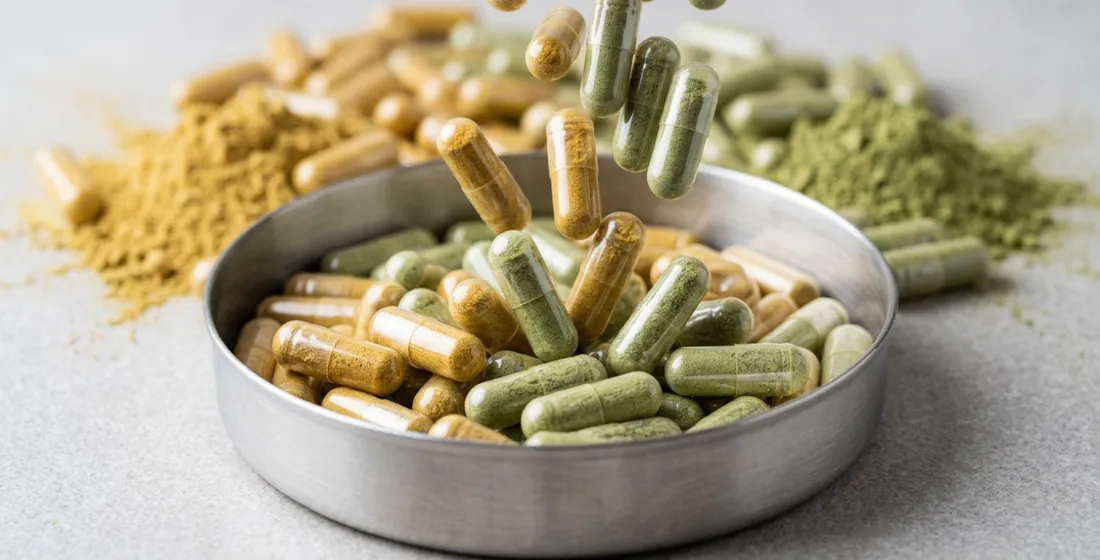
Hero: vegetable HPMC capsules falling into a clean stainless dish with loose herbal powder. AI-generated (Higgsfield nano_banana_2), no text/branding. Alt text: Clear vegetable HPMC capsules in amber and green falling into a brushed stainless dish beside loose herbal powder.
Buyer's snapshot Most capsule contract manufacturers set first-order MOQs at 2,500 to 5,000 bottles per SKU, and many large-scale lines start at 5,000 to 10,000 (industry contract-manufacturing guides, 2025). A custom startup order at that floor commonly runs $20,000 to $40,000 before marketing. For an early-stage wellness brand turning 1,500 bottles a month, a 5,000-bottle minimum is 3.3 months of stock bought on day one, with the cash locked before a single reorder signal arrives. Roughly 85% of new consumer-packaged-goods products fail within two years (Nielsen, via FoodNavigator-USA). Inventory committed at a high MOQ is the single hardest cost to unwind when a SKU underperforms. Silk Foods Ceylon encapsulates from its Matale facility, under BRCGS and FSSC 22000 V6, on a line that runs 100,000 capsules per shift when volume scales, with the capsule MOQ confirmed on your quote. This post is for founders launching one to four capsule SKUs who need a defensible first run. For brands already moving five-figure monthly volume, the unit-cost math points the other way, and this post says so. |
The supplement category is not short of demand. The global dietary-supplements market reached roughly $209.5 billion in 2025 and is forecast to keep compounding near 9% a year (Grand View Research, 2025). What it is short of is a way for a new wellness brand to enter without betting its working capital on a single production run. Most contract manufacturers quote capsule MOQs in the thousands of bottles. A smaller number quote in the low thousands. A handful quote 180. This post is the math behind that number, and the honest case for when it is the right one and when it is not.
What is the typical MOQ for capsule contract manufacturing?
Across the industry, custom capsule MOQs cluster between 2,500 and 5,000 bottles per SKU, with high-volume lines starting at 5,000 to 10,000 and stock private-label formulas occasionally available from a few hundred (industry contract-manufacturing guides, 2025). The floor exists for a reason. Encapsulation lines are built for throughput, and a changeover (cleaning, lot documentation, identity testing on every incoming ingredient under FDA 21 CFR Part 111) costs the same whether the run is 500 bottles or 50,000. Manufacturers spread that fixed cost across volume, so the quoted minimum protects their economics, not the buyer’s.
Silk Route Ventures (SRV) and its manufacturing arm, Silk Foods Ceylon (SFC), confirm the capsule MOQ on your quote. A small first run is not a loss leader. It is a structural choice about which buyers the line is built to serve.
When does a 180-bottle capsule run actually make sense?
A low MOQ earns its keep in three situations. First, a genuine product launch, where a founder has one to four formulations and no demand history to justify thousands of bottles per SKU. Second, a shelf-life-sensitive active, where capsules sitting in a warehouse for a year lose assay value before they sell. Third, a retail or practitioner test, where a buyer wants a small, fully certified, salable batch to validate a listing before committing volume.
In all three, the constraint is not unit price. It is the cost of being wrong. Roughly 85% of new consumer-packaged-goods products fail within two years, and only about 15% remain commercially viable at the two-year mark (Nielsen, reported by FoodNavigator-USA, 2014, and consistent with later category analyses). A 180-bottle run lets a brand discover which of its SKUs lands before the capital is committed across the whole line.
The MOQ math: unit cost against working capital
Two numbers move in opposite directions as MOQ rises. Per-bottle cost falls, because fixed run costs spread across more units. Working capital tied up climbs, because every bottle produced is cash that does not return until it sells. The buyer’s job is to find where those two lines cross for their actual sales velocity, not for a velocity they hope to reach.
Consider a brand selling 1,500 bottles a month of a new SKU. The table below shows what each MOQ tier means in months of stock and in cash committed before the first reorder decision.
| First-order MOQ | Months of stock at 1,500/mo | What it signals | Risk if the SKU underperforms |
| 180 bottles | About 4 days | Test or staged launch | Minimal: a few hundred dollars of capsules to write off |
| 2,500 bottles | About 1.7 months | Standard custom floor | Moderate: low-five-figure order, partly recoverable |
| 5,000 bottles | About 3.3 months | Common co-pack minimum | High: cash locked 3+ months before any reorder signal |
| 10,000 bottles | About 6.7 months | Large-scale line | Severe: capital buried while best-sellers stock out |
Illustrative, based on a 1,500-bottle monthly velocity. SRV does not publish per-bottle pricing on the blog; request a quote against your SKU and volume.
The 5,000-bottle row is where most launches get hurt. As one inventory analysis put it, if a co-manufacturer requires a 5,000-unit minimum but the brand turns 1,500 units a month, it is carrying roughly 3.3 months of stock from day one (Kickfurther, 2025). The danger is rarely the overorder itself. It is that the cash buried in slow-moving stock is unavailable when a retailer asks for a test order or a wholesale lead converts.
In Q1 2026, the SRV trade desk fielded the same pattern three times in a month: founders who had paid a high MOQ on their first SKU, watched it sell slower than projected, and had no capital left to fund the SKU that was actually moving. A small first run, with the capsule MOQ confirmed on your quote, exists for exactly that founder. It is not a marketing line. It is a structural answer to a cash-flow problem the team has watched repeat for a decade.
What you give up at a low MOQ (the honest trade-off)
Low MOQ is not free. At 180 bottles, the per-bottle cost is higher than at 5,000, because the fixed costs of a clean changeover and per-batch identity testing sit on a smaller base. A brand that already moves five-figure monthly volume on a proven SKU is leaving margin on the table by running small. For that brand, the right move is to consolidate into larger runs and take the unit-cost break. SRV’s volume tiers exist for precisely that transition.
Where SRV's low-MOQ pricing does not fit Brands with proven, fast-moving SKUs at consistent five-figure monthly volume. Pure price-led private label competing on the lowest shelf cost. Buyers who want thousands of bottles at the per-unit price of a 50,000-bottle run. For those briefs, a high-throughput line quoting a 5,000-bottle floor is the more honest economic answer than a small-run minimum stretched to fit. |
The discipline cuts both ways. A supplier willing to tell an established brand to order larger is the same supplier worth trusting on a small first run. The right buyer reads that as a signal, not a limitation.
Specifying a low-MOQ capsule run: shell, assay, and certification
A small run is still a regulated run. The spec a buyer sends does not get lighter because the volume is low. Encapsulation under FDA 21 CFR Part 111 requires identity testing on every incoming ingredient, a designated quality-control function independent of production, and a batch record that matches the master manufacturing record. Those obligations are fixed; the bottle count does not change them.
Spec snapshot: low-MOQ herbal capsule run Capsule shell: vegetable HPMC or gelatin (confirm with the formulator; HPMC suits vegan, halal, and kosher claims) Active marker: assay specified per botanical (for example, withanolides for Ashwagandha) Fill weight and moisture: COA on request; microbial and heavy-metals panel tested through an external laboratory on request Bottle: 60-count, white or black Certifications: BRCGS and FSSC 22000 V6 facility scope; USDA Organic and EU Organic on selected SKUs, confirmed per SKU SFC MOQ: capsule MOQ confirmed on your quote; samples free for evaluation (you cover the courier) |
The vegetable-shell question matters more each year. The HPMC (vegetarian) capsule market reached around $610 million in 2025 and is forecast to climb toward $664 million by 2030 on rising demand for vegan, gelatin-free, halal, and kosher formats (Research and Markets, May 2025). For a wellness brand whose end-customer reads the label, a plant-based HPMC shell is often the gating spec, not an upgrade. SFC encapsulates in both HPMC and gelatin and is registered with Sri Lanka’s Department of Ayurveda for its botanical scope.
Buyer's checklist: low-MOQ capsule run 1. Botanical identity and active-marker assay confirmed in writing 2. Capsule shell material chosen against your claim platform (vegan, halal, kosher) 3. Per-batch COA including microbial and heavy-metals panel 4. Facility cert stack with versions (BRCGS, FSSC 22000 V6); request the dossier 5. USDA Organic or EU Organic transaction certificate if the SKU carries an organic claim 6. Sample dispatched against the spec before the production PO |
How Silk Foods Ceylon runs low-MOQ encapsulation
The same line that handles a small first run runs 100,000 capsules per single shift, and up to 200,000 per day, when a brand scales. That is the point of the model. A founder starts with a small run (the capsule MOQ is confirmed on your quote) to validate a SKU, then grows into volume tiers on the same line, the same cert stack, and the same documentation pack, without re-auditing a new supplier at each step.
The facility sits in Hapugasyaya, Nalanda, in Matale, the geographic centre of Sri Lanka and the country’s historic spice and herb belt, on a cellular-manufacturing floor that lets short runs and scaled runs share one footprint. Cellular layout is why a small Gurmar run and a five-figure Turmeric run can move through the same week without the changeover cost that forces other manufacturers to quote a high floor. The capsule scope sits under BRCGS and FSSC 22000 V6, with a COA available on request and lots traceable from raw material intake to shipment through our batch coding.
Frequently asked questions
What is the contract manufacturing MOQ for herbal capsules at Silk Foods Ceylon?
The capsule MOQ is confirmed on your quote, scoped to the SKU and the run. The same line scales to 100,000 capsules per shift as volume grows. Samples are free for evaluation (you cover the courier). Contact SRV for a co-manufacturing capability briefing.
Why do most capsule manufacturers set MOQs at 2,500 to 5,000 bottles?
A clean changeover and per-batch identity testing under FDA 21 CFR Part 111 cost roughly the same regardless of run size. High-throughput lines spread that fixed cost across thousands of bottles, so a high minimum protects the manufacturer’s economics. A low MOQ requires a manufacturing model, such as a cellular floor, built to absorb frequent changeovers.
Does a low MOQ mean lower certification standards?
No. A small run at Silk Foods Ceylon carries the same BRCGS and FSSC 22000 V6 facility scope, the same COA (available on request), and the same documentation pack as a five-figure run. Regulatory obligations under 21 CFR Part 111 are fixed by process, not by volume.
Can Silk Foods Ceylon produce capsules with USDA Organic or EU Organic certification on a small first run?
Yes, per SKU, where the botanical and supply chain support an organic claim. The organic import certificate the destination requires (an EU or GB Certificate of Inspection, or a USDA NOP Import Certificate) travels with the order so the brand’s downstream organic claim stays valid. Vegetable HPMC and gelatin shells are both available. Request a sample against your spec to confirm.
When should a brand order more than the minimum?
When a SKU is proven and moving at consistent five-figure monthly volume, larger runs lower the per-bottle cost meaningfully. At that point the working-capital risk has fallen and the unit-cost saving is real. SRV’s volume tiers are built for that transition, and the trade desk will say when a buyer has reached it.
How Silk Route Ventures can help
For early-stage wellness and nutraceutical brands, Silk Route Ventures foregrounds contract manufacturing and private label for capsules from the Silk Foods Ceylon facility in Matale. The capsule MOQ is confirmed on your quote, and the line scales to 100,000 capsules per shift on the same BRCGS and FSSC 22000 V6 scope, with USDA Organic and EU Organic on selected SKUs, confirmed per SKU, and lots traceable from raw material intake to shipment through our batch coding. Samples are free for evaluation (you cover the courier); production runs 2 to 3 weeks from PO to dispatch for standard SKUs (4 to 6 weeks for private label, custom specifications and organic orders). To validate a first SKU or to map a scale-up path, contact Silk Route Ventures (https://www.esilkroute.com.lk/contact) for a co-manufacturing capability briefing. For volume pricing, see our herbal powder supplier.
Sources
Grand View Research (2025), Dietary Supplements Market Size, Share & Trends Analysis Report. https://www.grandviewresearch.com/industry-analysis/dietary-supplements-market-report (retrieved 30 May 2026)
Research and Markets, via GlobeNewswire (27 May 2025), Hydroxypropyl Methylcellulose (HPMC) Capsules Research Report 2025: Market to Reach $664.1 Million by 2030. https://www.globenewswire.com/news-release/2025/05/27/3088757/28124/en/Hydroxypropyl-Methylcellulose-HPMC-Capsules-Research-Report-2025-Market-to-Reach-664-1-Million-by-2030-Rising-Demand-for-Vegetarian-and-Gelatin-free-Capsules-Drives-Growth.html (retrieved 30 May 2026)
U.S. FDA / eCFR, 21 CFR Part 111: Current Good Manufacturing Practice for Dietary Supplements. https://www.ecfr.gov/current/title-21/chapter-I/subchapter-B/part-111 (retrieved 30 May 2026)
FoodNavigator-USA (2014), Why do 85% of new CPG products fail within two years? (Nielsen data). https://www.foodnavigator-usa.com/Article/2014/07/31/Why-do-85-of-new-CPG-products-fail-within-two-years/ (retrieved 30 May 2026)
Kickfurther (2025), Common Inventory Mistakes CPG Brands Make. https://www.kickfurther.com/blog/common-inventory-mistakes (retrieved 30 May 2026)
Written by the Silk Route Ventures Trade Team. Silk Route Ventures (E-Silk Route Ventures (Pvt) Ltd, T/A Silk Route Ventures) is a Sri Lankan B2B supply-chain operator for the Food, Beverage, Wellness, and Nutraceuticals sectors. The Silk Foods Ceylon manufacturing arm holds BRCGS and FSSC 22000 V6 certifications. Questions or to request a sample: https://www.esilkroute.com.lk/contact or email info@esilkroute.com.lk.